Musky Lifespan Calculator
Estimate muskellunge or tiger musky age, likely lifespan, maturity stage, growth outlook, and confidence from type, length, weight, girth, northern or southern water, forage, sex, and temperature band.
📌Musky age and lifespan presets
⚙Musky measurements and water conditions
Model: age starts with a musky length-at-age curve, then shifts for type, tiger musky status, northern or southern water, forage index, sex, maturity, body condition, temperature, and confidence.
Estimated musky age and lifespan
The estimate blends size, type, water region, forage, temperature, sex, maturity, and confidence.
Calculation breakdown
📊Musky growth, gear, and species grid
Northern Natural
Great Lakes Strain
Southern Reservoir
Tiger Musky
🧬Musky type lifespan baselines
| Musky type | Length ceiling | Typical lifespan | Calculator effect | Notes |
|---|---|---|---|---|
| Northern barred muskellunge | 50-54 in / 127-137 cm | 14-24 years | Balanced age and growth | Common inland reference class |
| Spotted / Great Lakes strain | 54-60 in / 137-152 cm | 18-30 years | Longer life, larger ceiling | Large water, cool refuge profile |
| Leech Lake strain | 52-58 in / 132-147 cm | 16-26 years | High trophy potential | Strong length ceiling in forage-rich lakes |
| Ohio / southern strain | 46-52 in / 117-132 cm | 10-16 years | Faster growth, shorter upper age | Warm summers lower old-age odds |
| River muskellunge | 48-54 in / 122-137 cm | 12-20 years | Moderate age ceiling | Current and thermal swings add uncertainty |
| Tiger musky hybrid | 40-50 in / 102-127 cm | 8-13 years | Earlier maturity, shorter lifespan | Stocked fisheries often dominate records |
📏Length, age, and maturity reference
| Length class | Common age signal | Maturity cue | Growth note | Confidence note |
|---|---|---|---|---|
| 20-29 in / 51-74 cm | 2-4 years | Juvenile or maturing | Fastest size change | Age band broad in stocked water |
| 30-39 in / 76-99 cm | 4-8 years | Males often mature | Useful tiger musky range | Weight improves condition check |
| 40-47 in / 102-119 cm | 6-12 years | Most adults mature | Southern fish may be younger | Forage index matters strongly |
| 48-53 in / 122-135 cm | 9-17 years | Females dominate trophies | Cold lakes read older | Girth narrows the range |
| 54-60 in / 137-152 cm | 14-28 years | Exceptional adult class | Great Lakes or trophy lake signal | Exact age needs hard structure aging |
🌡Water, temperature, and forage modifiers
| Condition | Age influence | Lifespan influence | Forage signal | Best use |
|---|---|---|---|---|
| Canadian Shield / boreal lake | Older for length | Raises upper age | Often moderate to strong | Cold clear trophy waters |
| Northern natural lake | Baseline to older | Good longevity | Perch, sucker, cisco mix | Classic musky range |
| Great Lakes water | Older at giant size | Highest ceiling | Strong open-water forage | Spotted-strain comparisons |
| Large river system | Mixed signal | Slightly lower ceiling | Seasonal forage pulses | Current and backwater fish |
| Southern reservoir | Younger for length | Lower old-age odds | Shad can accelerate growth | Warm-water musky fisheries |
| Stocked put-grow fishery | Known cohorts possible | Depends on stocking strain | Can be strong or limited | Tiger and managed lakes |
🔎Confidence and body-condition reference
| Input clue | What it changes | Age effect | Confidence effect | Calculator handling |
|---|---|---|---|---|
| Measured length | Primary growth curve | Largest driver | High value | Clamped to realistic musky range |
| Weight and girth | Condition factor | Heavy fish can trend older or better fed | Strong value | Compared with length-weight estimate |
| Sex estimate | Size ceiling and maturity | Females stay in growth longer | Medium value | Unknown remains neutral |
| Forage index | Growth rate | Rich forage makes same length younger | Medium value | 1-10 scale shifts age and lifespan |
| Maturity known | Life-stage floor | Prevents over-aging juveniles | Strong value | Auto mode estimates from size and age |
💡Musky age estimate notes
Cold-water note: A 50 inch musky from a cold northern lake can be several years older than a similar length fish from a forage-rich southern reservoir.
Measurement note: Length drives the model, but girth and real weight decide whether the fish is lean, average, or heavy for its size. Exact age still requires biological aging structures.
Muskies is long-lived fish species, and the fish can live long enough to be recognized by many of the individuals who keep muskies in they ponds. Muskies live for many year. For these reasons, individuals has the potential to catch the same musky fish in different years.
The ability to determine the age of a musky is important for the individual who keeps the fish, but also for the management of musky fish populations. If muskies is naturally replacing themselves with younger muskies, the age of the muskies indicates the health of the population. However, if the muskies is aging but not being replaced by young muskies, their ages indicate that the musky population is in decline.
How to Tell the Age of a Musky
Length is the first characteristic used to indicate the age of a musky fish. However, length is not always an accurate indicator of the age of the fish. Two muskies of the same length may have experienced different aging processes due to the effect of the environment on the growth of the muskies.
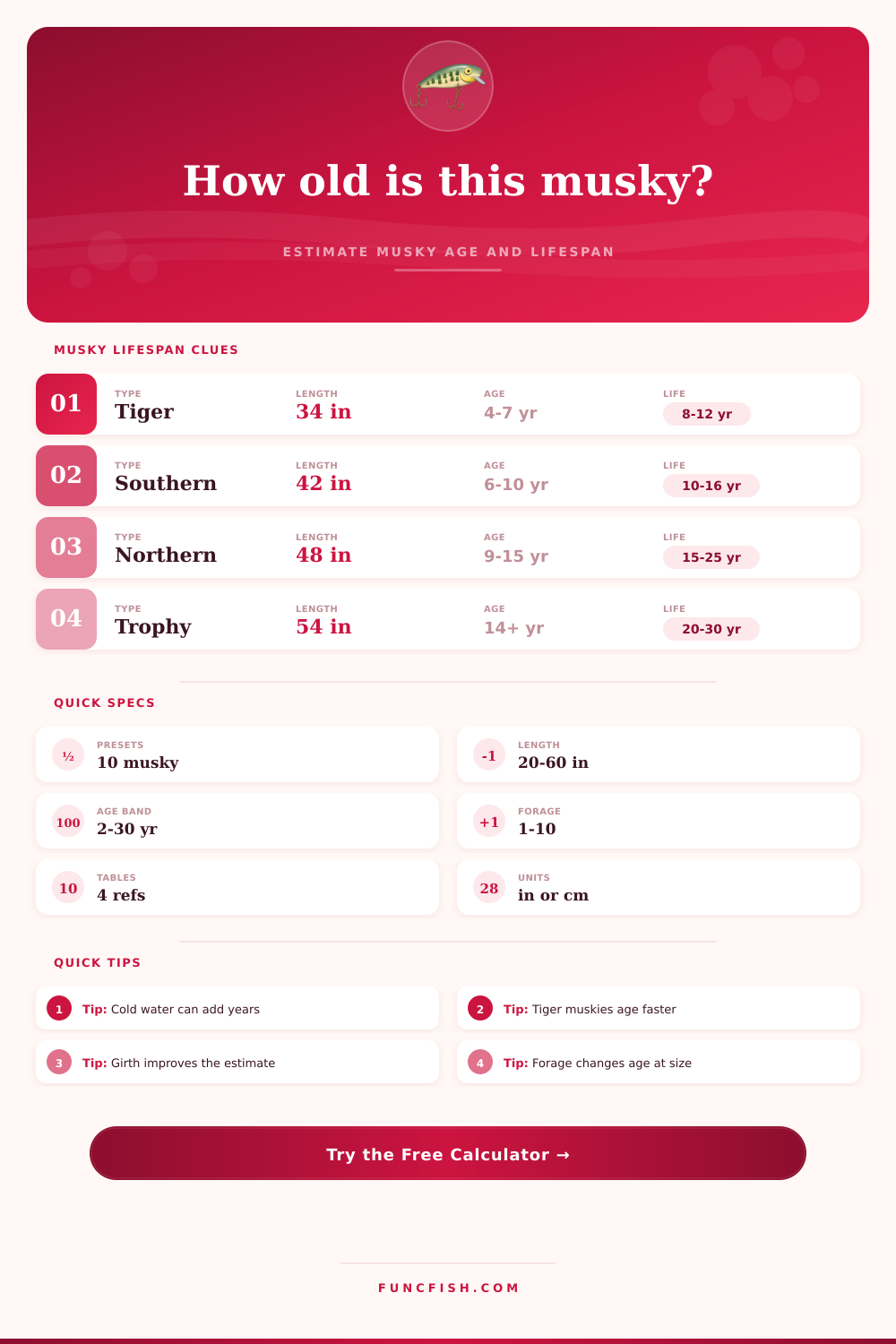
For example, muskies that live in cold lakes will grow more slow than muskies that live in warm reservoirs. Thus, a musky fish that grows slowly will reach the same length as another musky fish in a warm lake at a much older age. The calculator takes into account the region in which the water is located, the temperature of the water region, and the forage availability to calculate the age of the musky.
By taking into account these variables, the user can be certain the age calculated for the musky is accurately rather than guessing the age of the musky. The availability of forage for muskies also has an effect on the age of the fish. Forage fish such as cisco and whitefish are required for muskies to maintain their health.
When forage fish are available in abundant number in a musky’s habitat, muskies will grow to the required length for their species at a younger age. However, if there is a scarcity of forage fish, muskies will take longer to reach the same length and will be of an older age. The quality of forage also has an effect upon the lifespan of muskies.
Muskies that grow to their full length quickly in areas with abundant forage will have shorter lifespans than muskies that slowly grow to their full length in areas with less forage availability for the fish. The sex of the musky is another variable that can affect the age of the fish. Muskies that are female will continue to grow in length as they age, while males will reach the maximum length for muskies at a younger age.
Musky males also have fewer years of lifespan than muskies of both sexes. If the user select the sex of the musky in the maturity selector in the tool, the tool will be able to calculate the age of the musky more accurately. The maturity selector prevents the tool from providing an incorrect age to a musky that is young and juvenile in length.
Finally, another indicator of the age of a musky is it’s girth and weight. A musky that is heavy for its length may be well-fed, but a heavy musky could also be an older musky that has had many years to eat. The calculator compares the weight of the musky to the expected weight for a musky of that specific length and musky type.
Based on that comparison, the calculator can adjust the age estimate and the remaining lifespan estimate for that musky. If you dont include the weight and girth of the musky in your calculation, the calculator will assign a lower confidence score to the estimate of the age of the musky. The temperature patterns in the water where the musky lives impact the metabolic rate of the musky.
The metabolic rate of the musky has an impact upon the lifespan of that musky. Muskies that live in cold water burn energy at a slower rate than muskies in warm water. Muskies in cold water can reach an older age than muskies in warm water before the musky body wear out.
However, muskies that grow rapidly in their early years due to warm water may have a shorter lifespan than muskies that develop at a slower rate. Such differences in lifespan is accounted for in the temperature band input for the tool. Tiger muskies are a hybrid fish species and exhibit different aging patterns from muskies that has no hybrid genetics.
Tiger muskies mature at a younger age than muskies of other species and rarely live as long as muskies of other species. If you are fishing in a fishery stocked with tiger muskies, select the option for tiger muskies in the tool to ensure the correct age calculation for your catch; the age calculation would otherwise incorrectly suggest that a 40-inch tiger musky is 20 years old. A person can determine the age of a musky by examining its scales, cleithra, or otoliths.
However, such an inspection cannot be performed on a musky if the musky is to be released back into the water. The age estimation field in the tool provides an estimate of the age of a musky based on measurements that can be obtained from the musky while it is on the water. The tool allows a person to recognize patterns in the age of muskies from different lakes.
Recognizing these patterns allows a person to make determinations about the requirements of that lakes muskies, if any. While age is one piece of information that can be obtained from the calculator, knowledge of the length of the musky, the type of water in which it lives, the forage in that water, the temperature of the water, and the sex of the musky can help a person to understand the age of that musky.