Walleye Lifespan Calculator
Estimate walleye age, likely lifespan range, maturity stage, sex influence, growth zone, and confidence from length, weight, habitat type, forage index, water temperature band, and measurement quality.
📌Walleye lifespan presets
⚙Walleye size, habitat, and confidence inputs
Walleye lifespan estimate
Enter walleye measurements and habitat details, then calculate to estimate age and lifespan.
Calculation breakdown
📊Walleye growth and habitat comparison grid
Southern Lake
Northern Shield
Reservoir
Big Water
📘Age by length reference
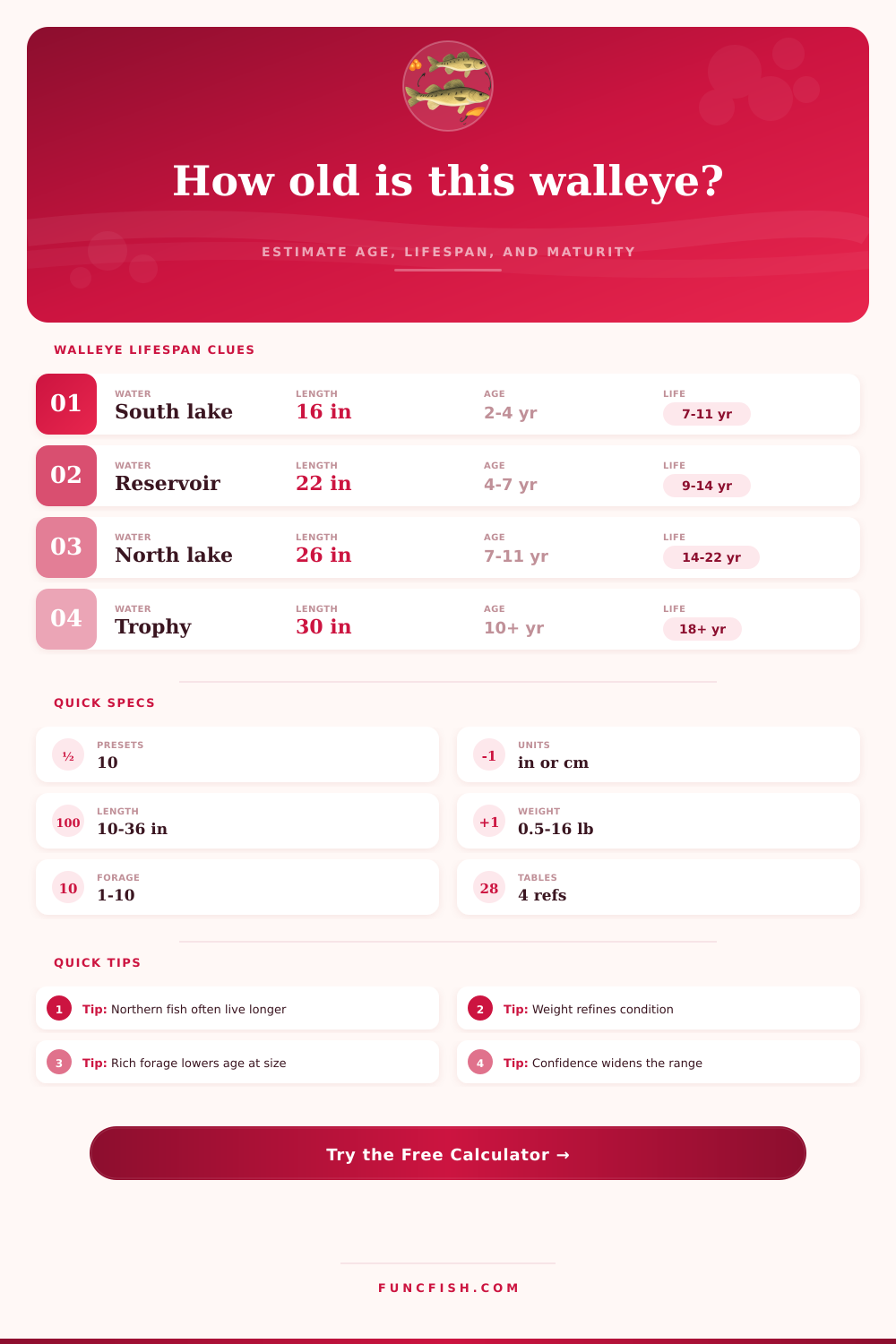
| Walleye length | Southern age | Northern age | Typical maturity clue |
|---|---|---|---|
| 10-13 in / 25-33 cm | 1-2 years | 2-3 years | Juvenile to first mature male |
| 14-17 in / 36-43 cm | 2-3 years | 3-5 years | Many males mature; females approaching |
| 18-21 in / 46-53 cm | 3-5 years | 5-8 years | Common adult spawning class |
| 22-25 in / 56-64 cm | 5-8 years | 7-11 years | Prime adult, often female if heavy |
| 26-29 in / 66-74 cm | 7-11 years | 9-15 years | Large adult, female likelihood rises |
| 30+ in / 76+ cm | 10+ years | 12-20+ years | Trophy adult in most systems |
🌊Habitat and lifespan reference
| Habitat type | Growth pattern | Common lifespan | Calculator adjustment |
|---|---|---|---|
| Clear natural lake | Moderate, sight-feeding dependent | 10-16 years | Balanced age and lifespan |
| Stained productive lake | Good forage and protected light | 11-18 years | Slightly longer lifespan |
| Cold shield lake | Slow growth, older fish at size | 15-24 years | Older age and longer lifespan |
| Large river or flowage | Current cost with forage pulses | 9-15 years | Moderate age, wider range |
| Warm reservoir | Fast early growth, shorter old-age tail | 7-13 years | Younger at size, shorter lifespan |
| Great Lakes / big water | Rich forage, broad age structure | 12-20 years | Strong growth with long lifespan |
🌡Temperature, forage, and condition reference
| Factor | Low value signal | High value signal | Effect on estimate |
|---|---|---|---|
| Forage index | Perch or shiner scarcity | Cisco, smelt, shad, or perch abundance | Rich forage makes fish younger at a given length |
| Temperature band | Cold slows annual growth | Warm stress shortens lifespan potential | Cool to prime bands balance growth and survival |
| Body condition | Thin fish may be older or post-spawn | Heavy fish suggests strong forage access | Weight shifts confidence and growth class |
| Sex estimate | Males usually top out smaller | Females dominate large old classes | Female signal raises maximum lifespan and trophy odds |
| Maturity stage | Immature fish caps the age estimate | Post-prime adults widen upper range | Known maturity anchors the life-stage label |
📝Walleye maturity and confidence table
| Stage | Typical age | Size clue | Confidence note |
|---|---|---|---|
| Juvenile | 0-2 years | Under 12 in / 30 cm | Length-only estimates are usually adequate |
| First mature male | 2-4 years | 12-16 in / 30-41 cm | Sex uncertainty can matter more than weight |
| First mature female | 3-6 years | 15-20 in / 38-51 cm | Habitat and zone strongly affect timing |
| Prime adult | 5-12 years | 20-28 in / 51-71 cm | Length plus weight gives the best field estimate |
| Old trophy adult | 10-20+ years | 28+ in / 71+ cm | Direct aging is needed for high certainty |
💡Calculator notes
Length and weight together: A long, light walleye and a shorter, heavy walleye can land in different growth classes, so measured weight improves the confidence card.
Habitat context matters: A 24 inch walleye from a warm reservoir may be much younger than a 24 inch walleye from a cold northern shield lake.
Walleye live for different amounts of time depending on the water where the walleye live. The differences in how long the walleye live isnt visible to a person looking at the outside of the walleye. For instance, a 24-inch walleye that live in a warm reservoir may be several years younger than a 24-inch walleye that lives in a cold northern lake.
The age of a walleye is important in determining whether the walleye population can sustain additional harvesting of walleye, or if any specific walleye in the population is unusually old for its length. The calculator that is provided utilize length, weight, and habitat type to calculate the age of a walleye due to the fact that each of these three factor has an impact upon the lifespan of the fish. Length is one of the first measurements that the calculator can utilize to determine the age of the walleye.
How to Estimate Walleye Age
Walleyes add inches to their length at different rates; the temperature and forage in the water in which they live influence the rate at which they add inches to their length. Walleye that add inches to their length rapid are likely living in conditions that are supportive of rapid growth of the walleye, whereas walleye that slowly add inches to their length are likely living in water that is cooler to the walleye or in water that contains thin forage for those walleye. The second measurement that the calculator can utilize to determine the age of a walleye is the weight of the walleye.
The weight of the walleye is another measurement that provide additional information about the growth of that fish. For instance, a walleye that is long in length but light in weight is different than a walleye that is short in length but heavy in weight. The third and final measurement that the calculator can utilize is the habitat type of the walleye.
Walleyes that live in different types of habitats have different lifespans and grow at different rates. For instance, clear lakes, stained lakes, rivers, and reservoirs all have different lifespans for walleye and different rates at which walleye grow within those different type of habitats. Walleye that live in cold shield lakes grow slowly due to the low metabolism of the walleye in those lakes and, therefore, live to be older and reach a larger size.
Walleye that live in warm reservoirs grow rapidly to reach a large size at a young age, but their short lifespan due to the effect of warm temperatures on the walleye is likely counterbalanced by the benefits of rapid growth. Therefore, the calculator can adjust the expected age and the remaining years of the walleye based off the specific habitat type of the walleye. Both temperature and forage can impact the walleye similarly.
For instance, cooler water temperatures (within the preferred temperatures for walleye) allow for walleye to grow at their rates without the metabolic stress that results from high water temperatures. Walleye that can find abundant forage (like cisco, smelt, or perch) will grow to larger sizes more rapidly than walleye that find thin forage in their habitats. Consequently, the growth of the walleye impacts the age of the walleye that the calculator calculates; the longer the walleye takes to reach a certain length, the more slowly that it is growing, and the shorter the lifespan of that walleye.
The sex and maturity stage of the walleye are also two factor that impact the age of the walleye. For instance, female walleye live longer than male walleye, and they also grow to larger sizes than male walleye in the same water. Walleye that have a heavy bodied build are more likely to be female walleye; thus, the lifespan of those fish is likely to be longer.
Furthermore, immature walleye cannot live to be an old walleye; the fish have not yet reached the maturity stages that permit them to live to the same ages as immature walleye. For instance, a post-prime adult walleye has already experienced the years of peak growth of that fish; thus, its lifespan has begun to shorten after reaching the age of maturity. The calculator also utilizes reference tables to show the age of walleye within different length and habitat types.
One table displays the age of walleye in various length sizes within the southern zones and northern zones of the species’ habitat. The other table displays the typical lifespan of walleye within each habitat type. Each of these tables are not the calculator of the age of a walleye, but they do exhibit the patterns that the calculator utilizes.
Each of the tables can be referenced when using the calculator to determine the age of a specific walleye in terms of its weight, temperature, and forage in its habitat. Although the calculator is a useful prediction of the age of the walleye, there is always some uncertainty to the calculations that the calculator performs. The age of the walleye could have experienced harsh winters within its habitat, or the water could have contained low levels of oxygen to support the walleye.
In these situations, the accuracy of the calculator may not be achieved with the information required for the calculator to determine its results. Therefore, if an angler knows the age of the walleye (from scale samples or otoliths), it is likely that the calculator is close to the actual age of the walleye, but it may not be exact. This lack of exactness is to be expected of the calculator.
The results of the calculator can be most useful when the result is compared to other potential results of the calculator. For instance, the same length of walleye could be entered into the calculator with different habitat types to determine how each habitat impacts the age of the walleye. This type of comparison could help an angler to determine if a 26-inch walleye is typical of its habitat, or if it is an exceptional individual within its range of typical sizes.
Furthermore, the different comparisons could help an angler understand why certain waters contains more large walleye than other waters of the same region. Understand these different factors and how they impact the age of a walleye will allow an angler to become accustomed to reading the conditions on the water. For instance, it is possible to understand why the largest walleye are not the oldest of those fish, and why the oldest walleye are not located within the clearest waters in the region.
The calculator makes it easier for anglers to understand these factors regarding walleyes when the age, length, weight, habitat type, and water temperature are each combined into a single estimate for the age of an individual fish. It’s important to note that some people would of preferred more data.