Tarpon Lifespan Calculator
Estimate Atlantic or Indo-Pacific tarpon age, likely lifespan, maturity read, body condition, and confidence from fork length, girth, weight, habitat stage, growth zone, and measurement quality.
📌Tarpon presets
⚙Tarpon measurements and habitat
Tarpon lifespan estimate
Estimated age, lifespan, maturity, and confidence band will appear here.
Calculation breakdown
📊Tarpon life-stage comparison grid
Juvenile Nursery
Backcountry Subadult
Pass Adult
Offshore Giant
📘Tarpon reference tables
| Species | Typical adult age | Longevity reference | Maturity cue | Calculator behavior |
|---|---|---|---|---|
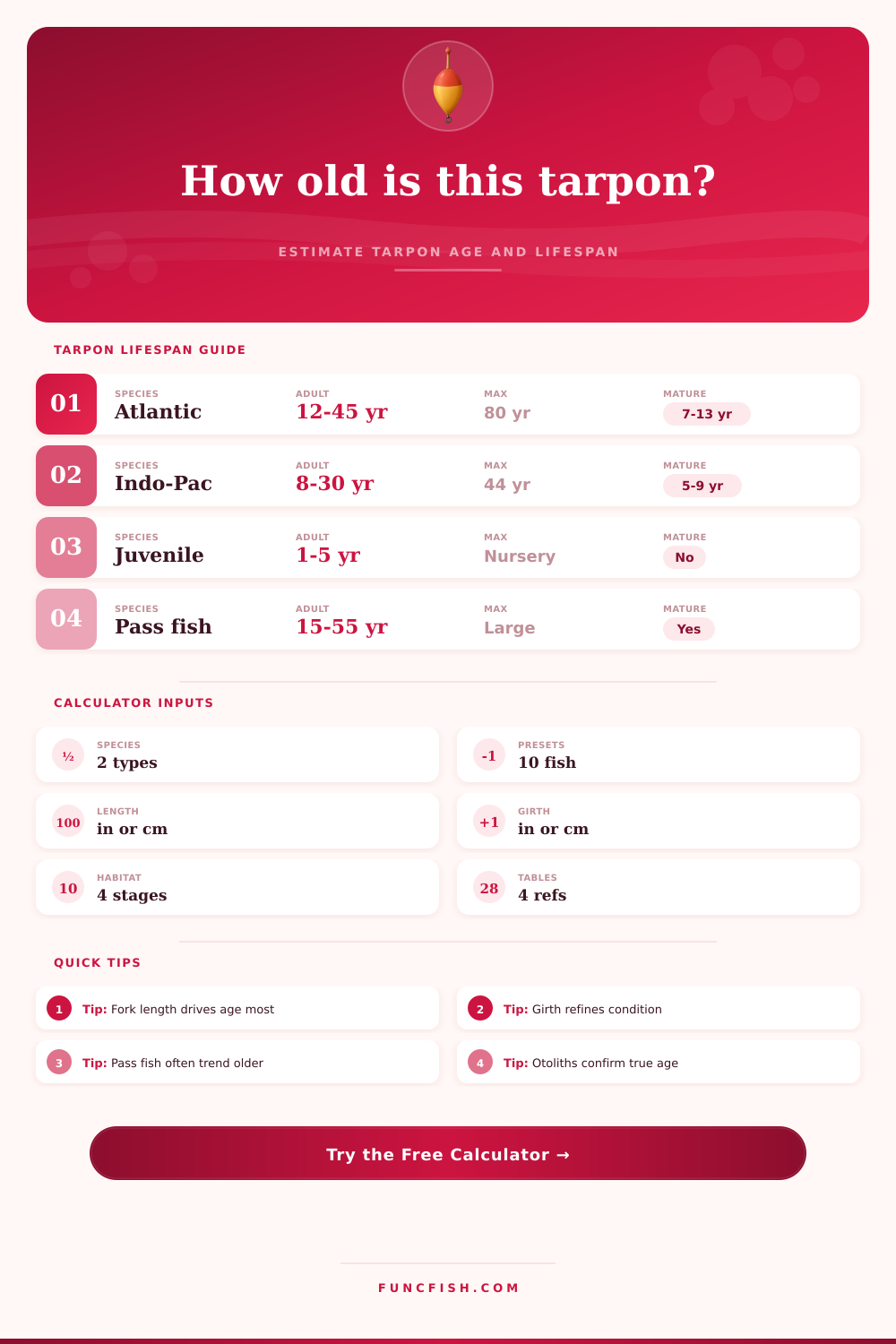
| Atlantic tarpon | 12 to 45 years | Can exceed 60 years, with an upper reference near 80 years | Often mature around large subadult size | Longer lifespan band and wider old-fish range |
| Indo-Pacific tarpon | 8 to 30 years | Shorter upper reference, often modeled below Atlantic tarpon | Matures at smaller size | Faster curve and tighter upper lifespan range |
| Nursery tarpon | Under 5 years | Habitat points to early growth | Usually immature | Juvenile stage limits older age estimates |
| Large migrator | 20 years and older | Older adults can overlap strongly by length | Mature or large adult | Confidence band widens for giant fish |
| Fork length band | Atlantic tarpon read | Indo-Pacific read | Likely stage | Measurement note |
|---|---|---|---|---|
| 10 to 30 in / 25 to 76 cm | Young nursery fish | Young to subadult | Juvenile | Small length errors can shift age quickly |
| 30 to 50 in / 76 to 127 cm | Late juvenile to subadult | Subadult to adult | Backcountry | Habitat stage is important here |
| 50 to 70 in / 127 to 178 cm | Mature adult range | Large adult range | Pass adult | Girth and weight refine condition |
| 70 to 90 in / 178 to 229 cm | Older mature fish | Very large adult | Pass or offshore | Age spread widens at big sizes |
| Over 90 in / 229 cm | Potential long-lived giant | Rare trophy-size signal | Offshore giant | Tag or sample data matters most |
| Habitat stage | Age tendency | Lifespan effect | Model signal | Best matching input |
|---|---|---|---|---|
| Juvenile creek or nursery | Younger at length | Not an upper lifespan cue | Caps age toward early growth | Small tarpon with nursery habitat |
| Backcountry bay or lagoon | Slightly younger at length | Neutral | Subadult and early adult blend | Rolling fish in bays and mangroves |
| Pass, inlet, bridge, or beach | Baseline to older | Raises mature adult likelihood | Applies adult-stage floor | Large fish on migration routes |
| Offshore migratory adult | Older at length | Raises upper age signal | Widens older-adult band | Large open-water tarpon |
| Input cue | Low confidence | Medium confidence | High confidence | Calculator result |
|---|---|---|---|---|
| Fork length | Photo estimate or rough boat mark | Tape over straight body line | Measured fork length on board | Primary age curve input |
| Girth | Unknown or guessed | Approximate tape around body | Measured at maximum body depth | Condition and weight cross-check |
| Weight | Visual estimate only | Length-girth field estimate | Reliable whole-weight estimate | Refines heavy or lean condition |
| Age evidence | Calculator only | Field notes and measurements | Tagged, sampled, or otolith reference | Narrows confidence band |
💡Tarpon estimate tips
Most tarpon age estimates start from fork length. Girth and weight are useful, but they mainly adjust body condition, maturity interpretation, and confidence rather than replacing the length curve.
A 45-inch tarpon in a backcountry bay and a 45-inch tarpon moving through a pass can land in different maturity bands because habitat stage changes the biological context.
Tarpon are large fishes, as are most species of tarpon. Additionally, tarpon can live for an long time. Because of the long lives of tarpon fishes, anglers and fishing guides wants to know the age of the tarpon that they catch.
Knowing the age of a tarpon is important for understanding the health of the tarpon population in a given area. Additionally, knowing the age of a tarpon can help a fisherman to deciding how to handle the fish. The most important measurement of a tarpon that is used to determine its age is it fork length.
How to Tell the Age of a Tarpon
A relationship is established between the fork length of a tarpon and the age of that tarpon. However, the relationship between the fork length of a tarpon and the age of that tarpon is actualy different for Atlantic tarpon and Indo-Pacific tarpon. A calculator is available that will allow anglers to enter the fork length of the tarpon that they have caught to calculate its age.
However, the fork length alone will not provide an accurate description of the age of the tarpon. Two tarpon may have the same fork length but one may be considerably older than the other due to the different habitats in which they live and grow. Additionally, the habitat stage of the tarpon should be considered when calculating its age as that will also impact the relationship between its fork length and its age.
For instance, a tarpon in a backcountry bay will have a different habitat stage than a tarpon in a coastal pass which will impact the age calculations for those two fish. The other two measurements of tarpon that can help provide an accurate estimate of its age are its girth and its weight. While the girth and weight of a tarpon do not replace the importance of fork length in estimating the age of the tarpon, those two measurements can help to provide information about the condition of the tarpon in relation to its predicted length.
For instance, if a tarpon is heavy for its length it may be in prime condition but if it is light for its length it may be recovering from its spawning season. Thus, while girth and weight does not factor into the age calculation itself, it can help to indicate whether the tarpon is still growing or if it has finish growing. Additionally, these two measurements can also be used in conjunction with the calculator to provide a confidence band for the age calculation.
The concept of growth zones is another factor that can help in the calculation of the age of the tarpon. As with many species, the availability of food in their habitat as well as the temperature of the water in which they live influences the rate at which tarpon grow. For instance, tarpon may grow more fast in warm nursery waters than in cooler areas in which they live.
Thus, the growth zone of the tarpon will factor into the calculation that determines its age. Another factor that can impact the age of a tarpon is its maturity stage. A tarpon that has grown to its spawning size will be in a different maturity stage than a tarpon that has not yet reached its spawning size.
Thus, the individual can select the maturity stage of the tarpon using the calculator or it can be estimated by the calculator based off the length of the tarpon and the habitat in which it live. The output of the calculator will tell the individual whether the tarpon that it is calculating for is a juvenile, subadult, mature or older adult tarpon. While it may seem logical to believe that a tarpon that weighs and measures more than another caught tarpon must be of an older age, that is not always true.
For tarpon that measure 70 inches or more in fork length, the fork length alone is not an accurate way to determine the age of the fish. Two tarpon of the same length could have a ten-year age difference for instance. Tarpon of these sizes experience a slowing of their growth rate.
Thus, the habitat of the tarpon becomes more important in this scenario. The calculator will provide a wider range within the confidence interval for tarpon of these sizes in that determining the age of such a large tarpon is more difficultly. The reference tables that are provided with the calculator provide information about the age of the various species of tarpon that live in these areas as well as in different habitats.
These tables can help to ensure that the age estimate of the tarpon is accurate. Additionally, the tables indicate that the fork length and girth of a tarpon will provide a more accurate estimate of its age than merely visually estimate the age of the fish. Thus, visual estimates will provide a wider range of ages than those visually estimated yet measured.
Finally, it is important to remember that the calculator is not a tool that will provide the same information as using otoliths to measure the age of the tarpon or through the use of tagged tarpon. These two methods are used to obtain the most precise determination of the age of the tarpon. This calculator, however, is a helpful tool in determining the life stage and lifespan of the tarpon that is being measure.
Thus, it can assist the fisherman in making decisions regarding the tarpon while they are on the boat or in the water.