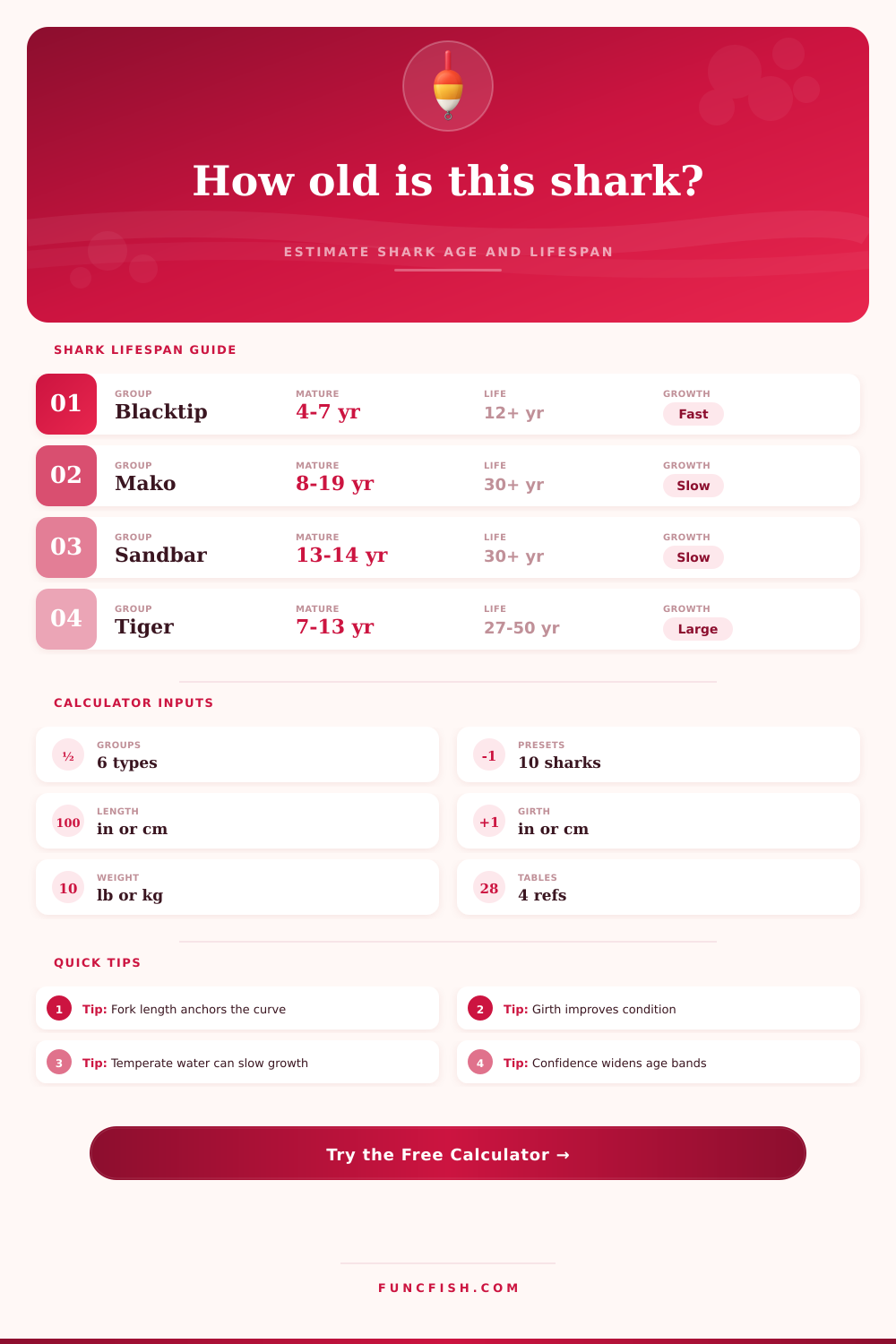
The age of a shark is a complex process due to the fact that measuring the length of a shark dont always reveal the age of that shark. Sharks of the same length may be either young sharks that has developed quickly to that length, or they may be older sharks that develop at a slower rate. Factors such as the species of shark, the water temperature of the water in which the shark lives, and the amount of food that the shark has consume will impact the rate at which that shark develops to its adult length.
Consequently, these different factors must be considered in the shark age calculator to determine the age of that individual shark. To determine the age of a shark with the age calculator, several different input are required. The fork length or precaudal length of the shark must be entered.
How to estimate a shark’s age
Additional inputs include the girth of the shark, the weight of the shark, the water temperature in which the shark lives, the maturity class of the shark, and the growth rate of the shark. Each of these factors can impact the age of the shark; sharks that are heavy in weight may be younger and are eating good rather than being older sharks, the water temperature will impact the rate at which the shark grow to its full length, and the maturity class will determine how old the shark must be to reach the length that it possesses. The calculator will output four different parameters that relates to the age of the shark.
These four parameters include the estimated age of the shark, the upper range of the lifespan of the shark, the maturity read of the shark, and a confidence band for the age estimate. The estimated age will indicate the age of the shark based upon the data entered, but it isnt a birth certificate for that shark. The upper lifespan range will provide information regarding how long the shark may live in comparison to other shark of that species group.
Information regarding the maturity of the shark will compare its length with its age to the known lengths of sharks of that species that have reached maturity. Finally, the confidence band will indicate the level of certainty in the age estimate; it is wider for estimates based upon less precise measurement. In general, the assumption is that the larger a shark is, the more developed it is and, therefore, the older it must be.
However, a shark living in a coastal area may reach a large size quick, as compared to a shark living in a pelagic area that may take years to reach the same size. Consequently, the species group of the shark is more important than any measurements that are taken of the shark. The calculator will use the growth curve for that species group to calculate the age of the shark, and use the other data to adjust that estimated age up or down.
Several factor will impact the accuracy of any age estimations of the shark. For instance, if the shark is being measured while it is on a boat, it may be stressed out, which will alter its girth measurements. Additionally, the length of the shark can be altered if the tail of the shark is relaxed versus held in a straight position.
For example, a nurse shark will have a different girth relative to its length then a mako shark. Consequently, the calculator accounts for these differences in some way; it asks for information regarding the girth of the shark, and for information regarding the condition of the shark. The calculator will account for these differences when it calculates the age of the shark, but only if those specific measurement are used when determining age.
Because length measurements are generally visual estimates, they are less accurate than other measurements, such as girth. Consequently, if visual measurements are used of the length of the shark, the age estimate will incorporate a confidence setting in its calculations. The calculator will widen the age band for visual length estimates to ensure the age estimate is not too precise based upon the visual measurements of the length.
Consequently, rather than presenting an inaccurate age, the calculator will account for the inaccuracy of visual estimates. Because water temperature impacts the growth of the shark, water temperatures will impact the age estimate. Warm water will cause the shark to grow more quickly, which may lead to an age estimate of the shark that is younger than the shark actualy is.
Cool water will reduce the growth of the shark, leading the age estimate to show that the shark is actually older than its length indicate. Consequently, the growth rate of the shark can be adjusted to account for these differences in water temperatures. If the shark grew slowly, the estimated age will reflect that determination of slow growth.
An additional factor that impact the age estimate of a shark is the condition of the shark itself. A shark that is very heavy may be eating well and is young, rather than being an older shark. Consequently, both the weight and girth of the shark will impact the age estimate; however, it will not impact the age estimate to the extent that it may appear to.
While it may change the age estimate slightly, it will not drastically change the age estimate for that shark. One of the purposes of the calculator is to separate the data that is known about the shark from the estimations made based upon that data. For instance, an 180 centimeter blacktip shark will have a different age than an 180 centimeter mako shark; such an age will be different if those same sharks lives in warm waters versus in cooler water.
Consequently, the calculator will provide the age estimate based upon the information that is entered into the calculator. The accuracy of that age is based upon the decisions that are made. Because the age cannot be determined through the examination of the vertebrae of the shark, or through the tracking of any tags that may be placed on that shark, the estimate provided through the calculator will never be exact.
Consequently, the calculator allows for the measurements to be entered, as well as for the adjustments to those estimates due to different factor (such as growth rate and length) to account for each of those factors. The calculator will produce an estimate for the age of the shark, as well as an estimate of how certain the calculator is in that provided age estimate. If the confidence in that estimate is narrow, it indicates that the data that was entered into the calculator is consistent with the calculations of the age of the shark.
If the confidence in that age estimate is wide, it suggests that there may be discrepancies in the measurements provided for that shark, or in the parameter that was entered into the calculator. You should of checked the data again.