Flounder Lifespan Calculator
Estimate summer, southern, Gulf, or winter flounder age, likely lifespan band, maturity read, and confidence from total length, weight, body thickness, habitat, temperature, growth region, and measurement quality.
📌Flounder presets
⚙Flounder measurements and habitat
Flounder lifespan estimate
Estimated age, lifespan, maturity, and confidence will appear here.
Calculation breakdown
🐟Flatfish species comparison grid
Summer flounder
Southern flounder
Gulf flounder
Winter flounder
📊Flounder reference tables
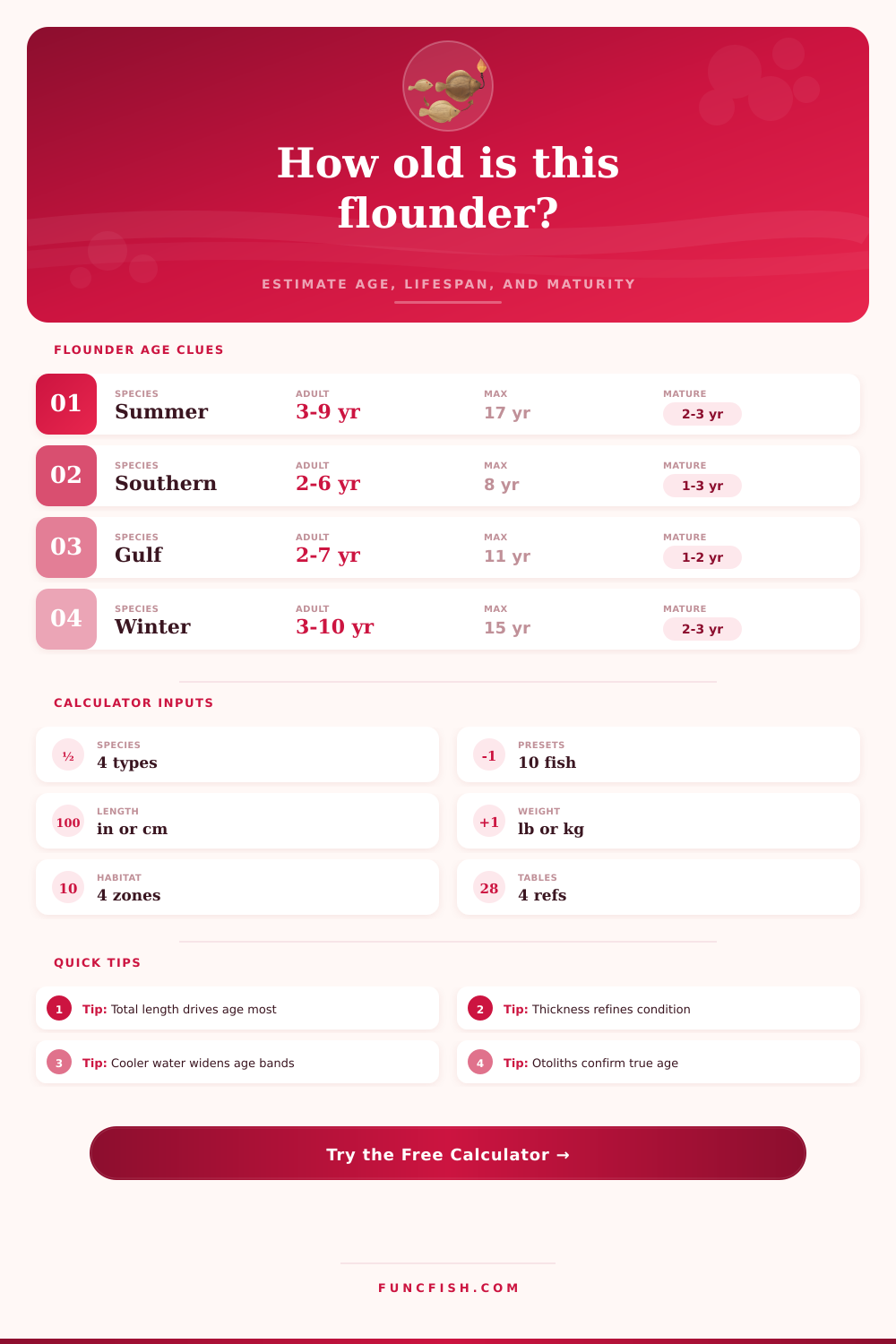
| Species | Typical adult age | Upper age reference | Maturity clue | Age reading note |
|---|---|---|---|---|
| Summer flounder | 3-9 years | Up to about 17 years | Often mature near 2-3 years | Large females can keep adding size after maturity |
| Southern flounder | 2-6 years | About 7-8 years common upper reference | Females usually outgrow males | Warm estuary growth can make young fish look large |
| Gulf flounder | 2-7 years | About 8-11 years reference band | Maturity can occur early | Smaller maximum size makes length bands overlap |
| Winter flounder | 3-10 years | About 12-15 years reference band | Often mature near 2-3 years | Cool-water growth can make age spread wider |
| Habitat setting | Calculator effect | Best species fit | Condition cue | Confidence behavior |
|---|---|---|---|---|
| Upper estuary | Younger at length | Southern, winter juveniles | Thin fish may be recent movers | Band widens if weight is missing |
| Lower estuary | Near baseline | All four species | Good weight match centers age | Medium confidence with tape and scale |
| Nearshore sand | Slightly older | Summer, Gulf, southern | Thick adults score higher maturity | Habitat supports adult-stage estimate |
| Offshore shelf | Older at length | Summer, winter adults | Cool, thick fish may read older | Temperature and region become important |
| Temperature band | Approx range | Growth signal | Age effect | Use carefully when |
|---|---|---|---|---|
| Cool | Under 55°F | Slower growth | Raises age at same length | Fish recently shifted habitat |
| Moderate | 55-68°F | Baseline growth | Neutral model effect | Seasonal average is unknown |
| Warm | 69-78°F | Fast shallow growth | Slightly lowers age | Weight is unusually heavy |
| Hot shallows | Over 78°F | Stress or fast nursery growth | Wider estimate band | Length and condition disagree |
| Measurement set | Age band | Best input | Weak point | Output behavior |
|---|---|---|---|---|
| Visual estimate | Wide | Species and length class | No scale or tape | Confidence card stays conservative |
| Tape and scale | Medium | Total length plus weight | Thickness may be missing | Condition ratio refines age slightly |
| Measured set | Narrower | Length, weight, thickness | Species variation remains | Band tightens when inputs agree |
| Otolith reference | Tightest | Known age context | External sizing still varies | Calculator treats age as strongly anchored |
💡Measurement notes
Flounder are flatfish, so a small change in body thickness can change condition without meaning the fish is much older. The calculator uses thickness as a condition check, not as a direct age substitute.
Estuary fish often show fast early growth, while cool offshore fish can overlap across more ages at the same total length. That is why habitat, temperature, and region all affect the confidence band.
Flounder live most of the lifes of flounder who live on a bottom of the water. Because flounder live on a bottom of the water, individuals often overlook flounder until they are pulled from the water. Knowing the age of a flounder is important in that the age of a flounder will let an individual know if the flounder has reached breeding size for that year, if the local populations of flounder can sustain the catches that are made of those flounder, and if the environmental condition for the flounder are stable.
Looking at the flounder cannot determine the age of a flounder since flounder dont show their age on the outside of the fish. There are four differently species of flounder. Those four species are the summer flounder, the southern flounder, the Gulf flounder, and the winter flounder.
How to Tell a Flounder’s Age
Each of these species of flounder grow at different rates. For instance, summer flounder can continue to add to their length for many year, while southern flounder often reach the age of eight years. Gulf flounder species tend to stay small in size, while winter flounder grow slow due to the fact that winter flounder typically live in cooler water environments.
The age calculator use several different layers of information to calculate the age of the flounder. For instance, the individual must choose the species of flounder since that species choice will set the growth curve and upper age reference. The length of the flounder must be provided, as length is the strongest driver of the calculation of age.
Additionally, the weight and thickness of the flounder must also be provided; thick flounder typically reach an older age than flounder with the same length but less thickness, and thin flounder may be young flounder that are still growing to reach there full size. Lastly, the habitat and temperature range in which the flounder were spotted must also be selected; for instance, flounder in an estuary will grow faster than those spotted in an offshore location. The age calculator can indicate whether the flounder has spawned.
Each species of flounder have different maturity clues, and the age calculator will tell an individual if the length and age of that caught flounder indicates that it has spawned. The age calculator will provide no substitute for examining the gonads of the flounder, but will indicate whether the flounder has reached breeding age or not. Additionally, the age calculator can help in comparing the ages of flounder that are caught during different season.
For instance, if many flounder are caught that are of large sizes yet young in age, this could mean that the younger flounder are being killed off, but if many flounder are of large sizes yet of old ages, this may mean that the younger flounder are not surviving. Temperature is one factor that affect the age of the flounder. For instance, cool water will slow the metabolism of the flounder, slowing its rate of gaining the length required to reach maturity.
Therefore, flounder caught in warm water may be younger than flounder of the same length but spotted in cold water. Additionally, another factor that will influence the age of the flounder is the habitat of the flounder. For instance, flounder in an estuary that contains an abundance of food will grow faster than flounder spotted in an offshore habitat.
Body thickness is one measurement that can be used in the age calculator for flounder. Changes in thickness of the flounder will change the weight of the flounder without changing the age of the flounder. Therefore, the age calculator can use body thickness to calculate age and to indicate whether the age estimate is accurate.
Reference tables list the information that can be used to determine the age of flounder of each species. Additionally, these tables can explain the logic of the age calculator, as well as allow individuals to understand how and why the age calculator may arrive at the age of the flounder that was caught. The quality of the measurements of the flounder will also have an impact on the accuracy of the age estimate.
For instance, if length is estimated visually, the age band will be large due to the lack of precision of an visual estimate. However, if a tape measure and scale measure the length of the flounder, the age band will be narrow. Additionally, if the thickness of the flounder is also measured, the age band will become even narrower.
Flounder often live in different habitats at different periods of their lives. For instance, young flounder may live in warm estuaries, but the age calculator cannot determine the history of the flounder. However, by selecting the habitat in which the flounder was spotted, the age calculator can account for this.
Additionally, the age of the flounder can be used to compare the age of the flounder to the trends of the coastline on which the flounder was spotted. For instance, if the age calculator indicates that the flounder is younger than expected in that area, the population may be growing quick. However, if the flounder is determined to be older than expected, the growth of that population may be slow.
Finally, the age calculator is a biological tool that can be used to determine the age of a flounder, but does not provide any advice regarding fishing regulations or limits.