Halibut Lifespan Calculator
Estimate Pacific, Atlantic, or California halibut age, maturity read, lifespan band, and confidence from total length, weight or thickness, shelf depth, sex estimate, growth region, and body condition.
📌Halibut presets
⚙Halibut measurements and shelf setting
Halibut lifespan estimate
Estimated age, likely lifespan, maturity read, and confidence band will appear here.
Calculation breakdown
📊Halibut species comparison grid
Pacific halibut
Atlantic halibut
California halibut
📘Reference tables
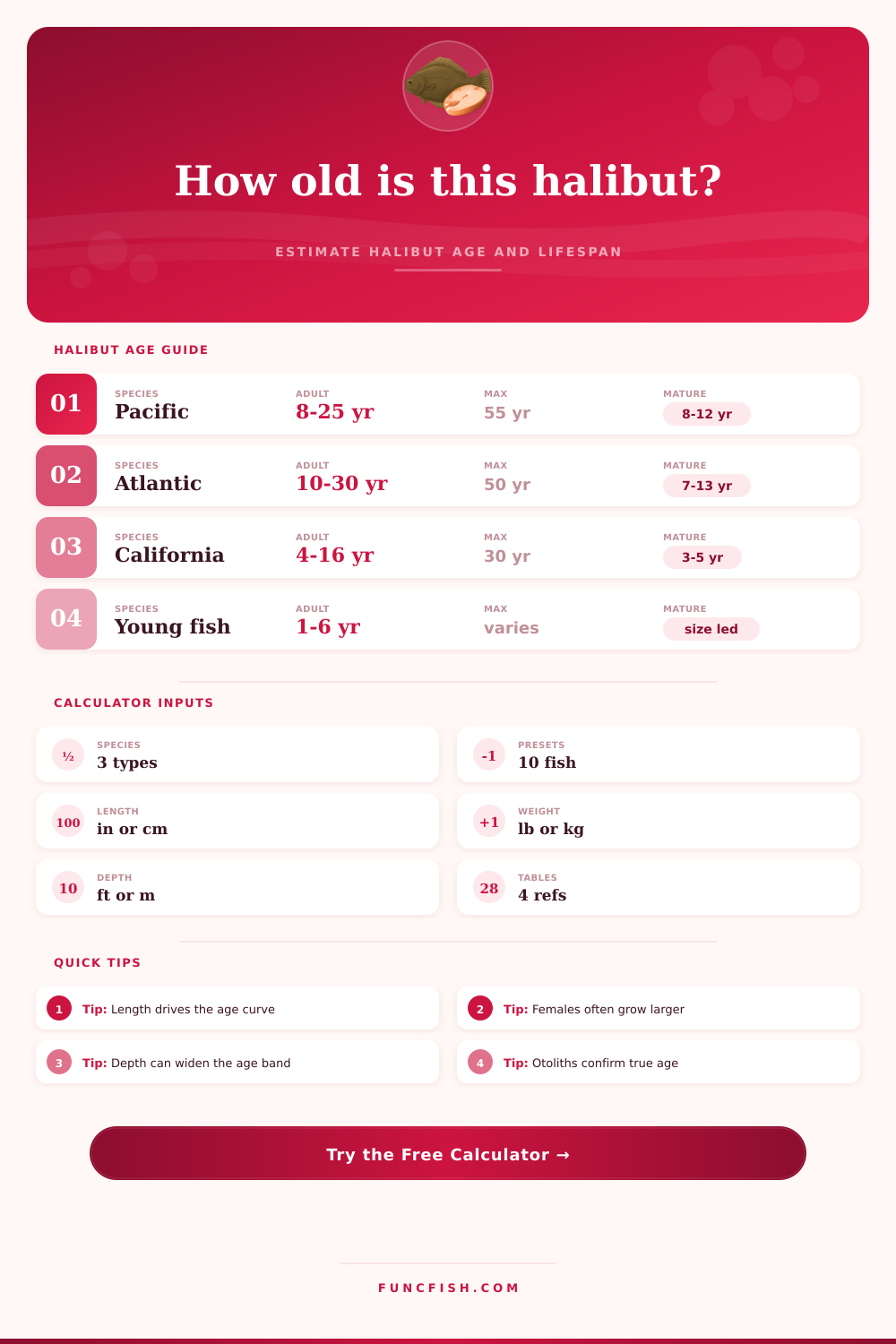
| Species | Typical adult ages | Upper age reference | Maturity signal | Model note |
|---|---|---|---|---|
| Pacific halibut | 8 to 25 years | About 55 years | Later maturity, females larger | Large fish may keep growing slowly for many years |
| Atlantic halibut | 10 to 30 years | About 50 years | Late adult size and deep habitat | Slow growth creates broad overlap among adult ages |
| California halibut | 4 to 16 years | About 30 years | Earlier maturity, faster coastal growth | Smaller species with younger adult bands |
| Very large females | 15 years and older | Species dependent | Large adult stage dominates | Age estimate widens when length nears the curve ceiling |
| Growth region | Age factor | Best fit | Condition effect | Confidence behavior |
|---|---|---|---|---|
| Warm nearshore growth | 0.90x | California coast and young shelf fish | Can add length quickly | Usually reads younger at length |
| Moderate shelf growth | 1.00x | Baseline bank or shelf habitat | Neutral body condition | Standard age band |
| Cool northern shelf | 1.10x | Pacific or Atlantic cooler grounds | Slower adult length gain | Wider band for large adults |
| Deep slope / cold water | 1.20x | Deep shelf edge and slope fish | Depth can mimic older size classes | Band widens unless inputs are strong |
| High-forage bank | 0.96x | Thick fish on productive banks | Weight may outpace age | Condition check matters more |
| Depth class | Approx depth | Age modifier | Use case | Interpretation |
|---|---|---|---|---|
| Nearshore shelf | 0 to 120 ft / 0 to 37 m | 0.94x | Coastal and juvenile habitats | Length often reads a bit younger |
| Mid shelf | 120 to 420 ft / 37 to 128 m | 1.00x | Common bank and shelf setting | Baseline halibut age signal |
| Shelf edge | 420 to 900 ft / 128 to 274 m | 1.08x | Adult shelf-edge habitat | Older-at-length tendency |
| Deep slope | 900+ ft / 274+ m | 1.16x | Deep cold-water adult signal | Age band expands noticeably |
| Input quality | Age band | Best measurements | Weak point | Output behavior |
|---|---|---|---|---|
| Rough visual | Wide | Species and approximate length | No scale or thickness | Confidence stays conservative |
| Tape and field scale | Medium | Total length plus weight | Thickness may be missing | Condition score refines age slightly |
| Measured set | Narrower | Length, weight, and thickness | Species curves still vary | Band tightens when inputs agree |
| Otolith or tag | Tightest | Known age context | External sizing still approximate | Calculator treats age as strongly anchored |
💡Measurement notes
Halibut aging curves are sensitive to length. A few inches of measurement error can move the estimate more than weight or thickness, especially in young fish.
A thick halibut is not automatically much older. The calculator treats thickness and weight as body-condition signals that refine, but do not replace, the length curve.
Halibut live for an long time. Because halibut lives for such a long time, a person may want to know the age of a halibut. A person may want to know the age of a halibut in order to determine the health of the halibut stocks, or the person may be simply curious about the age of the halibut.
This calculator will use field measurement to provide an estimate of the age of that halibut. The calculator will include a maturity reading for the halibut, as well as provide a plausible age range for the halibut. The calculator utilize the same measurements as the biologists in the field, except that the calculator will perform the math for the users.
Estimating the Age of a Halibut
Length is the most important measurement for estimating the age of a halibut. However, the halibut slow in its growth after it reaches the age of maturity. Thus, two halibut of the same length may not have the same age.
Thus, other measurements have to be included in the equation. The weight of the halibut and its body thickness will help to reveal the condition of the halibut. If the halibut is thin, it may be young halibut compared to a heavy halibut of the same length.
However, the thin halibut may have been living in an area with less available food for the halibut. Thus, the condition of the halibut will adjust the age band for the halibut, but it will not change the age band for the halibut to an implausible age. Depth is another important measurement.
Halibut that are caught in deep waters or cold depths will grow more slower than halibut that live in shallower areas or warm waters. Thus, the calculator will expand the age range for halibut that are caught in deep waters. The growth region where the halibut lives will have an impact on its age.
Halibut that live in warm waters near the shore will grow to the same length as halibut of the same age that live in different regions of Canada, for example, will grow faster during the early years of its life. Halibut that live in cool northern regions or deep waters will exhibit a slower growth rate from birth until the halibut reaches its maximum age. Thus, the growth region will impact the age of the halibut to such way that none of the factors impact the maximum age of halibut, but will alter the rate at which the halibut reaches the length that is measured from halibut of the same species.
The sex of the halibut and its maturity will also factor into the age calculation. Females of the majority of halibut species will grow to be larger than males of the same species, and the females will live longer than the males of those species. Thus, if a person enters a halibut of large length into the calculator as a female halibut, the age will be higher on the age band than if the halibut were entered as a male.
The juvenile setting will ensure that the age band for young halibut is not too old according to the length of the halibut. Thus, none of these factors will change the length measurement of the halibut, but they will ensure that the age band provided is not implausible. There are reference tables included in the calculator that can assist in understanding the age of halibut of different species.
Pacific halibut can live to much older ages than California halibut, and Atlantic halibut can live to an age that is somewhere in between the lifespan of Pacific and California halibut. These reference tables can also show the difference in maturity between the different species of halibut. Thus, this information can assist a person in understanding if the halibut has reached the age of maturity and contributed to the next generation of halibut.
This maturity reading is based on the species of halibut that are observed. The calculator is unable to provide the same information as an otolith sample of the halibut. An otolith contains annual rings that can reveal the true age of the halibut species.
However, the information provided by the calculator is more accurate with accurate measurements of the halibut. If the halibut measurements are rough and approximate, the calculator will provide an age band for the halibut. However, if the user measures the length, weight, and thickness of the halibut, the age band will be much narrower.
It is possible for a halibut to be of a large length and not be of an old age. A halibut that can reach a length that is much larger than other halibut of the same species has access to great amounts of food. Thus, it may not have yet reached its maximum age.
However, a halibut that lives in deep waters, where food is scarce and the growth rate for halibut is slow, can be of an older age than the length of the halibut would suggest. These two scenarios are accounted for in the calculator. Body condition is another factor that those who attempt to calculate the age of a halibut often overlook.
A halibut that has a thick body may have experienced great amounts of food during a specific time of the year, but may have been thin throughout the majority of its life. Thus, the thickness and weight of the halibut will factor into the calculator and adjust the age band for the halibut, but will not be the main factors that determine the age of the halibut. Thus, the calculator will not increase the age of the halibut by several years due to a single meal with great amounts of food.
The confidence setting for the calculator will ensure that the user has realistic expectation of the calculator. Using a tape measure to determine the length of the halibut and using a scale to measure the weight of the halibut are common field measurements. However, measuring the thickness of the halibut will improve the data for the calculator.
Using an otolith sample or a tag to the halibut will narrow the age band that is presented to the user. Thus, the calculator will not provide information that is more precise than the information provided by the user. By understanding these factors, scientists and researchers will be able to better estimate the age of halibut.
Thus, a 50-year-old Pacific halibut and a 12-year-old California halibut may have the same length, but the calculator will help to reveal the age of the halibut. The calculator will not change the age of halibut of different lengths, but the calculator will make an age band for halibut of any length. The calculator will also reveal the age range if the depth or condition of the halibut is uncertain.
Thus, the value of the calculator is that it allows individuals to perform the calculations in their minds instead of using the rule of thumb for halibut age.