Fish in Livewell Survival Calculator
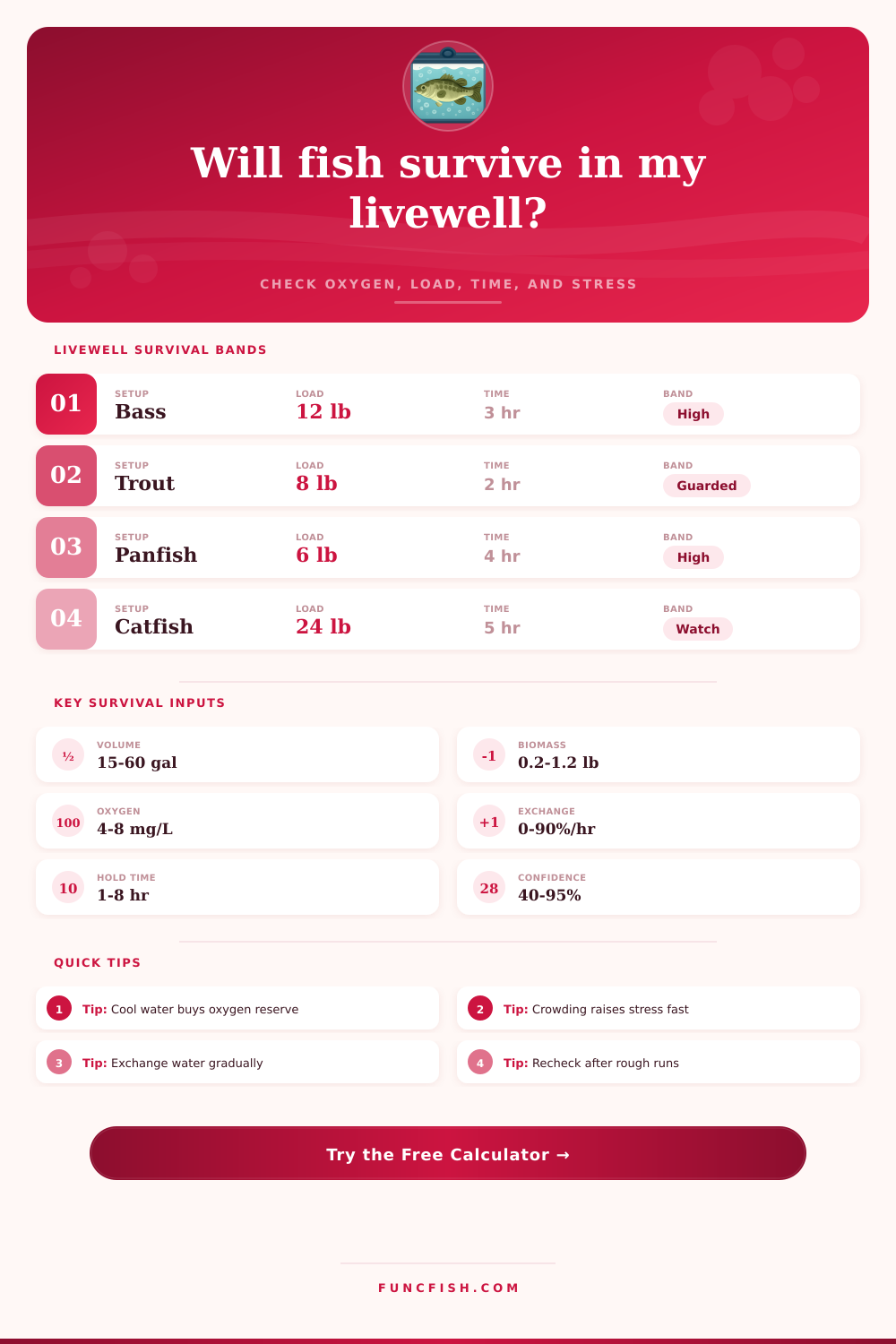
Estimate a livewell survival band from tank volume, fish biomass, species group, temperature, dissolved oxygen, aeration, water exchange, holding time, and handling stress.
📌Named livewell presets
⚙Livewell and fish load
Livewell survival estimate
Calculation breakdown
📊Livewell and species comparison grid
Cool, aerated tournament wells often stay strongest near this density.
Coldwater fish need lower density and higher oxygen reserve.
Tougher fish tolerate load, but waste and heat still accumulate.
Below this point, sensitive fish and warm wells lose margin quickly.
📘Reference table: species oxygen and density
| Species group | Target density | Oxygen demand base | Sensitivity note |
|---|---|---|---|
| Bass and black bass | 0.20-0.30 lb/gal | 95 mg O2/kg/hr | Moderate heat and handling sensitivity |
| Walleye, sauger, perch | 0.16-0.25 lb/gal | 105 mg O2/kg/hr | Needs cool water and dark, low-stress holding |
| Trout and salmonids | 0.10-0.18 lb/gal | 135 mg O2/kg/hr | High oxygen demand and low heat tolerance |
| Panfish and crappie | 0.25-0.38 lb/gal | 85 mg O2/kg/hr | Small fish load well when temperature is controlled |
| Catfish and bullhead | 0.30-0.50 lb/gal | 75 mg O2/kg/hr | Hardy, but high biomass can foul water fast |
| Inshore drum and redfish | 0.14-0.24 lb/gal | 115 mg O2/kg/hr | Large fish need space, turnover, and low abrasion |
| Pike and musky | 0.10-0.20 lb/gal | 110 mg O2/kg/hr | Long-bodied fish need more usable water length |
| Baitfish and shad | 0.08-0.16 lb/gal | 160 mg O2/kg/hr | Small schooling fish crash quickly in warm, stale water |
⚗Reference table: oxygen and aeration levels
| Aeration level | Assumed DO | Best use | Risk signal |
|---|---|---|---|
| Low bubbles or stale recirc | 4.2 mg/L | Very short cool holds | Surface piping or sluggish recovery |
| Basic pump or partial spray | 5.6 mg/L | Light loads under moderate temperature | Demand can exceed reserve on long runs |
| Steady spray or venturi | 7.0 mg/L | Most recreational livewell loads | Still watch warm water and crowding |
| Spray plus air stone | 8.0 mg/L | Longer holds and heavier tournament wells | Reserve depends on clean intake water |
| Supplemental oxygen system | 9.2 mg/L | Sensitive or high-value release scenarios | Too much gas or poor mixing still causes trouble |
| Metered DO input | User value | Best confidence when measured correctly | Probe calibration affects the result |
🌡Reference table: temperature multiplier
| Temperature band | Multiplier | What it means | Calculator effect |
|---|---|---|---|
| Under 55 F / 13 C | 0.78x | Cool water holds oxygen better | Lower oxygen demand, higher margin |
| 55-64 F / 13-18 C | 0.92x | Comfortable for many freshwater groups | Small demand discount |
| 65-74 F / 18-23 C | 1.08x | Common mixed-season livewell range | Near baseline demand |
| 75-82 F / 24-28 C | 1.28x | Warm water narrows oxygen reserve | Demand and stress penalties rise |
| Over 82 F / 28 C | 1.55x | Hot water is the danger zone | Strong penalty even with good aeration |
🚤Reference table: livewell preset volumes
| Preset | Assumed water volume | Typical role | Reference caution |
|---|---|---|---|
| Kayak micro well | 8 gal / 30 L | Single fish or light bait holding | Low volume swings temperature quickly |
| Jon boat stern well | 16 gal / 61 L | Short local trips | Watch rough-water slosh and pump intake |
| Bass boat divided well | 28 gal / 106 L | Typical bass tournament compartment | Density climbs fast with larger fish |
| Walleye deep well | 34 gal / 129 L | Longer cool-water fish | Depth helps, but oxygen still limits time |
| Bay boat release well | 42 gal / 159 L | Larger inshore fish | Shape and abrasion matter as much as gallons |
| Round bait tank | 30 gal / 114 L | Baitfish circulation | Schooling bait needs constant exchange |
| Insulated cooler well | 24 gal / 91 L | Controlled temperature holding | Insulation helps only if oxygen is supplied |
| Pontoon family well | 22 gal / 83 L | Mixed panfish and casual keeping | Mixed species may need the stricter target |
| Tournament recirc well | 36 gal / 136 L | Heavy aeration and culling systems | Still limited by biomass and hold time |
Reference tip: The survival band is not a release guarantee. Treat it as a load, oxygen, and time screen, then watch actual fish behavior and measured dissolved oxygen whenever possible.
Calculator tip: If two inputs are uncertain, choose the more conservative option for confidence and handling stress. The result will show a wider, more realistic survival band.
This calculator is for livewell reference planning only. It does not replace local fish-care rules, tournament procedures, or direct dissolved oxygen measurements.
Maintaining the fish in a livewell requires that you pay attention to several different variable. The volume, biomass, temperature, and the amount of dissolved oxygen in the water are four different variable that must be managed. Each of these variables interact with each other, and each of them changes over time.
Consequently, conditions that may be safe for the fish at one point in time may not be safe for them after some period of time has passed. Many people focus exclusively on the number of gallon in their livewell as the determining factor of how many fish are safe in the livewell. The usable volume in the livewell isnt necessarily the same than the total number of gallons in the livewell.
How to Keep Fish Safe in a Livewell: Oxygen, Temperature, and Number of Fish
The shape of the livewell impact the amount of water that is usable for the fish and impacts how stable the temperature within that livewell will be. For instance, a narrow and deep livewell will maintain a more stable temperature than a wide and shallow livewell, but the narrow and deep livewell may develop problems with the waste that the fish create. Consequently, fifteen pounds of fish may be comfortable in one livewell but may be overcrowded in another.
The temperature of the water will impact the amount of dissolved oxygen that can exist in the water. Warm water contain less dissolved oxygen than cool water. Fish require more dissolved oxygen in warm water than in cool water because the metabolic rate of their bodies increase with rising water temperatures.
Consequently, a temperature that is comfortable for fish when it is sixty-five degrees may result in the fish experiencing stress when the water temperature reaches seventy-eight degrees. How much the water within that livewell is disturbed and how much fresh water enter the livewell impacts the amount of dissolved oxygen that exists in a livewell. Using a venturi spray to disturb the water is one means of increasing the amount of dissolved oxygen in the livewell, but using such a device may not prevent the development of dead zone within the livewell if the water pump within that livewell is cycling too slow.
Using a dissolved oxygen probe is another means of maintaining adequate dissolved oxygen in the livewell. However, ensuring the owner calibrates and places the dissolved oxygen probe in the appropriate location within the livewell (where the fish are swimming) is crucial for ensuring the dissolved oxygen readings are accurate. Another variable that must be managed is the biomass within the livewell.
Biomass is a term used to describe the weight of the fish within the livewell relative to the amount of water in that livewell. Because different species of fish contain different requirements of biomass within their livewells, different amounts of biomass needs to be managed within different species of fish. For instance, catfish can tolerate higher levels of biomass than trout fish can tolerate.
However, both species can experience problems if the water temperature within the livewell rises to the point where ammonia accumulates within the livewell. Calculators are available that can help owners determine if the biomass of the fish in their livewell is within the safe zone. The length of time that the fish remain in the livewell is another variable that impact all other variables related to the livewell.
For instance, an hour during which the water temperature, dissolved oxygen, and biomass are within safe limits may be safe for the fish, but four hours spent within that same environment may not be safe for those same fish. Water exchange is one method of increasing the dissolved oxygen and diluting the waste in the livewell. However, water exchange only works effectively if the water entering the livewell is both clean and cool.
Using water exchange in locations where the water entering the livewell is warmer than the water in the livewell will increase the water temperature within the livewell. The stress experienced by the fish while in the livewell is another variable. For instance, fish that have been handled rough or that have fought within the livewell will require more dissolved oxygen in the livewell than fish that have not been handled in those manners.
Thus, two groups of fish that have the same biomass may require different amounts of dissolved oxygen in the livewell if one group was handled differently than the other group. While the survival band is a helpful tool in determining if the water conditions in the livewell are likely to allow for the survival of the fish, the survival band is not a guarantee of the survival of the fish in that livewell. For instance, if the survival band indicates that the conditions within the livewell are marginal for the survival of the fish, the owner of the livewell may want to adjust variables in the livewell, such as reducing the biomass, increasing water exchange, or reducing the length of time the fish remain in the livewell.
In these situations, it is better to make adjustments to the livewell to avoid the marginal conditions rather than to attempt to fix those marginal conditions by adding more gadgets to the livewell. Many fish owners make mistake with their livewells. For instance, many people dont understand that the livewell may be larger than the usable volume of that livewell.
Additionally, people make the assumption that the strength of aeration will be the same in the livewell regardless of the battery upon which that aeration gadget is dependent or the condition of the water pump. Additionally, people may not understand how fast the temperature of the water in the livewell will rise if the boat is left in the sun. Overall, the livewell should be treated as a temporary life-support system for the fish.
Consequently, people should check the dissolved oxygen in the livewell at regular intervals and they should ensure that the water in the livewell is moving at all times. Finally, when finished with the fish in the livewell, the fish should be released into the water. While the calculator can help plan for the fish in the livewell, the survival of the fish depends upon whether the owner was able to maintain proper levels of dissolved oxygen, temperature, and biomass in the livewell.