Fishing Snap Swivel Size Calculator
Choose a snap swivel size from snap style, swivel size, lure weight, line test, species, casting or trolling load, current speed, opening force, and safety margin.
📌Snap-swivel presets
⚙Snap, swivel, line, and lure inputs
Snap-swivel recommendation
Results update as inputs change.
Calculation breakdown
🧰Snap, swivel, and lure grid
Duo-lock
Coastlock
Crosslock
Ball bearing
Finesse lure
Bass lure
Surf rig
Troll gear
📊Reference tables
| Snap-swivel size | Nominal rating | Typical body length | Line test window | Common use |
|---|---|---|---|---|
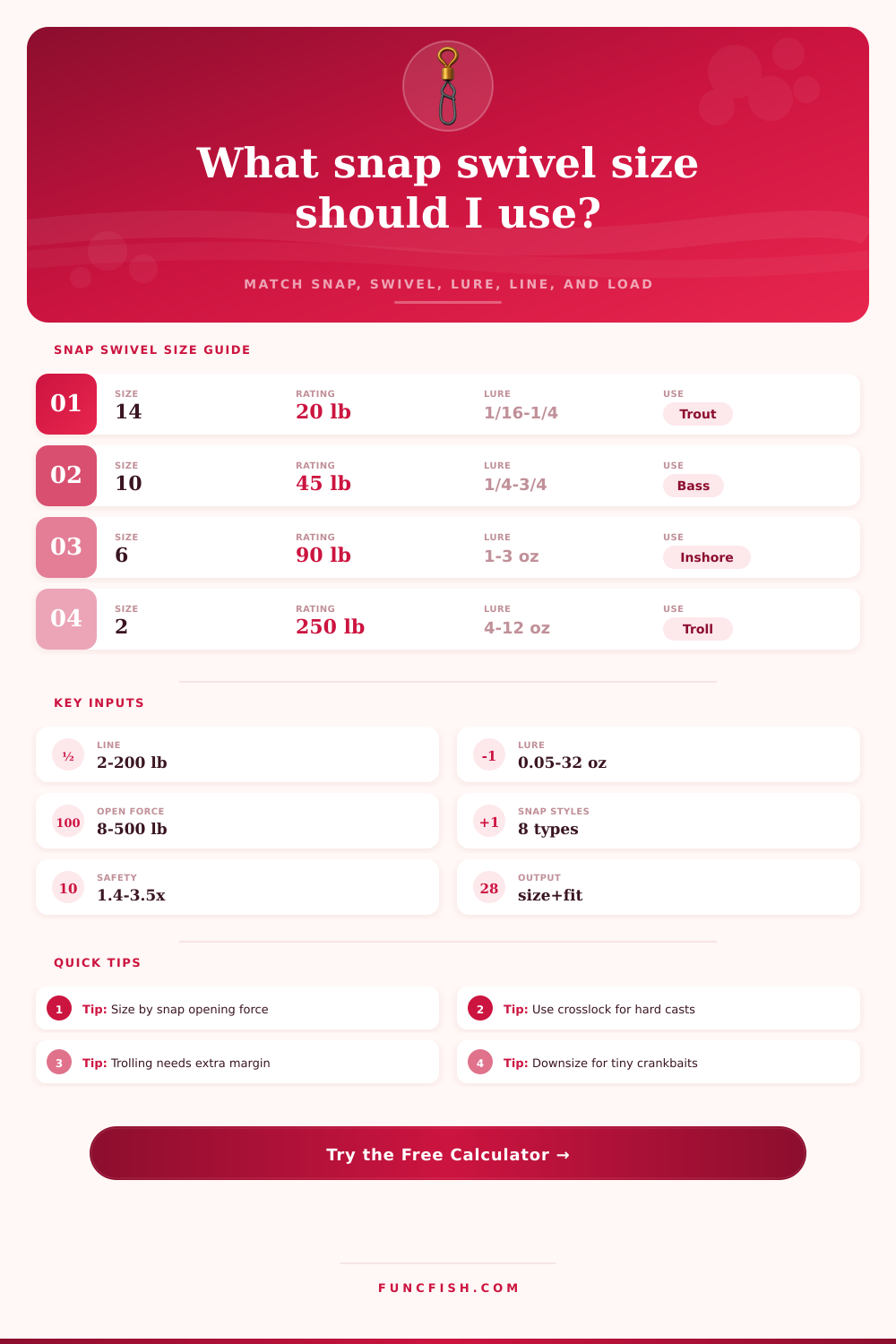
| 14 | 20 lb / 9 kg | 7 mm | 2-6 lb / 1-3 kg | Panfish, tiny spoons |
| 12 | 30 lb / 14 kg | 9 mm | 4-10 lb / 2-5 kg | Trout, finesse crankbaits |
| 10 | 45 lb / 20 kg | 11 mm | 6-14 lb / 3-6 kg | Bass, walleye, small plugs |
| 8 | 60 lb / 27 kg | 13 mm | 10-20 lb / 5-9 kg | Bass casting, light inshore |
| 6 | 90 lb / 41 kg | 17 mm | 15-30 lb / 7-14 kg | Redfish, catfish, spoons |
| 4 | 150 lb / 68 kg | 24 mm | 30-50 lb / 14-23 kg | Surf, pike, heavy current |
| 2 | 250 lb / 113 kg | 32 mm | 50-80 lb / 23-36 kg | Salmon trolling, heavy rigs |
| 1/0 | 400 lb / 181 kg | 42 mm | 80+ lb / 36+ kg | Offshore trolling |
| Snap style | Opening security | Lure action | Twist control | Best match |
|---|---|---|---|---|
| Duo-lock | Medium | Excellent | Normal | Crankbaits, spoons, jerkbaits |
| Interlock | Low-medium | Good | Normal | Light bait, panfish, trout |
| Coastlock | High | Moderate | Normal | Surf, pike, live bait rigs |
| Crosslock | Very high | Moderate | Normal | Hard casts and shock load |
| Quick-change clip | Medium | Excellent | Low | Frequent lure swaps |
| Ball bearing snap | High | Bulky | Excellent | Trolling, flashers, spinners |
| Species | Typical line | Lure or rig weight | Snap-swivel range | Margin note |
|---|---|---|---|---|
| Panfish | 2-6 lb / 1-3 kg | 1/32-1/8 oz / 1-4 g | 14-12 | Keep hardware tiny |
| Trout | 4-8 lb / 2-4 kg | 1/16-1/4 oz / 2-7 g | 12-10 | Favor lure action |
| Bass | 10-20 lb / 5-9 kg | 1/4-1 oz / 7-28 g | 10-7 | Match crankbait size |
| Redfish / snook | 15-30 lb / 7-14 kg | 1/2-2 oz / 14-57 g | 8-5 | Add current margin |
| Pike / musky | 30-80 lb / 14-36 kg | 1-6 oz / 28-170 g | 6-2 | Use locking snaps |
| Salmon | 20-50 lb / 9-23 kg | 2-8 oz / 57-227 g | 5-2 | Ball bearing often helps |
| Scenario | Load source | Opening-force risk | Suggested margin | Hardware choice |
|---|---|---|---|---|
| Finesse casting | Light lure acceleration | Low | 1.4-1.8x | Duo-lock or round bend |
| Hard casting | Rod loading plus lure mass | Medium-high | 1.8-2.2x | Crosslock or coastlock |
| Surf casting | Sinker shock and waves | High | 2.2-2.8x | Coastlock or crosslock |
| Current rig | Water pressure on rig | Medium | 1.8-2.8x | Coastlock or power clip |
| Slow trolling | Steady pull and twist | Medium | 2.2-2.8x | Ball bearing snap |
| Fast trolling | Speed load and strikes | Very high | 2.8-3.5x | Ball bearing or power clip |
🗂Snap-swivel and lure matching
Tiny Spoon
Small metal lure where swivel bulk can dampen wobble.
Crankbait
Rounded snap shape helps the plug hunt without binding.
Spinner
Spinning blade benefits from better rotation control.
Spoon
Wide wobble needs a secure snap with moderate bulk.
Surf Rig
Sinker plus bait load needs stronger opening reserve.
Flasher
Rotating attractors push twist and steady trolling load.
Wire Leader
Stiff bite sections can pry weak open-wire snaps.
Offshore Lure
Higher drag, speed, and strike load call for top reserve.
💡Snap-swivel tips
Opening force tip: A snap swivel can fail by opening long before the swivel body reaches its rated break strength. When in doubt, size from the lower of rating and opening force.
Action tip: Oversized snap swivels add bulk at the lure nose. Step up only as much as needed for casting shock, trolling pull, current load, and toothy-fish leaders.
When a snap swivel fails, it is rarely the product of the swivel body failing. Instead, the snap portion of the swivel open, which releases the lure or the fishing rig before the rated strength of the hardware is reached. The size of the snap swivel that you choose should be based off the opening force that the snap swivel can handle, not the line test strength of the hardware.
The opening force of a snap swivel is typicaly less than the strength rating of the swivel body. For example, a snap swivel that is tested and rated for 45 pound may open at 30 pounds of test force if the angle of the fishing cast is incorrect, or if the leader material is too stiffly. Many anglers choose the size of their snap swivels based upon the numbers on the package upon which the snap swivels is sold.
How to Choose the Right Snap Swivel Size
Many anglers find that their snap swivels will fail during a hard cast. Beyond the line test strength of the snaps, other factor should be considered when choosing the size of the snap swivels that are used on fishing rigs. For example, factors like the weight of the lure, the speed at which the anglers troll their baits, the strength of the current in which they are fishing, the stiffness of the leader, and the safety margin should all be accounted for.
Each of these factors will change how the load upon the snap swivels act upon the swivel, thus creating different types of force. For instance, a finesse cast with a light crankbait will create different force upon the snaps than will a surf cast with a heavy sinker. Fast trolling places a steady load upon the snaps, but also creates a rotational force that can work a marginal snap swivel open.
Each of these factors the calculator considers so that the output of the calculator reflect the forces that are created by a set of fishing scenarios rather than an average force. The species of fish that are being targeted will also change the type of snap swivels that is required of the anglers. For instance, panfish and trout typicaly do not require the heavy equipment of snap swivels.
Instead, the smaller snap swivels can fail if the anglers use a stiff leader to connect the bait to the snap swivels. Pike and musky setups require the extra reserve of snap swivels because these setups often use wire or titanium section of the bait to hook the fish. Salmon trolling imposes a speed load upon the snap swivels, but also introduces a twisting action into the snap swivels if flashers are used to attract the salmon.
Thus, salmon trotting requires specific consideration of snap swivels. Each of these factors is included in the calculator to assist anglers in avoiding the guesswork in determining the margin of snap swivels that their specific species of fish require. The action of the lure is a factor that many anglers dont consider when choosing their snap swivels.
However, the action of the lures can be important in preventing the snaps from failing when using spoons or crankbaits that can cause the snaps to wobble. For example, the bulk of the lures material that is located at the nose of the lure can change the action of the lures. For instance, if anglers choose a priority of fit for snap swivels that emphasize clean action of the lure, the size of the snap swivels will be smaller than if the priority of fit for snap swivels was for shock margin.
Thus, anglers must make a tradeoff in the size of the snap swivels with the type of action that the lure should exhibit while fishing. The tables that are included in the calculator provide typical ranges of snap swivel sizes based upon the species of fish and the scenarios in which they are fishing. These tables are not rules, but instead context for the numbers that the calculator outputs.
For instance, a size 10 snap swivel may be typical for bass fishing in the tables, but be marginal if the anglers use a fluorocarbon leader that is relatively stiff and perform hard cast with their fishing rigs. These tables allow anglers to understand in what range their specific fishing scenarios sit. One common mistake is using the snap swivels as if they are a single unit with a single rating.
However, the snap portion is typicaly the weaker portion of snap swivels. Additionally, many anglers do not consider the effect that the material of the leader have upon the snap swivels. For instance, a single strand wire leader will create more prying force upon the snaps than a monofilament leader of the same line test.
The difference in leader material the leader input box accounts for. Finally, another consideration is the safety margin that the anglers implement into their fishing efforts. A light safety margin should be employed for target fish species that are relatively light in weight and are caught in calm water.
For instance, a safety margin that is established for trophy or offshore fishing will provide for a safety margin that provides for the strike of a giant fish or a wave that hit the fishing boat. Thus, the safety margin that is selected will match the style with which the anglers are fishing. Rather than the smallest size of snap swivels that can handle the load, the goal is to find the size of snap swivels that will remain closed under the loads that are created while fishing, yet still allow for the action of the fishing lures.
Meeting these two requirements will lead to more fewer lost lures due to snap swivel failure.