Fishing Line Wind Knot Probability Calculator
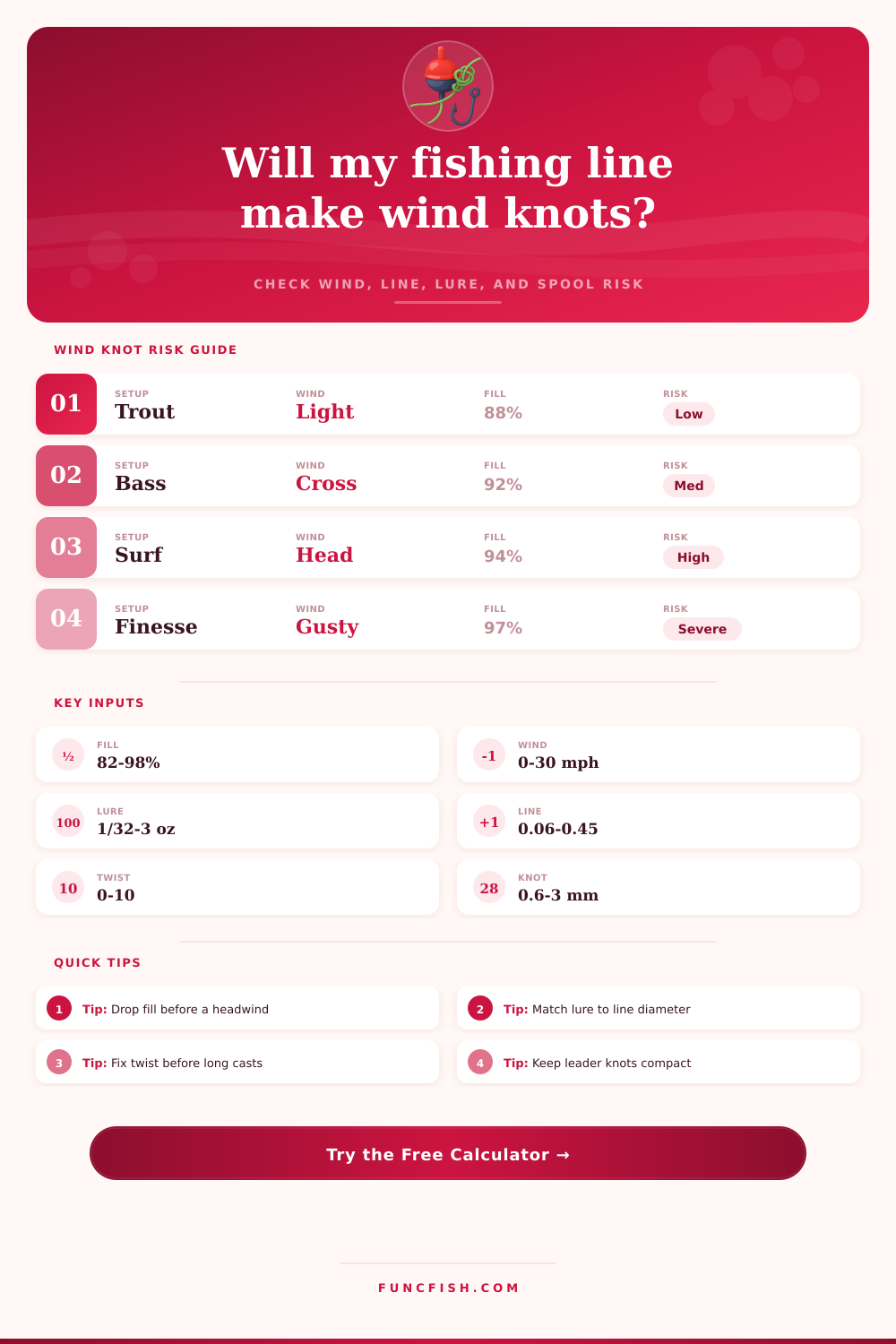
Estimate wind knot probability from line type and diameter, spool fill, braid limpness, wind speed and angle, lure weight, casting style, guide condition, line twist, and leader knot size.
📌Casting presets
⚙Line, reel, wind, and cast inputs
Wind knot forecast
Risk score blends spool behavior, line memory, wind loop pressure, lure tension, and leader-knot guide contact.
Score breakdown
🎣Line and casting comparison grid
Light braid finesse
All-round braid
Mono control
Heavy shore cast
📊Line material reference
| Line type | Wind knot tendency | Diameter behavior | Best control zone |
|---|---|---|---|
| 8-carrier braid | Moderate to high when limp | Thin, slick, low memory | 88-93% fill with steady lure tension |
| 4-carrier braid | Moderate | Rougher surface slows loops | 87-92% fill with clean guides |
| Fused superline | Moderate | Holds shape better than braid | 88-94% fill in light crosswind |
| Nylon monofilament | Low to moderate | Thicker line spills slower | 90-95% fill if memory is managed |
| Fluorocarbon mainline | Moderate from coil memory | Stiffer coils jump off spool | 85-91% fill on spinning reels |
| Copolymer mono | Low to moderate | Balanced stretch and memory | 89-94% fill with smooth casting |
| Gel-spun ribbon line | High in gusts | Very flat and very light | 84-90% fill with compact knots |
🌬Wind angle and casting load table
| Wind angle | Loop pressure | Calculator multiplier | Line management adjustment |
|---|---|---|---|
| Tailwind | Low; lure keeps line tight | 0.10 | Normal fill is usually stable |
| Quartering tailwind | Low to moderate belly | 0.30 | Close the bail by hand after splashdown |
| Crosswind | Side belly forms loose wraps | 0.65 | Reduce slack on the first crank |
| Quartering headwind | Lure slows while coils keep leaving | 0.85 | Use a heavier lure band or reduce fill |
| Straight headwind | High loop collapse risk | 1.00 | Shorten cast and keep the rod path smooth |
| Swirling gusts | Uneven line belly and sudden slack | 1.15 | Leave extra spool margin and avoid snap casts |
🧵Spool fill, twist, and leader knot table
| Input area | Stable range | Warning range | Why it matters |
|---|---|---|---|
| Spool fill | 86-93% braid, 88-95% mono | 96% or more on spinning gear | High fill lets loose loops slide over the lip |
| Line twist score | 0-3 after lure change | 7-10 visible corkscrew coils | Twist creates spring-loaded loop stacks |
| Leader knot diameter | Under 1.4 mm for micro guides | Over 2.2 mm through small guides | Bulky knots slap guides and shed slack coils |
| Line lay | Even, firm wraps below spool lip | Loose wraps or lip-side stacking | Uneven wraps release in bunches during a cast |
| Guide condition | Clean inserts and smooth tip | Salt film, groove, nick, or cracked ring | Drag spikes slow the line while coils keep moving |
⚖Practical lure weight bands by line diameter
| Actual line diameter | Typical line family | Low-wind lure band | Windy adjustment |
|---|---|---|---|
| 0.06-0.10 mm / 0.002-0.004 in | Ultra-thin braid | 1/64-1/8 oz / 0.5-3.5 g | Move toward 1/16 oz or 2 g minimum |
| 0.11-0.16 mm / 0.004-0.006 in | Finesse braid or light mono | 1/32-1/4 oz / 1-7 g | Add 25-45% in a headwind |
| 0.17-0.24 mm / 0.007-0.009 in | All-round braid or 6-10 lb mono | 1/8-5/8 oz / 3.5-18 g | Use compact casts above 15 mph |
| 0.25-0.34 mm / 0.010-0.013 in | Mono, fluoro, or heavier braid | 1/4-1 oz / 7-28 g | Watch coil memory on fluoro |
| 0.35-0.45 mm / 0.014-0.018 in | Heavy mono, shore line, or leader | 1/2-3 oz / 14-85 g | Check guide clearance and knot slap |
💡Risk control notes
Spool margin tip: If the score is near the high tier, reduce fill by 2-4 percentage points before changing line type. That single change often gives braid enough lip clearance for gusty casts.
Lure tension tip: A lure below the recommended band may still cast far, but it will not keep thin braid tight on the first retrieve. Move up slightly or use a smoother rod load.
Wind knots can occur very quick when fishing, and there is several different factor that contribute to the development of a wind knot. A wind knot occurs when a loose coil of fishing line slip over the lip of the spool, and a wind knot occurs because the wind catch that coil of line. In this case, the cast will be ruined before the lure even reach the water.
The cause of a wind knot isnt typically the fishing line but the combination of the fill of the spool, the wind direction, and the weight of the lure. If the weight of the lure are not sufficient to maintain tension on the fishing line as the line leave the reel, a wind knot will be more likely to occur. The fill of the fishing line is one of the primary factor that will determine whether a fishs line will remain tight on the reel or if it will begin to form loops.
How to Prevent Wind Knots When Fishing
If the fishing line is filled to the very top of the lip of the spool, the line is likely to slip over the lip and form a loose coil. By reducing the amount of line that is filled into the spool, even by a small amount, the line will be less likely to form a wind knot, even with the presence of wind. The diameter of the fishing line also play a role in the likelihood of the formation of a wind knot.
If the fishing line is thin, it will leave the spool more easy. Thin lines also tend to develop memory coils. Thicker lines will not develop memory coils but will still lead to the formation of a wind knot if the weight of the lure is too light for the line.
The angle of the wind can also impact the formation of a wind knot. For instance, if the wind is a tailwind, the lure will travel ahead of the fishing line. This will cause the line to remain in a stretched position.
However, if the wind is a headwind, the lure will travel at a slower rate than the line leaving the reel. This can cause the line to form loops. If the wind has a crosswind component, it may push the belly of the lure into the fishing line.
When the lure lands or when fishing begin, this belly of the lure will collapse into coils in the fishing line. Using the calculator, anglers can input the wind angle, the speed of the wind, and there casting style to determine the mathematical probability of the occurrence of a wind knot. An individual’s casting style can also impact the development of a wind knot.
For instance, if an angler use an overhead lob cast to cast their lure, the fishing line will remain under tension throughout the cast. This is because an overhead lob cast is a smooth movement that does not include a sudden stopping of the line. However, if the angler uses a snap cast or a skip cast, the sudden stop of the movement will cause a line loop to form in the fishing line.
Therefore, the same fishing line and the same fill of the spool will have different result based off the different casting styles of each angler. The casting style is a separate variable from the wind speed and the wind angle that can be entered into the calculator to determine the probability of a wind knot. The amount of line twist in the fishing line and the size of the leader knot are two other variables that contribute to the formation of a wind knot.
The changes in the lure that is being used, the fight between the line and the fish, and the line being tightened within the reel when closing the bail cause the line twist that develops in the line. If there is any line twist, the line will attempt to leave the spool in a corkscrew pattern. The twist can be made worse if the leader knot that is attached to the lure is large in diameter.
This knot will catch on the guide on the fishing rod. When the fishing line is cast, this large leader knot will yank the slack line taut. It is easier to prevent the development of line twist and a large leader knot than it is to fix either problem once they has developed.
The reference tables that is available on this page can provide information about the stable range for the fill of the spool, the line twist, and the size of the leader knot. These reference tables will allow anglers to know if their fishing line is within a stable range without having to use the calculator. The reference tables also contain information that allows anglers to see how the angle of the wind can impact the load on the fishing line.
With this information, anglers can decide whether they need to change the type of lure that they use or the length of the cast that they perform with their fish. While it is not the goal to eliminate every risk factor that may lead to a wind knot, anglers should become aware of each risk factor and understand which one is creating the most danger with their current fishing line. Because fishing conditions are changeable, anglers will encounter both shifting wind direction and different weight of lure that are appropriate for the diameter of their fishing line.
The calculator can help them to determine these variable and the trade-offs between each. Using the calculator will allow anglers to understand the relationship between the fill of the spool, the wind, and the tension of the line so that they dont need to guess why a wind knot has developed. By developing a habit to inspect three different aspect of the fishing line prior to beginning to fish in a new location or in different wind conditions, anglers can increase their ability to avoid the development of a wind knot.
The first of these aspects to inspect is the fill of the fishing line. The second of these aspects to inspect is whether the weight of the lure match the diameter of the fishing line. The third of these aspects to inspect is the amount of line twist that is present in the fishing line.
Each of these aspect should be inspected prior to fishing. If the fishing line is outside of the stable range in relation to any of these three aspect, the angler should fix the problem before they make their first cast of the day. Wind knots are not a mystery to anglers who are aware of the various input variable that contribute to the formation of a wind knot.