
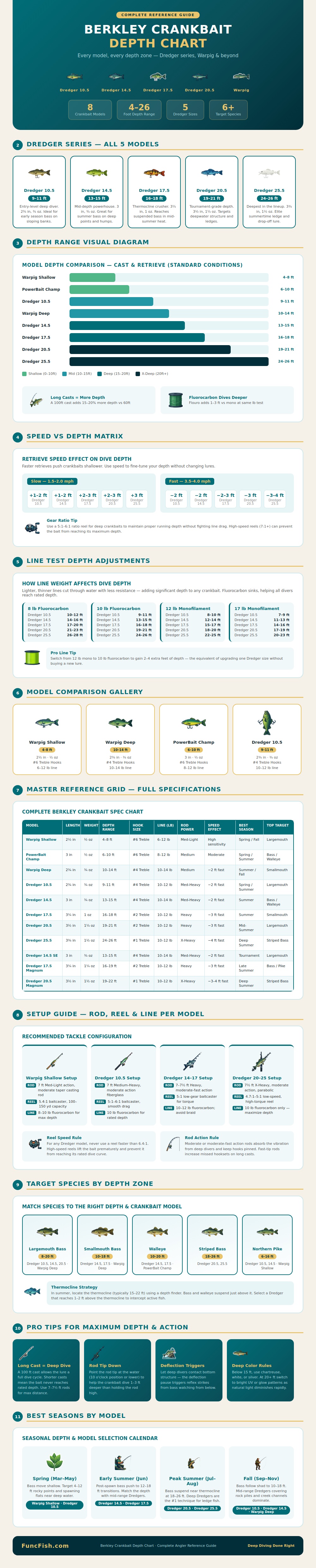
Crankbaits is fishing lures that move through the water at specific depths. The depth at which the crankbait move is one of the main factor that determine whether the fish will strike the crankbait. Many anglers use a variety of factors to select the best crankbait for the water in which they are fishing, such as the color of the crankbaits or the size of the crankbait.
However, using these factors to select the type of crankbait to use dont guarantee that the crankbait will reach the correct depth. If the crankbait does not reach the correct depth, then the angler may miss any fish that may be in an area. Therefore, the angler must use a crankbait that is selected according to the depth of the water in which the fish live.
How to Make Your Crankbait Reach the Right Depth
The Berkley lineup of crankbaits include a variety of different models that are designed to move through the water at specific depth. The angler can use these models to cover a variety of depths within a water area. If the angler attempts to force one of these models to reach a deeper depth within the water, the angling process will be less efficient.
Instead, the angler should use the model of crankbait made by Berkley that is designed for the depth of the water that they are fishing in. Using the correct Berkley model will allow the crankbait to remain in the strike zone for a longer period of time. Additionally, using the correct Berkley model will eliminate the need for the angler to constantly adjust the retrieve of the crankbait in order to maintain the depth at which it is traveling.
The speed at which the angler retrieves the crankbait will affect the depth at which the crankbait moves through the water. The speed of the retrieve is one of the variable that the angler can control. Using a slow and steady retrieve will allow the bill of the crankbait to dig into the water, causing the crankbait to settle to its designed depth.
If the angler increases the rate at which they retrieve the crankbait, the crankbait will move toward the surface of the water. If the angler increases the rate of the retrieve, the crankbait may move several feet toward the surface of the water, beyond the depth for which it was design. Because the angler can adjust the depth at which the crankbait moves through the control of the retrieve speed, the same model of crankbait can be used to reach different depths in the water.
The type of fishing line that the angler uses will also affect the depth to which the crankbait travels through the water. If the fishing line is thinner and denser than the line that is typically used with the crankbait, the crankbait will dive deeper into the water. For instance, if the angler changes the line from a twelve-pound monofilament line to a ten-pound fluorocarbon line, the crankbait may dive a few feet deeper into the water without changing the crankbait.
Using a thicker fishing line will make the crankbait dive less deep into the water. The angler should use a fishing line that matches the depth that the angler wants the crankbait to reach. By matching the line to the depth, the angler ensure that the crankbait will reach the correct depth in the water.
The rod and the reel that are used when fishing with a crankbait will also impact the depth at which the crankbait travels. Using a rod and reel with a moderate action and slow gear ratio will allow the crankbait to remain under the control of the angler. This helps to even the retrieve of the crankbait so that it does not rise toward the surface of the water before it reaches its maximum depth.
Using fast reels can cause the crankbait to rise toward the surface of the water before the crankbait reaches the maximum depth for which it was designed. This defeats the purpose of its use. The Berkley company also provides a setup guide for each crankbait model that details the type of fishing rod and reel that will allow the crankbait to reach its designed depth.
The depth at which the fish live in the water will change with various factor throughout the year. According to seasonal guides, in the spring, bass will be located in the shallower portions of the water in which they live. Anglers should use a crankbait model that covers the mid-range depths of the water.
During the midsummer months, the bass will move to deeper portions of the water. Therefore, anglers will have to use a crankbait model that will allow the crankbaits to reach those deeper part of the water. Additionally, not all species of fish will live at the same depth.
For instance, smallmouth bass and walleye live at specific depths within their habitat. Therefore, anglers will have to use crankbaits that are designed to travel at these specific depths. Using the appropriate crankbait model for the depth at which the fish live will eliminate the number of empty casts that anglers make while attempting to catch the fish.
A depth chart can be used to remove the variables of the depth at which the crankbait travels. Using a depth chart, anglers dont have to worry about the depth at which the crankbait travels. They can focus on where they are casting the crankbaits and how they are retrieving the crankbaits.
The depth chart ensure that the crankbait is performing its main purpose. By using a depth chart, anglers will have a more productively day fishing for the fish that they desire to catch.