
Fishing weights may seem like the simplest of all the fishing gear. There is hardly anything to study in a lump of lead with a hole in it. Yet the right weight can make all the difference in the fishing day.
The wrong weight will cause your bait to either drift uselessly in the water column or continually snag on rocks in the river. Understanding the different types of fishing weights will allow you to more better match the weight to your water, to the weight of the fish you are after, and to the fishing technique you will use to avoid wasted time and spooked fish. Many anglers tend to use the first weight that comes into sight as they purchase or the weight closest to their hand.
This will work well until it ceases to work well. There are vast difference in the way the different types of fishing weights will behave once they meet the water. Some will allow your bait to stay close to the bottom even in the presence of strong currents.
Others will allow your bait to fall gentle even in still water. The difference between these two types of weights, for example, will make a difference in whether you feel the bite or not. There are many different types of fishing weights, each with specific uses that will cover nearly every scenario for freshwater and inshore fishing.
Common Types of Fishing Weights to Use
1. Split Shot Weights
Split shot weights are the smallest in size among the different types of fishing weights. They are used for most versatility in light-line fishing. These weights feature a slit on one side that allows them to be pinned onto the fishing line.
You can pin these on with pliers or even with your teeth in a hurry. Because of their minimal addition of weight to the fishing line, these weights can be used to fish for light baights such as worms or minnows. However, using too much weight with split shot will make your bait look like it was dropped from a helicopter.
Most people using finesse fishing for species like trout or panfish often miss the mark with the proper amount of split shot weights to use. Split shot weights can be quickly added onto or remove from the fishing line. This will allow for changes in the depth that your bait travels through the water due to different water clarity or currents in the water.
However, adding too much pressure on the line with split shot weights will weaken the light fishing line. To avoid this, adding a small plastic tube between the split shot and the fishing line will prevent the loss of a good catch due to the line breaking.
2. Bullet Weights
Bullet weights get their name from their sleek design with a pointed end.
The purpose of bullet weights is for them to slide easy on the fishing line in front of the bait. The point allows them to easily pass through thick vegetation when they reach the bottom of the fishing spot. The bait can either remain on the bottom or crawl on the bottom without interference from the bullet weight.
The reason for the stop on bullet weights allows them not to slide onto the hook when cast. This allows the bait to fall slowly on the fishing line which will trigger the fish to strike. The problem with bullet weights is that they can become stuck on rocks when the angler begins to retrieve the bait.
However, for areas where other fishing rigs will often snag the bait, bullet weights are worth having in a variety of color.
3. Egg Sinkers
Egg sinkers are simply lead beads in the shape of eggs with a hole in the middle. They are used mostly for bait that is alive and for areas with moving water.
The bait can move naturally in the water while the egg sinker remains in contact with the bottom of the fishing spot. One egg sinker can be threaded onto the fishing line, followed by a bead and the hook. This allows the bait to move in the water while the egg sinker holds onto the bottom of the fishing spot.
Because catfish are often found on the bottom, egg sinkers are preferred by catfish anglers. Additionally, they are the simplest type of fishing weight. They dont tangle easy and they cast well even in the presence of the wind.
For egg sinkers, the sizes vary depending on where they will be used. Larger sizes will work well in the surf or in areas of strong river currents. Smaller sizes will work well in areas of slow-moving creeks.
However, care must be taken not to use an egg sinker that is too heavy for the bait. Using an oversized egg sinker may cause the bait to anchor to the bottom which may cause the fish to drop the bait before it even sense its presence.
4. Bank Sinkers
Bank sinkers are weights that have a flat side and a tapered side.
They hold the bottom of the fishing spot well and are well-suited for moderate currents. Bank sinkers can be tied directly to the fishing line or used as the bottom weight for a fish-finder rig. The flat side of the weight will not allow it to roll about once it reaches the bottom of the fishing spot.
Bank sinkers will work well for anchoring bait in an eddy in a river or for holding a lure in a tidal rip. The flat side of the bank sinker will not allow it to bury itself in the mud. However, in rocky terrain, the tapered end of the bank sinker can get wedged between rocks that will require the use of pliers to extract the weight.
5. Walking Sinkers
Walking sinkers, also referred to as coin weights or disk weights, are round and flat with a hole near the end. Because of their low profile, they will easily crawl across the bottom without snagging on the natural features of the fishing spot. Walleye anglers will often use walking sinkers because they will drift behind the fishing boat in weedy area.
Additionally, walking sinkers will work well for casting along banks with riprap. Because walking sinkers will lie flat on the bottom of the fishing spot, they will transmit the feeling of the bottom through the fishing line. This will allow anglers to feel the difference between sand, gravel, and rock.
These weights will keep anglers in the strike zone for a longer time. However, walking sinkers will not hold the bait to the bottom in fast-moving currents.
6. Pyramid Sinkers
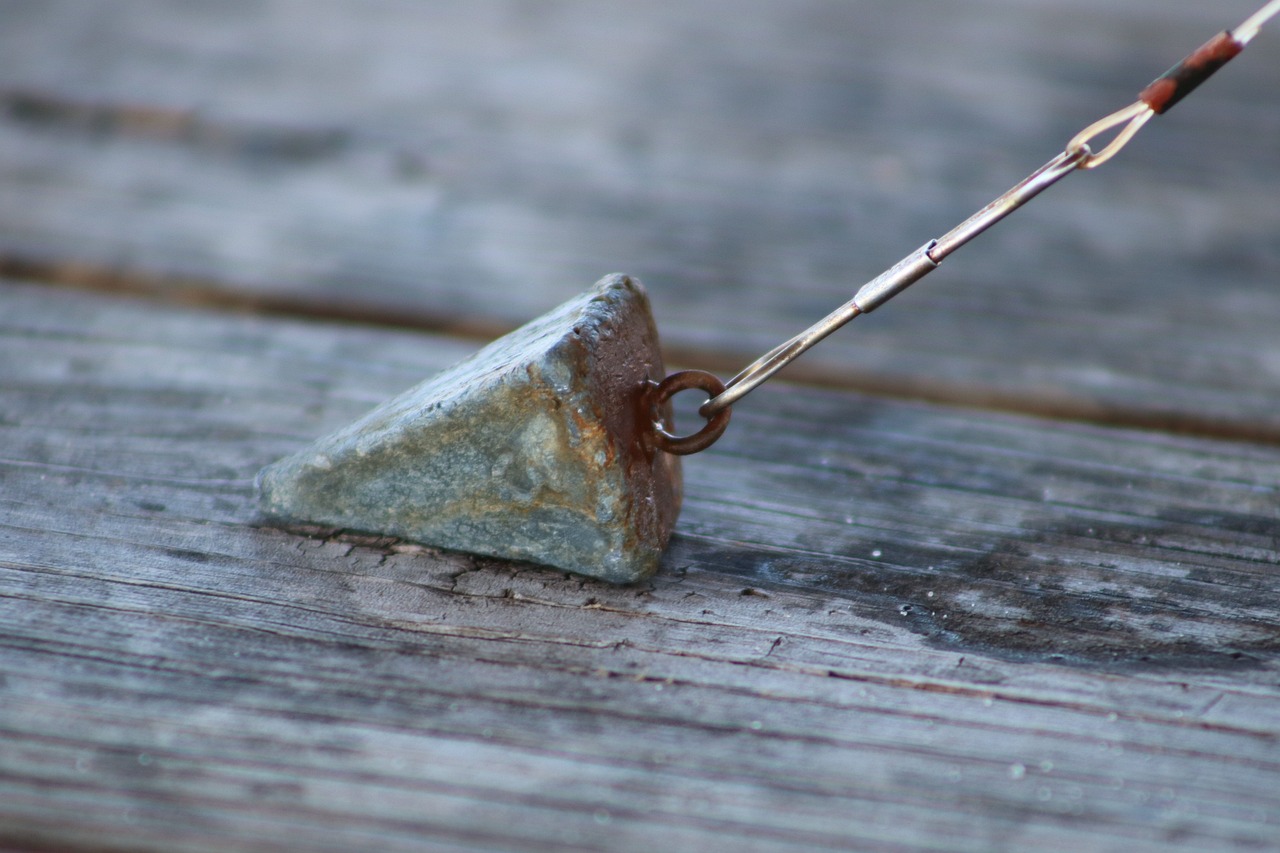
Pyramid sinkers have four flat sides and a point at the end.
When dropped into the surf or a fast-moving river, the weight will dig in. Because of the four flat sides, waves or strong river currents will not easily roll pyramid sinkers. These weights are perfect for situations where fish bait will need to be held to the spot for long periods.
Surf fishermen will use pyramid sinkers to keep bait in place for fish that come to feed on the bait that the surf washes to the shoreline. The pointed end of a pyramid sinker will allow for easy retrieval of the weight. This will save anglers from having to clean up their spot and keep their expensive fishing rigs from becoming reef decorations.
However, the same shape that allows the weight to hold to the bottom will allow for difficulties in casting these weights in the presence of strong winds.
7. Trolling Sinkers
Trolling sinkers are long and have a keel or a fin on them. These weights will help anglers of all species to get the bait to a specific depth behind the boat.
The keel allows these weights to stay straight in the water so that multiple fishing lines does not tangle. Fishermen who fish for salmon and trout in the Great Lakes use these weights. Trolling sinkers can easily be clipped on and off the fishing line using snap swivels.
This will allow the angler to adjust the depth of the bait as the fish move along the fishing spot. However, care must be taken to ensure that the line has enough length and the boat is moving at the right speed so that the bait does not get too far from the boat or the fish do not get bored of the sight of the fishing line.
8. Drop Shot Weights
Drop shot weights are specialized weights used for bass and perch with clear water.
You tie the weight to the end of the fishing line with the hook tied several inches from the weight. This will allow the bait to naturally float above the bottom while the weight remains on the bottom. Using a drop shot weight will allow anglers to feel the lightest of bites on the line and will allow them to set the hook when a fish take the bait.
Because the drop shot weight is located below the bait, it will not spook fish that are searching for bait on the bottom. With drop shot weights, anglers can shake the tip of the fishing rod to move the bait without disturbing the drop shot weight. The only real problem with drop shot weights is that they will get snagged on the bottom from rocks or weeds.
However, because drop shot weights are relatively cheap and easy to replace, this problem is of minimal concern to most anglers. Anglers who use drop shot weights may want a variety of size in the range of one-eighth ounce to half an ounce to allow for proper adjustments to the depth at which they will be fishing and the strength of the wind at the fishing spot.
9. Reef Sinkers
Aransas Pass-style weights, also known as reef sinkers, have wire loops on the end of them.
The angler ties the fishing line to one loop and the leader to the other loop. The weights work well for bait drifting in currents while staying on the bottom. Anglers who like to fish inshore for redfish and speckled trout use these weights.
The wire loops allow for changing the weight without having to cut the fishing line. This will be of great benefit to the angler when the tide changes and the current changes. The added knots are compensated for by the benefits of the bait drifting naturally with the current.
Once anglers see how well these weights will allow their bait to drift, they will find themselves using these types of weights more often. Ultimately, choosing the right fishing weight depends on what your bait needs to do once it enters the water. The split shot that will fool a trout in a mountain stream will be of no use to you when fishing in the surf.
Similarly, the pyramid sinker that will hold your bait to the bottom when you fish in the surf will spook the fish in a clear lake. It is a good idea to carry with you a small assortment of fishing weights. If you carry a small assortment of fishing weights, you will never find yourself in a situation where your bait is either underweighted or overpowered.
Take a few extra seconds the next time you are at the water’s edge to ensure that the fishing weight you select for your bait match the fishing conditions. Your line will thank you. And, even more importantly, the fish will thank you.