
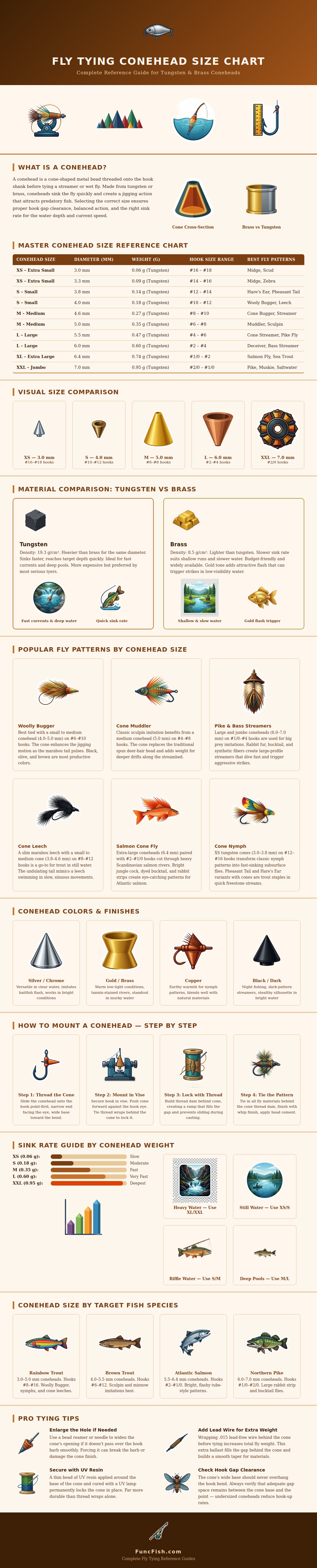
A conehead is a tapered metal bead that you adds to a hook before you tie your fly. The conehead is essential because it determines the sink rate of the fly and the movements of the fly in the water. Too light a conehead will cause the fly to sit too high in fast moving water, and too heavy a conehead will cause the fly to snag on things in the water or not move as you want it to when fishing for baitfish.
The conehead should be apropiate for the hook, the fly, and the water condition. The relationship between the cone diameter, the cone weight, and the size of the hook is another essential factor for someone interested in tying flies to understand. A conehead that seem small up close may be much larger once placed on a hook.
How to Choose and Fit a Conehead on a Fly
Conversely, a large conehead on a large hook may appear smaller when on the hook. Using a visual aid to compare the different size of coneheads will allow the person tying the fly to understand how the conehead will grow in size with the size of the hook. This will allow people to decide if the conehead will clear the hook gap once all of the materials are added to the hook.
Tungsten and brass are the two materials used to make coneheads. The difference in the sink rates that both materials present allow flies with coneheads made of either material to be useful in different situations. Tungsten is nearly twice as dense then brass; therefore, a conehead made of tungsten will allow a fly to sink much faster than a conehead made of brass of the same diameter.
This will be useful for targeting fish in deep water or in strong currents. On the other hand, brass will allow the fly to descend slowly with a warmer flash of light. This will come in handy for fishing in stained water or in the water when there isnt much light.
The angurist should choose the material of the conehead according to the condition of the water in which the angurist will be fishing. The way in which the conehead sit on the hook can have an impact on the movement of the fly. The angler should place the conehead onto the hook point first, against the eye of the hook, and the thread ramp should be created behind the conehead.
The thread ramp will stop the conehead from moving while fishing and will provide a foundation for the body and wing of the fly. Not creating a thread ramp may cause the conehead to become crooked or become loose after catching fish. Different fly require different weights of coneheads.
For instance, a Woolly Bugger fly targeted at trout will require a small conehead so that the marabou portion of the fly will be able to move. However, a Woolly Bugger fly targeted at pike or bass will require a conehead that is larger than a Woolly Bugger for trout because the conehead will allow the fly to reach the depths at which the pike or bass live. Smaller coneheads will be used for more delicate flies targeted at specific strike at will, while larger coneheads will be used for big water streamers.
The sink rate of the fly will be the most important factor in the conehead that is chosen. A light conehead will be able to get a leech pattern to trout in still water. However, a fast riffle in the water will require a larger conehead to get the fly to the bottom of the water’s depth.
It is far more important to choose the right conehead for the water than to add split shot to the fishing line after the fly is complete. The species of fish that you are targeting will determine the conehead that will be used on the fly. For instance, trout will usually take to medium coneheads on mid-sized hook.
However, large predator such as pike or salmon will require heavy coneheads so that the flies can be stripped or swung to the appropriate depth. There are a few things that the angurist should do to make the conehead selection and placement process easier. First, ensure that the conehead leaves enough hook gap.
If the coneheads hole is too tight, open the conehead slightly to allow it to slide over the barb of the hook. Another option is to add lead wire behind the conehead to fine tune the coneheads weight. Finally, applying head cement or UV resin around the conehead will ensure that the conehead will remain in place while on the hook while fishing for fish.
You should of checked the weight too.