Chum Salmon Weight Calculator
Estimate chum salmon weight from fork length, girth, body depth, ocean or river phase, sex and maturity, run timing, condition index, and measurement confidence.
📌Chum salmon presets
⚙Fork length, girth, phase, and condition inputs
Chum salmon weight estimate
Calculation breakdown
📊Chum salmon phase data
Ocean Bright
Estuary Fresh
Lower River
Upriver Spawn
🐟Salmon species comparison grid
Chum Salmon
Deep-bodied adult with strong river-phase shape changes.
Coho Salmon
More compact body and often higher weight per inch.
Pink Salmon
Smaller average size with strong mature male hump.
Sockeye Salmon
Streamlined body, often dense but less broad than chum.
Chinook Salmon
Largest common Pacific salmon with the widest weight range.
📘Reference tables
| Fork length | Typical girth | Body depth | Common weight window |
|---|---|---|---|
| 22 in / 56 cm | 11 to 12 in / 28 to 30 cm | 5.0 to 5.6 in / 13 to 14 cm | 4.5 to 7.0 lb / 2.0 to 3.2 kg |
| 25 in / 64 cm | 12.5 to 14 in / 32 to 36 cm | 5.8 to 6.4 in / 15 to 16 cm | 6.5 to 10.0 lb / 2.9 to 4.5 kg |
| 28 in / 71 cm | 14 to 16 in / 36 to 41 cm | 6.5 to 7.5 in / 17 to 19 cm | 9.0 to 14.0 lb / 4.1 to 6.4 kg |
| 31 in / 79 cm | 15.5 to 18 in / 39 to 46 cm | 7.2 to 8.5 in / 18 to 22 cm | 12.0 to 19.0 lb / 5.4 to 8.6 kg |
| 34 in / 86 cm | 17 to 20 in / 43 to 51 cm | 8.0 to 9.5 in / 20 to 24 cm | 16.0 to 26.0 lb / 7.3 to 11.8 kg |
| Ocean or river phase | Weight factor | Shape cue | Use when |
|---|---|---|---|
| Ocean bright, sea-run body | 1.06 x | Silver, full shoulders | Recently ocean-fed fish |
| Estuary transition, fresh fish | 1.03 x | Firm body, slight blush | Tidewater or river mouth |
| Lower river, chrome to blush | 1.00 x | Baseline adult chum body | Default field estimate |
| Mid-river colored fish | 0.95 x | Developing bars and shape | Migration is underway |
| Upriver spawning phase | 0.89 x | Darker, drawn-down body | Near spawning areas |
| Sex or maturity | Factor | Body change | Calculator note |
|---|---|---|---|
| Unknown ocean adult | 1.00 x | Neutral adult profile | Use when sex is unknown |
| Female, silver to blush | 1.02 x | Firm belly and eggs | Small fullness increase |
| Male, silver to blush | 1.01 x | Broader head and back | Moderate body increase |
| Female, pre-spawn | 0.98 x | Body mass shifting | Use with river phases |
| Male with kype and hump | 0.96 x | Shape changes, less belly | Depth may overstate mass |
| Spent or noticeably thin | 0.82 x | Low reserves | Use a wider confidence band |
| Run timing phase | Factor | Reserve signal | Confidence impact |
|---|---|---|---|
| Fresh tidewater push | 1.05 x | Ocean-fed reserve | Tighter with good girth |
| Early summer entry | 1.02 x | Firm muscle and fat | Normal estimate range |
| Main fall run | 1.00 x | Balanced migration body | Best default timing |
| Late fall holding fish | 0.94 x | Mass begins falling | Range widens slightly |
| Winter holdover or late spawner | 0.88 x | Low reserves | Use wide confidence |
| Long migration interior fish | 0.91 x | Travel loss likely | Expect leaner profile |
These tables are field-estimation references. A certified scale is required when an exact chum salmon weight is needed.
💡Measurement tips
Fork length tip: Chum salmon references often use fork length, so do not mix it with total length unless you convert the measurement. Total length usually reads longer than fork length.
Girth and phase tip: Girth is squared in the estimate, while river phase trims body reserve. A fresh tidewater fish and an upriver spawner can share length but differ sharply in weight.
Due to the fact that chum salmon often change there physical shape as they move from the ocean to a river, it can become difficult to accurately calculate the weight of the fish. A chum salmon that is measured to have the same fork length in the ocean as a chum salmon in the river may weigh more than the river chum salmon due to the fact that the river chum salmon have lost weight during they journey to the river. The weight that is lost by the chum salmon during this period is from there energy reserves that are necessary to travel to and to spawn in the river.
In order to calculate the weight of a chum salmon, the user must enter the length, girth, and depth of the chum salmon into the calculator, as well as the life-stage settings of the chum salmon. Within the calculator, the relationship between the length of the chum salmon and its girth calculates the weight of the chum salmon. The calculator squares the girth of the chum salmon to calculate the volume of the fish, as is the length of the chum salmon.
How to Calculate the Weight of a Chum Salmon
Various adjustments is made to the weight of the chum salmon based off factors like the phase of the chum salmon, the sex of the chum salmon, its maturity, and the timing of its run. For instance, ocean-bright chum salmon have full bellies and deep shoulders as they have spent the majority of their lives in the ocean and have been feeding. In contrast, chum salmon that have traveled to the spawning grounds of the river will have flat bellies and narrow backs as they have used there energy reserves to travel to these areas and to spawn.
Therefore, a chum salmon with a flat belly will weigh less than a chum salmon with full belly and of the same length. Additionally, the weight of the chum salmon can change according to the sex of the salmon and its maturity. Female chum salmon may weigh more than male chum salmon of the same length due to the fact that the female salmon is carrying the egg.
Additionally, because the female salmon utilizes its energy to produce those eggs, its weight may decrease more rapidy than that of a male salmon after it begins to spawn. Males develops a kype and a dorsal hump that changes the body outline of the salmon, but do not contribute to the weight of the male salmon. These differences in body composition require that the user of the calculator selects the correct maturity setting for the salmon.
Furthermore, the timing of the spawn of the chum salmon may impact the weight of the salmon as well. For example, chum salmon that arrive at the river early in the spawning season will have more energy reserves than those that arrive late in the season. Late arrivals have often burned through there energy reserves during the migrations from the ocean to there spawning grounds.
Thus, the user must also select the correct timing phase of the chum salmon to ensure that the weight calculation is accurate. If either the timing phase or the maturity of the salmon are incorrectly selected, the weight that is calculated for the chum salmon will be incorrect because the calculator will assume that the salmon has just departed from the ocean. Another tool within this article that may be of use to the reader is the condition index.
The condition index is a value that helps to indicate whether or not the physical shape of the salmon match the expected shape of a chum salmon of that length. A salmon that weighs more than the expected weight will receive a higher score in the condition index than a salmon that weighs less than the expected weight for that length. Thus, this index does not replace the necessity of weighing the salmon on a scale, but it does provide a means of understanding whether or not that salmon is heavier or lighter than the average chum salmon.
Many individual may use the condition index score to monitor the health of the salmon populations from different areas. The quality of the measurements of the chum salmon will impact the confidence range that is provided by the calculator. For instance, if the length, girth, and depth measurements are taken with a board and tape measure from a calm chum salmon, the confidence range will be narrow.
If those measurements are estimated from a moving chum salmon or from a photograph of the chum salmon, the confidence range will be wide. Thus, confidence range incorporates both the natural variation of the chum salmon as well as the quality of the measurements of the salmon. When measuring the weight of the chum salmon, fork length should be utilized as the standard measurement.
Fork length will remain the same even if the tail of the salmon is damaged. In contrast, total length includes the lobes of the tail of the salmon, and the total length may change based upon the holding of the salmon. The person should measure the girth of the salmon at the widest portion of the salmon, and the body should not be compressed when measuring the girth.
Additionally, the depth of the chum salmon should be measured from the back of the fish to its belly. These three measurements provide the calculator with the information necessary to perform its calculations. Errors may occur with the weight calculation if the length measurements of the chum salmon are mixed with different types of length measurements, or if the phase of the salmon is ignored.
For instance, if total length is used instead of fork length, the total length will be too long and the calculated weight will be too high. Similarly, if a river-phase salmon is treated as if it is an ocean-bright salmon, the calculated weight will be too high due to the weight that is lost in traveling to the river. These errors can be avoided by correctly selecting the length type and phase settings within the calculator.
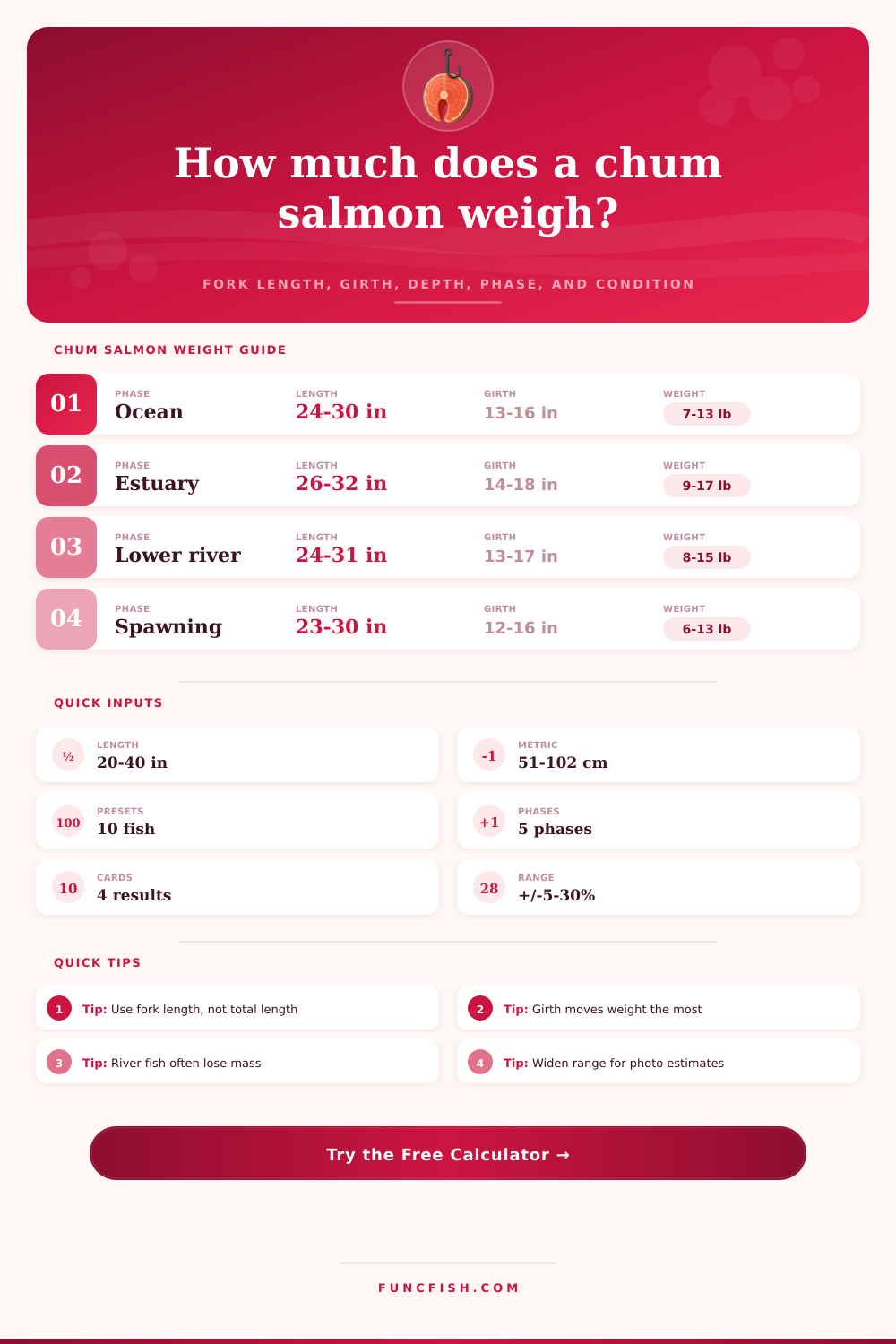
The reference tables within the article reveal the typical length, girth, and depth measurements of chum salmon of each phase. These tables are not to be used as a means of calculating the weight of the salmon, but may help to provide an understanding of the weight of the salmon based upon its length, girth, and depth. These tables may also show the change in the weight of the salmon as it travels up the river.
Additionally, those individuals that intend to use the calculator over long periods of time may use the tables. For instance, anglers may use the calculator to measure the length, the girth, and the phase of each chum salmon that they catch each year. By measuring each chum salmon over several years, the angler may be able to determine if the average condition of chum salmon in that area is rising or falling over time.
Similarly, managers of chum salmon may use such information to manage the salmon populations within those rivers. Thus, the calculator allows individuals to rapidly and consistently calculate the weight of the salmon. Furthermore, the weight of the salmon can tell individuals about the current state of the salmon; an ocean-bright chum salmon contains energy, but a lean chum salmon may be near the end of its journey.