Wels Catfish Weight Calculator
Estimate Wels catfish weight from total length, widest girth, body depth, river or lake habitat, belly condition, maturity class, forage pattern, confidence band, and unit mode.
📌Named Wels catfish presets
⚙Measurements and Wels profile
Estimator note: Wels catfish have long frames, heavy heads, and large belly swings. This calculator combines the classic length times girth squared model with depth and profile corrections.
Wels catfish weight estimate
Weight, range, body index, and class update from the selected measurement profile.
Calculation breakdown
📊Wels model constants
Classic formula
Depth correction
Confidence band
Class markers
🐟Catfish comparison grid
Long, thick head
Deep heavy body
Wide head, thick belly
Compact, forked tail
Small compact body
📘Reference tables
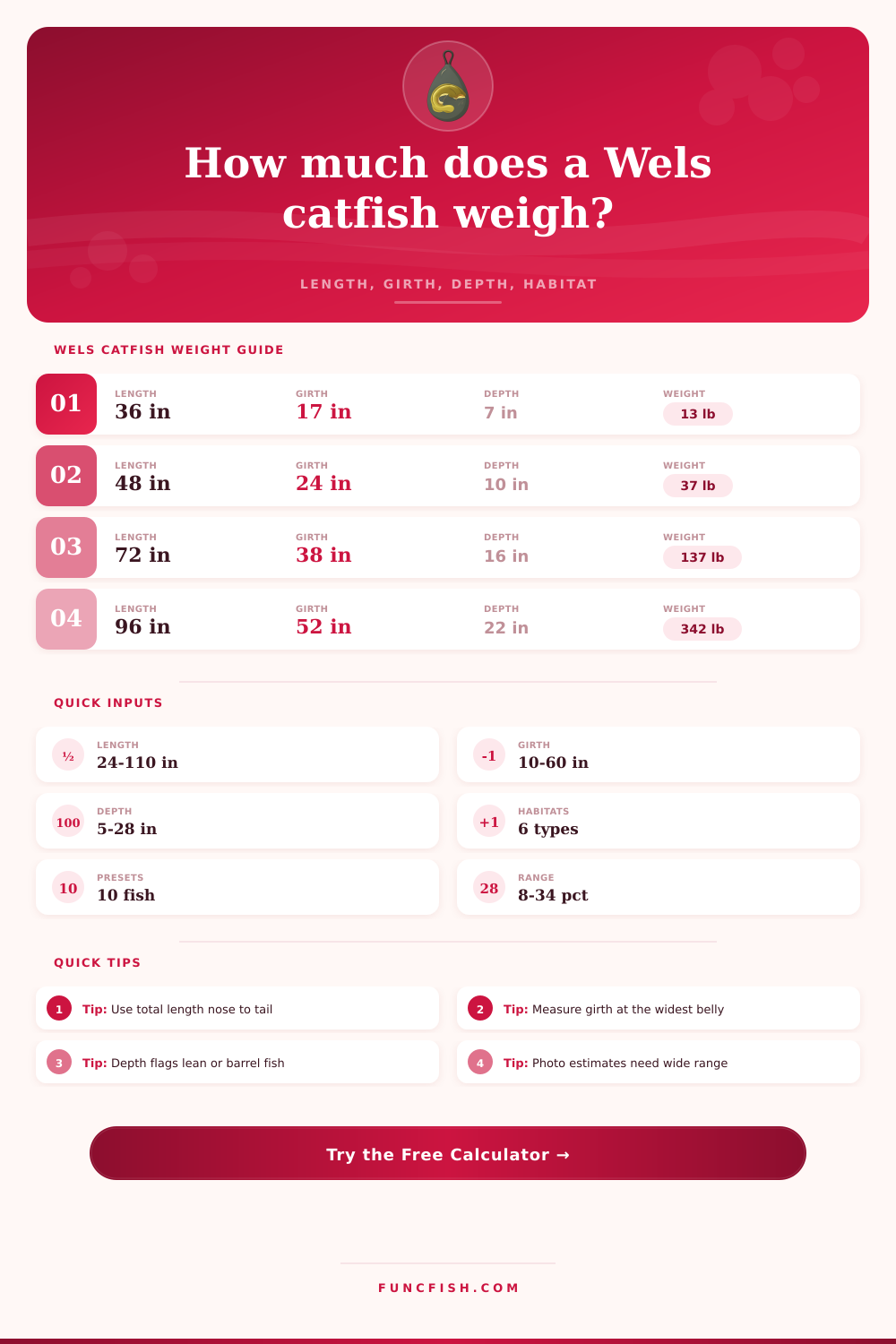
| Total length | Typical girth | Typical depth | Approx weight | Field class |
|---|---|---|---|---|
| 24-36 in / 61-91 cm | 10-17 in / 25-43 cm | 5-8 in / 13-20 cm | 4-15 lb / 2-7 kg | Juvenile to sub-adult |
| 37-48 in / 94-122 cm | 17-24 in / 43-61 cm | 8-11 in / 20-28 cm | 15-40 lb / 7-18 kg | Adult river fish |
| 49-72 in / 124-183 cm | 24-38 in / 61-97 cm | 11-17 in / 28-43 cm | 40-145 lb / 18-66 kg | Large adult |
| 73-96 in / 185-244 cm | 38-52 in / 97-132 cm | 17-23 in / 43-58 cm | 145-355 lb / 66-161 kg | Giant Wels |
| 97-110 in / 246-279 cm | 52-60 in / 132-152 cm | 23-28 in / 58-71 cm | 355-540 lb / 161-245 kg | Exceptional giant |
| Habitat profile | Base coefficient | Habitat factor | Usual body shape | Best confidence |
|---|---|---|---|---|
| Fast river run | 790 | 0.96 | Long, lean, strong frame | Careful tape plus girth |
| Deep river hole | 770 | 1.00 | Balanced adult profile | Length and widest girth |
| Delta or lower river | 745 | 1.04 | Heavy feeding belly | Girth and belly check |
| Open lake basin | 760 | 1.02 | Rounder mid-body | Depth helps photo checks |
| Warm weedy lake | 735 | 1.06 | Shorter, heavier belly | Depth and girth both needed |
| Reservoir ledge or dam pool | 755 | 1.03 | Heavy head and belly | Standard tape estimate |
| Belly condition | Multiplier | Visual cue | When it appears | Range effect |
|---|---|---|---|---|
| Hollow or post-spawn belly | 0.90 | Flat lower belly behind head | After spawn or low feeding | Wider low side |
| Lean river belly | 0.96 | Long frame, modest belly curve | Current-heavy river fish | Normal range |
| Normal rounded belly | 1.00 | Even curve from head to vent | Average adult Wels | Normal range |
| Full bait-fed belly | 1.08 | Deep belly and thick shoulders | After strong forage periods | Higher top side |
| Barrel or pre-spawn heavy | 1.15 | Very round and deep mid-section | Big females or stuffed fish | Use careful tape |
| Maturity or forage | Adjustment | Expected depth ratio | Weight behavior | Calculator use |
|---|---|---|---|---|
| Juvenile or sub-adult | 0.95-0.98 | 0.17-0.20 | Length grows faster than girth | Check girth carefully |
| Mature adult | 1.00 | 0.20-0.22 | Balanced length and belly mass | Standard model baseline |
| Large adult or trophy | 1.03-1.08 | 0.22-0.25 | Head and belly mass climb fast | Depth correction matters |
| Carp or large coarse fish | 1.06 | 0.22-0.26 | High belly reserve potential | Use full-belly setting if visible |
| Low-forage or cold period | 0.94 | 0.18-0.21 | Same length can weigh less | Confidence range should widen |
💡Field estimate tips
Use total length and the widest belly girth from the same fish position. A small girth error changes a Wels estimate much more than a small length error.
Use the photo-only confidence band when length, girth, or depth came from memory. Giant Wels vary widely because belly volume changes fast after feeding.
This tool gives a field estimate for angler notes and comparison. Certified scales remain the standard for official weights, records, and exact claims.
Wels catfish have bodies that dont always match there length. The weight of these catfish can vary significant from one individual to the next, even with the same length of the Wels catfish. While one could measure the length of the Wels catfish from tip to tip with a tape, the length does not always indicate the weight of the Wels catfish.
The shape of the Wels catfish influence the weight of a Wels catfish, and the shape of the Wels catfish is dependent upon both the diet of the catfish and where the catfish lives. Therefore, an estimate tool for the weight of a Wels catfish are necessary in order to account for the differences in the shapes of the catfish. The weight of a Wels catfish is distributed unevenly throughout it’s body.
Estimating the Weight of a Wels Catfish
Wels catfish often have large heads and bellies, the size of whose bellies can vary with the passing of the season. Wels catfish that live in areas of fast-moving water has different body shapes than Wels catfish that live in warm areas with abundant weedy growth. These types of differences is important to account for since the standard formula for calculating the weight of a Wels catfish assumes that all Wels catfish have the same body shape.
An estimate tool must account for depth and belly fullness since these factor can impact the weight of the catfish. The calculator ask for several specific measurements of the Wels catfish in order to calculate the weight of that fish. For instance, one of the questions ask for the habitat in which the Wels catfish lives; this habitat will impact the body shape of the Wels catfish that is being weighed.
Additionally, another question ask for the maturity class for the Wels catfish. As the Wels catfish age, it gain more mass in its head and belly. Another question asks for the condition of the belly of the Wels catfish.
Wels catfish with hollow bellies have less weight than Wels catfish with full bellies. The forage pattern the Wels catfish use for its diet impacts the body composition of the Wels catfish. Wels catfish that eat carp will have more mass than Wels catfish that eat small fish.
Finally, lastly, one asks for the confidence in the measurements that were taken for that Wels catfish. Reference tables exist on the estimation tool for the weight of a Wels catfish. These table are not an alternative to the calculator to estimate the weight of the Wels catfish, but exist to allow individuals to understand how each individual variable can impact the weight of the Wels catfish.
For instance, Wels catfish from fast moving rivers will weigh less than Wels catfish from deltas. The calculator accounts for this weight difference. Many individuals may be unaware of the different factors that can impact the weight of a Wels catfish.
For example, individuals may believe that length and girth are the only measurements of a Wels catfish that matter. The girth of the fish is measured at the widest part of the Wels catfish, which is often behind the pectoral fins of the Wels catfish. An incorrect measurement of the girth will create error in the estimated weight of the Wels catfish.
A depth measurement of the Wels catfish is also another measurement that can be used to obtain a more accurat calculation of the weight of the Wels catfish. The calculator use depth measurements so as to adjust for the body composition of the Wels catfish being weighed. While length is one of the measurements that determine if a Wels catfish is a trophy fish, the weight of the Wels catfish is also a determining factor.
A Wels catfish that is 70 inches in length but lean may weigh less than another Wels catfish that is 60 inches in length but is very full of fish. The length and weight of the Wels catfish is used to determine its maturity class, and this prevent the individual from incorrectly labelling a Wels catfish as a giant due to its low mass. The environment in which a Wels catfish lives impact the weight of that Wels catfish.
Wels catfish that live in reservoirs has more mass in the head and shoulders of the fish than Wels catfish that live in rivers. Reservoirs has calm waters and steady forage for the Wels catfish. Therefore, the calculator account for this difference in habitats.
Without these habitat term, the calculator will always output the same value for the weight of a Wels catfish; however, catfish of the same length have different weights based on their habitat. The forage in which a Wels catfish eat also changes the weight of that species. Wels catfish that eat carp will have deeper bellies and thicker shoulders than those Wels catfish that eat smaller fish.
Accounting for forage allow the individual to avoid guessing the percentage of the weight of that fish. The water temperature in which the Wels catfish live and the length of time that it was fed also impacts the weight; these measurements is also necessary to account for in the estimation tool. The value of the estimate tool is that it force an individual to observe the different variable that impact the weight of a Wels catfish.
By recording the habitat, belly condition, depth, length and girth of the Wels catfish, an individual will begin to recognize any patterns in the weight of those Wels catfish. For instance, one could begin to recognize that certain rivers will yield lean Wels catfish, or that the fullness of the belly will change the weight of that Wels catfish. By using these measurement value, the individual transform the estimation tool from an estimation to a data measurement tool.
A certified scale is the only way to obtain the exact weight of the Wels catfish. A scale would be used to weigh the Wels catfish for official records. However, the estimation tool is also of great value in that the individual can obtain a number from the tool while the Wels catfish is still in the water.
Thus, by taking the length, girth, depth, maturity class, belly condition and forage pattern of the Wels catfish, the individual can determine the weight of the Wels catfish; however, the estimated weight may not be exact, but close enough to determine whether or not to release the Wels catfish from the water.