Fishing Line Capacity by Spool Diameter Calculator
Estimate usable reel capacity from spool diameter, arbor diameter, spool width, line diameter, lip clearance, packing density, backing, and top-shot length.
📌Scenario presets
⚙Spool and line settings
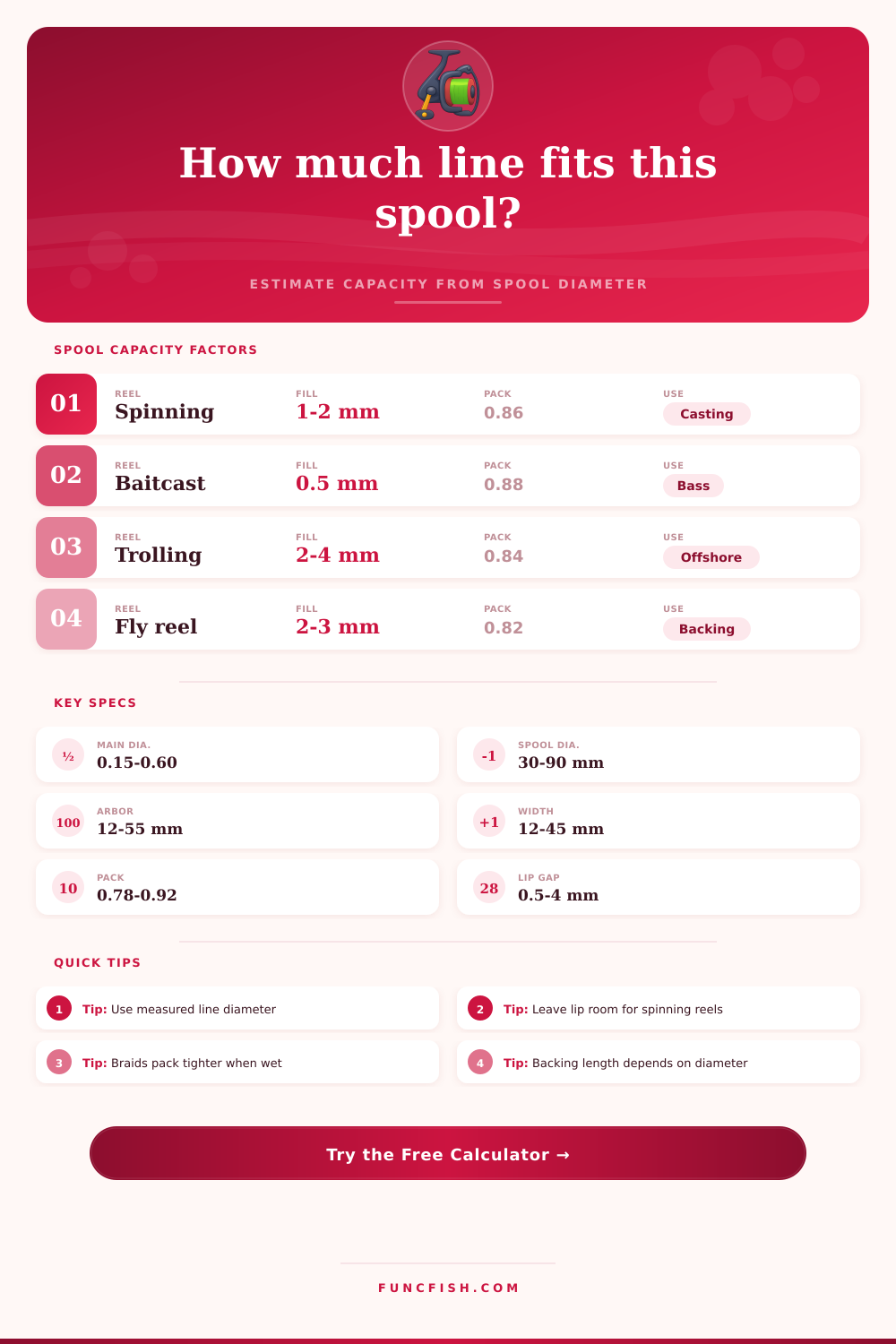
Use 0.78 for loose wraps, 0.86-0.90 for normal fills, and up to 0.92 for tight wet braid.
Spool capacity estimate
Full breakdown
📋Line material data grid
Mono
Fluoro
8x Braid
Dacron
📐Spool fill reference tables
| Reel style | Typical lip clearance | Packing factor | Capacity note |
|---|---|---|---|
| Spinning shallow spool | 0.04-0.08 in / 1-2 mm | 0.84-0.88 | Leave lip space to reduce loops |
| Low-profile baitcaster | 0.02-0.04 in / 0.5-1 mm | 0.86-0.90 | Levelwind helps line stack evenly |
| Conventional reel | 0.06-0.12 in / 1.5-3 mm | 0.82-0.88 | Thumb leveling changes capacity |
| Trolling reel | 0.08-0.16 in / 2-4 mm | 0.80-0.86 | Large spools need more margin |
| Large arbor fly reel | 0.08-0.12 in / 2-3 mm | 0.80-0.84 | Fly line consumes outside volume |
| Main line | Common diameter | Useful capacity effect | Best capacity use |
|---|---|---|---|
| 6 lb mono | 0.009 in / 0.23 mm | Baseline small reel fill | Trout and panfish spinning |
| 10 lb braid | 0.006 in / 0.15 mm | About 2.3x mono length | Finesse braid with leader |
| 12 lb fluorocarbon | 0.011 in / 0.28 mm | Lower length than mono | Baitcaster main line |
| 30 lb braid | 0.011 in / 0.28 mm | Strong line in mono volume | Inshore, pike, and cover |
| Lead core | 0.028 in / 0.71 mm | Very short length per layer | Trolling depth control |
| Scenario | Target capacity | Backing strategy | Fill check |
|---|---|---|---|
| Bass spinning braid | 90-150 yd / 82-137 m | Mono backing saves braid volume | Stop 1-2 mm below lip |
| Surf spinning | 250-350 yd / 229-320 m | Thin braid plus shock leader | Conservative lip margin |
| Offshore trolling | 300-600 yd / 274-549 m | Braid backing under mono top-shot | Leave space for levelwind |
| Fly reel backing | 75-250 yd / 69-229 m | Dacron or gel-spun backing | Account for fly line bulk |
| Catfish mono | 120-220 yd / 110-201 m | Usually minimal backing | Avoid overfilled coils |
💡Practical checks
Tip: If the line maker lists a diameter, use that number instead of pound test. Capacity scales with the square of line diameter, so tiny diameter changes matter.
Tip: For backing plus top-shot fills, measure the arbor and flange after any tape or backing knot is installed. A bigger arbor reduces the available volume quickly.
Fishing line capacity refers to the amount of fishing line that can fit on a fishing reel’s spool. Fishing line capacity are essential as it determines if a specific fishing line is sufficient for a fishing trip. The manufacturers set the line capacity, but its possible to find instances where the capacity is too low or too high for specific fishing scenarios.
For instance, if the fishing line capacity is too low, the line will run out during the fishing trip. If the fishing line capacity is too high, the fishing line will jump off the fishing reel while fishing. As such, people often guess the fishing line capacity for the reel.
Things That Change Fishing Line Capacity
However, guessing at the capacity will not yield accurate results as there is several variable that directly impact the fishing line’s capacity. One of the variables that determine the fishing line’s capacity is the shape of the spool. The spool often features an arbor in the middle of the spool.
The arbor features the same amount of space as the fishing line. Additionally, the size of the arbor impact the fishing line’s capacity. The larger the arbor, the less space the fishing line will have on the spool.
Another factor that impacts the fishing line capacity is the line’s diameter. If the fishing line feature a larger diameter, there will be less room for the fishing line on the spool. For instance, braided fishing lines has a smaller diameter than monofilament lines, hence taking up less space on the fishing reel.
The packing factor for the fishing line impacts the line’s capacity. If a fisherman packs the fishing line with a tight tension, the fishing line’s capacity will be higher. If the tension is lower, the fishing line will have a lower capacity.
Additionally, the moisture content in the fishing line will also affect the packing factor for the fishing line. The lip clearance for the fishing reel is the gap between the fishing line and the lip of the fishing reel. Fishing reels require lip clearance to ensure that the fishing line does not jump off the reel while fishing.
Spinning reels requires lip clearance to allow the fishing line to jump off the reel during a cast. Baitcasters feature a levelwind system that organize the fishing line on the spool, hence offering less lip clearance than spinning reels. If the line is filled to the lip of the spinning reel, the fishing line may get entangled when fishing.
Therefore, people must leave a margin of lip clearance for the fishing line. An additional material that can be filled on the fishing reel’s spool is backing. Backing can increase the capacity of the fishing line or raise the arbor.
Some people use backing lines that are less expensive than the main fishing line to save money on the main line. Backing lines will take up the space on the spool but increase the starting diameter of the fishing line on the reel. The material of the fishing line impacts the line’s capacity.
Monofilament lines will feature air gaps between the line because they stretch. Fluorocarbon lines will also create air gaps but have a stiffer material. Eight-carrier braided lines are smoother than four-carrier lines hence take up less space on the spool.
The temperature and humidity of the fishing line impact the line’s capacity. Cold lines are stiffer hence take up less space on the fishing reel. The fishing line will loosen up in the hot sun hence creating a larger diameter for the line.
A fishing line capacity calculator can estimate the line capacity for a given fishing reel. The calculator will require the diameter of the arbor on the reel, the width of the spool, and the diameter of the fishing line. Based off the given information, the calculator will provide information on the amount of backing lines required and the amount of main fishing line that will fit on the fishing reel.
Using the calculator will help people avoid mistakes when adding line on the fishing reel. For most people, fishing line capacity is a fixed number. However, the line’s diameter and packing tension will change depending on the fishing trip’s environment and line material.