🐟 Bass Lifespan Calculator
Estimate your bass's age, growth stage, and remaining lifespan based on length, weight, and species
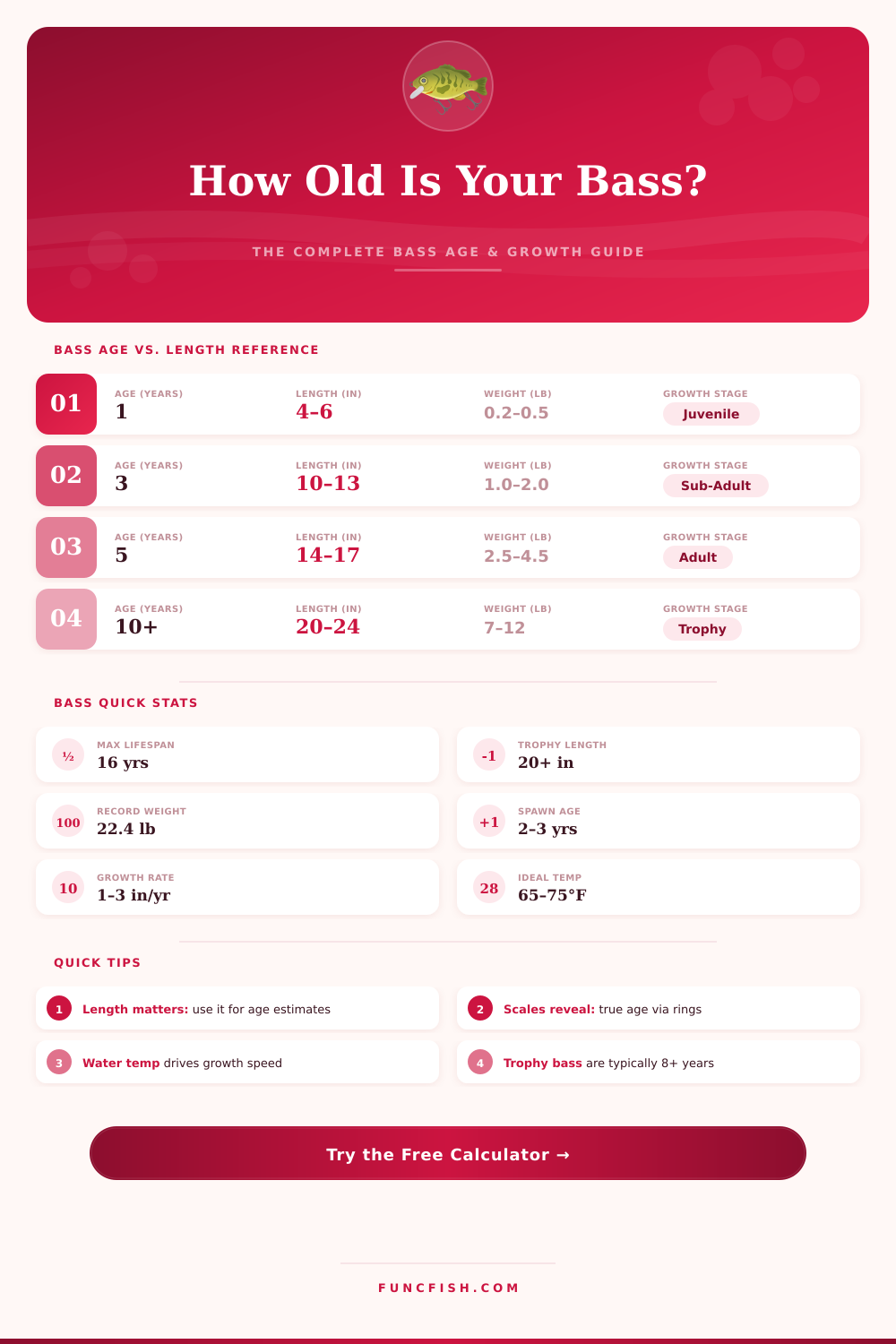
| Age (Years) | Length (in) | Length (cm) | Weight (lb) | Weight (kg) | Growth Stage |
|---|---|---|---|---|---|
| 1 | 4–6 | 10–15 | 0.1–0.4 | 0.05–0.18 | Juvenile |
| 2 | 7–10 | 18–25 | 0.5–1.0 | 0.23–0.45 | Sub-juvenile |
| 3 | 10–13 | 25–33 | 1.0–2.0 | 0.45–0.91 | Sub-adult |
| 4 | 13–15 | 33–38 | 2.0–3.0 | 0.91–1.36 | Young Adult |
| 5 | 14–17 | 36–43 | 2.5–4.5 | 1.13–2.04 | Adult |
| 6 | 16–18 | 41–46 | 3.5–5.5 | 1.59–2.49 | Mature Adult |
| 8 | 18–20 | 46–51 | 5.0–7.5 | 2.27–3.40 | Large Adult |
| 10+ | 20–24 | 51–61 | 7–12 | 3.18–5.44 | Trophy |
| Species | Avg Lifespan | Max Lifespan | Max Length | Max Weight | Growth Rate |
|---|---|---|---|---|---|
| Largemouth Bass | 10–12 yrs | 16 yrs | 25 in (64 cm) | 22.4 lb (10.1 kg) | Moderate–Fast |
| Smallmouth Bass | 6–10 yrs | 18 yrs | 22 in (56 cm) | 11.9 lb (5.4 kg) | Moderate |
| Spotted Bass | 5–8 yrs | 12 yrs | 20 in (51 cm) | 10.4 lb (4.7 kg) | Moderate |
| Florida Strain LMB | 12–14 yrs | 20+ yrs | 28 in (71 cm) | 22+ lb (10+ kg) | Fast |
| Size Class | Length | Est. Age | Line Weight | Rod Power | Hook Size |
|---|---|---|---|---|---|
| Juvenile | <8 in (<20 cm) | 1–2 yrs | 4–6 lb (2–3 kg) | Ultralight | #4–#6 |
| Sub-adult | 8–12 in (20–30 cm) | 2–3 yrs | 6–10 lb (3–5 kg) | Light | #2–#4 |
| Adult | 12–16 in (30–41 cm) | 3–6 yrs | 10–15 lb (5–7 kg) | Medium | 1/0–3/0 |
| Large Adult | 16–20 in (41–51 cm) | 6–10 yrs | 14–20 lb (6–9 kg) | Med-Heavy | 3/0–5/0 |
| Trophy | 20+ in (51+ cm) | 10+ yrs | 17–25 lb (8–11 kg) | Heavy | 4/0–7/0 |
The lifespan of a bass fish are the result of several different factors that can impact the species. These factor include the species of the bass fish, the quality of a water in which the bass lives, and the amount of food that is available to the bass fish. Through observation of different species of bass fish, it is evident that each species have a different lifespan as an adult fish.
Additionally, those species has different life cycles and can tolerate different level of stress relative to other species of bass fish. For instance, largemouth bass can live between 8 and 16 years in habitats where the conditions is good for largemouth bass populations, and tend to reach lengths of 20 inches or more as adult fish. Smallmouth bass can live for approximately 14 year and reach lengths of 18 to 22 inches.
What Affects Bass Lifespan
Striped bass can live for up to 20 years, as they live in deep water habitats that contain high level of oxygen. Lastly, peacock bass fish has a shorter lifespan of 12 years and live in warm, tropical waters where the water conditions are generaly better for the survival of the species. The species of the bass is one of the major factors that impact the lifespan of a bass fish.
Beyond the species itself, water quality is another of the most important factor. Water quality impacts the lifespan of the fish in relation to the temperature of the water and the dissolved oxygen that is present within the water habitat. Water temperatures of around 70 degrees Fahrenheit allow the bass fish to metabolize their food efficient without overexhausting the fish.
However, at water temperatures of the 80s, bass fish require more oxygen from the water to perform efficient, but there is less available for the bass fish to breathe. Additionally, water with less than 5 milligrams of dissolved oxygen per liter of water can prove lethal to bass fish if maintained for long periods of time; the cells of the bass fish starves in these habitats. Finally, the amount of space in which the bass live can impact its lifespan; without enough space to establish their own territories, bass fish begin to fight with other bass in their habitat, which erode their vitality.
Habitat pressure and the availability of food for the bass fish also has an impact upon the lifespan of that species. Bass fish that human beings handle to frequent will experience spikes in the stress hormone cortisol, leading to the damage of their protective scales, which can wear at the bass fish over time. Additionally, the availability of food in the habitat of the bass impacts their lifespan; with food available in their habitat, bass can store fat for the winter month.
Without food available at regular intervals in the habitat, the bass expend more energy in searching for food then they could if food was regularly available. This energy debt ages the bass fish from the inside. These factors are not separate from one another, but instead, impact the lifespan of a bass as a connected group of factors.
Bass fish tend to exhibit certain growth patterns that allow for the estimation of the age of the fish. For instance, young bass grow quickly, but as they age, their growth rate slow. If the length of the bass in an environment is less than expected from the species growth curve, those bass may be under stress; stress can reduce the lifespan of the bass.
Additionally, female bass tend to grow heavier than male bass, but both sexes exhibit the health of the fish in how well they grow. Through observation of each of these factors, a person can successfully make forecasts as to how many years a bass have left to live. A person can make such forecasts by considering the age of the bass and the total lifespan of that species.
However, no prediction of the lifespan of a bass is certain; other factors, like predators, habitat destruction, and pollution could impact the lifespan of that individual fish. By managing the oxygen in the water in which a bass lives and reducing the impact of habitat pressure on that environment, however, a person can extend the lifespan of that species.