🐟 Betta Fish Age Calculator
Estimate your betta's age, life stage, and health benchmarks with real betta biology data
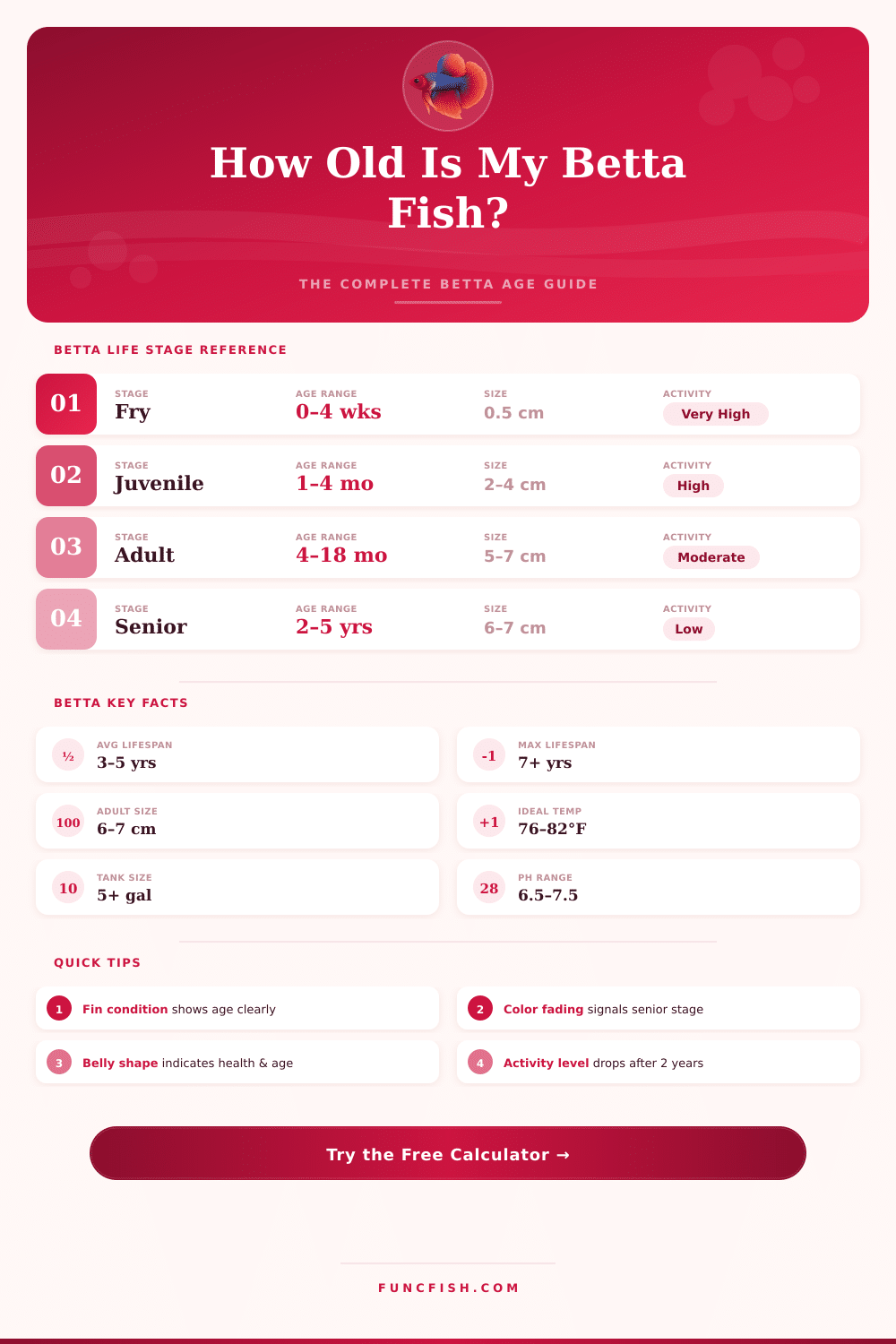
| Life Stage | Age Range | Length (in / cm) | Weight (oz / g) | Key Traits |
|---|---|---|---|---|
| Fry | 0 – 4 weeks | 0.2–0.4" / 0.5–1 cm | <0.01 oz / <0.3 g | Transparent, no fins visible yet |
| Early Juvenile | 1 – 2 months | 0.5–1" / 1.3–2.5 cm | 0.01–0.05 oz / 0.3–1.5 g | Color starts emerging, fins forming |
| Late Juvenile | 2 – 4 months | 1–2" / 2.5–5 cm | 0.05–0.12 oz / 1.5–3.5 g | Sex distinguishable, colors vivid |
| Sub-Adult | 4 – 8 months | 2–2.75" / 5–7 cm | 0.12–0.22 oz / 3.5–6.5 g | Rapid growth, high energy, territorial |
| Prime Adult | 8 – 24 months | 2.5–3" / 6.4–7.6 cm | 0.18–0.28 oz / 5–8 g | Peak color, full fins, most active |
| Mature Adult | 2 – 3 years | 2.5–3" / 6.4–7.6 cm | 0.18–0.28 oz / 5–8 g | Slightly reduced activity, stable color |
| Senior | 3 – 5 years | 2.5–3" / 6.4–7.6 cm | 0.14–0.24 oz / 4–7 g | Fading color, slower movement, less eating |
| Elder | 5+ years | 2.2–2.75" / 5.5–7 cm | 0.1–0.2 oz / 3–6 g | Very slow, pale, minimal fin display |
| Body Length (in) | Body Length (cm) | Estimated Age | Estimated Weight (g) | Typical Life Stage |
|---|---|---|---|---|
| 0.2 – 0.4" | 0.5 – 1 cm | 0–4 weeks | <0.3 g | Fry |
| 0.5 – 0.8" | 1.3 – 2 cm | 1–1.5 months | 0.3–0.8 g | Early Juvenile |
| 0.8 – 1.2" | 2 – 3 cm | 1.5–2.5 months | 0.8–2 g | Juvenile |
| 1.2 – 1.8" | 3 – 4.5 cm | 2.5–4 months | 2–3.5 g | Late Juvenile |
| 1.8 – 2.3" | 4.5 – 5.8 cm | 4–6 months | 3.5–5 g | Sub-Adult |
| 2.3 – 2.75" | 5.8 – 7 cm | 6–18 months | 5–8 g | Prime Adult |
| 2.75 – 3" | 7 – 7.6 cm | 12–36 months | 6–9 g | Adult / Mature |
| 2.5–3" (shrinking) | 6.4–7.6 cm | 36+ months | 4–7 g | Senior / Elder |
| Variety / Type | Max Body Length | Max Length (cm) | Typical Lifespan | Notes |
|---|---|---|---|---|
| Veiltail | 2.5–3" | 6.4–7.6 cm | 3–5 yrs | Most common, robust |
| Halfmoon | 2.5–3" | 6.4–7.6 cm | 2.5–4 yrs | Large fins = shorter lifespan |
| Crowntail | 2.5–3" | 6.4–7.6 cm | 2–4 yrs | Spiked fins, more fin rot risk |
| Plakat | 2.5–3.5" | 6.4–9 cm | 3–6 yrs | Short fins, most vigorous |
| Double Tail | 2–2.5" | 5–6.4 cm | 2–3.5 yrs | Genetic variation, shorter body |
| Giant Betta | 4–5" | 10–12.7 cm | 3–5 yrs | Selectively bred for size |
| Wild Type (B. splendens) | 2–2.5" | 5–6.4 cm | 2–4 yrs | Less colorful, more resilient |
Betta fish normally live between two and four years. Although, if one cares really well about them some can reach even five to seven years. I hear that some rare betta fish reached ten years, but none has firm proof for those maximum ages.
Because the age of betta fish no one officially follows or tracks, there are no confirmed records for the oldest one.
How Long Do Betta Fish Live?
When one buys betta fish from a store for pets, it usually already has six to nine months. One commonly hears that the so called babies in stores are only around four months old. Sometimes the females sell younger than the males.
That shows that the time passed with the fish home forms only part of its whole lifetime. Fish bought from a store, that after two years still lives home, probably already reaches close to three years in total age.
Genetics play also an important part. Fish badly bred simply do not reach long life. Betta fish from good breeders can sometimes manage to live seven to nine years, if one cares well.
On the other hand, those from worse sources commonly limit to around eighteen months. Some copies last only some months, no matter the care.
It is quite hard to estimate the age of betta fish. One way is to observe the size. Adult betta fish most commonly measure around three inches long and own long flowing fins.
Younger ones will be more small and with more short fins. Curling fins can point to old age, but bad quality of water causes that also. Silver scales sometimes show on old fishes, even so they can mean also stress or disease, so alone that does not work as a reliable mark.
Signs of old age tend to become weaker and less active. Some older betta fish hardly swim upward to take air. Also bloating can appear.
Four years one considers already old age for betta fish. Hear the main task is simply to ensure the fish the best life quality that is possible.
Cold water apparently slows the metabolism of betta fish, which could help them age a bit more slowly. Surprisingly, many of the most long-lived betta fish passed part of their life in less warm places. Even so that does not mean that one should keep betta fish in cold water.
Bad water quality with ammonia can kill fish and hurt its health, which leads to diseases like finrot.
Betta fish that reach three years and yet swim well with clear eyes without tumors can seem like healthymiddle-aged fish. Not every young death happens because of bad care. Sometimes the genetics or the history of breeding simply works against them.