🐟 Bluefin Tuna Weight Calculator
Estimate bluefin tuna weight from length & girth measurements using industry-standard formulas
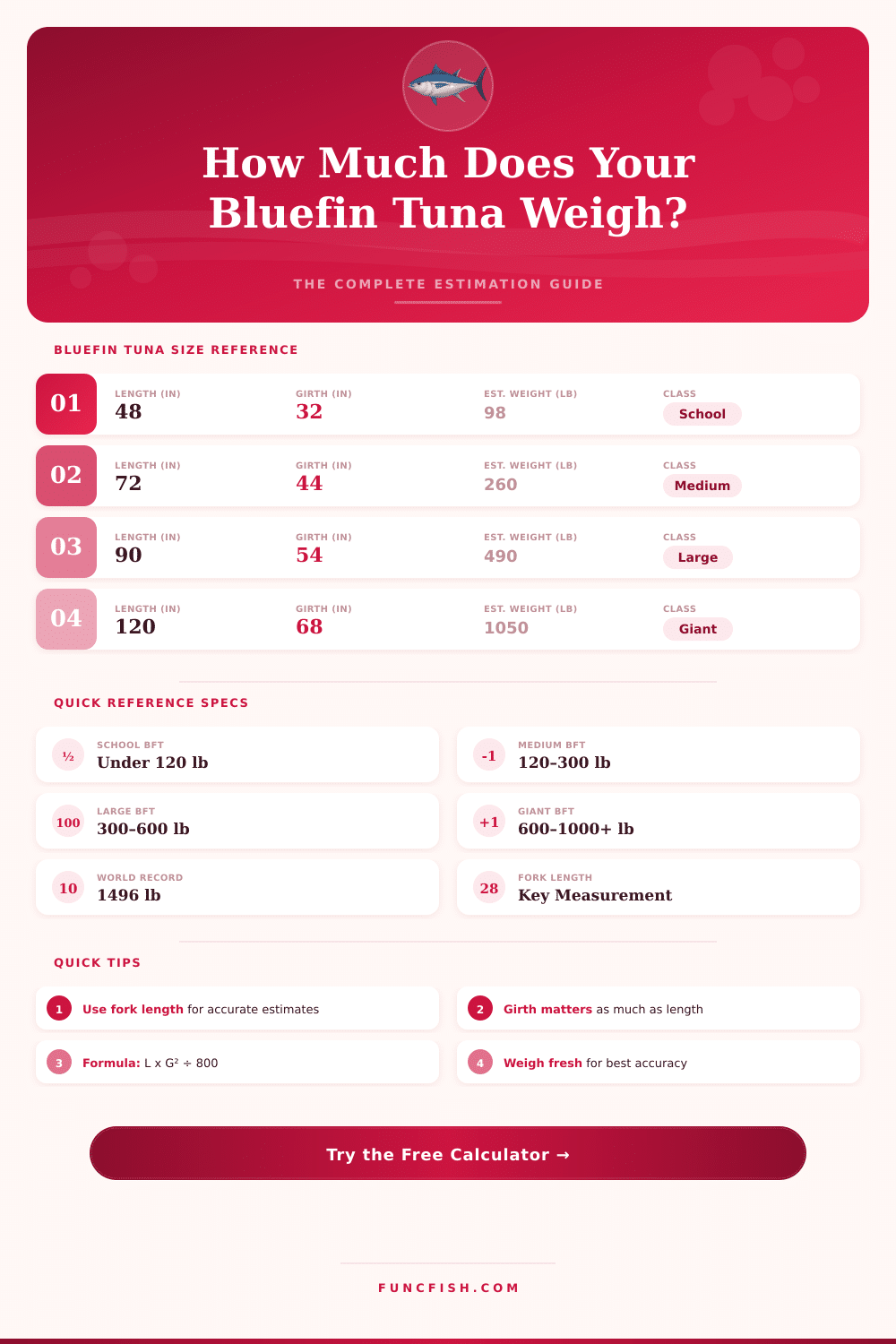
| Fork Length | Typical Girth | Est. Weight (lb) | Est. Weight (kg) | Size Class |
|---|---|---|---|---|
| 36 in / 91 cm | 22 in / 56 cm | ~28 lb | ~13 kg | School |
| 42 in / 107 cm | 26 in / 66 cm | ~46 lb | ~21 kg | School |
| 48 in / 122 cm | 30 in / 76 cm | ~68 lb | ~31 kg | School |
| 54 in / 137 cm | 34 in / 86 cm | ~98 lb | ~44 kg | Medium |
| 60 in / 152 cm | 38 in / 97 cm | ~136 lb | ~62 kg | Medium |
| 66 in / 168 cm | 42 in / 107 cm | ~185 lb | ~84 kg | Medium |
| 72 in / 183 cm | 46 in / 117 cm | ~242 lb | ~110 kg | Medium |
| 78 in / 198 cm | 50 in / 127 cm | ~309 lb | ~140 kg | Large |
| 84 in / 213 cm | 54 in / 137 cm | ~386 lb | ~175 kg | Large |
| 90 in / 229 cm | 58 in / 147 cm | ~476 lb | ~216 kg | Large |
| 96 in / 244 cm | 62 in / 157 cm | ~576 lb | ~261 kg | Giant |
| 108 in / 274 cm | 68 in / 173 cm | ~784 lb | ~356 kg | Giant |
| 120 in / 305 cm | 76 in / 193 cm | ~1083 lb | ~491 kg | Giant |
| Size Class | Rod Power | Reel Size | Line Strength | Leader |
|---|---|---|---|---|
| School (<73 lb) | Medium Heavy | 4500–6000 | 30–50 lb | 60–80 lb mono |
| Medium (73–300 lb) | Heavy | 6000–10000 | 50–80 lb | 100–150 lb mono |
| Large (300–600 lb) | Extra Heavy | Wide Spool 50 | 80–130 lb | 200 lb mono |
| Giant (600+ lb) | Stand-Up / Bent Butt | 130 Wide | 130+ lb | 300–400 lb mono |
| Formula Name | Formula | Best Use | Accuracy |
|---|---|---|---|
| NMFS Standard | L x G² / 800 | All BFT (lb) | ±5–10% |
| NMFS Modified | L x G² / 750 | Heavy condition | ±5% |
| Fork Length Adj. | TL x 0.93 = FL | Total → Fork | ±2% |
| Metric Equivalent | (L x G² / 800) / 2.205 | kg output | ±5–10% |
| Curved Fork Adj. | CFL x 0.96 = FL | Curved to straight | ±3% |
The bluefin tuna is a real giant of the sea, a big species from the tuna family that swims freely around. That fish can reach more than 13 feet long and weigh almost 2 000 pounds what passes the weight of many horses. Their speed in the water comes from the torpedo-shaped body.
Across, their bodies form almost ideal round, and that smooth shape helps them slip through the water at high speed. They can reach bursts of more than 40 miles per hour, or around 64 kilometers per hour if one uses metric system.
Big Bluefin Tuna: Size, Speed and Threats
The Atlantic bluefin tuna holds the crown as the biggest of all tuna. At age of 30 years, those giants commonly reach around 3 metres long and pass 600 kilos of weight. Here is where it becomes interesting: the size and mass during maturity changes according to the area.
The western Atlantic group mostly limits to around 13 feet and 2 000 pounds, while the eastern Atlantic relatives can grow to 15 feet. In the Pacific, the case is differnet, adults usually stay around 5 feet long and 130 pounds heavy, although the biggest recorded reached 1 000 pounds.
The record catch was an Atlantic bluefin tuna caught beside Nova Scotia, that weighed 1 496 pounds. After it eight a trolled mackerel, the fisherman needed only 45 minutes to draw it quite close to the boat. Truly surprising is, that the fish after that sat in the ship almost 10 hours, losing water weight during the whole time and still weighing that impressive amount.
The growth of bluefin tuna is quite attractive. Fish long 67 inches one year later can grow to 74 inches and get more than 61 pounds. Most adults reach around 200 pounds before the 10th year.
Younger copies are much less big, many catches weigh between 18 and 30 pounds, although reports about 100-pound fishes appear commonly.
Unlike some other fish species, the bluefin tuna can not be farmed. They stay only wild and caught, what makes them rare and prices attractive. Once a 650-pound bluefin tuna sold for 745 000 dollars at the fish market of Tokyo.
In 2026, a 535-pound copy passed that with a record sale of 3.2 millions of dollars at the Toyosu market. Even a 440-pound Pacific bluefin tuna brought 220 000 dollars in Japan.
The Atlantic bluefin tuna supplies face the most severe challenges, although the North Atlantic groups stand well currently. The Pacific groups stay stable and even improve. Illegal fishing is still a big problem for the Atlantic bluefin tuna, increased by weak watching.
Interestingly, bluefin tuna sometimes work as filter feeders, eating tiny creatures and little things. One even saw them eat kelp. During centuries, the Atlanticbluefin tuna was carefully valued as one of the most wanted food fishes.