Bolt Rig Bolt Weight Calculator
Estimate a practical carp bolt rig lead weight from cast distance, rig mechanics, bottom transfer, bait buoyancy, water movement, and target species.
🎯Real Bolt Rig Presets
⚙Calculator Inputs
Bolt Rig Weight Results
Formula Breakdown
🧰Lead Profile Data Grid
Distance Pear
Inline Flat
Grip Lead
Method Frame
🐟Gear and Species Comparison Grid
Common Carp
2.5–3.5 ozBest all-round bolt range for 12–15 lb mono, size 6–8 hooks, and medium lake casts.
Tench
1.5–2.5 ozLower prick requirement; method feeders and light inline leads usually keep bite indication crisp.
Barbel
3–5 ozFlow and rolling stones dominate the weight choice more than hook-prick load.
Catfish
5–8 ozHeavy ledger leads and strong links are used where bait mass and current are both high.
📊Bolt Rig Lead Weight Reference
| Lead Size | Metric Mass | Typical Range | Best Use | Hook-Prick Character |
|---|---|---|---|---|
| 1.5 oz | 43 g | Short margin | Crucian, tench, winter carp | Light but sensitive |
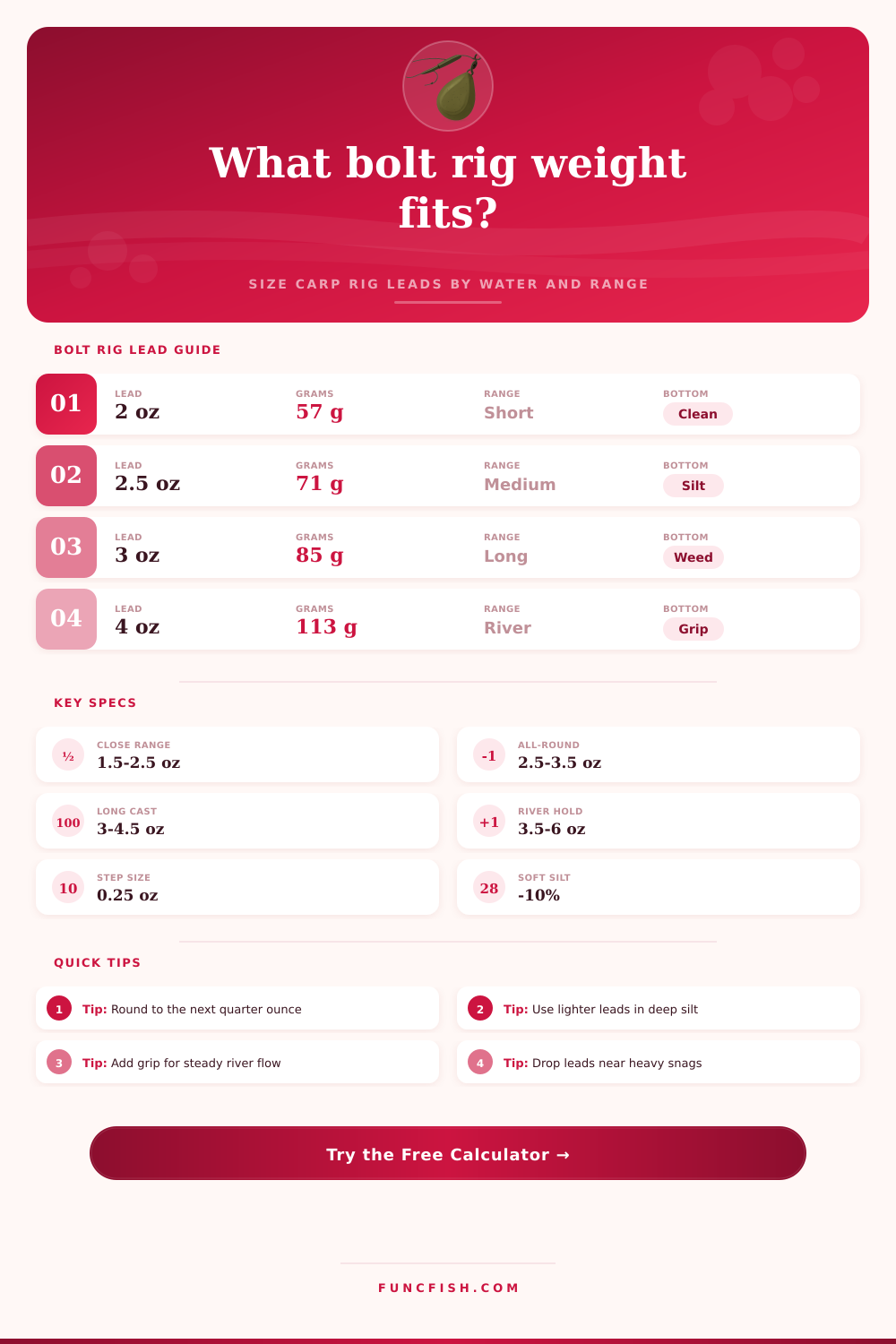
| 2 oz | 57 g | 20–55 yd | Close stillwater and method work | Fine for low-pressure rigs |
| 2.5 oz | 71 g | 40–75 yd | Standard carp lead clip | Strong all-round bolt effect |
| 3 oz | 85 g | 60–95 yd | Inline or helicopter lake rigs | Positive pick-up resistance |
| 3.5 oz | 99 g | 75–115 yd | Range fishing and light tow | Firm hook-point load |
| 4 oz | 113 g | 90–135 yd | Distance leads or river edges | High resistance, check rod rating |
| 5 oz | 142 g | Heavy river | Gripper leads and barbel work | Hold-driven rather than bite-driven |
| 6 oz | 170 g | Strong flow | Catfish or floodwater ledgering | Use only with matching tackle |
🗺Bottom and Water Adjustment Table
| Bed or Water Type | Hook Transfer | Hold Multiplier | Weight Adjustment | Calculation Note |
|---|---|---|---|---|
| Clean gravel | 1.00 | 1.00 | Baseline | Lead beds down cleanly |
| Firm clay | 0.98 | 1.05 | Little change | Slight suction after settling |
| Light silt | 0.88 | 0.92 | Often slightly lighter | Too much mass can bury |
| Deep silt | 0.76 | 0.82 | Use wider profile | Hook load is damped |
| Low weed | 0.82 | 1.14 | Add security | Stem drag reduces movement |
| Heavy weed | 0.70 | 1.30 | Drop lead favored | Lead ejection may matter |
| River stone | 0.95 | 1.45 | Grip lead likely | Rolling force dominates |
| Sand undertow | 0.93 | 1.22 | Flat or gripper lead | Steady tow adds drag |
⚖Rig Style and Lead Profile Ratings
| Rig or Lead | Transfer Factor | Cast Efficiency | Hold Value | Best Match |
|---|---|---|---|---|
| Inline lead | 0.96 | High | Medium | Clean or firm bottoms |
| Lead clip | 0.90 | High | Medium | General carp rigs |
| Drop-off clip | 0.86 | Medium | Medium | Weed and snags |
| Helicopter or chod | 0.84 | Very high | Low | Silt and long range |
| Method feeder | 0.89 | Medium | High loaded | Tench and small carp |
| Running bolt ledger | 0.78 | Medium | Medium | Flow or wary fish |
| Grip lead | 0.88 | Low | Very high | Rivers and tow |
| Backlead-assisted | 0.82 | Medium | Medium | Line concealment rigs |
🧮Species and Tackle Matching Table
| Species | Typical Mainline | Hook Range | Lead Range | Calculator Emphasis |
|---|---|---|---|---|
| Common carp | 12–15 lb mono | Size 8–4 | 2.5–4 oz | Balanced hook-prick and cast |
| Mirror carp | 15–20 lb mono | Size 6–4 | 3–4.5 oz | Secure hook hold |
| Grass carp | 15–20 lb mono | Size 6–2 | 3–4.5 oz | First-run resistance |
| Tench | 8–12 lb mono | Size 12–8 | 1.5–2.5 oz | Delicate indication |
| Barbel | 10–15 lb mono | Size 10–4 | 3–5 oz | Flow and hold reserve |
| Catfish | 30–50 lb braid | Size 2–1 | 5–8 oz | Bait mass and current |
| Crucian carp | 6–8 lb mono | Size 14–10 | 1–2 oz | Lightest reliable bolt |
| Bream | 8–12 lb mono | Size 12–8 | 1.5–2.5 oz | Feeder mass included |
💡Calculation Tips
Lead rounding: When the formula returns an in-between value, choose the next quarter-ounce size for clean casting and a consistent bolt effect. In very deep silt, compare the rounded result with the silt adjustment before increasing mass.
Hold reserve: A high hold reserve is useful in tow or flow, but it is not always better in weed. If the calculator flags a heavy snag setup, match the lead size with a drop-off arrangement.
There are always two requirements when selecting the proper lead size on a bolt rig. You want enough weight to get the bait down far enough to give it some authority during the retrieve but not so much that the carp feels like he’s got an anchor on his nose in the bottom of lake. It’s one of those age old angler conundrums; where our intuition conflicts with laws of physics. So many guys has used too large a lead to assure delivery only to witness curious fish circling the bait and drifting off because the rig appeared unnaturally motionless.
When you break this down to a few simple forces, such as casting load, bottom hold stability and hook prick resistance, the math falls neatly into place. How does the math work out? The calculator above figures all that complicated math for you and spits out a suggested weight based off those opposing needs. You enter your best estimate of distance, what kind of bottom it’s on, the level of current, and the amount of buoyancy you’re giving your bait. Then, it calculates a weight. Then you can understand why it gives you a 3 as opposed to a 2.5 ounce weight.
How to Choose the Right Lead Weight
The heavier lead will help you cast more accurately since it resists wind better and helps keep the momentum going. However, it also require a harder pull from a carp to get your rig moving. Most misses occur on big water swims due to this trade off.
Finally, think about lakebed, always the most overlooked aspect of rig design. Throw almost any sensible weight at clean gravel and you know what to expect; it’ll bed out reliably. Toss that same rig into deep silt, however, and your lead simply dissapears into the soft muck and basically buries your hookbait beneath a blanket of mud. Even a relatively heavy lead will blunt bite indications in such circumstances because the fish isn’t able to sense the subtle change in tension when it raises the bait off the bottom.
This is where the tool comes into play with its transfer factors that reduces perceived hook load based on increasing bottom density. A 3 ounce lead on soft silt doesn’t act like a 3 ounce lead on hard clay (even though they’re the same raw mass) and the tool recognizes that. Static charts don’t always do justice to how current affects things. Fishing a river tow or a lake margin with strong inflow creates lateral pressure against your terminal tackle and mainline. If your line isn’t weighted down enough to offset this pressure, it will ride out of position next to the fish holding in the seam. Grip leads and heavier weights comes into play here.
It’s not all about putting it out there. It’s also about keeping it in place when you get out there. But throwing too much weight without care can create issues too, like snagging on submerged cover or losing the feel for those more delicat bites. Fewer anglers realize how important bait presentation is. A balanced wafter will lift and pull the hookpoint away from the bottom. A sinking pellet lays naturaly and needs less lead stability. If you are trying to get the bait to rise but the lead is trying to sink, then you’ve created an internal tension between the two that carp pick up on immediately.
The difference in buoyancy means the calculator accounts for this so the suggested weight won’t overload the hooklink but still keep the whole rig stable. This avoids that awkward moment when the lead either sinks too far into the ground or floats up a fraction of a millimeter to appear unnatural. All-in-all it’s best thought of as a guide not a rule book.
Water rises and falls. Weather comes and goes. The sun beats down and temperatures changes. Pressure builds, and the mood of the fish alters too. For instance, a result might say a 2 ounce lead will be just right. You could have a perfect afternoon with calm conditions where this works great, but then a wind storm could come along. This would make the surface chop and change the current flow.
What you want to do is start with the calculated weight then make adjustments from there depending on what you witness as you watch it go to the bottom. Does the bait land as intended? How does the lead sit? Does the bait remain presented well once the weight settles? Do small increments or do big jumps work better for you? Make small changes instead of large leaps.
The formula is about finding the sweet spot. It is not necessarily about one number, but rather about understanding how much weight is needed to get the right movement and keep the fish confident. Math first, eyes to fine tune the rest. You should of used the tool more often.