🐟 Catfish Stocking Density Calculator
Calculate the ideal number of catfish for your pond, tank, or aquaculture system
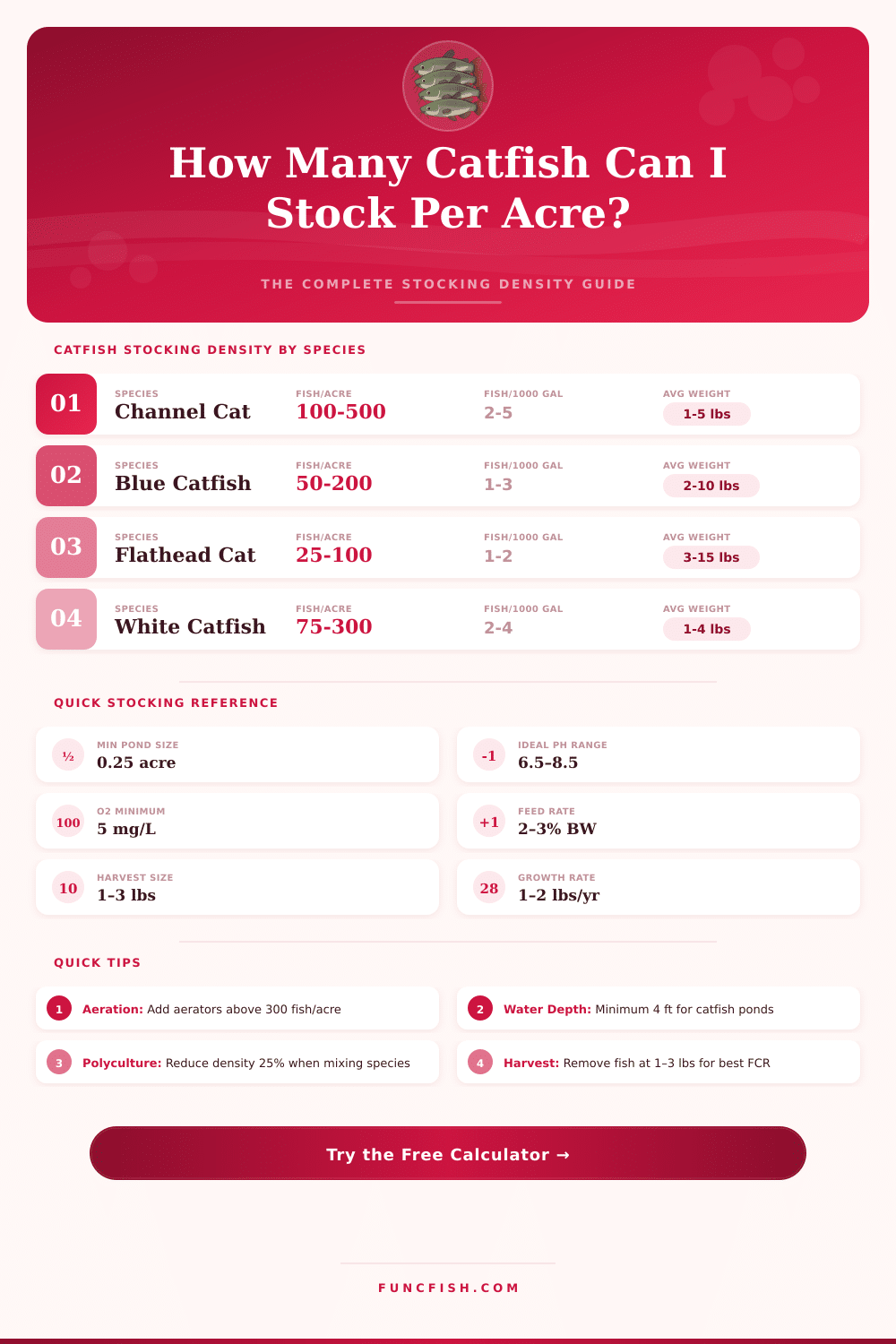
| Species | Fish / Acre (Rec.) | Fish / 1,000 gal | Max Biomass (lbs/acre) | Avg Harvest Wt |
|---|---|---|---|---|
| Channel Catfish | 100–500 | 2–5 | 1,500–3,000 | 1–3 lbs |
| Blue Catfish | 50–200 | 1–3 | 1,000–2,500 | 2–10 lbs |
| Flathead Catfish | 25–100 | 1–2 | 500–1,500 | 3–15 lbs |
| White Catfish | 75–300 | 2–4 | 800–2,000 | 1–4 lbs |
| Bullhead Catfish | 100–400 | 2–5 | 600–1,500 | 0.5–2 lbs |
| Wels Catfish | 30–120 | 1–2 | 1,200–3,000 | 5–30 lbs |
| Aeration Level | Max Fish / Acre | Max Biomass (lbs/acre) | O2 Produced (lbs/hr/hp) | Notes |
|---|---|---|---|---|
| No Aeration | Up to 300 | Up to 800 | — | Natural O2 only; dawn stress risk |
| Moderate (0.5–1 hp/acre) | Up to 600 | Up to 2,000 | 1.5–2.0 | Paddlewheel or diffuser aeration |
| High (>1 hp/acre) | Up to 1,500 | Up to 5,000 | 2.0–3.5 | Commercial intensity; daily monitoring req. |
| Recirculating (RAS) | N/A | Up to 40,000 | Continuous | Per tank volume; intensive management |
| Co-Stocked Species | Ratio (Catfish:Other) | Catfish Density Reduction | Benefit |
|---|---|---|---|
| Largemouth Bass | 10:1 | −15–20% | Predator control of stunted fish |
| Bluegill / Sunfish | 5:1 | −10–15% | Forage base; insect control |
| Grass Carp | 20:1 | −5% | Aquatic vegetation control |
| Tilapia | 3:1 | −20–25% | Algae control; nutrient cycling |
Stocking density simply shows how many catfish stay in a particular pond or tank. For catfish farmers, choosing the best number to stock in a pond helps reach maximum yield. Mistakes here can injure the fish and the profits.
Because density directly affects the growth of fish, it decides production and profitability.
How Many Catfish to Keep in Ponds and Tanks
Both too high and too low density harmed the welfare of African catfish from 10 to 100 grams. Interestingly, at weight of 100 to 300 grams the welfare improved as density grew. Like this the best density adjusts according to the size of fish.
Final densities of around 100 to 500 kg per cubic meter did not affect growth or welfare of African catfish in a certain size range, which shows that this species lasts well in quite full conditinos.
Fry of African catfish, weighing around 0.1 gram, can be kept in high stocking densities of 30 fry per liter or 30,000 per cubic meter, in average breeding containers. Efficient grading every 5 days helps to lower total losses. Larvae of catfish are optimal at 100 per square meter.
After 5 weeks you can expect around 35 to 40 fingerlings per square meter.
Before stocking fingerlings require acclimation. Stock them at 5 to 20 pieces per square meter. Feed the catfish twice a day with 5% of the whole biomass during the first month, later reduce by 0.5% monthly until the fifth month of farming.
A static pond system fits 1.8 kg of fish per square meter. So 2000 square meters of static water bear 3600 kg. Concrete ponds work for high density farming because of controlled surroundings, with advised density of 70 to 80 kg per cubic meter.
In pond systems you advocate stocking a maximum of 10 fingerlings per square meter, with regular thinning to keep maximum crop of 40,000 kg per hectare with daily water exchange.
Expert farmers in earthen pond systems succeeded stocking 100 fishes per cubic meter without negative impacts. For little businesses, 40 fishes in a 55-gallon barrel forms one practical method with advised maximum density. General rule says: plan one pound of fish for every 8 to 10 gallons of water.
In aquaponic systems low stocking densities surpassed those at 300 and 450 fishes per cubic meter. Density of 500 fishes per cubic meter gave the best products, with growth of around 4.28% per day, survival of about 86% and feed conversion of 0.95. Studies tested four common densities: 10, 15, 20 and 25 fishes per square meter, with a diet of 36% protein for 120days.