
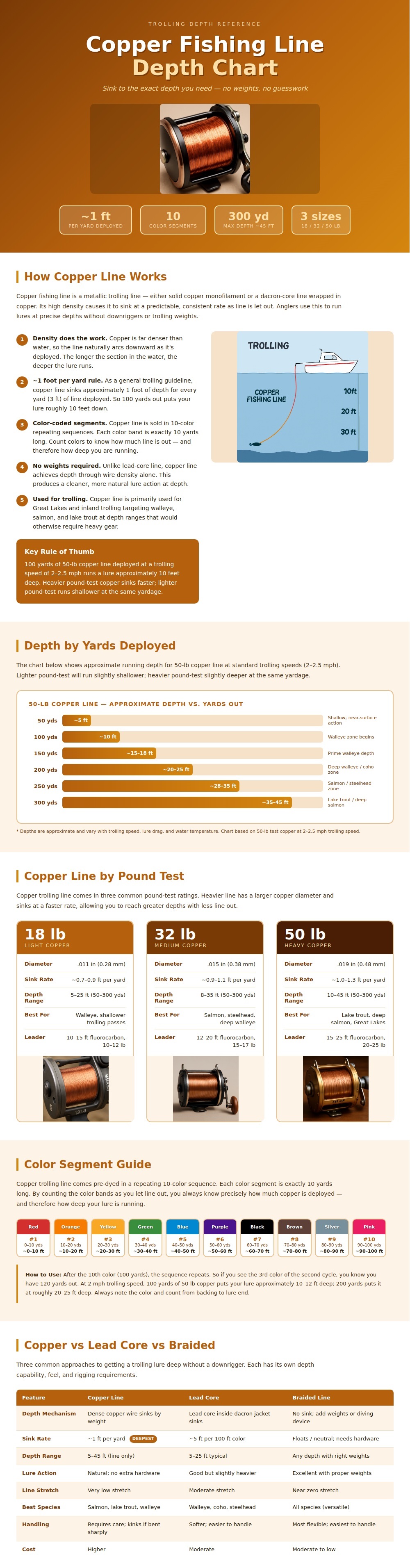
Copper fishing line is an tool that anglers use to control the depth of the lure while trolling. Copper fishing line is denser than water and copper fishing line is denser than monofilament fishing line. Because copper fishing line is so dense when compare with water, copper fishing line sinks in an arc when the angler deploys the copper fishing line into the water.
The density of copper fishing line allow it to reach specific depths in the water. Many anglers uses copper fishing line when fishing in large body of water as copper fishing line allow them to set their lures to the depth where the fish are located. To calculate the depth of copper fishing line, anglers can use a standard measurement rule.
How to Use Copper Fishing Line
When an angler deploys one hundred yards of copper fishing line at a trolling speed of a standard speed, the copper fishing line will reach a depth of ten feet. When the boat deploys at a faster speed, the depth that the copper fishing line can reach will be shallower. However, when the boat speed is reduced to below two miles per hour, the depth that the copper fishing line can reach will be deeper into the water.
The temperature of the water will also affect the copper fishing line for deeper water as copper fishing line will sink more effective in colder water. An angler can use color coded tape on their fishing rod to monitor how much copper fishing line is in the water. The color-coded tape will allow the angler to visually determine how many yards of copper fishing line are in the water without having to do mental math to calculate this measurement.
The weight of copper fishing line, also known as the pound test, will also affect its performance. Anglers can use eighteen-pound copper fishing line for shallow water as this pound test is thinner and will be more nimble in movement. However, using a thirty-two-pound or a fifty-pound copper fishing line is better for deep water as the thicker copper fishing line will sink more quick.
However, the angler should use care when employing heavy copper fishing line as it can kink when moved too much. Always attach a fluorocarbon leader to the copper fishing line. This leader should be between ten and twenty-five feet long.
The fluorocarbon leader will be lighter than the copper fishing line and allow the angler’s lure to remain invisible to the fish in the water. If fluorocarbon leader is not use, the fish may bite on the copper fishing line and snap it. To create a trolling spread with copper fishing line, use multiple rod with different lengths of copper fishing line.
For instance, use one rod with fifty yards of copper fishing line to target fish that live in shallow water, and use another rod with two hundred yards of copper fishing line to target fish that live in deep water. Copper fishing line has low stretch, which allow anglers to feel the strike of fish on the line with their hand. In contrast, lead core fishing line sinks, but has more stretch than copper fishing line; therefore, the strike of fish on the line will feel duller to the angler with lead core line.
It is important to avoid bending copper fishing line sharply around the corner of a boat; this can lead to copper fishing line tangling around the boats structures. Use sonar to identify the depth where specific fish species are located. For instance, walleye stay between fifteen and twenty-five feet deep.
Therefore, copper fishing line should be deployed to these depth. Coho salmon live at depths of thirty feet deep. King salmon live at depths of forty feet deep.
Lake trout live near the bottom of the lake; hence, a full spool of copper fishing line should be deployed to catch lake trout using copper fishing line. To troll with copper fishing line, use braided fishing line to attach to a copper fishing line using a spool. Add a leader swivel to the copper fishing line and add the fishing lure to the end of the leader swivel.
This type of rigging allow for repeatability of the fishing line setup for future use. The amount of copper fishing line that can be use on the main fishing line can be adjusted based off the weather conditions or the movement of the fish. If the wind increases in strength, the angler should shorten the amount of copper fishing line that is attached to the main fishing line.
If the fish move to deeper water, the angler should increase the amount of copper fishing line that is attached to the main fishing line.