🎣 Downrigger Blowback Angle Calculator
Calculate your true trolling depth accounting for cable blowback angle at any speed and weight
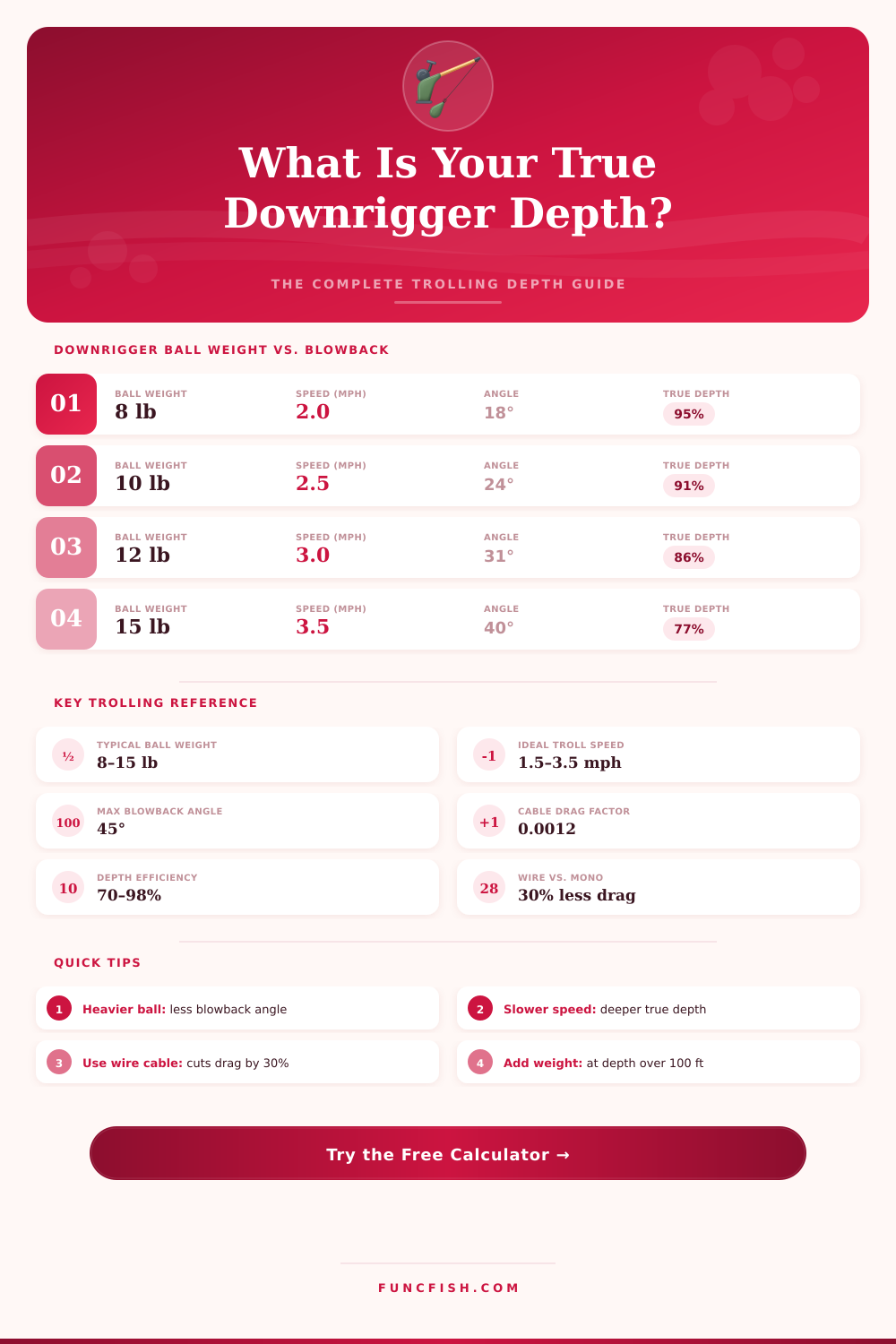
| Ball Weight (lb / kg) | Speed 1.5 mph (2.4 km/h) | Speed 2.5 mph (4.0 km/h) | Speed 3.5 mph (5.6 km/h) | Depth Efficiency |
|---|---|---|---|---|
| 6 lb / 2.7 kg | 12° | 28° | 46° | 88% / 74% / 55% |
| 8 lb / 3.6 kg | 9° | 22° | 38° | 90% / 80% / 65% |
| 10 lb / 4.5 kg | 7° | 18° | 31° | 92% / 85% / 73% |
| 12 lb / 5.4 kg | 6° | 15° | 26° | 94% / 88% / 78% |
| 15 lb / 6.8 kg | 5° | 12° | 20° | 96% / 91% / 84% |
| 20 lb / 9.1 kg | 4° | 9° | 15° | 97% / 94% / 89% |
| Species | Typical Depth Range | Ideal Troll Speed | Rec. Ball Weight |
|---|---|---|---|
| Chinook Salmon | 60–120 ft (18–37 m) | 2.0–3.0 mph (3.2–4.8 km/h) | 10–15 lb (4.5–6.8 kg) |
| Coho Salmon | 30–80 ft (9–24 m) | 2.5–3.5 mph (4.0–5.6 km/h) | 8–12 lb (3.6–5.4 kg) |
| Lake Trout | 80–200 ft (24–61 m) | 1.5–2.5 mph (2.4–4.0 km/h) | 12–20 lb (5.4–9.1 kg) |
| Walleye | 15–50 ft (5–15 m) | 1.5–2.5 mph (2.4–4.0 km/h) | 6–10 lb (2.7–4.5 kg) |
| Kokanee | 20–60 ft (6–18 m) | 1.5–2.0 mph (2.4–3.2 km/h) | 6–8 lb (2.7–3.6 kg) |
| Striped Bass | 25–70 ft (8–21 m) | 2.5–4.0 mph (4.0–6.4 km/h) | 8–12 lb (3.6–5.4 kg) |
| Brown Trout | 10–30 ft (3–9 m) | 2.0–3.0 mph (3.2–4.8 km/h) | 6–8 lb (2.7–3.6 kg) |
| Muskellunge | 20–60 ft (6–18 m) | 3.0–5.0 mph (4.8–8.0 km/h) | 10–15 lb (4.5–6.8 kg) |
| Cable Out (ft / m) | Blowback Angle | True Depth (ft / m) | Depth Efficiency |
|---|---|---|---|
| 25 ft / 7.6 m | 18° | 23.8 ft / 7.2 m | 95% |
| 50 ft / 15.2 m | 20° | 47.0 ft / 14.3 m | 94% |
| 75 ft / 22.9 m | 22° | 69.5 ft / 21.2 m | 93% |
| 100 ft / 30.5 m | 24° | 91.4 ft / 27.9 m | 91% |
| 150 ft / 45.7 m | 28° | 132.5 ft / 40.4 m | 88% |
| 200 ft / 61.0 m | 33° | 167.7 ft / 51.1 m | 84% |
Blowback angle is an angle at which the downrigger cable leans away from vertical due to water resistance. As the boat trolled, the boat’s movement created drag against the downrigger ball. This drag created a force that caused the downrigger cable to lean in the opposite direction.
This lean of the downrigger cable is referred to as blowback angle. Blowback angle is critical to understanding how deep the downrigger ball actualy is in the water. Blowback angle can change the depth of the ball.
What is blowback angle and how it affects downrigger depth
If the blowback angle are significant, the ball will be much shallower then the depth displayed on the sonar screen. Several factors influence the blowback angle, including the boat’s speed, the water current, and the amount of drag created by the fishing gear. As the boat speed increase, the blowback angle increases due to increased resistance in the water.
If the current of the water is against the boat, the blowback angle will increase due to the increased speed of the water against the downrigger ball. The fishing gear will also influence the blowback angle. Any fishing gear that have drag upon it will pull on the downrigger cable.
This pull on the downrigger cable will make the blowback angle increase. There are two angles that relate to the blowback angle: the measured angle and the predicted angle. The measured angle is the actual angle of the downrigger cable that you measure with your depth finder and cable counter.
This angle tells you the current position of the downrigger ball. The predicted angle is the calculated angle that takes into account the effect of water resistance. Because water resistance does not increase at a linear rate of boat speed, the predicted angle will change to account for this drag in the water.
The blowback angle can influence the efficiency of you fishing spread. If the blowback angle is too large, the downrigger balls will come closer together. This will cause the lures to fish in the same area of the water.
You will not effectively cover as much water with your fishing spread and will waste part of your fishing spread. If the blowback angle is maintained to be small, each downrigger lane will be distinct and able to target specific depth with your fishing spread. The type of gear that you use will change the blowback angle.
For instance, stainless steel wire will create less drag than coated downrigger cable. Using stainless steel wire will reduce the blowback angle. Torpedo-shaped downrigger balls will track further in the water than the pancake-shaped downrigger balls.
Using torpedo-shaped balls will reduce the blowback angle. The type of lure that you use will change the blowback angle. If you use a spoon, there will be less drag than if you used a large flasher that will significantly increase the blowback angle of the downrigger cable.
When the boat turns, the downrigger cable increases the amount of drag on the downrigger cable due to the increased length of the downrigger cable that is in contact with the water. This increased drag will increase the blowback angle of the downrigger cable. The blowback angle will be more stable when trolling in a straight line than when trolling in a curve.
To control the blowback angle of the downrigger cable, there are several adjustments that can be made. If the blowback angle is too large, you can decrease the boat speed. Another adjustment that can be made is using a heavier downrigger ball.
Using a heavier ball will increase the weight of the downrigger ball. This will allow it to fight against the drag more effective. Finally, adjusting the fishing gear will change the drag on the downrigger cable.
If you can reduce the drag on the downrigger cable, the blowback angle will also be reduced.