🎣 Fish Finder Rig Calculator
Calculate the ideal sinker weight, leader length, hook size & line strength for any bottom fishing scenario
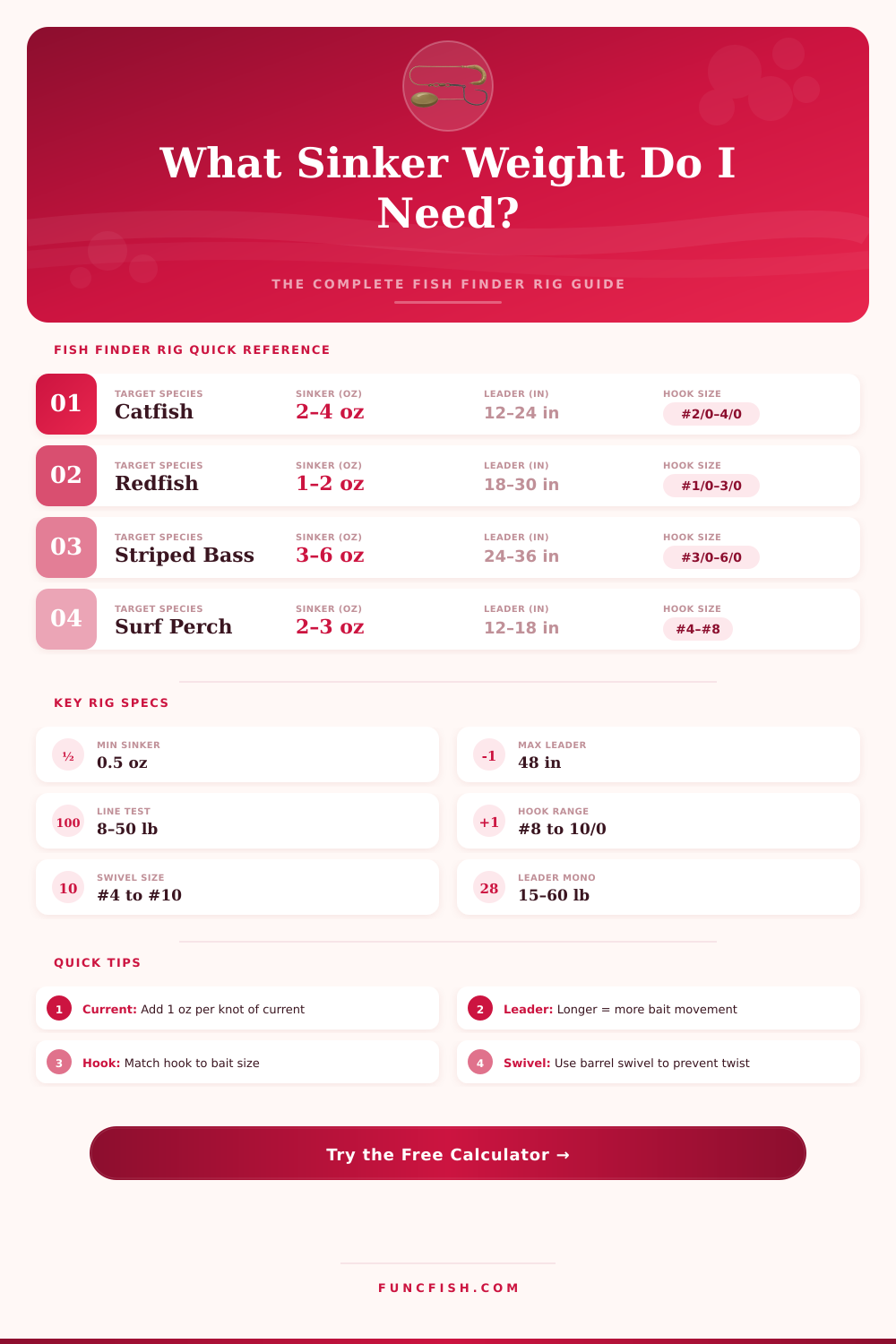
| Species | Avg Weight | Rec. Line Test | Hook Size | Leader (in) | Sinker (oz) |
|---|---|---|---|---|---|
| Catfish (Channel) | 2–15 lb (0.9–6.8 kg) | 12–25 lb | #2/0–4/0 | 12–24 | 1–4 |
| Redfish / Red Drum | 3–12 lb (1.4–5.4 kg) | 15–25 lb | #1/0–3/0 | 18–30 | 0.75–2 |
| Striped Bass | 5–30 lb (2.3–13.6 kg) | 20–50 lb | #3/0–7/0 | 24–42 | 2–6 |
| Flounder | 1–5 lb (0.45–2.3 kg) | 10–20 lb | #1–2/0 | 12–24 | 0.5–1.5 |
| Trout (Sea) | 1–4 lb (0.45–1.8 kg) | 8–17 lb | #4–1/0 | 12–18 | 0.25–1 |
| Walleye | 1–6 lb (0.45–2.7 kg) | 8–14 lb | #6–1/0 | 12–24 | 0.5–1.5 |
| Carp | 5–20 lb (2.3–9 kg) | 12–25 lb | #4–2/0 | 6–18 | 1–3 |
| Halibut | 10–60 lb (4.5–27 kg) | 40–80 lb | #4/0–10/0 | 24–48 | 4–12 |
| Perch / Panfish | 0.25–1.5 lb (0.11–0.68 kg) | 4–10 lb | #6–10 | 8–14 | 0.25–0.75 |
| Leader Material | Strength Range | Diameter | Abrasion Rating | Best Use |
|---|---|---|---|---|
| Monofilament (Mono) | 8–60 lb (3.6–27 kg) | 0.23–0.70 mm | Good | All-purpose, stretch buffer |
| Fluorocarbon (FC) | 10–80 lb (4.5–36 kg) | 0.26–0.84 mm | Excellent | Clear water, abrasive bottom |
| Wire (Stainless) | 27–90 lb (12–41 kg) | 0.30–0.55 mm | Superior | Sharp-toothed species |
| Braided Leader | 20–100 lb (9–45 kg) | 0.20–0.55 mm | Poor | High-stretch main line setups |
| Heavy Mono (Shock) | 40–150 lb (18–68 kg) | 0.64–1.20 mm | Very Good | Surf, offshore, big species |
| Current Speed | Base Sinker (oz) | Base Sinker (g) | +Depth Modifier | Recommended Shape |
|---|---|---|---|---|
| Slack / 0–0.5 knots | 0.25–0.75 oz | 7–21 g | +0.25 oz / 10 ft | Egg / Round |
| Slow / 0.5–1.5 knots | 0.75–1.5 oz | 21–43 g | +0.5 oz / 10 ft | Pyramid / Bank |
| Moderate / 1.5–3 knots | 1.5–3 oz | 43–85 g | +0.75 oz / 10 ft | Pyramid |
| Fast / 3–5 knots | 3–5 oz | 85–142 g | +1 oz / 10 ft | Sputnik / Grapnel |
| Very Fast / 5+ knots | 5–8 oz | 142–227 g | +1.5 oz / 10 ft | Sputnik / Anchor |
Sonar technology use a sonar beam to locate both fish and the bait that will attract the fish. The sonar beam spread out in a cone shape as the sonar beam travels deeper into the water. The sonar beam are the widest at the bottom of the cone.
This is due to the fact that the beam expand as it travels out into the water with every foot of depth. Bait located near the outer edge of the cone will appear as a blurry smudge on the screen. To avoid this smudging of the bait, the bait need to be maintained near the center of the cone.
How to Keep Bait in the Center of the Sonar Beam
In order to maintain the bait near the center of the cone, an understanding of how geometry, boat speed, and current effect the baits position within the cone is required. The angle of the beam of the sonar device creates the width of the cone. The narrower the angle of the sonar beam, the smaller the circle that the sonar beam creates on the ocean floor.
Conversely, the wider the angle of the beam, the more larger the circle will be created on the ocean floor. A narrow beam is often used to target fish in specific areas of the ocean. However, very narrow beams of sonar become very difficultly to use as the boat goes deeper into the ocean.
A wide beam is often used to search for fish in large areas of the ocean. However, the wide beams often smear the image of the bait on the screen unless the operator adjust the offset of the sonar device to the desired distance. The movement of the boat often create line drag, which can often pull the bait away from the center of the sonar beam.
Therefore, if trolling a boat with fishing rigs, an offset must be used so that the bait remain within the sonar beam despite the drag created by the boat. Additionally, if drifting in an area with a current, the current will often pull on the line and the bait. Therefore, adjustment to the offset of the sonar device will be needed to compensate for the pull of the current on the bait.
By using braided fishing line you can reduce the bow of your line as braided fishing lines are thinner than monofilament lines and will cut through the water more effective. The type of fishing rig you use will change how your sonar images appear. For instance, using a vertical jig will allow your bait to quickly reach the desired depth, whereas a crawler harness will take longer to sink to the desired depth due to the slower movement of the bait.
Furthermore, the size of the bait will impact the offset of the image on the sonar screen; longer baits will show up offset from the center of the sonar beam due to the drag of the bait through the water. In addition to the type of fishing rig you use, the placement and settings of the sonar transducer will also impact the clarity of the screen. For instance, if the sonar is placed six inches below the surface of the water, the depth of the scan will be six inches less than the setting on the sonar fish finder.
Using the CHIRP mid-range mode on the sonar will help to provide even detail of the fish finder screen and reduce the cluttering of the screen that can occur with a wide-beam fish finder sonar. Additionally, the clarity of the water will also impact the use of the sonar sonar. For instance, in clear water, the fish finder can use tight cones to image the sonar screen; however in muddy water and particulates, the fish finder will need to use wider beams to penetrate the particles in the water.
You can use a fit score to determine if your sonar display screen is correctly set up for fishing. For instance, if the fit score is 80 or above, it means that the sonar display screen is correctly set up for fishing. If the fit score is 60 or below, it means that you should of recheck your boat speed or change your fishing line.
To get the best sonar readings, ensure that the bait you are using stay within the center lane of your sonar beam. If the bait remain in the center lane of the beam, the screen will display clear images of the fish in the area rather than blurry smudges on the screen.