🐟 Fish Girth from Length Estimator
Estimate fish girth and weight from length using species-specific formulas — no scale needed
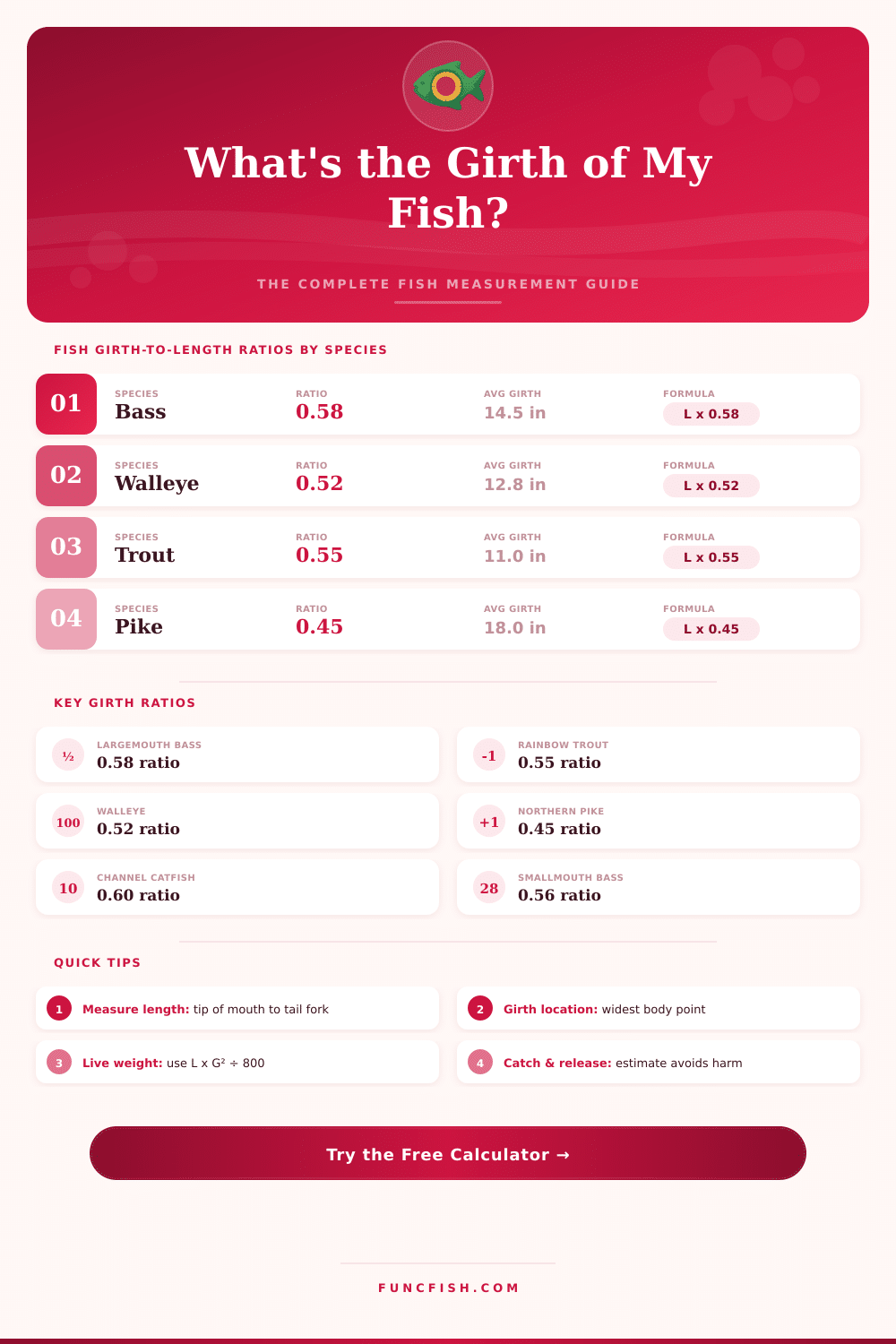
| Species | Girth Ratio | Weight Formula (lb) | Divisor | Typical Length Range |
|---|---|---|---|---|
| Largemouth Bass | 0.58 | L x G² ÷ 800 | 800 | 10–25 in |
| Smallmouth Bass | 0.56 | L x G² ÷ 800 | 800 | 8–22 in |
| Walleye | 0.52 | L x G² ÷ 800 | 800 | 12–30 in |
| Northern Pike | 0.45 | L x G² ÷ 800 | 800 | 18–48 in |
| Muskellunge | 0.42 | L x G² ÷ 800 | 800 | 24–60 in |
| Channel Catfish | 0.60 | L x G² ÷ 800 | 800 | 12–35 in |
| Rainbow Trout | 0.55 | L x G² ÷ 800 | 800 | 8–28 in |
| Brown Trout | 0.54 | L x G² ÷ 800 | 800 | 8–30 in |
| Crappie | 0.50 | L x G² ÷ 900 | 900 | 6–15 in |
| Striped Bass | 0.54 | L x G² ÷ 800 | 800 | 18–48 in |
| Species | Length (in) | Est. Girth (in) | Est. Weight (lb) | Est. Weight (kg) |
|---|---|---|---|---|
| Largemouth Bass | 15 | 8.7 | 1.42 | 0.64 |
| Largemouth Bass | 20 | 11.6 | 3.36 | 1.52 |
| Largemouth Bass | 25 | 14.5 | 6.56 | 2.98 |
| Walleye | 20 | 10.4 | 2.70 | 1.22 |
| Walleye | 28 | 14.6 | 7.44 | 3.37 |
| Northern Pike | 36 | 16.2 | 11.81 | 5.36 |
| Northern Pike | 48 | 21.6 | 27.99 | 12.70 |
| Rainbow Trout | 18 | 9.9 | 2.20 | 1.00 |
| Channel Catfish | 28 | 16.8 | 9.88 | 4.48 |
| Muskellunge | 48 | 20.2 | 24.49 | 11.11 |
| Condition | Multiplier | Visual Description | Typical Season |
|---|---|---|---|
| Thin / Post-Spawn | 0.88x | Sunken belly, narrow girth | Late spring / early summer |
| Average Condition | 1.00x | Normal healthy profile | Summer / fall |
| Chunky / Well-Fed | 1.12x | Rounded belly, wider girth | Late summer / fall |
| Pre-Spawn Heavy | 1.18x | Full egg-laden belly | Early spring |
| Trophy Class | 1.22x | Exceptional girth for length | Any season |
Fish girth is the biggest circumference of the fish body That differs from the body depth, which is vertical distance. Girth measures the contour according to the shape of the fish to find the maximum circuit. Right value is important to estimate the weight.
For estimate girth, wrap the ruler around the thickest part of the fish. Hold it so that you look directly down on its back. The part that sticks out most on both sides, measure here.
How to Measure Fish Girth and Estimate Its Weight
For trout the broad part usually lies in front or after the dorsal fin. Simple wrap the tape here. Length you measure quickly without a lot of handling the fish, girth on the other hand requires more effort.
Length estimate from the nose tip until the tail tip. Later measure girth at the thicekt part of the center. Some calculations use the “short length“, the distance of the bottom jaw tip until the tail fork.
If girth is not given, you apply default of 0.58 times the length. Average largemouth bass or northern strain have girth around 75% of the length. And head and maximum girth grow linear with the body length at many species.
Various weight formulas count for different fish. Bass weight matches length times girth times length divided by 1,200. For pike it is length times length times length divided by 3,500.
Trout weighs length times girth times girth divided by 800. For instance with 15 inch girth and 29 inch length: 15 times 15 times 29 divided by 800 give 8.16 pounds. Others use length times girth divided by 740 for approximate rating.
Actual catches prove the impact of girth on weight. Fish long in 34.25 inches with 22.25 inch girth weighed a bit more than 20 pounds. Big female long in 51.5 inches with 33.5 inch girth had 59 pounds and 9 ounces.
Steelhead long in 39 inches with 19 inch girth. Exactly estimate only by means of length is hard. Girth genuinely does not lack.
The belly size makes a decisive difference for weight.