🐟 Fish Girth Calculator
Estimate fish weight from length & girth measurements — supports all major species, imperial & metric
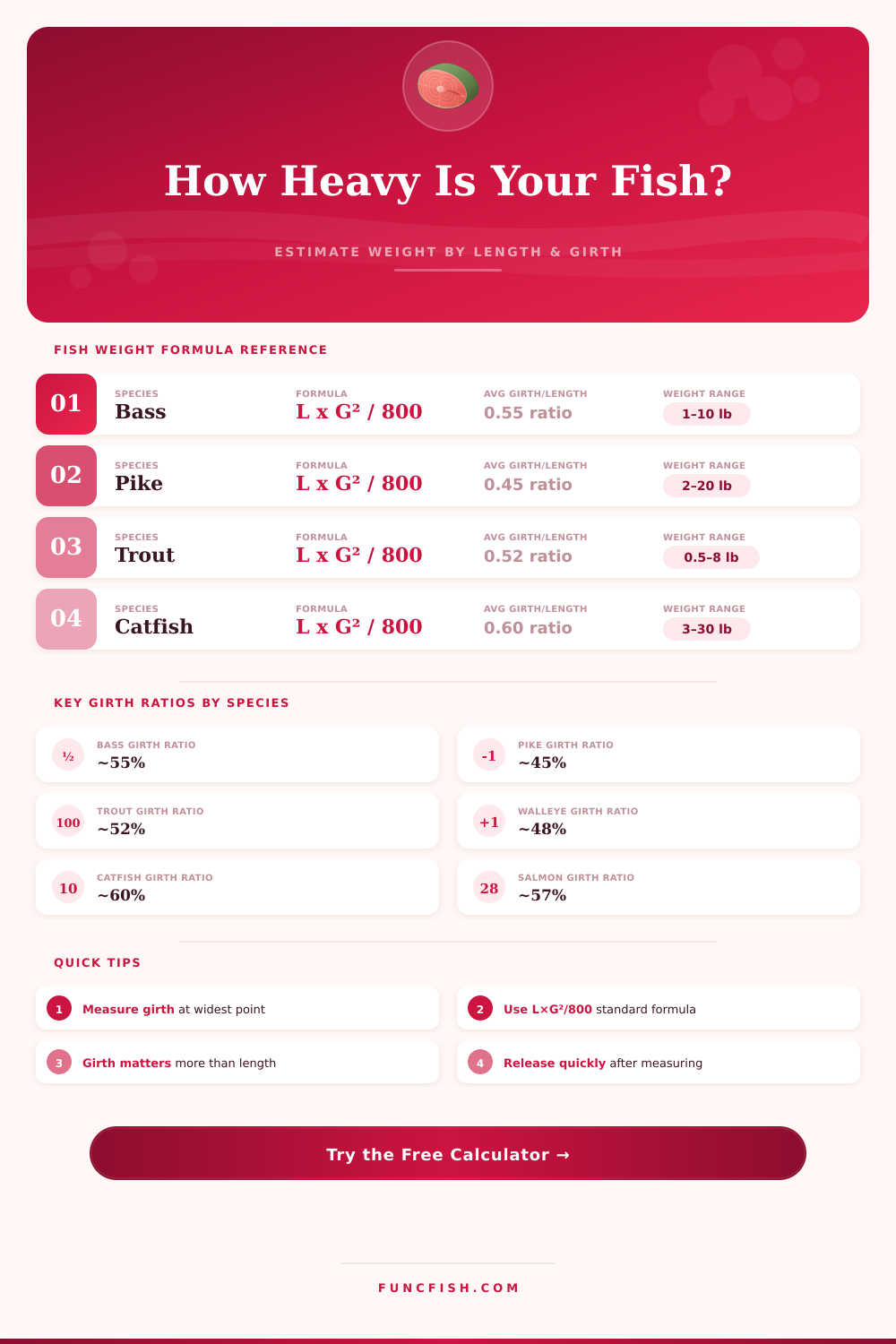
| Species | Recommended Formula | Divisor | Avg Girth at 20 in (cm) |
|---|---|---|---|
| Largemouth Bass | L x G² / 800 | 800 | 11 in (28 cm) |
| Smallmouth Bass | L x G² / 800 | 800 | 10 in (25 cm) |
| Rainbow Trout | L x G² / 800 | 800 | 10.4 in (26 cm) |
| Brown Trout | L x G² / 800 | 800 | 10 in (25 cm) |
| Northern Pike | L x G² / 800 | 800 | 9 in (23 cm) |
| Walleye | L x G² / 800 | 800 | 9.6 in (24 cm) |
| Channel Catfish | L x G² / 800 | 800 | 12 in (30 cm) |
| Muskellunge | L x G² / 800 | 800 | 8.8 in (22 cm) |
| King Salmon | L x G² / 800 | 800 | 11.4 in (29 cm) |
| Striped Bass | L x G² / 800 | 800 | 11 in (28 cm) |
| Crappie | L x G² / 800 | 800 | 7.2 in (18 cm) |
| Bluegill | L x G² / 1200 | 1200 | 6.4 in (16 cm) |
| Common Carp | L x G² / 750 | 750 | 13 in (33 cm) |
| Species | Typical Length Range | Typical Weight | Trophy Size |
|---|---|---|---|
| Largemouth Bass | 12–22 in (30–56 cm) | 1–6 lb (0.5–2.7 kg) | 8+ lb (3.6+ kg) |
| Rainbow Trout | 10–24 in (25–61 cm) | 0.5–5 lb (0.2–2.3 kg) | 10+ lb (4.5+ kg) |
| Northern Pike | 24–42 in (61–107 cm) | 3–15 lb (1.4–6.8 kg) | 20+ lb (9+ kg) |
| Walleye | 14–28 in (36–71 cm) | 1–8 lb (0.5–3.6 kg) | 12+ lb (5.4+ kg) |
| Channel Catfish | 18–30 in (46–76 cm) | 2–12 lb (0.9–5.4 kg) | 20+ lb (9+ kg) |
| King Salmon | 24–48 in (61–122 cm) | 10–30 lb (4.5–13.6 kg) | 40+ lb (18+ kg) |
| Muskellunge | 36–54 in (91–137 cm) | 8–25 lb (3.6–11.3 kg) | 40+ lb (18+ kg) |
| Striped Bass | 20–40 in (51–102 cm) | 5–25 lb (2.3–11.3 kg) | 40+ lb (18+ kg) |
| Formula Type | Divisor | Best For | Example (20 in x 12 in girth) |
|---|---|---|---|
| Standard (Default) | 800 | Bass, trout, walleye, pike | 3.60 lb (1.63 kg) |
| Pennsylvania Method | 900 | Conservative estimate | 3.20 lb (1.45 kg) |
| Elongated Body | 750 | Muskie, pike, eels | 3.84 lb (1.74 kg) |
| Flat Body | 1200 | Bluegill, sunfish, crappie | 2.40 lb (1.09 kg) |
Fish girth is the biggest around measure of the body. It follows the shape of the fish for find that maximum. That differs to the body depth, that is distance up and down.
Measuring girth commonly requires more effort than length, because length is easy and quick, without a lot of touching of the fish. Only by means of length commonly do not work for accuracy, so you also need girth.
How to Measure Fish Girth and Estimate Weight
For girth measure, identify the broadest place at the trout. Usually it is in front or after the top fin. Wrap cloth around the thickest part of the fish.
Keeping the fish so that it lies with back up, find the part that sticks out the most on both sides; here is the girth. Alternatively, measure at the thickest part of the middle. Complete length do of the nose until the tail, then add girth.
Some goes until the tail, others until the fork.
Girth and length helps to estimate weight of various fishes. For instance, bass count as length times length times girth divided by 1200. For pike it is length times length times length divided by 3500.
Sunfish uses length times length times length divided by 1200. Trout weight you finds multiplying length by means of girth square, later sharing by means of 800. For size one takes the short length, of bottom jaw until tail fork.
If girth lack, default one uses 0.58 times the length.
Various species have dissimilar body shapes. At north largemouth bass girth are around 75 % of the length. Some fishes are very slim, as if terrific plate.
For reach 1000 pounds, fish requires at least 72 inches of girth and 156 inches length by means of short measure. Terrific marlin of 12 inches weigh 200 pounds, and every additional inch adds 100 pounds.