🐟 Fish Relative Weight Calculator
Calculate the Wr score to assess fish body condition relative to standard weight by species
| Species | log a | b (exponent) | Length Range (in) | Avg Wr Target |
|---|---|---|---|---|
| Largemouth Bass | –5.316 | 3.191 | 8–24 | 95–105 |
| Smallmouth Bass | –5.329 | 3.200 | 6–20 | 95–105 |
| Walleye | –5.453 | 3.180 | 10–28 | 90–105 |
| Bluegill | –5.374 | 3.316 | 3–12 | 95–105 |
| Channel Catfish | –5.800 | 3.294 | 8–30 | 90–100 |
| Northern Pike | –5.521 | 3.096 | 12–40 | 95–105 |
| Black Crappie | –5.618 | 3.345 | 4–16 | 90–100 |
| Rainbow Trout | –4.997 | 2.979 | 6–24 | 95–110 |
| Striped Bass | –5.626 | 3.224 | 12–36 | 90–105 |
| Yellow Perch | –5.386 | 3.240 | 4–14 | 90–100 |
| Species | 12" Std Weight (lb) | 16" Std Weight (lb) | 20" Std Weight (lb) | Typical Wr Range |
|---|---|---|---|---|
| Largemouth Bass | 0.84 | 2.00 | 4.04 | 80–120 |
| Smallmouth Bass | 0.82 | 1.95 | 3.95 | 80–115 |
| Walleye | 0.74 | 1.78 | 3.68 | 75–115 |
| Bluegill | 1.05 | – | – | 80–125 |
| Channel Catfish | 0.63 | 1.62 | 3.60 | 80–120 |
| Northern Pike | 0.58 | 1.45 | 3.20 | 80–115 |
| Black Crappie | 0.68 | – | – | 75–120 |
| Rainbow Trout | 0.72 | 1.72 | 3.50 | 85–120 |
| Striped Bass | 0.71 | 1.78 | 4.10 | 75–115 |
| Yellow Perch | 0.44 | – | – | 80–115 |
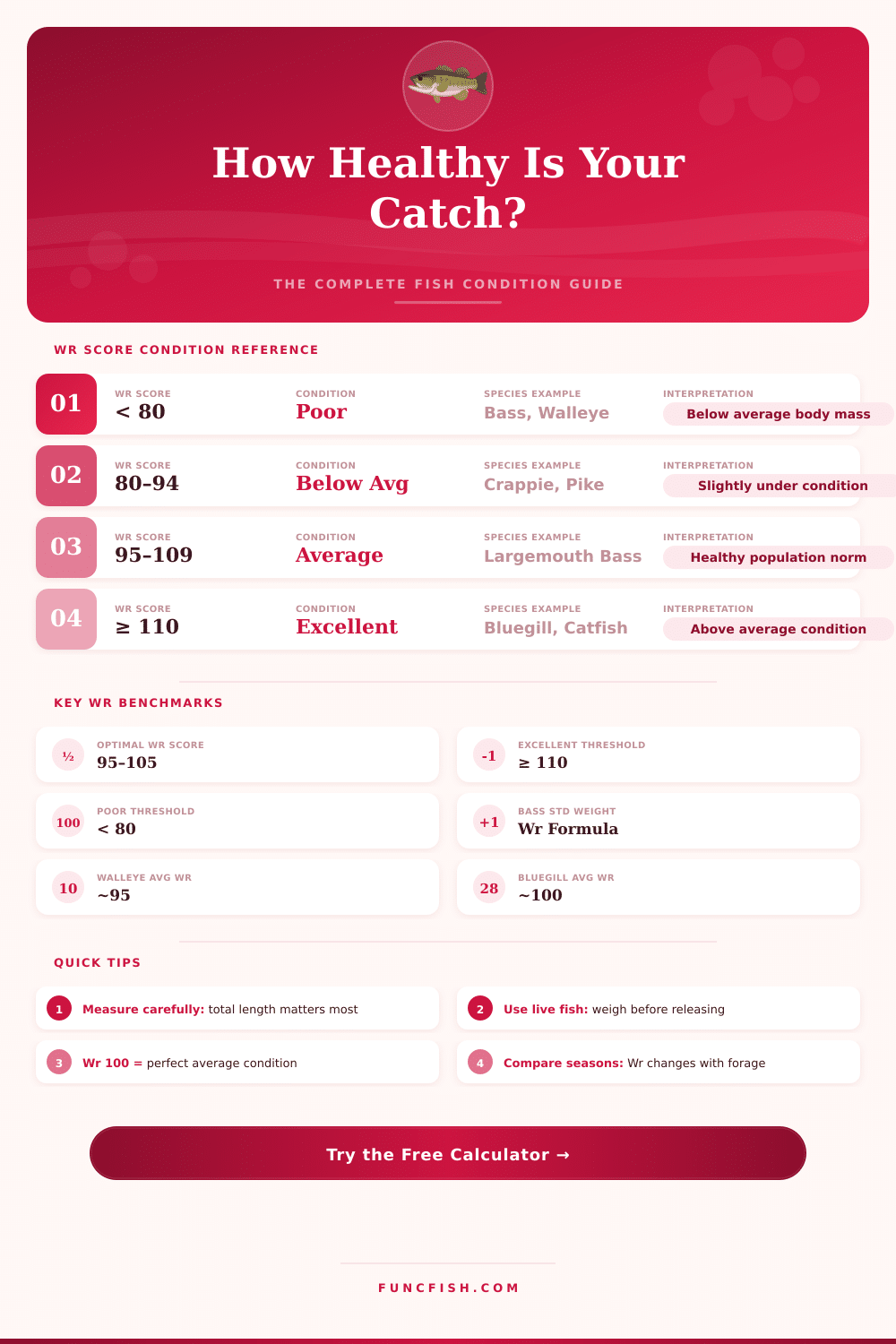
| Wr Score Range | Condition Class | Population Meaning | Management Implication |
|---|---|---|---|
| < 70 | Very Poor | Severely underweight | Forage base likely depleted |
| 70–79 | Poor | Below healthy threshold | Possible overpopulation / low food |
| 80–89 | Below Average | Slightly under condition | Monitor forage availability |
| 90–94 | Near Average | Approaching normal range | Population likely stable |
| 95–109 | Average / Good | Healthy, normal body mass | Well-balanced ecosystem |
| 110–119 | Above Average | Above-normal body mass | Abundant forage present |
| ≥ 120 | Excellent | Exceptional body condition | Highly productive water body |
All try to reach crisp skin on Fish sons, but that seems more hard than many believe. When the sons slip in the warm bread they commonly want to curl up. After that happens, you struggle with uneven cook and skin, that stays soft instead of become crisp.
Here steps in the Fish press, it simply presses the son against the bottom, so that the skin can burn outside and become truly crisp, during the whole cook evenly. The press spreads the force equally through the whole sons. First it could seem like a press for hamburgers.
Make fish skin crispy and weigh fish
Actually, they look quite a lot alike in form.
Josh Niland makes one of the most popular models, stainless steel press for Fish and pan pressing, that ships quickly in United States and Canada. For less money, old iron tools of old style work well. I mean those, that are only solid metal with a fitted handle.
They weigh surprisingly a lot for their size and do not need much cleaning afetr use.
When dealing about weighing the Fish itself? Everything changes entirely. Many choose digital hanging scale.
A good model lasts until about 50 kilos and includes tools, lit LCD screen, hooks and grips, that do not slip. For those, that weigh Fish directly on the water, a scale with built-in lip grip is almost unbeatable. You simply set it too the bottom jaw of the Fish at the centre.
If your scale has only a hook, add a separate lip grip and take its weight off the amount.
What if no scale is available beside you? Simple math can estimate the weight using only string and line. Here is how: measure the girth and square it, later multiply by the length and divide everything by 800.
This gives the weight in pounds, if you measure girth and length in inches. No measure of girth? Take 0.58 times the square of the length as a replacement.
One commonly uses this formula for bass, but you can change the number 800, if the Fish is thicker or slimmer than usual.
Even so, that length-based method does not always count. Skinny Fish and thick Fish of same length can have entirely different weights. Only relying on length is a weak rating for certain species.
Fish lose weight after they come out of the water. Blood flows out. They vomit.
Even waste affects it. What most changes them? Loss of water.
Because Fish live in water, they always struggle to keep internal water balance through body control. Do think about that before weighing prey, that sits in air a bit of time.
Measures of length sometimes are chosen above Relative Weight, because Relative Weight changes, but thelength of Fish stays the same.