🐟 Fish Standard Length to Total Length Converter
Convert Standard Length (SL) to Total Length (TL) or Fork Length (FL) for any species using real ichthyology conversion factors
TL/SL Ratio
TL/SL Ratio
TL/SL Ratio
TL/SL Ratio
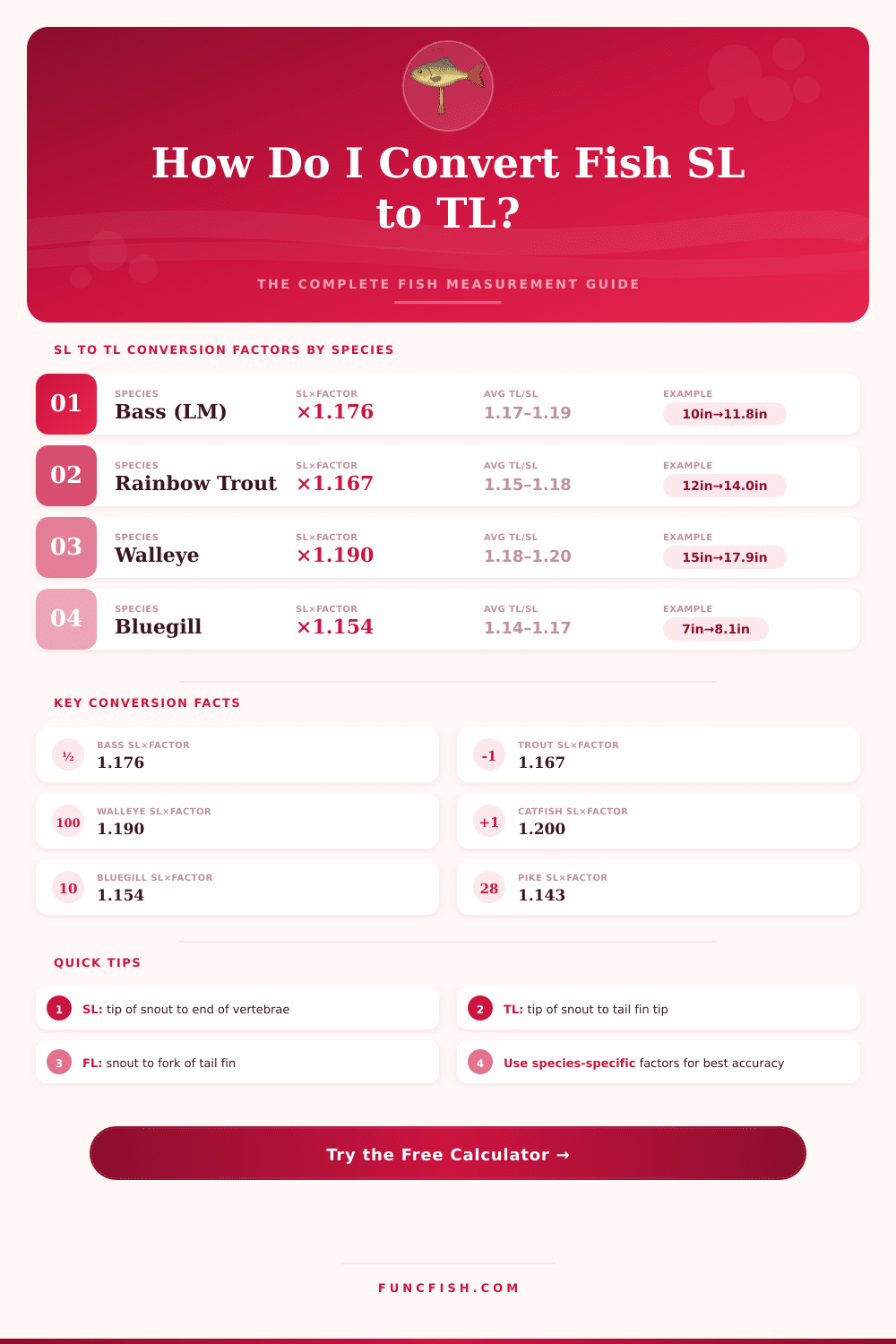
| Species | SL → TL Factor | SL → FL Factor | FL → TL Factor | Typical Adult SL (in) |
|---|---|---|---|---|
| Largemouth Bass | × 1.176 | × 1.113 | × 1.057 | 10–18" |
| Smallmouth Bass | × 1.181 | × 1.115 | × 1.060 | 9–16" |
| Striped Bass | × 1.185 | × 1.120 | × 1.058 | 14–30" |
| Rainbow Trout | × 1.167 | × 1.100 | × 1.061 | 9–22" |
| Brown Trout | × 1.162 | × 1.098 | × 1.058 | 10–24" |
| Chinook Salmon | × 1.172 | × 1.108 | × 1.058 | 20–40" |
| Walleye | × 1.190 | × 1.123 | × 1.060 | 12–24" |
| Northern Pike | × 1.143 | × 1.087 | × 1.052 | 18–40" |
| Bluegill | × 1.154 | × 1.095 | × 1.054 | 4–9" |
| Black Crappie | × 1.162 | × 1.100 | × 1.057 | 6–12" |
| Channel Catfish | × 1.200 | × 1.130 | × 1.062 | 12–28" |
| Yellow Perch | × 1.158 | × 1.097 | × 1.056 | 6–12" |
| Measurement Type | Abbreviation | Definition | Use Case |
|---|---|---|---|
| Standard Length | SL | Tip of snout to posterior end of vertebral column (base of caudal fin) | Scientific research, taxonomy |
| Fork Length | FL | Tip of snout to deepest point of the fork of the caudal fin | Fisheries management, forked-tail species |
| Total Length | TL | Tip of snout to end of longest caudal fin ray (tail tip) | Fishing regulations, slot limits, catch records |
| Body Depth | BD | Greatest vertical depth of body, excluding fins | Species identification, condition factor |
| Head Length | HL | Tip of snout to posterior edge of operculum | Morphometric analysis |
| Species | Trophy TL (in) | Trophy TL (cm) | Avg TL/SL Ratio | Weight at Trophy TL (lb) |
|---|---|---|---|---|
| Largemouth Bass | 22"+ | 56+ cm | 1.176 | 8–10 lb |
| Smallmouth Bass | 20"+ | 51+ cm | 1.181 | 5–7 lb |
| Rainbow Trout | 24"+ | 61+ cm | 1.167 | 5–8 lb |
| Walleye | 28"+ | 71+ cm | 1.190 | 8–12 lb |
| Northern Pike | 40"+ | 102+ cm | 1.143 | 15–25 lb |
| Channel Catfish | 30"+ | 76+ cm | 1.200 | 10–20 lb |
| Chinook Salmon | 42"+ | 107+ cm | 1.172 | 20–40 lb |
| Bluegill | 10"+ | 25+ cm | 1.154 | 1–2 lb |
| Striped Bass | 36"+ | 91+ cm | 1.185 | 20–40 lb |
| Yellow Perch | 13"+ | 33+ cm | 1.158 | 1.5–3 lb |
Fish length converter is a handy tool that means to estimate the weight of fish only from its length It is easy to use: choose the species, enter the length, receive the approximate weight together with info about that species. Currently some versions have 23 species, but more will be added over time.
Fish commonly suffer damage while weighing. By means of the right formula for a species you can quickly estimate the weight using a ruler. Some tools even offer a downloadable trophy calculator, where the math is already ready.
Estimate Fish Weight from Length
Because of the decline of salmonids, anglers more commonly release fishes instead of keeping them. Even so exactly weighing alive fish is hard, hence you developed equations for counting that exactly as possible. Length measure instead of weighing has much sense for catch and release.
20-inch trout weigh approximately 3 pounds. For largemouth bass of 27 inches exists special formulas for length to weight. The weights are calculated by means of equations, and if girth is not pointed, you use a default of 0.58 times the length.
For the formulas length and girth are the two main values.
For well measure fish, from the tip until the nose extend the tape to the longest tail when squeezed. Tail pinching is important, because it adds length. Mouth keep closed.
Whole length includes the fins, but standard length no, only body from mouth until tail.
For convert fork length to whole length or back, use special formulas or factors for every species. Fishes have different heads, for example undershot jaws or subterminal mouth, and tails can be forked, square or concave. The conversions base on whole length divided by standard or by means of fork.
Some calculators intend saltwater fish. On-line weight calculators for South African saltwater anglers estimate weight from length. British saltwater length to weight converter allow you to choose caught fish, enter length and receive weight in pounds plus facts.
It covers bass, halibut, tope, smoothhound, cod etc. Mobile version exists, so you can check weight on the beach.
Weight ranges up or down, but bass length never shrinks. That alone makes length the most reliable mode to trace fish size. Already many lands use length-based systems, even for freshwater, as in many contests.