🎣 Maxima Fishing Line Lifespan Calculator
Estimate how long your Maxima fishing line will last based on usage frequency, storage, water type, and line material
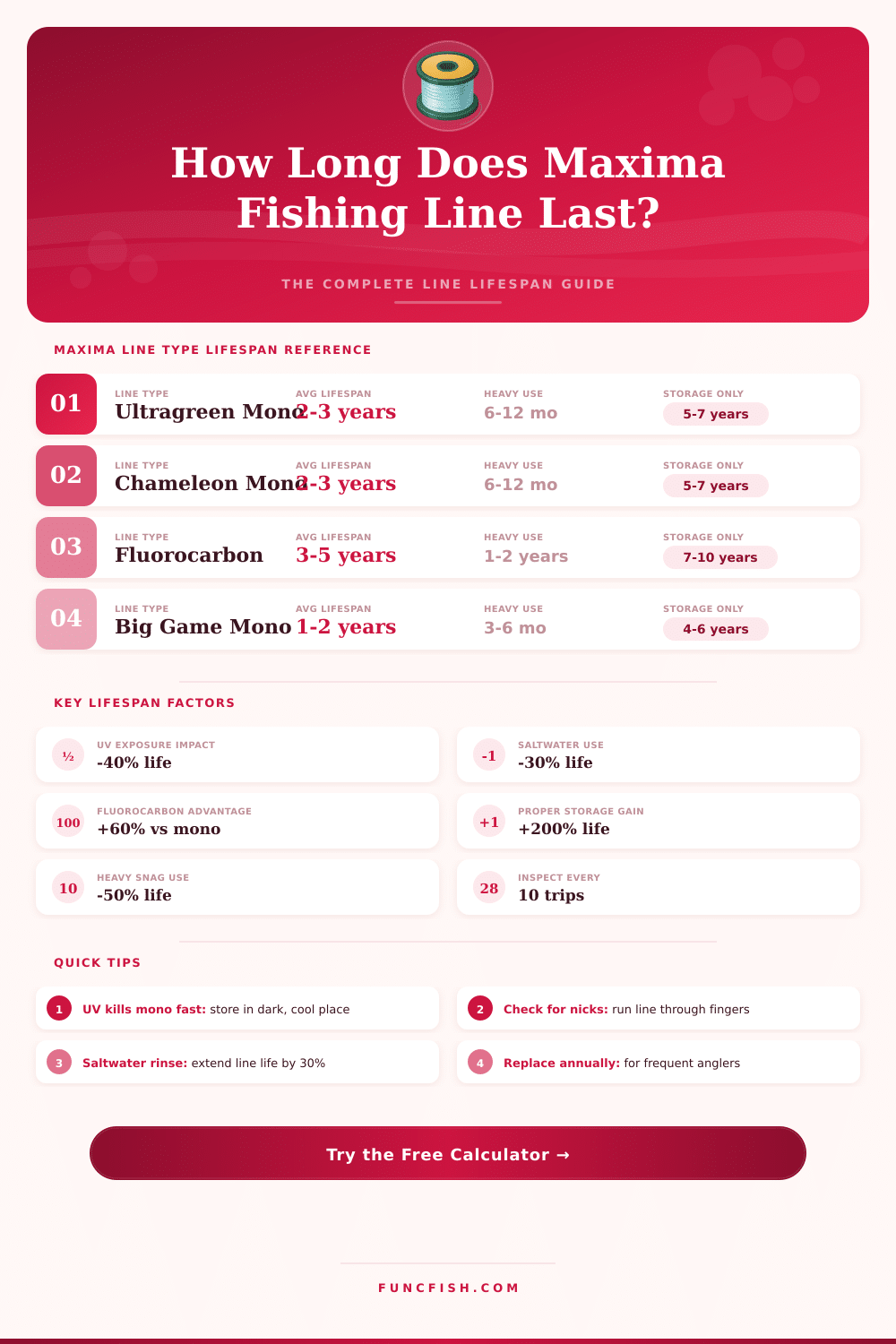
| Line Type | Base Lifespan | Diameter (0.010") | UV Resistance | Saltwater Safe | Replace Interval (Heavy Use) |
|---|---|---|---|---|---|
| Ultragreen Mono | 2–3 years | 0.011–0.017" | Moderate | Yes (rinse) | Every 6–9 months |
| Chameleon Mono | 2–3 years | 0.012–0.018" | Moderate | Yes (rinse) | Every 6–9 months |
| Clear Mono | 2–3 years | 0.010–0.016" | Low | Yes (rinse) | Every 6–9 months |
| Fluorocarbon Leader | 3–5 years | 0.008–0.014" | High | Excellent | Every 12–18 months |
| Big Game Mono | 1–2 years | 0.020–0.032" | Moderate | Yes (rinse required) | Every 3–6 months |
| Ultragreen Ice | 1–2 seasons | 0.008–0.012" | Low (indoor) | No | Annually or each season |
| Tournament Mono | 1–2 years | 0.011–0.016" | Moderate | Yes (rinse) | Every 3–6 months |
| Braided Mainline | 4–8 years | 0.006–0.014" | High | Excellent | Every 2–3 years (heavy use) |
| Target Species | Typical Weight | Recommended Line | Line Test (lb) | Lifespan Est. | Replace Interval |
|---|---|---|---|---|---|
| Largemouth Bass | 1–8 lb (0.5–3.6 kg) | Ultragreen Mono | 12–17 lb | 2–3 years | Annually |
| Rainbow Trout | 0.5–5 lb (0.2–2.3 kg) | Clear / Ultragreen | 4–8 lb | 2–3 years | 1–2 years |
| Walleye | 1–10 lb (0.5–4.5 kg) | Chameleon Mono | 8–12 lb | 2 years | Annually |
| Northern Pike | 5–25 lb (2.3–11 kg) | Big Game Mono | 20–30 lb | 1–2 years | Every 6–9 mo |
| Channel Catfish | 2–20 lb (0.9–9 kg) | Ultragreen / Big Game | 17–30 lb | 1–2 years | Every 6 mo |
| Panfish (Bluegill) | 0.2–1 lb (0.09–0.45 kg) | Ultragreen Ice / Clear | 4–6 lb | 2–3 years | 1–2 years |
| Striped Bass | 5–30 lb (2.3–14 kg) | Big Game Mono | 20–40 lb | 1 year (saltwater) | Every 6 mo |
| Salmon (Chinook) | 10–50 lb (4.5–22.7 kg) | Tournament / Big Game | 25–50 lb | 1–2 years | Every 6–9 mo |
| Factor | Condition | Lifespan Multiplier | Impact Notes |
|---|---|---|---|
| UV Exposure | Low (overcast / stored) | +20% longer | Minimal photodegradation |
| UV Exposure | Medium (normal outdoor) | Baseline | Standard degradation rate |
| UV Exposure | High (tropical, all-day sun) | –40% shorter | Significant polymer breakdown |
| Water Type | Freshwater (clear) | Baseline | Minimal chemical attack |
| Water Type | Saltwater | –30% shorter | Salt crystals cause micro-abrasion |
| Snag/Abrasion | Low (open water) | +15% longer | Minimal mechanical wear |
| Snag/Abrasion | High (rocks, timber) | –50% shorter | Rapid surface damage |
| Storage | Ideal (cool, dark, dry) | +30% longer | Minimal chemical aging |
| Storage | Poor (hot car, UV) | –40% shorter | Heat and UV compound aging |
| Trip Frequency | Occasional (5/yr) | +40% longer | Low cumulative stress hours |
| Trip Frequency | Pro/Tournament (150/yr) | –60% shorter | High cumulative stress hours |
Fishing line is a basic string that must be strong and flexible, so that it works well with hook during capture and wraps around fish. Usually one draws it by means of reel and keeps it there, but you can also weave it by hand, if it attached to a stable spot. Here is the basic description even so a lot more happens, when one digs into various types and their practical usage.
For choosing fishing line, you have some main options on the market. Mono, fluorocarbon, braided line and wire form the main types. Each of them designed for particular fishing and certain fish species.
How to Choose a Fishing Line
Mono costs the least and is the most liked. It forgives mistakes, especially for beginners. Tying it is easy, cutting is no problem, and winding it on a spool is simple.
Fish hardly notice it, because it floats neutral, so it sinks with lead and stays on the surface with a float. Obviously, mono almost does not show underwater. Its buoyancy and stretch make it ideal for topwater baits on a basic guide.
Braided line beats mono in strength and takes up less space. Compare two lines of same strength, and braided always wins by a lot. Like this you cast longer and get better all-around activity.
One benifets from less memory in the line, more sensitive reaction and extra casting distance, what really helps. Take braided line from Dyneema or Spectra fibers, and you keep the strongest option available. The disadvantage?
If it tangles, it can become really difficult to remove.
Fluorocarbon forms another reliable choice, that anglers commonly use. Underwater fish hardly glimpse it, what gives a big advantage. Some fluorocarbon lines stay soft and flexible, created for easy casting and serve as main line in freshwater fishing.
It shines also as leader material thanks too that invisibility.
Choose the right test strength matters more than many believe. Your line should nearly match the weight of intended fish. For panfish, for instance, around four pounds of test is enough.
Using ten pound line for panfish is too heavy. Six pounds works well, but for the smallest species it is possible even lighter.
Leaders need attention too. Generally, one wants a length of five to ten feet, with a bit weaker breaking strength than the main line. That setup saves you against total loss, if something breaks.
The leader can be thicker than your braided line, but always with lower test strength. For toothy fish like pike or musky, attach a bite-proof leader directly to the braid.
For long-term care of your braided line in good shape, wash it after every trip and keep the spool away from direct sunshine. Cheap braids seem good at first, but soon they tangle into chaotic mess after some uses. Invest in quality brands because they last without damage and withoutissues for more time, so the price difference pays for itself.