🎣 Fishing Line Lifespan Calculator
Find out exactly how long your fishing line lasts — based on type, usage, and storage conditions
| Line Type | UV Sensitivity | Saltwater Effect | Heat Tolerance | Abrasion Resistance | Shelf Life (Stored) |
|---|---|---|---|---|---|
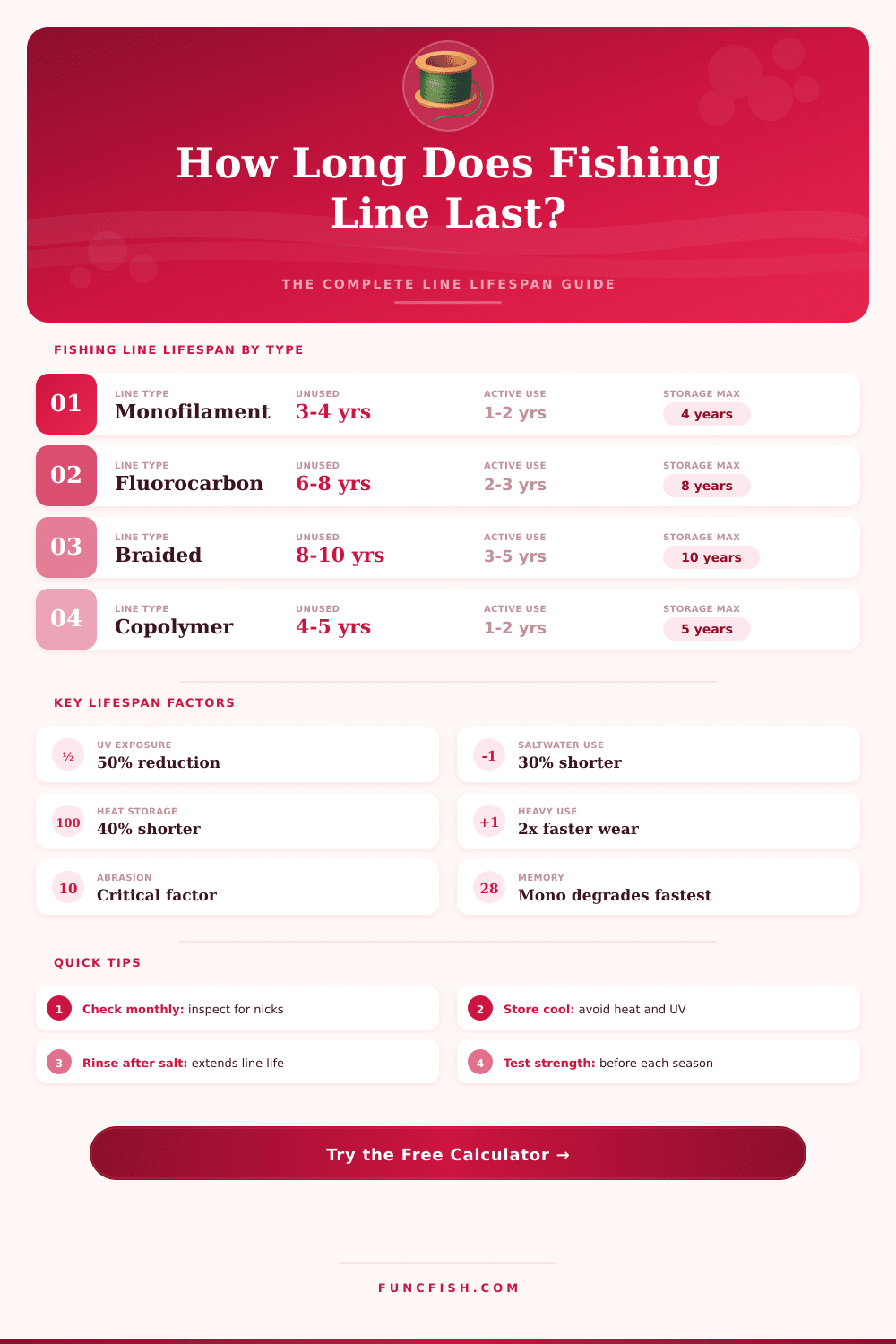
| Monofilament | High — degrades fast | Moderate – absorbs water | Low | Moderate | 3–4 years |
| Fluorocarbon | Low — UV resistant | Low – very resistant | Moderate | High | 6–8 years |
| Braided | Moderate — some fading | Low – rinse recommended | High | Very High | 8–10 years |
| Copolymer | Moderate | Moderate | Low–Moderate | Moderate–High | 4–5 years |
| Fused Superline | Moderate | Low | High | High | 6–8 years |
| Wire Line | None — not affected | Low – rinse helps | Very High | Very High | 10+ years |
| Lead Core | Low — coating helps | Moderate | Moderate | Moderate | 5–7 years |
| Nanofil / Micro | Moderate | Low | High | Moderate–High | 6–8 years |
| Species / Technique | Recommended Line | Replace Every | Typical Test (lb) | Typical Test (kg) |
|---|---|---|---|---|
| Bass Spinning | Mono or Fluoro | Annually | 6–12 lb | 2.7–5.4 kg |
| Trout Stream | Fluorocarbon | Annually | 2–6 lb | 0.9–2.7 kg |
| Offshore Trolling | Braid / Mono | 1–2 seasons | 30–80 lb | 13.6–36.3 kg |
| Catfish Bottom | Mono / Braid | 1–2 years | 20–50 lb | 9.1–22.7 kg |
| Panfish Ultralight | Mono / Fluoro | Annually | 2–4 lb | 0.9–1.8 kg |
| Surf Casting | Braid + Mono leader | Each season | 20–40 lb | 9.1–18.1 kg |
| Walleye Jigging | Braid + Fluoro leader | Annually | 6–14 lb | 2.7–6.4 kg |
| Pike / Musky | Braid | 1–2 seasons | 30–65 lb | 13.6–29.5 kg |
| Kayak Inshore | Braid + Fluoro | Annually | 10–20 lb | 4.5–9.1 kg |
| Fly Fishing | Fly Line + Fluoro tippet | Tippet: each trip | 2–8 lb | 0.9–3.6 kg |
| Fishing Frequency | Monofilament | Fluorocarbon | Braided | Copolymer |
|---|---|---|---|---|
| 1–2 trips/month | 1–2 years | 2–3 years | 3–5 years | 1–2 years |
| 3–5 trips/month | 6–12 months | 12–18 months | 2–3 years | 8–14 months |
| 6+ trips/month | 3–6 months | 6–12 months | 12–18 months | 4–8 months |
| Tournament / Pro | Monthly | 2–4 months | 6–12 months | Monthly |
| Stored (unused) | 3–4 years | 6–8 years | 8–10 years | 4–5 years |
fishing line do not have a set date of end, even so it weakens over time. Never would one want the line to break at the worst moment. The life of fishing line depends on the kind that one uses, the quality of care and some factors that one can not control.
The three main kinds of fishing line are monofilament (nylon), fluorocarbon and braid. Each of them has a different expected lifetime. Monofilament usually lasts one to three years.
How Long Does Fishing Line Last
Fluorocarbon stays good for two to six seasons. Braided line has the longest life and can serve up to a decade.
Monofilament is made up of one continuous strand, commonly from nylon. It stretches before reaching its breaking spot. The force of monofilament is measured by a test that points how much pressure is needed to break it.
Even so monofilament and fluorocarbon weaken after some seasons of usage in water. On the other hand braided line lasts many years without needing a refill.
Care plays a big role. Monofilament, kept from heat and UV light, can serve a very long time (maybe even decades), if it has good quality. A simple method to check its force is to tie a knot and try to hardly pull it.
Monofilament that sits on a reel can weaken after a year, but unused line well kept in a box stays good for several years. Fluorocarbon lasts up to seven or eight years on the spool without losing its action. One ruler of fluorocarbon served only as a guide during a whole decade without problems.
For main monofilament line, changing it yearly once is a wise way to escape twist because of long sitting on a reel. For heavy usage, swapping line monthly two or three times makes sense. Line in a dark drawer lasts much more then that which is regularly exposed to sunshine.
Braided line one can even rewind on the ruler. Remove the line and respool it at season start can extend its life to two to four years. All this depends on how often you fish, the intended species and the place of fishing.
If visual or touch checks raise doubt, best is to swap the line. Experts in fishing usually change their line each six to twelve months. Keeping track of months helps, but it does not stop all failures.
Line costs little compared to other costs for fishing, so risking a big catch ondoubtful line does not deserve the accident.