Fishing Line Sink Rate by Diameter Calculator
Estimate how line diameter, material density, rig weight, line length, angle, depth, and current change sink rate and time-to-depth.
📌Scenario presets
⚙Sink model inputs
Sink-rate forecast
Calculated from net downward force, line drag area, rig drag, water density, current, and slack.
Calculation breakdown
📋Line material data
Braided PE
Nylon mono
Fluorocarbon
Lead core
📐Diameter and rig reference
| Line class | Typical diameter | Bare sink behavior | Best calculator use |
|---|---|---|---|
| 4 lb mono | 0.007 in / 0.18 mm | Very slow sink | Trout, panfish, floats |
| 8 lb mono | 0.011 in / 0.28 mm | Slow sink | Light jigs and live bait |
| 10 lb braid | 0.006 in / 0.15 mm | Floats without ballast | Drop shot and finesse rigs |
| 12 lb fluoro | 0.012 in / 0.30 mm | Fast bare-line sink | Jigs, worms, leader sections |
| Lead core | 0.021 in / 0.53 mm | Very fast sink | Trolling depth control |
| Wire leader | 0.015 in / 0.38 mm | Fast but short section | Toothy fish leaders |
| Rig profile | Underwater weight factor | Drag area baseline | Sink-rate effect |
|---|---|---|---|
| Bare hook | 0.78 of air weight | Very small | Line material matters most |
| Compact jig | 0.84 of air weight | Small | Fastest for its weight |
| Drop shot weight | 0.86 of air weight | Small-medium | Good depth control |
| Soft plastic | 0.62 of air weight | Medium | Slower than jig math suggests |
| Crankbait / plug | 0.45 of air weight | Large | Current slows it sharply |
| Streamer or fly | 0.38 of air weight | Large | Mostly controlled by line type |
| Pyramid surf sinker | 0.88 of air weight | Medium | Heavy but current exposed |
| Fishing situation | Line angle | Current entry | Reading the result |
|---|---|---|---|
| Vertical jigging | 70-90° | 0-0.8 ft/s | Timer result is close to sonar depth |
| Long cast worm | 35-55° | 0-0.5 ft/s | Expect a longer countdown |
| River jig | 40-70° | 0.8-2.5 ft/s | Watch drag rating closely |
| Trolling core | 20-40° | 0.5-2.0 ft/s | Depth is a moving estimate |
| Surf cast | 25-45° | 0.4-2.2 ft/s | More line out may slow drop |
💡Practical checks
Thicker line adds a little more sinking mass when it is denser than water, but it also adds much more projected drag. In current, the drag side usually wins.
After the calculator gives a baseline, count down beside visible structure or sonar returns and tune the current and slack fields until the model matches your rig.
So there you are with brand-new spool tied on and you think about line strength, of course, the pound test. That’s the only thing you think matter, right? Wrong. What you’re tying onto matters just as much as what happens once you put it in the water.
A heavy jig will plummet to the bottom fast. However, your light soft plastic will suspend in midwater, where it will drift out of your target zone before sinking down where you want it. Knowing exactly how fast you’re going is the difference between catching fish and winging it around based off depth guesswork. It’s all very simple physics (density/drag), and it is vital to understand.
Why Line Sinking Speed Matters
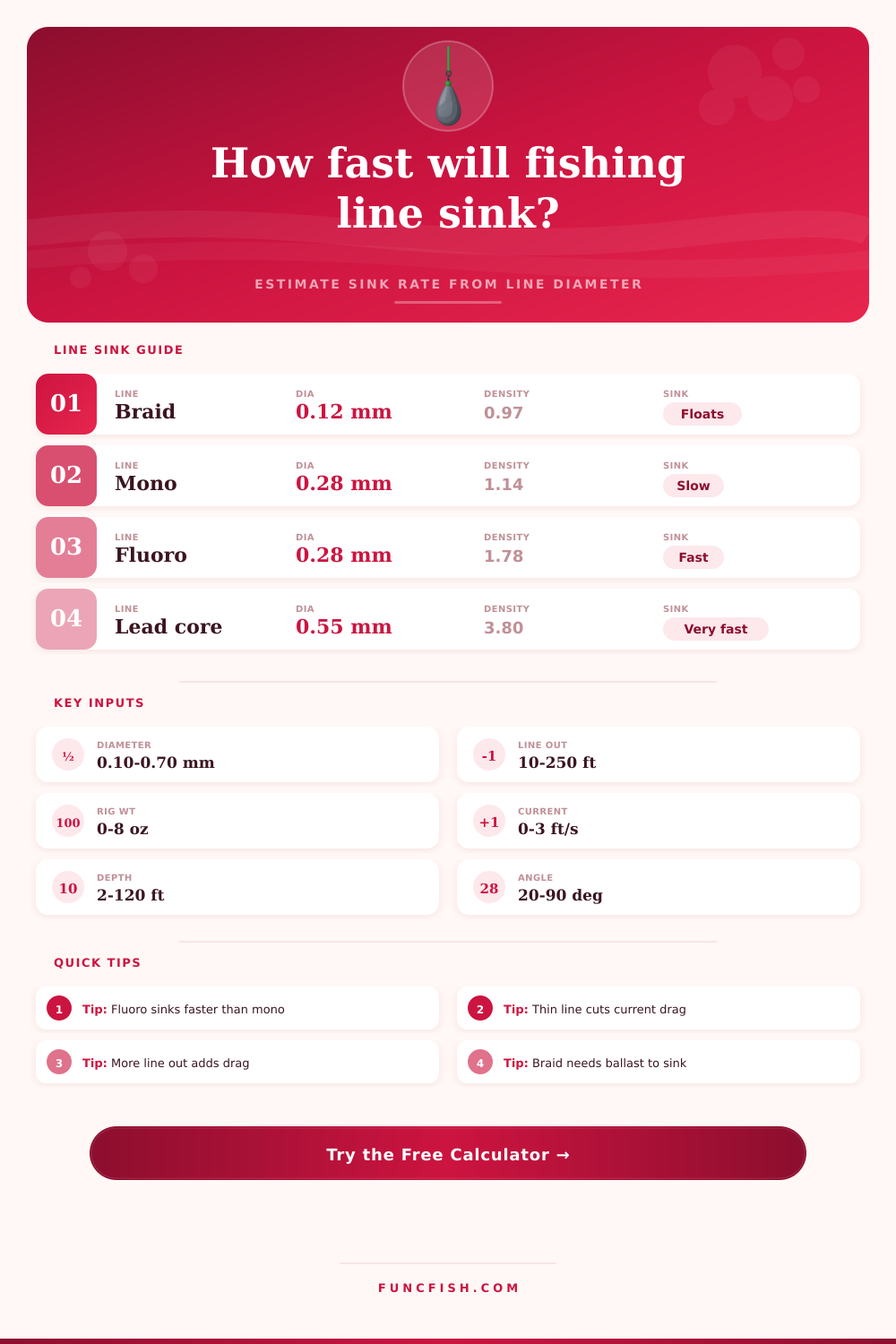
So here it goes: fluorocarbon typically have a specific gravity of approximately 1.78, making it almost twice as dense as water and causing it to sink towards the bottom. However, braided line differ and its density is more like 0.97 which result in it floating on the surface until you add some weight to it. When you input your exact material and diameter into the calculator above, it’ll run the numbers for you… Making complex physics become a practical countdown timer. You don’t have to know how to do the equations, but you should of understand what each input represents in your hand.
Diameter: Most folks mistake this one and believe that the smaller the line the less visible it is to the fish, so of course that means the smaller the diameter the better, right? This change when you consider the current. A heavy braid has a lot of surface area in relation to its weight. So when there is even a current of half a foot per second in a river, it acts as a parachute lifting your bait off the bottom.
This allow you to play with how much slack you use and the angle your line is held. You can then mimic the drag created by boat movement or wind on the surface of the water. For example if you’re sweeping your line out behind the moving boat, a 25-degree angle will cause a drastic difference in depth different than a vertical drop.
Don’t forget your rig, too. Since a jig’s weight is all in one small piece of lead, it cuts through the water easily and overcomes drag almost instantly. On the other hand, a big crankbait or a fluffy tube catches current on its body and displaces a whole bunch of water so the amount of weight they has underwater is not much at all. No matter how fast you get that line sinking, it pulls the lure back up, so the table below separate line data from rig profile data. Don’t expect a jighead to behave the same way as a crankbait when guessing how long it will take to reach depth.
Real world factors like saltwater being denser than fresh water play a small role in buoyancy. Cold water being slightly denser than warm water also provides a small increase in lift. These is minor factors, but they certainly help. That little bit of added buoyancy can be the difference between sitting on structure with 2 feet of clearance or hitting it square if you’re fishing offshore or on tidal waters. This is why the vast majority of anglers don’t consider it and it’s largely irrelevant on calm lake fisheries, but on those other fisheries it makes a big difference.
On the calculator, you can select salt or brackish. This will adjust for the change and make your calculation even closer without having to take it to the lab. When you input the data, it will give you an approximate time to get your bait to your target depth plus how fast it is going to fall. Those are baselines and not guarantees; fish aren’t just sitting there and water doesn’t stand completely still.
So if it projects that it will hit 12-feet in 40-seconds, then when you begin to fish, count it down gradually and feel around for any structure contact or check on your sonar. If you’re feeling bottom at the 30-second mark, adjust your estimate downward in the program or add some slack allowance because it need to be calibrated. The math gets you started, but your senses fine tune it
Depth control is really an attitude; it is about confidence. When we stop second-guessing ourselves and focus on fishing instead of just hoping, we know where our bait is. We stop guessing and start presenting it with purpose instead of hope.
Whether you troll for walleyes or drop shot for bass, you must know your line is heavy enough to reach the zone before the current carry you away. This is critical because it turns a chaotic event into a manageable one. So the next time you tie on new leader, take a minute to consider how heavy it is in water, because that simple mental exercise saves you from fishing empty space and moves you a little closer to the fish livig down there.