
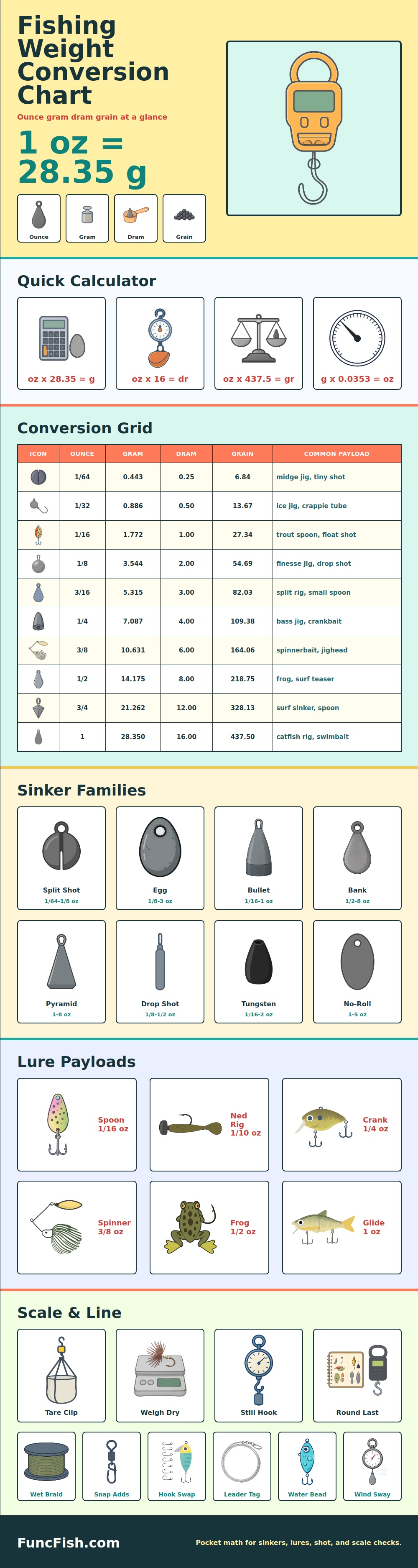
Fishing weights is used to ensure that a fishing rig sink at the correct rate. Many different unit of measurement are used for the weight of fishing gear from the manufacturers of the fishing gear. Due to these different units of measurement, it may be dificult for a persons to compare the weights of fishing gear from different manufacturers.
This chart make it easier for a person to compare fishing weights measured in ounces, grams, drams and grains to help determine the correct weight for the fishing rig for specific fishing condition. Fishing gear use many different units of measurement. Sinkers and lures made in America are typically measure in ounces, while imported fishing gear are measured in grams.
How to Choose and Compare Fishing Weights
Sinker weights used in specialized fishing gear are measured in drams while small weights used in fishing gear are measured in grains. To convert ounces to grams, the manufacturer multiplies the number of ounces by 28.35. To convert grams to ounces, the manufacturer multiplies the number of grams by 0.035.
These conversions is used to ensure that the correct weight of fishing gear is used for the specific conditions in the water. Panfish may require fishing weights that are less than a tenth of an ounce while larger fish like striped bass may require fishing weights of at least three-quarters of an ounce. The weight of fishing gear affect the way that a fishing rig move in different environments.
For example, crappie fishing may require very small fishing weight whereas bass fishing in current may require weights of 3/16 ounce. Using the correct type and weight of fishing weights will allow for the fishing rig to sink at the appropriate rate without scare the fish away. Weights for fishing gear are often made of tungsten because tungsten is denser than lead.
A tungsten weight of one gram will be smaller in physical size than a lead weight of one gram. Because tungsten weights are smaller in physical size, they are more easy able to move through weeds in the water. Additionally, because of the importance of the small weights of tungsten, tungsten is used in finesse fishing techniques like ned rig or drop shot.
Due to the different shape of fishing weights, each type have a specific use. Split shot weights are small and have a soft grip on the fishing line making it suitable for fishing for panfish. Egg sinkers are designed to slide easy on the fishing line making them suitable for fishing for catfish.
Bullet weights are designed to easily move through grass making them suitable for fishing for bass in areas with grass growth. Pyramid weights are used to anchor the fishing line against waves making them suitable for surf fishing. The shape of the fishing weight should of been chosen based off the habitat where the fishing will take place.
Certain types of lures comes in specific weight. For example, trout spoons may be of a weight of 1/16 ounce indicating that the spoon is light and easy cast in the wind. Crankbaits may be of a weight of a quarter ounce to create a wobbling motion in the water while frogs lures may be of a weight of half an ounce to allow the lure to move over lily pad.
It is important to weigh the lures before going fishing. In addition to the weight of the lures, the weight of the water or the wind may add to the lures weight so the fisherman should account for this as well to ensure accuracy in the scale of the lures. The type of fishing line that is used will also affect the fishing rigs sinking rate.
Braided fishing lines when wet will sink more heavy than monofilament fishing lines when dry. Thus, the weight of the braided fishing line will change the way that the fishing rig sink when fishing. Small changes or error in the weight or type of fishing line can impact the way the fishing rig move in the water.
By accounting for these small details, a fisherman will be able to properly use the correct weight of fishing weights for there fishing need.