Fly Line Belly Length Calculator
Estimate a practical fly line belly or head length from rod length, line weight, casting distance, taper family, wind, bank room, and caster control.
📌Scenario presets
⚙Line and cast settings
Fly line belly match
Full breakdown
📋Line family reference grid
WF Trout
Long Belly WF
Streamer Head
Spey Heads
📐Reference tables
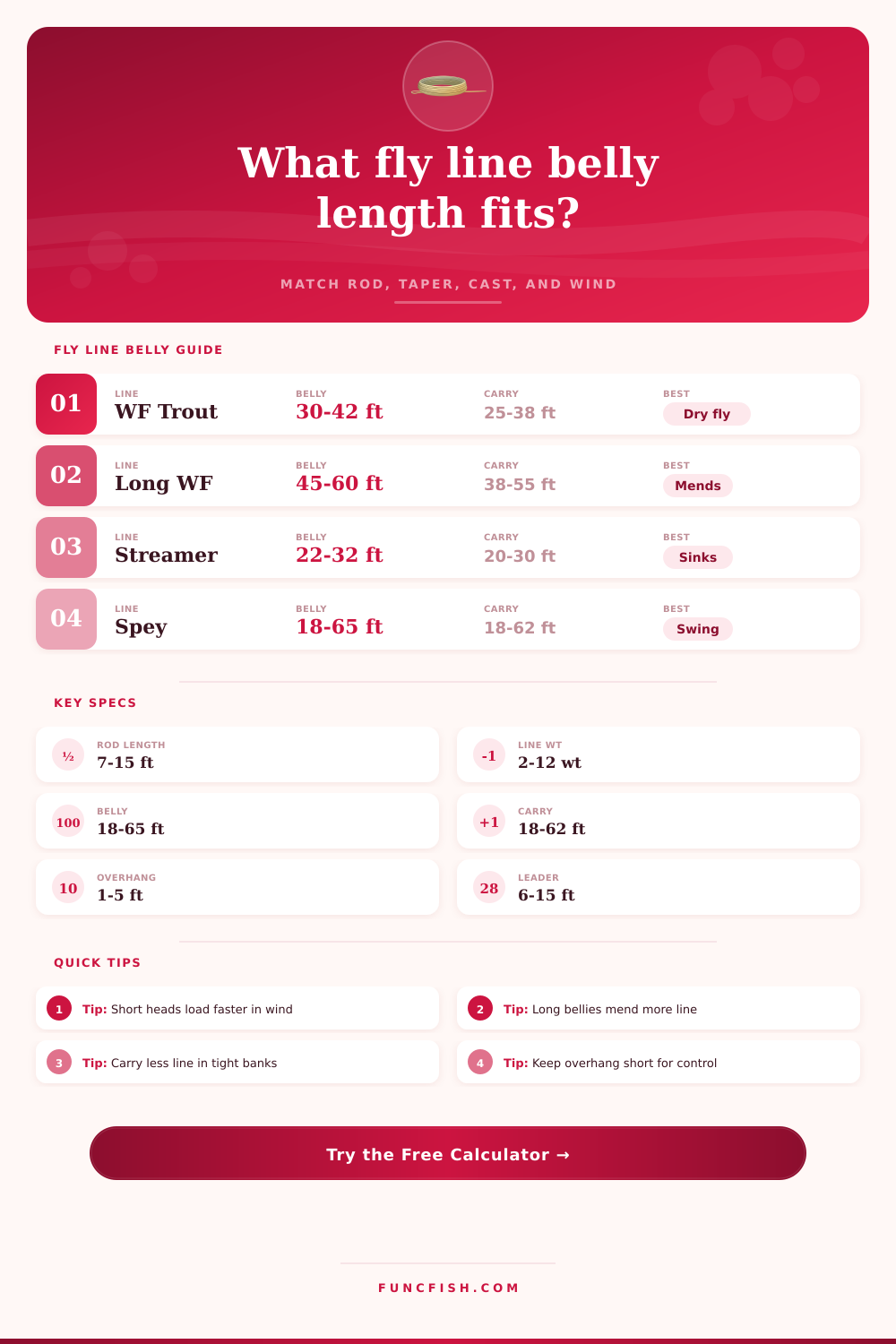
| Taper family | Typical belly or head | Useful carry | Best application |
|---|---|---|---|
| Standard WF trout | 30-42 ft / 9.1-12.8 m | 25-38 ft / 7.6-11.6 m | Dry flies, light nymphs, close to medium work |
| Long belly WF | 45-60 ft / 13.7-18.3 m | 38-55 ft / 11.6-16.8 m | Longer mends, reach casts, stillwater control |
| Double taper | 45-70 ft / 13.7-21.3 m | 30-55 ft / 9.1-16.8 m | Roll casts, small streams, controlled presentations |
| Compact streamer | 22-32 ft / 6.7-9.8 m | 20-30 ft / 6.1-9.1 m | Sink tips, weighted flies, fast shots |
| Bass or saltwater WF | 28-40 ft / 8.5-12.2 m | 25-36 ft / 7.6-11 m | Wind-resistant flies and quick loading casts |
| Shooting head | 24-34 ft / 7.3-10.4 m | 22-32 ft / 6.7-9.8 m | Distance with minimal false casting |
| Scandi head | 28-42 ft / 8.5-12.8 m | 27-40 ft / 8.2-12.2 m | Touch-and-go two-hand casts and light tips |
| Skagit head | 18-28 ft / 5.5-8.5 m | 18-27 ft / 5.5-8.2 m | Heavy tips, winter flies, short sustained anchors |
| Mid belly Spey | 45-55 ft / 13.7-16.8 m | 42-52 ft / 12.8-15.8 m | Balanced swing distance and manageable anchors |
| Long belly Spey | 60-75 ft / 18.3-22.9 m | 55-70 ft / 16.8-21.3 m | Expert line control and big river coverage |
| Fishing scenario | Preferred belly behavior | Typical rod | Calculator adjustment |
|---|---|---|---|
| Dry fly creek | Moderate head, delicate turnover | 7.5-9 ft 3-5 wt | Slightly shorter for accuracy |
| Indicator river | Stable belly that turns over rigs | 9-10 ft 5-7 wt | Adds length for mending |
| Streamer bank | Compact, powerful front section | 9 ft 6-8 wt | Shortens in wind and tight cover |
| Stillwater searching | Longer carry and reach | 9-10 ft 5-7 wt | Adds distance control |
| Saltwater flats | Quick loading, wind capable | 9 ft 7-10 wt | Keeps belly moderate |
| Surf shooting | Short head and long shoot | 9-11 ft 8-11 wt | Favors compact shooting head |
| Switch swing | Head matched to D-loop room | 10.5-11.5 ft 5-8 wt | Allows two-hand anchor carry |
| Spey swing | Anchorable belly for sustained load | 12.5-15 ft 6-10 wt | Uses head-style belly ranges |
| Condition | Belly shift | Carry effect | Use when |
|---|---|---|---|
| Learning loops | -10 percent | Shorter aerial load | The line collapses behind you |
| Open bank | +4 percent | More line in the air | You can use full backcast room |
| Gusty wind | -8 percent | Less false casting | Wind disturbs the backcast |
| Bulky fly | -5 percent | More compact turnover | Poppers, deer hair, or big streamers |
| Long mends needed | +8 percent | More belly beyond the rod tip | Riffles, seams, and stillwater drifts |
| Tight cover | -12 percent | Shorter carry window | Brush, docks, or steep banks |
💡Practical checks
Tip: If the rod tip feels overloaded before the cast straightens, shorten carry first; changing the line is the second move.
Tip: For roll casts and Spey casts, treat the belly result as the line held outside the rod tip before the forward stroke.
Once off the rod tip, a fly line ceases to be gear; it is a physics issue now. How do you get a heavy-core line moving fast enough to roll over a leader while not breaking the presentation and beating yourself silly? Belly length matter, unless of course you’re casting in a headwind and suddenly there’s way too much line hanging out behind you.
Most anglers select their lines according to looks or brand loyalty. Weight-forward sections makes a big difference, and how much you use them often determines whether you have a frustrated morning or a full limit basket.
How to Choose Your Fly Line Belly Length
How fast does your rod load? This is based off the length of its belly. Shorter bellies concentrates the mass closer to the tip, so there is less line in the air when it begin to bend. Longer bellies takes more line in the air before they realy start to flex. For tight casting, compact streamer heads are good as they don’t require that long false cast to get rod starting to bend.
Longer bellies give you more mending control, but take up more space behind you and need room. If you’re on a crowded bank, it can make a long-bellied rod feel sluggish because it won’t bend far enough to move the added length along fasterer.
After entering the specific conditions and your rod details, the calculator does the rest of math for you. It eliminates the need to guess where the sweet spot should of be based on your skill level or the presence (or lack) of wind. It looks at several variable that most folks don’t consider, like air resistance on the fly itself and length of space you have for your backcast. For instance, while a small dry fly needs less power to move down the line different than a big ole’ popper, the tool tweaks the optimal carry window to match. Choose a windy day and it will tell you to shorten the belly slightly to keep the cast within reach and avoid letting the line stall mid-flight.
Too Much Line… Many new angler make this mistake when they first start casting fly line. In their minds the more line they throw out there the further they will go. That’s not necessarily the case. Unless of course you can get all of it moving faster. If you have too much for your rod to handle then you will have a lazy loop which will collapse on itself. You are better off having a little less line and gradually building up your speed instead of trying to make your tip overload.
Also keep in mind where you are as an angler. An experienced angler has the ability to handle a longer carry due to the tightness of their loops, while a novice is better off keeping his belly short and allowing the rod to load easily.
Everything depends on the wind. If it’s blowing lightly, you’d expect to use a more traditional weight-forward taper. If it’s gusting, you want to go compact. The shorter overhang at the back produce less drag as you’re pushing forward with your stroke, while the beefier head cuts through air resistance more effectivey. In calm water you can give yourself a longer belly so you have more control when mending line… But into the wind? Efficiency is key. And that’s where the different taper families comes into play. Here are some of the reference tables showing their behavior under pressure.
So when do you choose long versus short line? That depends on your environment and what you can handle. It is not based on your intended casting distance or rod weight alone. Where’s the majority of the line in relation to the tip? How does the length of its belly affect your rod loading and line control? If you don’t know, go a bit shorter. You will gain confidence by adding line gradually, instead of wrestling with a heavy cast you can’t unload.
When you learn this, you stop battling the equipment. And you begin fishing it. Line is now a way to show your will, not something you’re having to continuously adjust.