🎣 Furled Leader Calculator
Calculate the perfect furled leader length, taper, strand count & total thread needed for any fly fishing setup
Best: 1-4 wt
Best: 2-5 wt
Best: 4-7 wt
Best: 8-10 wt
Best: 5-7 wt
Best: 6-9 wt
Best: 3-6 wt
Best: 4-6 wt
| Line Weight | Rec. Length (ft) | Rec. Length (m) | Butt Strands | Tippet Strands | Best Material |
|---|---|---|---|---|---|
| 1-2 wt | 5–6 ft | 1.5–1.8 m | 8 | 4 | Mono 6 lb / Thread 8/0 |
| 3-4 wt | 7–7.5 ft | 2.1–2.3 m | 12 | 6 | Mono 6-8 lb / Thread 6/0 |
| 5 wt | 7.5–9 ft | 2.3–2.7 m | 14 | 7 | Mono 8-10 lb / Thread 6/0 |
| 6-7 wt | 9 ft | 2.7 m | 16 | 8 | Mono 10 lb / Thread 3/0 |
| 8-9 wt | 9–10 ft | 2.7–3.0 m | 20 | 10 | Mono 12 lb / Kevlar |
| 10 wt | 9 ft | 2.7 m | 24 | 12 | Kevlar / Heavy Mono |
| Species | Avg Weight | Leader Length | Tippet Size | Line Weight | Technique |
|---|---|---|---|---|---|
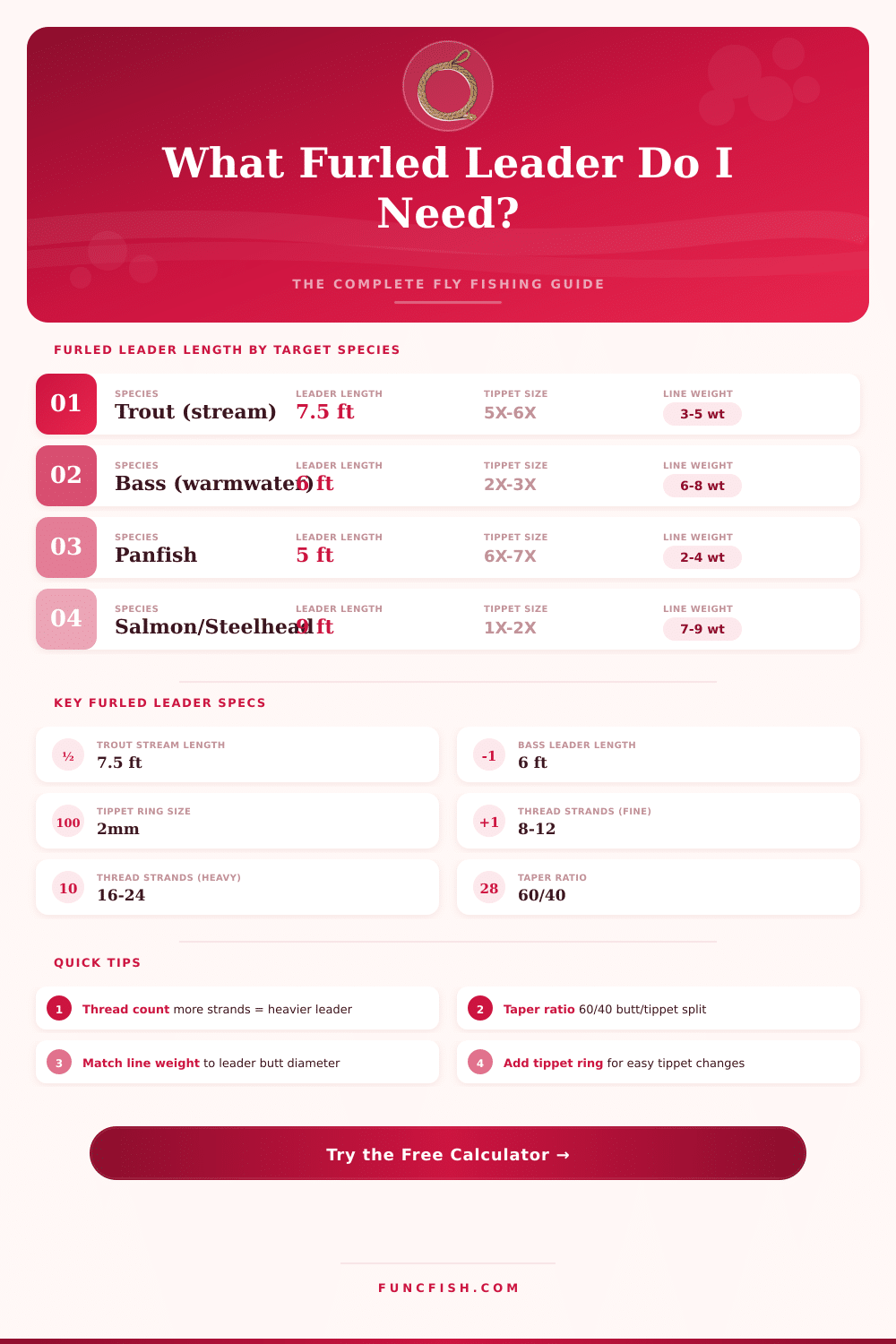
| Brown Trout (stream) | 0.5–3 lb (0.2–1.4 kg) | 7.5–9 ft (2.3–2.7 m) | 4X–5X | 4–5 wt | Dry fly / Nymph |
| Rainbow Trout | 0.5–5 lb (0.2–2.3 kg) | 7.5 ft (2.3 m) | 4X–6X | 4–6 wt | Dry fly / Streamer |
| Brook Trout | 0.2–1 lb (0.09–0.45 kg) | 5–7 ft (1.5–2.1 m) | 5X–7X | 2–4 wt | Dry fly / Emerger |
| Largemouth Bass | 1–5 lb (0.45–2.3 kg) | 6–7.5 ft (1.8–2.3 m) | 1X–2X | 6–8 wt | Popper / Streamer |
| Smallmouth Bass | 0.5–3 lb (0.2–1.4 kg) | 7–9 ft (2.1–2.7 m) | 2X–4X | 5–7 wt | Streamer / Nymph |
| Bluegill / Panfish | 0.1–0.5 lb (0.05–0.23 kg) | 5–6 ft (1.5–1.8 m) | 6X–7X | 2–4 wt | Dry fly / Wet fly |
| Atlantic Salmon | 5–20 lb (2.3–9 kg) | 9–12 ft (2.7–3.7 m) | 0X–2X | 7–9 wt | Wet fly / Spey |
| Steelhead | 5–15 lb (2.3–6.8 kg) | 9–10 ft (2.7–3.0 m) | 1X–3X | 7–9 wt | Nymph / Streamer |
| Bonefish | 2–8 lb (0.9–3.6 kg) | 9 ft (2.7 m) | 2X–3X | 7–9 wt | Saltwater |
| Permit | 5–20 lb (2.3–9 kg) | 9–10 ft (2.7–3.0 m) | 1X–2X | 8–10 wt | Saltwater / Crab fly |
| Tippet Size | Diameter (in) | Diameter (mm) | Approx Strength (lb) | Approx Strength (kg) | Hook Size Range |
|---|---|---|---|---|---|
| 0X | 0.011" | 0.28 mm | 15.5 lb | 7.0 kg | #2–#4 |
| 1X | 0.010" | 0.25 mm | 13.5 lb | 6.1 kg | #4–#8 |
| 2X | 0.009" | 0.23 mm | 11.5 lb | 5.2 kg | #6–#10 |
| 3X | 0.008" | 0.20 mm | 8.5 lb | 3.9 kg | #10–#14 |
| 4X | 0.007" | 0.18 mm | 6.0 lb | 2.7 kg | #12–#18 |
| 5X | 0.006" | 0.15 mm | 4.75 lb | 2.2 kg | #16–#22 |
| 6X | 0.005" | 0.13 mm | 3.5 lb | 1.6 kg | #20–#26 |
| 7X | 0.004" | 0.10 mm | 2.5 lb | 1.1 kg | #24–#28 |
Choosing the right fishing leader length isn’t easy, it depends mainly on the kind of fishing you do. The depth of the water, the fish species and your whole style all play a big role. Here there isn’t one length that answers for everything, although some good tips can lead you well.
If you should choose only one leader and stick with it, 36 inches gives solid ground for most cases. In many situations 12 to 18 inches work perfectly. Exceptions are blue sea for ocean fish or trevally, and those clear river parts with steelhead and wild trout.
How to Choose the Right Leader Length for Fishing
Because most baits are made to cause fast attacks, you genuinely don’t need too long a leader that only pulls the weight.
The clarity of the water changes everything. In very dirty or muddy water a leader of 8 to 12 inches simply makes sense. When the water looks like chocolate milk, don’t bother with more length.
Braided line won’t show anyway. Rather, during fishing with slow bait at the bottom, we match the leader to what the fish can see, and it works well. In 10 feet of visibility use a 10-foot leader.
In 20 feet go with 20 feet
For fly fishing everything is a bit different. Pre-made leaders come from 7.5 to about 12 feet, and 9 feet is the ideal for all around cases. Take a 9-foot leader and add some feet of tippet, and you cover about 90 percent of trout, bass and panfish situations.
The tippet usually is a third of the whole leader.
Streamer fishing likes shorter, 6 to 7 feet casts flat and naturally. For delicate nymph or dry fly presentation push to 12 feet. Those 12 to 15-foot ones?
They are hard to cast, but they keep the fly away from the thick fly line. That matters in technical spring brooks. On smooth water during a hatch in big river many use 18 feet or even more.
Good general rule: match the leader to the length of the rod. In small brooks shorter gives better control. In still water you have freedom; from 4 to around 25 feet based on depth and how you fish.
Long leaders let live bait move freely, but that has downsides: fish can drop it without you feeling it. Short give stronger control over the movement. It is simply a trade-off both ways.
For lures on braided line 2 feet of mono leader works for the leader. Important, that the knot stays short enough, that it sits on the spool instead of sliding up through the guides during casting, which keeps itweaken.