🐟 Gill Net Mesh Size Calculator
Calculate the ideal mesh size for your target species based on fish girth, body dimensions, and net material
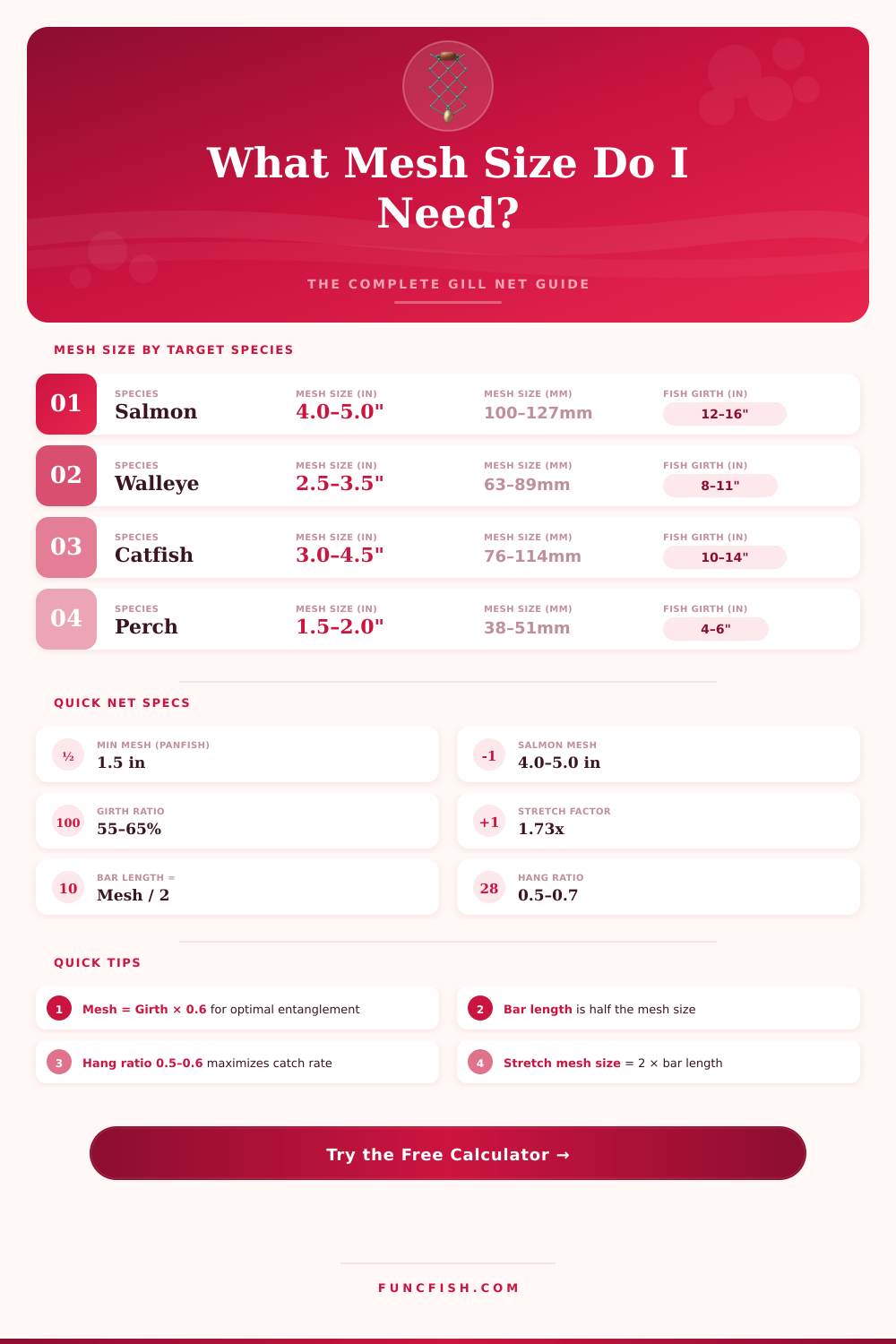
| Species | Mesh Size (in) | Mesh Size (mm) | Avg Girth (in) | Recommended Material |
|---|---|---|---|---|
| Atlantic Salmon | 4.0 – 5.0 | 100 – 127 | 12 – 16 | Monofilament / Nylon |
| Walleye | 2.5 – 3.5 | 63 – 89 | 8 – 11 | Multifilament Nylon |
| Northern Pike | 3.5 – 5.0 | 89 – 127 | 11 – 18 | Polyethylene (PE) |
| Common Carp | 3.5 – 5.5 | 89 – 140 | 12 – 20 | Nylon / Polyethylene |
| Rainbow Trout | 2.5 – 3.5 | 63 – 89 | 8 – 12 | Monofilament |
| Catfish (Channel) | 3.0 – 4.5 | 76 – 114 | 10 – 16 | Polyethylene |
| Yellow Perch | 1.5 – 2.0 | 38 – 51 | 4 – 7 | Monofilament |
| Tilapia | 1.75 – 2.5 | 44 – 63 | 6 – 9 | Nylon / Mono |
| American Shad | 1.75 – 2.5 | 44 – 63 | 5 – 8 | Monofilament |
| Lake Whitefish | 2.0 – 3.0 | 51 – 76 | 7 – 10 | Multifilament Nylon |
| Material | Visibility | Stretch (%) | Knot Strength | Durability | Best Use |
|---|---|---|---|---|---|
| Monofilament Nylon | Very Low | 25–35% | High | Good | Clear water, wary fish |
| Multifilament Nylon | Low | 15–25% | Very High | Very Good | General purpose |
| Polyethylene (PE) | Medium | 5–10% | Medium | Excellent | Heavy duty, pike/carp |
| Dyneema / UHMWPE | Low | 1–3% | Low (slippery) | Excellent | High-performance sets |
| Polyester | Medium | 3–8% | High | Excellent | Saltwater, tidal zones |
| Polypropylene | Medium-High | 5–12% | Medium | Good | Budget, freshwater |
| Cotton (Traditional) | Medium | 8–15% | Very High | Poor | Traditional / artisanal |
| Twisted Twine | High | 10–20% | High | Fair | Deep / murky water |
| Hang Ratio (E) | Net Openness | Best For | Bar Length Equiv | Mesh Shape |
|---|---|---|---|---|
| 0.40 – 0.45 | Very Tight | Tangling / Trammel nets | Short bars, deep mesh | Tall diamond |
| 0.45 – 0.55 | Tight | Active swimming species | Moderate | Diamond |
| 0.55 – 0.65 | Optimal | Most gill net species | Even bars | Square-ish |
| 0.65 – 0.70 | Open | Fast current rivers | Long bars | Wide diamond |
| 0.70 – 0.75 | Very Open | Large pelagic species | Very long | Flat diamond |
To select the proper mesh size for gill nets, a person must take into consideration the types of fish that they are targeting. If the person chooses a mesh size for a gill net that is too large for the species of fish that are to be target, the fish will be able to pass through the mesh and escape from the gill net. If the mesh size is too small for the species of fish that is to be targeted, the fish may becomes entangled in the gill net, experience difficulty in swimming through the gill net, or the gill net may contain bycatch (fish that are not the target species).
To avoid these instances, a person must select a mesh size that matches the widest part of the body of the targeted fish species. The width and girth of the body of the fish are the two more important measurements for establishing the proper size for the mesh of the gill net. In addition to the width and girth of the fish that is to be targeted, a person must also consider the way in which the
Choosing the Right Mesh Size for Gill Nets