Grouper Lifespan Calculator
Estimate grouper age, remaining lifespan, maturity read, and confidence band from species, total length, girth, weight, reef depth class, growth zone, body condition, and measurement confidence.
📌Grouper presets
⚙Grouper growth inputs
Grouper lifespan estimate
Estimated age, lifespan stage, remaining span, maturity, and confidence range will appear here.
Calculation breakdown
📊Grouper species comparison grid
Gag Grouper
Red Grouper
Black Grouper
Goliath Grouper
Scamp Grouper
Snowy Grouper
Yellowedge Grouper
Warsaw Grouper
Nassau Grouper
📘Reference tables
| Species | Typical adult age | Maximum reference age | Maturity reference | Age model note |
|---|---|---|---|---|
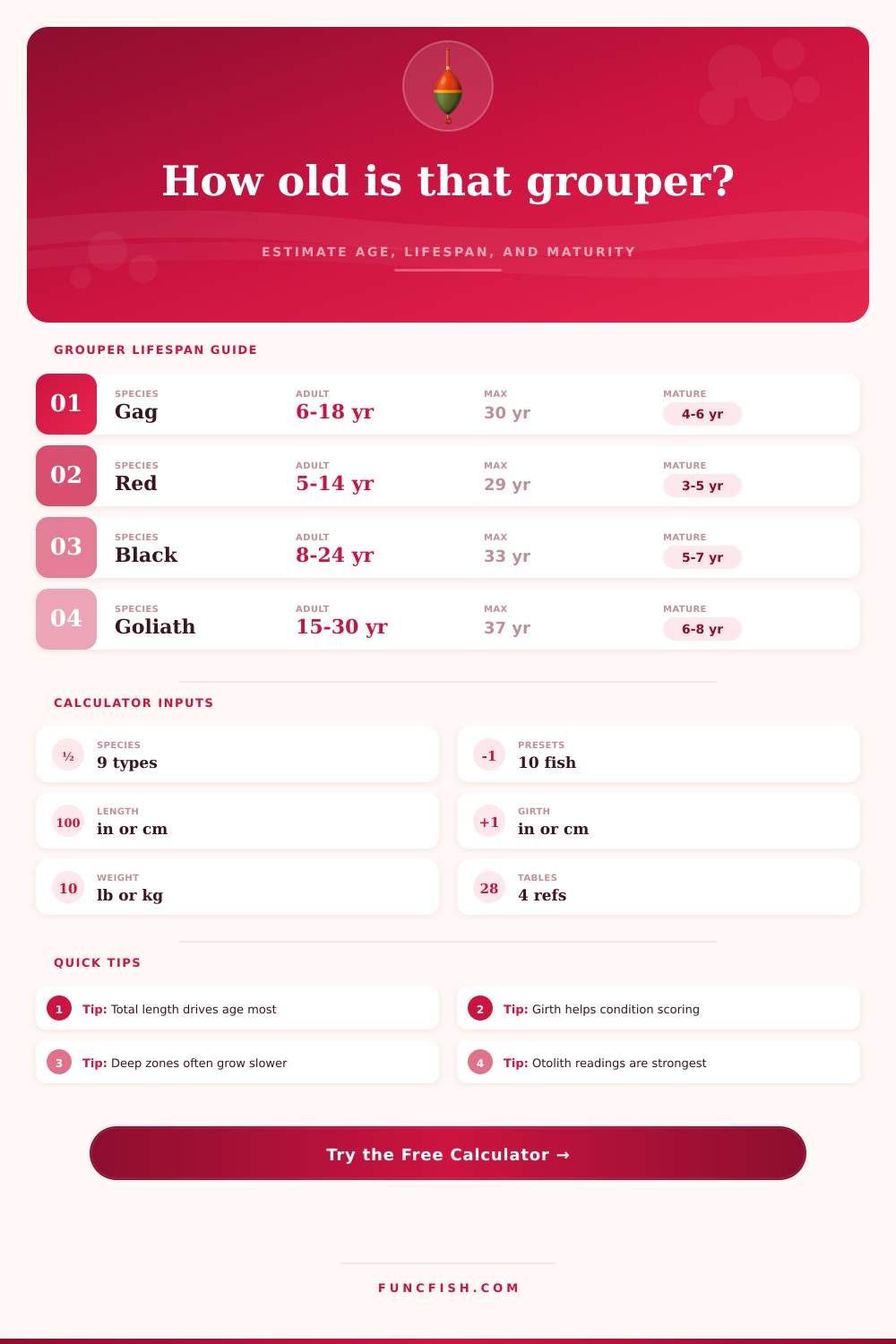
| Gag grouper | 6-18 yr | 30 yr | 4-6 yr | Moderate shelf growth, broad adult range |
| Red grouper | 5-14 yr | 29 yr | 3-5 yr | Earlier maturity and strong length signal |
| Black grouper | 8-24 yr | 33 yr | 5-7 yr | Large adults age slowly after mid-size |
| Goliath grouper | 15-30 yr | 37 yr | 6-8 yr | Very large fish need wider bands |
| Scamp grouper | 6-15 yr | 21 yr | 3-5 yr | Slender species with shelf-edge behavior |
| Depth class | Typical habitat | Age effect | Lifespan effect | When to use |
|---|---|---|---|---|
| Shallow reef | 0-60 ft / 0-18 m | Younger at length | Slightly lower | Patch reef, nearshore reef, clear shallows |
| Mid shelf | 60-180 ft / 18-55 m | Baseline | Baseline | Common reef ledges and shelf structure |
| Deep shelf | 180-450 ft / 55-137 m | Older at length | Higher | Deep ledges, shelf breaks, hard bottom |
| Slope or ledge | 450+ ft / 137+ m | Much older at length | Higher | Deep-drop and continental slope settings |
| Growth zone | Model direction | Condition pattern | Age uncertainty | Calculator note |
|---|---|---|---|---|
| Tropical carbonate reef | Faster early growth | Variable girth | Medium | Warm reef systems can compress early age estimates |
| Subtropical shelf reef | Baseline growth | Average | Low-medium | Use for mixed shelf reefs and ledges |
| Temperate transition reef | Slower adult growth | Often robust | Medium | Cooler water can raise age at length |
| Deep cool-water slope | Slow growth | Heavy-bodied | Higher | Deep species may be much older than size suggests |
| High forage structure | Fast condition gain | Robust | Medium | High weight may reflect feeding rather than older age |
| Input quality | Age band | Best measurements | Weak point | Output behavior |
|---|---|---|---|---|
| Rough visual | Wide | Species and approximate length | No scale or tape | Confidence card stays conservative |
| Tape and scale | Medium | Total length plus weight | Girth may be missing | Condition score refines age slightly |
| Accurate set | Narrower | Length, girth, and weight | Species curve still varies | Band tightens when inputs agree |
| Otolith or tag | Tightest | Known age context | External sizing still approximate | Calculator treats age as strongly anchored |
💡Measurement notes
When total length, girth, and observed weight point in the same direction, the confidence band tightens. A very heavy grouper is not always much older; it can also be in robust body condition for its length.
Deep shelf and slope groupers often need wider age ranges because slow growth makes similar lengths overlap across many years. The calculator reflects that with depth and growth-zone modifiers.
Estimating the age of a grouper is inherantly difficult due to the fact that groupers lives in complex environments, and the growth rates of groupers vary according to an environment in which they live. A grouper that measures 30 inches might be a young adult fish that lives in warm, shallow water, or the same sized grouper might be an older fish that live in cooler, deeper waters. The age of the grouper is a critical measurement in determining whether the grouper population is growing, and for establishing various fishing rules based off that calculation.
Thus, an attempt to estimate the age of a grouper must account for these varying factors. Length is one of the primary measurements use to estimate the age of a grouper, and length measurements typically follow the von Bertalanffy growth pattern for groupers. This pattern suggests that groupers grow quick when they are young, but slow down as they approach the maximum size for that species.
How to Estimate a Grouper’s Age
However, length measurements alone may not lead to the most accurate estimation of the age of the grouper, since two groupers of the same length may be of different age due to differences in there environments. For instance, one grouper might be exposed to abundant food in its habitat, while another might live in an area in which food is scarce. Additionally, girth and weight measurements can also be incorporated into the calculation of the age of the grouper to account for the body condition of the fish.
The maturity stage of the grouper is another of the primary factors that is utilized to estimate the age of that grouper. The maturity stage indicates the minimum age of the grouper. For instance, if a grouper has matured to the point of being able to reproduce, the age of the grouper cannot be younger than the age at which it matured.
This factor prevents error in the length-based age estimation from suggesting that an old grouper is of a younger age than it actualy is. Additionally, along with length, maturity stage allows for the estimation of both the age and the remaining lifespan of the grouper. This remaining lifespan figure provides insight into the age of the grouper within the lifespan of the species.
Finally, a confidence band is provided for the estimated age and remaining lifespan of the grouper. This confidence band will be wider for the age and lifespan estimates if the length, girth, and weight measurements is less certain of accuracy. Accuracy in the measurements of the length, girth, and weight of the grouper is essential in the age estimation calculation.
Visual estimations of length, for instance, might be off by several inch. Thus, the incorrect measurement of any of these three factor will lead to an age estimation error for the grouper. To combat this potential error, the confidence band for the estimated age of the grouper will be wider if any of these three measurements are provided with less certainty; the confidence band will be narrower if the length and weight measurements are provided with more certainty.
Because the age of a grouper can differ according to habitat, depth classes, and growth zones, it is important to provide these factors in the age estimation calculation for the same length of grouper to produce different age estimations. Thus, if an individual selects a depth class and growth zone for the grouper in the estimation calculator, that calculation will lead to different age estimations of groupers of the same length. Body condition also has an effect upon the age of the grouper.
For instance, if a grouper is thin, it may be of a younger age than a grouper of the same length but with a higher weight; thin groupers may have just spawn. Additionally, a grouper that has become very heavy might be of an older age than a grouper of the same length and body condition. These error can be prevented by calculating the expected weight of the grouper based on its length, and comparing that expected weight to its measured weight.
Additionally, the girth of the grouper can also be used to balance the age estimation error. Thus, two groupers of the same length may have different estimated ages based upon their body condition. Although the age estimation calculator does not account for factors like fishing pressure and diseases, those factors can impact the age of the grouper.
For instance, in areas where there is high fishing pressure of the grouper population, there may be fewer instances of the grouper attaining its maximum lifespan. Thus, a grouper that reaches such a long lifespan is a rare find in areas with high fishing pressure. In contrast, groupers in protected areas live longer lives, and grow at slower rates.
Thus, groupers in protected areas might be of an older age while exhibiting a smaller size than the groupers in fished areas. Thus, while the remaining-lifespan figure calculated by the program is a reference for the age of the grouper, it isnt a guarantee that the grouper will live to that calculated remaining lifespan. Overall, though, by utilizing this calculation tool, an individual can make better decisions with regard to groupers based upon biological facts rather than guesses.