Method Feeder Mix Ratio Calculator
Calculate a fishable method feeder batch from loaded feeder size, casts, pellet percentage, groundbait absorption, water conditions, binder strength, liquid attractor, waste margin, and recast pace.
📌Scenario presets
⚙Mix and feeder inputs
Method feeder batch result
Calculation breakdown
🧪Mix component reference
Fishmeal Method
2 mm Micros
Sweet Crumb
River Heavy
🎣Species and feeder comparison grid
Commercial Carp
35-55%Pellet-rich fishmeal method mix, medium compression, 6-10 minute recast, and 2-4% binder for a clean mould release.
F1 Carp
60-85%Soaked micros dominate the feed, with fine groundbait only to open the load and prevent a rubbery plug.
Bream
15-35%Sweet crumb, lower pellet share, and a softer washout keep feed spreading around the feeder without overfilling fish.
River Barbel
20-35%Firm heavy mix, added binder, and longer washout help the load survive the cast and settle in flow.
📊Base mix absorption table
| Base mix | Liquid per 100 g dry | Natural binder | Resting cue | Best method feeder use |
|---|---|---|---|---|
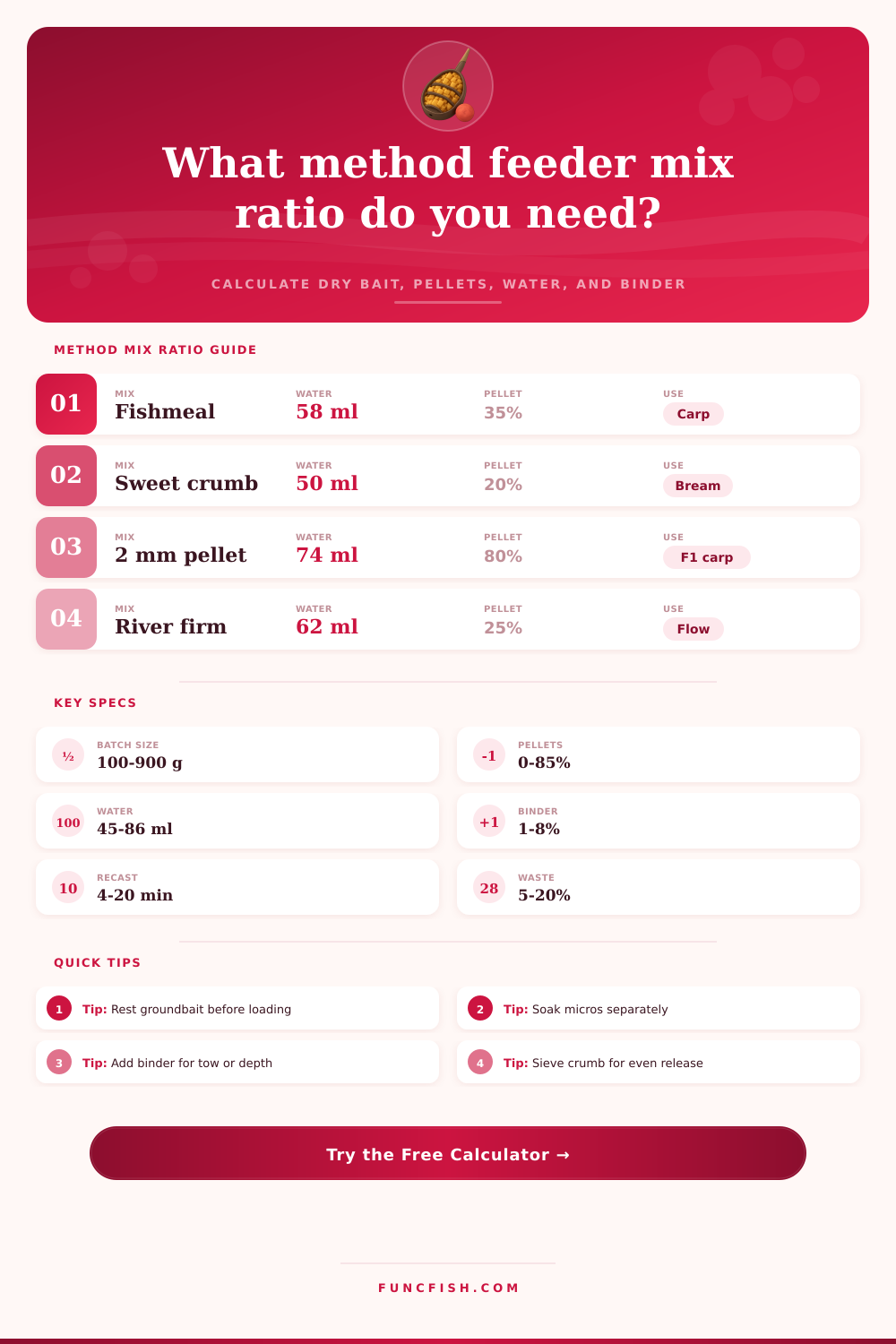
| Fishmeal method groundbait | 58 ml / 1.96 fl oz | Medium, about 3% | Darkens evenly after 5 min | Carp, F1, mixed commercial lakes |
| Sweet crumb groundbait | 50 ml / 1.69 fl oz | Light, about 2% | Crumbs squeeze without cracking | Bream, skimmers, canal edges |
| Soaked 2 mm micros | 74 ml / 2.50 fl oz | Low, about 1% | Pellets flatten but keep shape | F1 carp, summer carp, shallow islands |
| 50/50 micros and groundbait | 66 ml / 2.23 fl oz | Medium, about 3% | Pellets cling to crumb carrier | All-round carp method feeder work |
| Sticky green fishmeal | 62 ml / 2.10 fl oz | Strong, about 4% | Ball compresses with glossy skin | Deep margins, tench, bigger carp |
| Heavy river method mix | 62 ml / 2.10 fl oz | Strong, about 6% | Holds shape after a firm squeeze | Flow, tow, barbel, deep runs |
| Fine winter method crumb | 48 ml / 1.62 fl oz | Light, about 2% | Light squeeze opens in the palm | Cold water carp and cautious bites |
| Halibut pellet method blend | 80 ml / 2.71 fl oz | Medium, about 3% | Oily pellets bind after resting | Tench, barbel, carp in warm water |
📏Feeder style sizing table
| Feeder style | Typical wet load | Compression factor | Normal washout | Ratio note |
|---|---|---|---|---|
| Flat method feeder | 30-50 g / 1.1-1.8 oz | 1.00 | 90-150 sec | Works with standard 1:0.55 to 1:0.70 liquid ratios |
| Hybrid method feeder | 35-55 g / 1.2-1.9 oz | 0.96 | 120-180 sec | Needs slightly stickier bait because sides protect the load |
| Banjo feeder | 20-35 g / 0.7-1.2 oz | 0.90 | 60-120 sec | Best with fine crumb or micros for quick release |
| Mini method feeder | 12-25 g / 0.4-0.9 oz | 0.86 | 45-100 sec | Keep pellet share modest unless bites are very fast |
| Large method feeder | 55-80 g / 1.9-2.8 oz | 1.08 | 140-220 sec | Needs extra liquid resting time for the center of the ball |
| River method feeder | 60-100 g / 2.1-3.5 oz | 1.12 | 180-300 sec | Add binder and reduce quick-release crumb in steady flow |
| Long-cast method feeder | 45-70 g / 1.6-2.5 oz | 1.05 | 130-210 sec | Firm mould pressure lowers crack-off and mid-air loss |
| Open cage method feeder | 35-75 g / 1.2-2.6 oz | 1.02 | 80-170 sec | Use drier mix when you need a faster drop from the cage |
🐟Species ratio reference
| Target | Pellet share | Liquid ratio | Binder range | Recast rhythm |
|---|---|---|---|---|
| Commercial carp | 35-55% | 55-70 ml per 100 g | 2-5% | 6-10 min when fish are present |
| F1 carp | 60-85% | 65-82 ml per 100 g | 1-3% | 4-7 min to build competition |
| Bream and skimmers | 15-35% | 45-60 ml per 100 g | 1-3% | 8-14 min for a carpet feed |
| Tench | 25-45% | 58-72 ml per 100 g | 3-6% | 10-18 min around weed edges |
| Barbel in flow | 20-35% | 58-72 ml per 100 g | 5-8% | 12-20 min with stable feed |
| Cold water carp | 10-25% | 43-55 ml per 100 g | 1-3% | 12-20 min with small loads |
| Roach and skimmers | 0-20% | 42-55 ml per 100 g | 1-2% | 5-9 min with a mini feeder |
| Deep water bream | 20-35% | 55-68 ml per 100 g | 3-5% | 10-16 min after settling |
⚖Condition adjustment table
| Condition | Liquid change | Binder change | Washout change | Use when |
|---|---|---|---|---|
| Still water | Baseline | Baseline | Baseline | Open lake, calm canal, sheltered margins |
| Undertow or tow | +8% | +1% | 18% faster | Feeder rolls, line bows, or bait spreads too soon |
| Steady river flow | +15% | +2.5% | 30% faster | Barbel, chub, or heavy feeder tactics in current |
| Deep venue | +10% | +1.5% | 25% faster | Long fall before the feeder reaches bottom |
| Warm shallow swim | -3% | -0.5% | 12% faster | Active fish, quick feed response, short casts |
| Cold clear water | -7% | Baseline | 15% slower | Small loads, low feed, and cautious bites |
💡Practical mix notes
Two-stage wetting: Add about 80% of the calculated liquid first, rest the mix, then use the remaining liquid to tune squeeze, mould release, and washout speed at the peg.
Pellet-heavy caution: High micro-pellet batches keep absorbing after the first soak. Recheck the mould after 10 minutes and mist with a small part of the reserved liquid if it cracks.
While other variables may enters the process, this calculator does all that hard work and converts those fuzzy emotions into cold, hard percentages. Simply input your desired species, feed type (i.e., pellet, etc.), water parameters and it spits out exact amount of binder, water, pellets and dry base needed for each cast.
For most anglers, mixing baits is more of an art different than a science. They’ll rely on intuition and experience until the mix either liquifies in their hand or turns to powder halfway through the cast. This tool eliminates guesswork when it comes to sizing batches. It’s not just about having enough bait for 1 feeder, but enough for 30, perhaps 40 load during your day. How many casts do you plan on making? How long is the day? The calculator totals it up and provides exactly how much liquid and dry base you need. To be safe, it accounts for wastage. This happens when crumb stick to gloved hands, buckets, and mucky banks. It makes you consider the return first, not half-way into a tournament when you realize you’ve been rushing to soak-up parched powder and missing fish all along.
How to Use the Bait Calculator
That’s where the science comes in, knowing your inputs. There are preset options such as bream canal or commercial carp, but don’t stop there; look deeper. For example, barbel in flow want a heavy sticky blend that will hold its own going downstream, whilst carp mix is better served by a fast-release blend with more pellets. Because sweet crumb and fishmeal groundbait absorbs liquid at different rates, the tool alters the liquid percentage according to your selections. Are you going with something highly micro-pellet dominated? Your absorption rate just spiked. You now require much more volume but you have less time to let it rest. The built-in reference tables gives you a handy sanity check on your gut response. “Typically, commercially available fishmeals require approximately 58 milliliters of water per one-hundred-gram dry weight,” they explain. The soaked microencapsulated particles can absorbs as much as 74 milliliters. Why do those numbers matter? Because it’s all about the binder. A loose mixture with a lighter binder make an appealing bait for still water. You’ll significantly increase that percentage for a running river, where it is crucial to keep your load together during the cast. The calculator takes care of all this for you by automatically adjusting based off your choice of still or flow water conditions. Don’t be like the many anglers who under-bind in moving water.
Another less discussed yet just as important factor is temperature. Slow moving, wary fish in cold water require fewer drops and a slower wash out time. A fast wash-out with a soft mix will be required in warmer shallow swims. This is where the tool adjust the absorption factors so no matter what time of year you’re fishing it’s going to behave accordingly. You may want to turn off the adjustments and stick with your old favorite mix all the time. But bait does not behaving the same on the bottom in cold water versus warm due to metabolisms and water density. Theory becomes practice here.
No matter how well you calculate, you should of still put in approximately eighty percent of the recommended amount. Then, let the solution stand for several minutes to allow the pellets and fibers to expand evenly. Then check the consistency in your palm before topping up with the remaining water or attractor. The two-step procedure prevents over wetting. Overwetting results if you pour all the liquid in and then panic-add more because what you see on the surface appears dry.
Finally, waste is a factor. Crumb gets everywhere and sticks to everything. When building the calculator, we accounted for this waste by adding an extra margin. This ensures you’ll have just enough material to make your last few casts, and no more or less. It might seem like a minor point, but it’s the difference between finishing cleanly versus having to frantically scramble around to piece things back together.
If you let the numbers do the work beforehand, you can save some headspace and use it to pay attention to the rod tip rather than wondering if your next load will hold together. This time when you’re standing on the bank, there’s a jug of water and a bucket of dry crumb and you actualy know what they’re for.