🐟 Musky Weight Calculator
Estimate trophy musky weight from length & girth measurements — imperial & metric
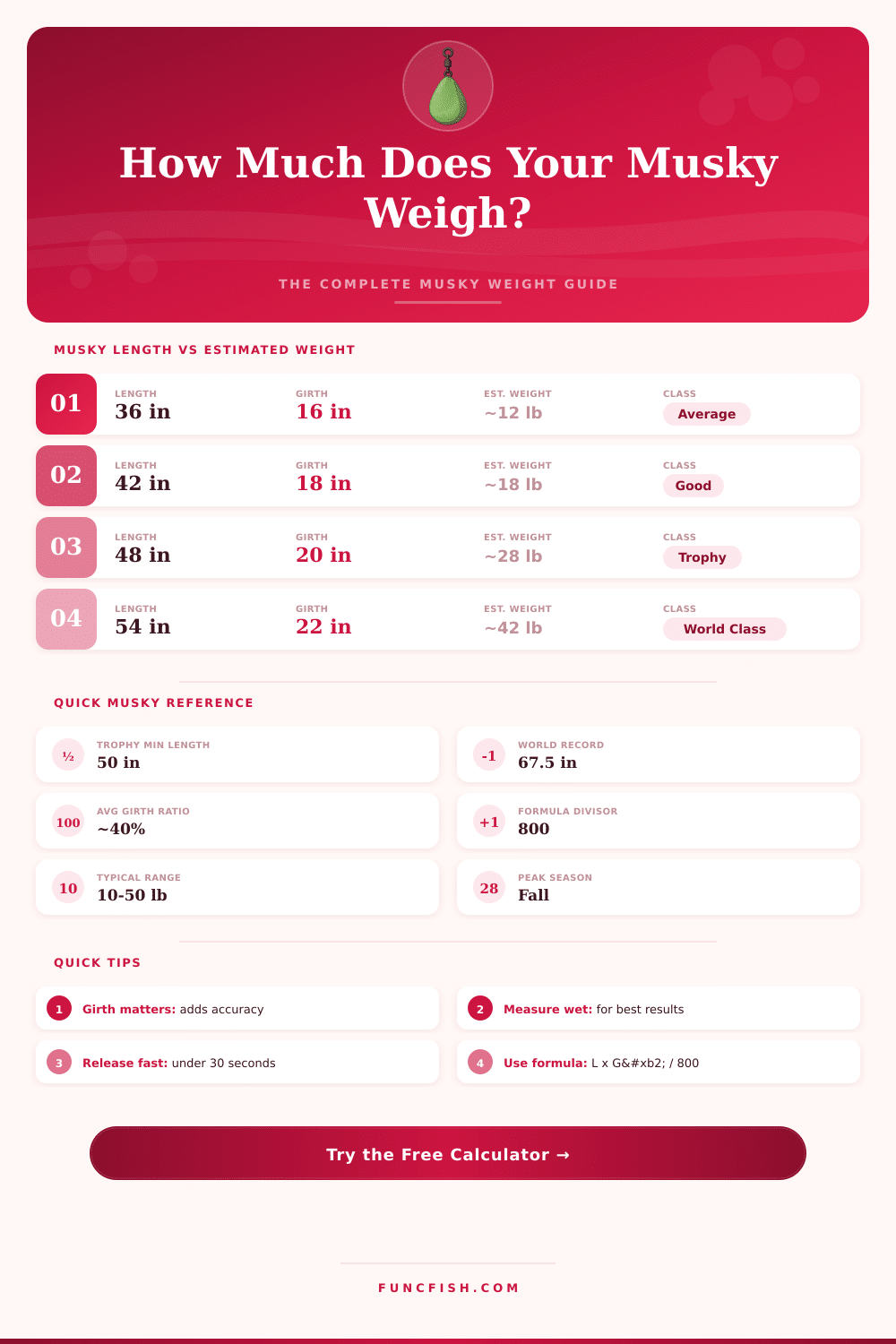
| Length (in) | Length (cm) | Typical Girth (in) | Est. Weight (lb) | Est. Weight (kg) | Classification |
|---|---|---|---|---|---|
| 30 | 76.2 | 13.5 | ~7.7 | ~3.5 | Juvenile |
| 34 | 86.4 | 14.5 | ~9.5 | ~4.3 | Sub-Legal |
| 36 | 91.4 | 15.5 | ~10.9 | ~4.9 | Average |
| 38 | 96.5 | 16.0 | ~12.2 | ~5.5 | Average |
| 40 | 101.6 | 16.5 | ~13.6 | ~6.2 | Good |
| 42 | 106.7 | 17.5 | ~16.0 | ~7.3 | Good |
| 44 | 111.8 | 18.0 | ~17.8 | ~8.1 | Good |
| 46 | 116.8 | 19.0 | ~20.8 | ~9.4 | Notable |
| 48 | 121.9 | 20.0 | ~24.0 | ~10.9 | Notable |
| 50 | 127.0 | 21.0 | ~27.6 | ~12.5 | Trophy |
| 52 | 132.1 | 21.5 | ~30.1 | ~13.7 | Trophy |
| 54 | 137.2 | 22.5 | ~34.2 | ~15.5 | Trophy |
| 56 | 142.2 | 23.0 | ~37.1 | ~16.8 | World Class |
| 60 | 152.4 | 25.0 | ~46.9 | ~21.3 | World Class |
| Formula Method | Formula | Best Use | Accuracy |
|---|---|---|---|
| Standard (with girth) | L x G² / 800 | All musky; most accurate | ★★★★★ |
| Length Only | L³ / 3500 | Quick field estimate | ★★★ |
| Girth-Heavy | L x G² / 750 | Fat fall fish | ★★★★ |
| Slim Adjustment | L x G² / 850 | Lean post-spawn | ★★★★ |
| Quick Release | L x G² / 900 | Boat-side estimate | ★★★ |
| Type | Avg Adult Length | Avg Adult Weight | World Record |
|---|---|---|---|
| Muskellunge (Pure) | 28–48 in (71–122 cm) | 15–36 lb (7–16 kg) | 67.3 lb (30.5 kg) |
| Tiger Musky (Hybrid) | 24–40 in (61–102 cm) | 10–20 lb (4.5–9 kg) | 51.3 lb (23.3 kg) |
| Great Lakes Strain | 36–60 in (91–152 cm) | 20–50 lb (9–23 kg) | Regional records |
| Northern Strain | 30–48 in (76–122 cm) | 12–30 lb (5.4–13.6 kg) | State records vary |
When talking about members of the Musky family, the head and the shoulders of the Musky are fairly broad compared with the rest of the body. In perfect conditions, those top predators can grow to between 60 and 70 inches while their Weight can reach almost 70 pounds. Even so most many Musky stay around 48 inches long (that is around four feet).
The average one weighs close to 36 pounds. Usually one finds them with length between 28 and 48 inches, and weights that range from 15 to 36 pounds. Although, some rare ones pass 6 feet and reach even 70 pounds.
Musky Size and Weight
The biggest Musky, that was officially measured, had 72.04 inches of length and 70.10 pounds of Weight. For the official world record, it measured 72 inches and weighed 67 pounds 8 ounces. In November 2000, Martin Arthur Williamson caught a 61.25-pound sample from the Georgian Gulf.
Fish that pass the 60-pound limt are truly rare, when Musky become this big, they tend to gain muscle and fat especially in the middle part of the body.
The Weight always was the most reliable way to estimate the real size of Musky. Length alone does not suffice, because two Musky can have very different body shapes. For instance, you could meet a thin fish and a thick fish with the same length, but with entirely different weights.
So fishers prefer to use the Weight as the main sign.
To estimate the Weight of Musky without weighing it, there are several different methods. Some of them combine length and girth in the calculation. One of them is made up of using the length measure, start from basic Weight, then expand for fat fish or reduce for slim.
For tiger Musky, who are hybrids between pike and Musky, 36-inch ones usually weigh around 12 pounds. 40-inch ones commonly have around 16 pounds. When you reach 43 inches, you almost always pass the 20-pound limit.
Here is a formula that uses the girth: take 0.75 of the girth, square the result, multiply it by the length, and divide by 800. Or the Modified Crawford Formula, that multiplies length in inches by girth in inches, divide by 25 and subtract 8. This method works better four fish above 50 pounds.
If you do not like formulas, simple printed charts do all the math for you.
When you catch a Musky, it is key to cut the time in air. Do not keep it outside water more than one minute, although two minutes are the most if you truly must. Photos, weighing and measuring must happen quickly.
Before release, hold it carefully by the belly and the lower jaw, and slide it back in the water. For your rod and line, choose somethingstrong enough to handle fish of 5 to 10 pounds in the lighter range, up to those 30 to 50-pound giants.