
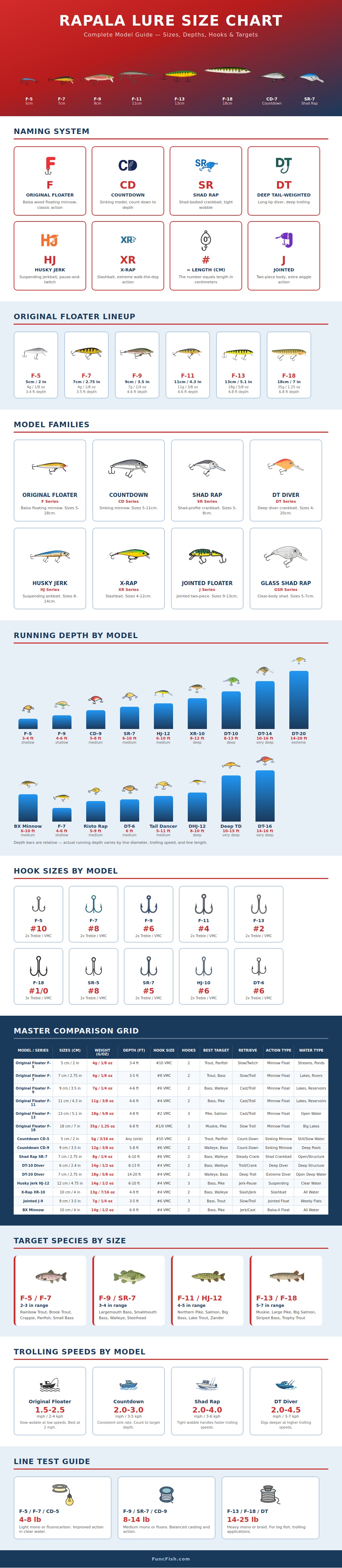
The Rapala lure naming system allow people to quickly learn the size and the function of each Rapala lure. Each Rapala lure have a prefix and a number. The prefix will let you know the movement of the Rapala lure in the water.
The number will let you know the length of the Rapala lure in centimeters. For example, the prefix F stands for an Original Floater. The Original Floater Rapala lure has a balsa body that allow it to remain near the water’s surface.
How Rapala Lure Names Tell Size and Movement
The prefix CD stands for Countdown. If you use this Rapala lure, it will eventualy sink to a specific depth in the water that you can calculate by counting the second that you retrieve the Rapala lure. The prefix SR stands for Shad Rap.
This Rapala lure will have a tight wiggling profile. Finally, the number will let you know the length of the Rapala lure in centimeters. You need to choose the correct Rapala lure size because the size of the Rapala lure will impact the types of fish that will react to the lure.
If you use small Rapala lure, they will help you catch small fish such as trout or panfish. If you use medium Rapala lures, they will help you catch species like bass or walleye. Large Rapala lures will allow you to catch large fish such as pike or muskie.
Using a lure that is too large for the type of water in which you are fishing may spook the fish. Additionally, if the Rapala lure that you are using is too small for the type of fish that you are trying to catch, the fish wont notice the Rapala lure. Another factor to consider is the depth at which the Rapala lure will travel.
For Rapala lures with short lips, for example, shallow runners, the Rapala lure will remain near the surface of the water. Rapala lures with longer lips, such as deep divers, will travel far into the water. The depth of the Rapala lure depends on the lip of the Rapala lure.
However, the more faster that you retrieve the Rapala lure, the deeper that the Rapala lure will travel into the water. The hooks on a Rapala lure are scaled to the Rapala lure size. Small Rapala lures will have smaller treble hooks on the Rapala lure.
Large Rapala lures will have large and stout treble hooks on the Rapala lure. The fishing line that you use should also match the Rapala lure size. If the fishing line that you use is too light for the Rapala lure that you are using, a large fish may pull the hooks out of the fishs mouth.
If the line is too heavy for the Rapala lure size, the line may prevent the Rapala lure from moving in the water the way that it should. Finally, there are different methods in which you can retrieve the Rapala lure. You can use a steady crank retrieval or a jerk pause method to retrieve the Rapala lure.
Additionally, slow trolling speeds will allow the Rapala lure to wobble in the water. If you are using Rapala lures at faster trolling speeds, the Rapala lure will go to great depths in the water. Test the retrieval methods that you use in the water to find the best retrieval method for the Rapala lure that you are using.
Following the Rapala lure naming system and the Rapala size charts will help you to choose the correct Rapala lure for the depth and type of fish that you are trying to catch.