Snook Lifespan Calculator
Estimate common, fat, or tarpon snook age, likely lifespan, maturity, habitat fit, temperature stress effect, growth-region read, and confidence from total length and weight.
📌Snook presets
⚙Snook measurements and reference factors
Snook lifespan estimate
Estimated snook age, lifespan, maturity, and confidence will appear here.
Calculation breakdown
🧭Snook habitat and growth grid
Mangrove nursery
Open estuary
Inlet channel
Tidal river
📊Snook reference tables
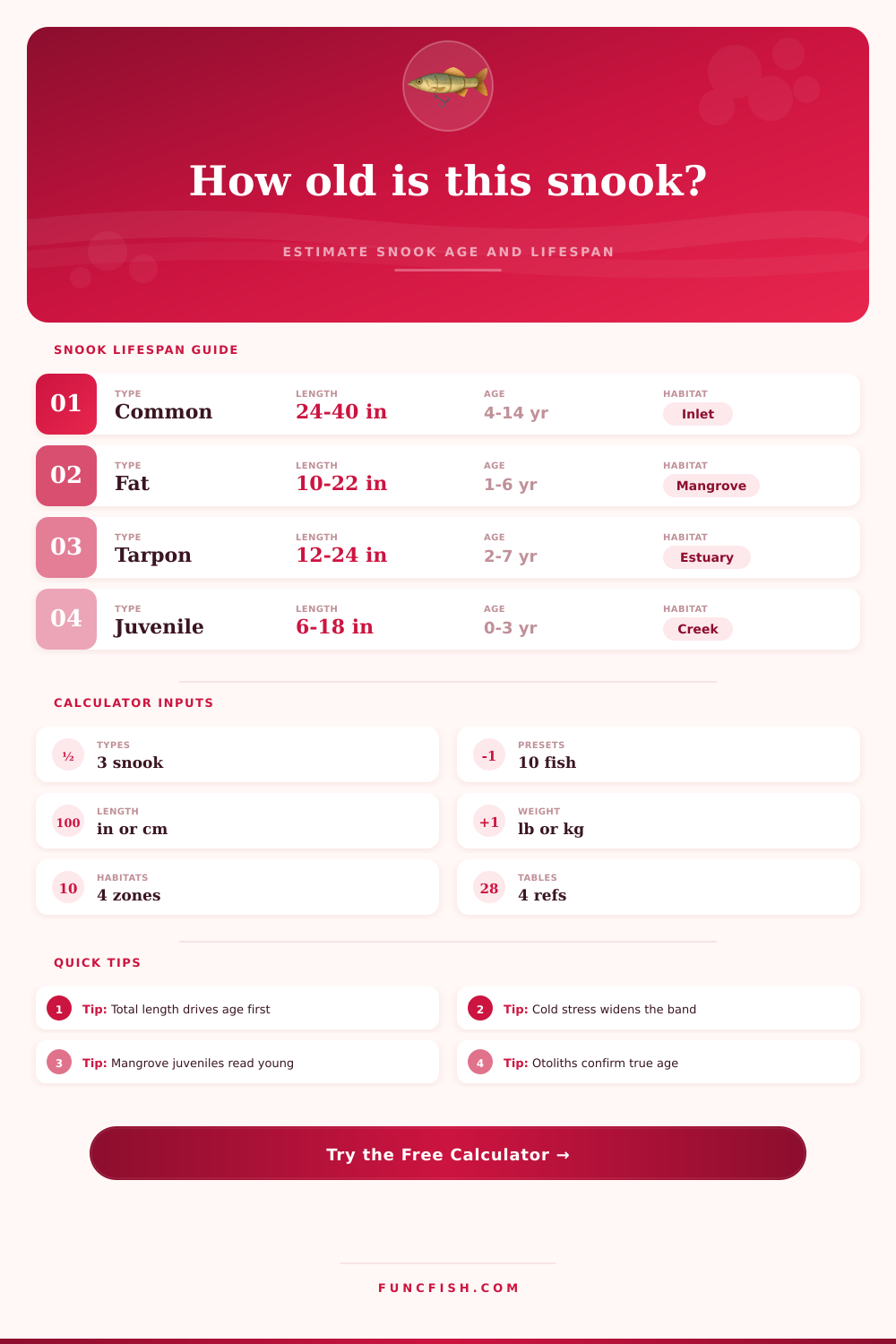
| Snook type | Common adult length | Likely field age | Upper reference | Model note |
|---|---|---|---|---|
| Common snook | 24-40 in / 61-102 cm | 4-14 years | About 21 years | Longer-lived, large inlet and estuary adults can span broad ages |
| Fat snook | 10-22 in / 25-56 cm | 1-6 years | About 8 years | Smaller body form, quick early growth, shorter upper band |
| Tarpon snook | 12-24 in / 30-61 cm | 2-7 years | About 9 years | Small to mid-size snook with estuary and creek overlap |
| Juvenile snook | 6-18 in / 15-46 cm | 0-3 years | Type dependent | Mangrove and tidal creek habitat keeps the estimate younger |
| Temperature band | Reference range | Age effect | Lifespan effect | Confidence effect |
|---|---|---|---|---|
| Cold stress | Below 60 F / 16 C | Older at length possible | Lower upper band | Wide band |
| Cool edge | 60-68 F / 16-20 C | Slightly older at length | Slightly lower | Moderate spread |
| Optimal band | 72-82 F / 22-28 C | Baseline growth | Baseline upper band | Best fit |
| Warm or hot stress | 82+ F / 28+ C | Growth fit varies | Upper band tapers | Wider band |
| Habitat | Typical snook signal | Length context | Weight context | Calculator treatment |
|---|---|---|---|---|
| Mangrove creek | Nursery or small resident fish | Short to mid length | Lean to average | Reduces age unless length is large |
| Open estuary | Mixed juvenile and adult fish | Broad size range | Average body shape | Baseline habitat reference |
| Inlet or pass | Adult movement corridor | Mid to large fish | Often robust | Raises maturity and age signal |
| Tidal river mouth | Mixed salinity transition | Variable size | Variable condition | Wider band, slight young pull |
| Input quality | Length | Weight | Reference evidence | Result impact |
|---|---|---|---|---|
| Rough visual | Estimated | Estimated or blank | None | Widest age and confidence band |
| Field estimate | Tape measured | Estimated | Habitat observed | Normal calculator band |
| Measured | Tape measured | Scale measured | Habitat observed | Narrower condition and age band |
| Sampled context | Measured | Measured | Tag, sample, or otolith context | Strongest confidence setting |
💡Snook estimate tips
For common, fat, and tarpon snook, total length anchors the age model. Weight changes condition and confidence more than it replaces the length-at-age estimate.
Cold or hot stress bands widen the estimate because growth and survival signals can separate. Use the band that best matches the fish habitat context.
Snook live in a variety of different environment, from mangrove creeks to open estuaries and inlet channels. The length of a snook can tell you much about the age of that snook. For instance, a twenty-eight inch snook that live in warm water may only be four years old, but the same sized snook that lived in cooler water in the northern regions of snook habitat may be eight years old.
The age of the snook is important in that it can help to determine whether the snook population is reproducing within the habitat, or if the snook population is comprise of only the older members of that species. Length is the main measurement used to estimate the age of the snook. Snook of different species may have different lengths and lifespans; common snook tend to be larger and live more longer than fat snook or tarpon snook.
How to Tell a Snook’s Age
Thus, a specific length of snook can mean different things according to the species of that snook. Weight is another way of providing additional information regarding the snook; heavy snook can be an indication of the age of the snook, as well as the amount of food that the snook has been provide. Snook that are very heavy may be an older snook that has been well-fed, while snook that are skinny may be either young or stressed snook.
The calculator utilizes both the length and the weight of the snook to calculate its age, as well as utilizes information regarding the habitat, temperature, and region to provide additional accuracy to those calculations regarding age. The water temperature in which the snook lives can impact how the length of the snook translates to age. If the water temperatures in which a snook lives are below sixty degrees, the snook will experience a slowing of its metabolism, which may slow the snook’s growth rate.
Conversely, if the water temperatures in which a snook lives are above eighty-eight degrees, its growth rate may increase, though the survival rate of those snook may decrease. Thus, the temperature that is selected for input into the calculator is the temperature of the water in which the snook lives; the air temperature should not be select. The habitat of the snook can also impact the age calculation.
For instance, the mangrove nurseries where young snook live may indicate that a snook of a given length in a mangrove nursery is of an older age than a snook of the same length found in an inlet pass. Tidal river mouths contains snook of all sizes and contain different salinities, which can make it difficult to determine the growth rates of snook that live in these environments. Thus, the habitat of the snook can also be used in calculating the age of the snook; however, to utilize this value on the calculator, the user must observe the habitat of the snook.
Another factor that may help to provide information regarding the age of the snook is the maturity stage of the snook. Common snook, for instance, are typically capable of spawning once they reach a length of twenty-two inch. However, while the snook are of optimal condition, a snook of the required length may reach that size in three years of optimal living conditions, but may take five years to reach that length if the snook lives in water that is exposed to cool climates year-round.
Thus, inputting the information regarding the maturity stage of the snook can help to provide additional information regarding its age. Geographical region where the snook lives may factor into the calculation of the age of the snook. For instance, the estuaries located in South Florida are often used as the baseline for the snook’s age, though snook in the Caribbean coast grow faster when young than snook in the northern edges of there habitat.
These different regions of snook habitats have an impact upon the calculated age of the snook and its potential lifespan. Thus, the snook calculator may also factor the region where the snook lives into the age calculation. Other information regarding the body condition of the snook may also provide additional information to the calculator regarding the age of the snook.
For instance, a robust snook is likely either well-fed or an older snook. Likewise, a lean snook may be experiencing stress or have a physical build that is different than other snook of the same length. Thus, while the body condition of the snook may factor into the snook age calculation, its impact upon age may be small and one part of the total information available regarding the snook.
The quality of the information that is provided for the snook calculator will impact the trustworthiness of the age calculation provided by the snook calculator. For instance, if only length is provided for the snook as an estimate, the age calculation will be less accurate than if length, weight, and habitat are provide. Thus, the better the information provided by the observer of the snook, the more narrow the uncertainty band for the age of the snook that is calculated by the snook age calculator.
The value of the information provided by the calculator can be used in a variety of ways. For instance, if the calculator reveals that the snook in a certain creek are of an old age, the health of that snook population may require additional protection. If the snook are young, investigations into the survival rate of the snook in that location may be require.
Thus, this information becomes valuable only when observed for a variety of snook over time. The age of the snook can be determined by calculating a range of possible ages for the snook, as opposed to providing the age of the snook itself. These calculations can be performed with length, weight, temperature, habitat, and the quality of the information regarding the snook.
Thus, the snook age calculator can help to provide the range of the age of the snook, but also requires that the observer of the snook understands the habitat in which the snook live.