🐟 Speckled Trout Weight Calculator
Estimate spotted seatrout weight from length & girth — imperial & metric supported
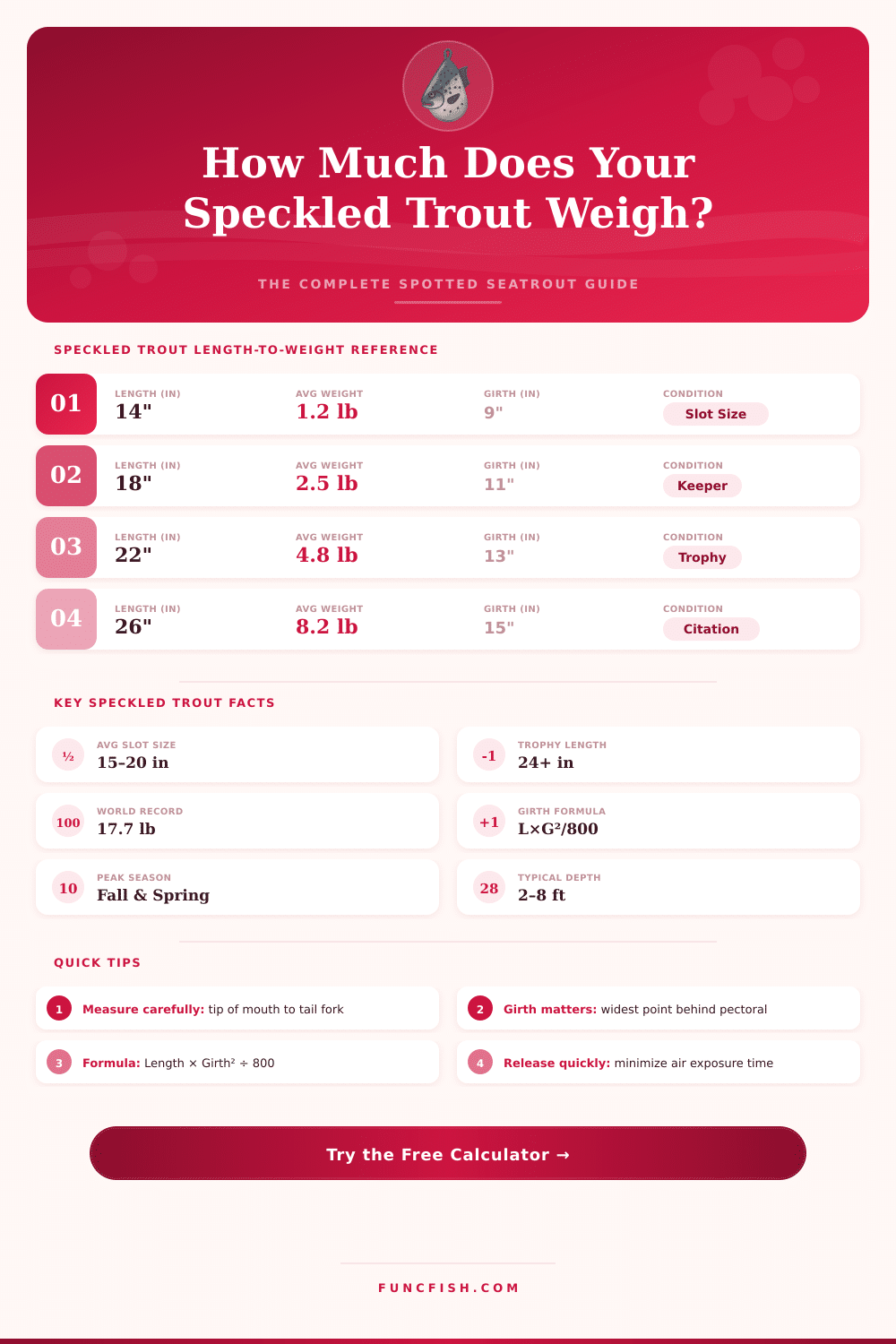
| Length (in) | Length (cm) | Est. Weight (lb) | Est. Weight (kg) | Typical Girth (in) | Classification |
|---|---|---|---|---|---|
| 12 | 30.5 | 0.9 | 0.41 | 8 | Sub-legal |
| 14 | 35.6 | 1.3 | 0.59 | 9 | Slot Minimum |
| 16 | 40.6 | 1.9 | 0.86 | 10 | Slot Size |
| 18 | 45.7 | 2.6 | 1.18 | 11 | Keeper |
| 20 | 50.8 | 3.5 | 1.59 | 12 | Good Fish |
| 22 | 55.9 | 4.8 | 2.18 | 13 | Quality |
| 24 | 61.0 | 6.3 | 2.86 | 14 | Trophy |
| 26 | 66.0 | 8.2 | 3.72 | 15 | Trophy+ |
| 28 | 71.1 | 10.4 | 4.72 | 16 | Citation |
| 30 | 76.2 | 13.0 | 5.90 | 17 | State Record |
| Condition | Condition Factor (K) | Description | Typical Season |
|---|---|---|---|
| Slim / Post-spawn | 0.85 | Lean body, recently spawned | Summer |
| Standard / Average | 1.00 | Normal healthy trout | Year-round |
| Fat / Pre-spawn | 1.15 | Heavy, actively feeding | Fall |
| Trophy / Bull Trout | 1.25 | Exceptional girth, top condition | Late Fall |
| Formula | Best For | Accuracy | Requires Girth? |
|---|---|---|---|
| Girth Formula (L x G² / 800) | Live fish, catch-and-release | ±5% | Yes |
| Anderson-Neumann (L³ / 1200) | General estimate, no girth | ±12% | No |
| TPWD Formula (0.000189 x L³) | Texas/Gulf Coast trout | ±10% | No |
| Power Law (a x Lᵇ) | Precise scientific estimates | ±7% | No |
| Fish Size | Rod Power | Line (lb test) | Hook Size |
|---|---|---|---|
| Under 2 lb (under 16") | Ultra-light to Light | 6–10 lb | #2 to #1/0 |
| 2–4 lb (16–21") | Light to Medium-Light | 10–15 lb | #1/0 to #2/0 |
| 4–7 lb (22–26") | Medium-Light to Medium | 15–20 lb | #2/0 to #3/0 |
| 7+ lb (over 26") | Medium to Medium-Heavy | 20–30 lb | #3/0 to #4/0 |
Guessing the Weight of fish often turns out surprisingly hard, whether you recently caught something big or pulled it from the water to check the Weight of your catch without a proper scale around. There are several reliable ways that work well for this.
A method often used involves a formula based on the length of the fish and body measures. Here is how it works: you take the girth square it, then multiply that result by the length. Then you divide everything by 800 to reach rough Weight in pounds.
How to Guess a Fish’s Weight Without a Scale
Both values must be in inches for this to work. For instance, if you caught a fish with a 15-inch girth and 29-inch length, you pass those through the math and you get a rough number. The number 800 can shift a bit more up or below based on the species in your region, that tends to be thicker or thinnre than average.
You often use this method for trout.
If you do not have a proper girth measure, here is a fix. You can use 0.58 times the length as a replacement for girth. Even so, these formulas have there limits.
Fish long and thin or short and strong can weigh very differently, even if they have the same total length. Length-only math really can fool you with species like pike, whose body shape makes you think about its build.
For truly weighing fish, a scale with a lip grip makes the task easier. You simply clip the grip to the center of the bottom jaw and you are done. When your scale has only a hook clip, you take a separate lip grip, weigh it, then use the tare function to remove the Weight of the grip itself.
Digital hanging scales with a max around 110 pounds are very common now, and many come with lit screen displays thatmake them much easier to read in dark light.
Here is something to recall: fish quickly loses Weight after it exits from the water. Blood loss, vomiting and waste all affect it. Even so, the main cause?
Loss of water usually hits most strongly. Fish always works to keep its internal water balance through regulation, and after it leaves the water, that system quickly crashes.
Some anglers simply skip Weight entirely and only measure the length. Weight changes, but the length of fish stays the same. That makes length a much safer sign for the real size of a fish.
It is especially useful when you release the fish… Keeping the time from water short helps more than exact Weight math.
There is also a handy tool called a fish press, that works like a burger press. When you cook skin-on pieces, the skin quickly curls upward when it touches the hot surface, which causes uneven cooking and soft, chewy skin. The press keeps everything flat, so the skin can cook and become crisp while the meat below cooks evenly.