🧸 Swordfish Weight Calculator
Estimate swordfish weight from length & girth measurements — trophy ratings, gear specs & metric equivalents
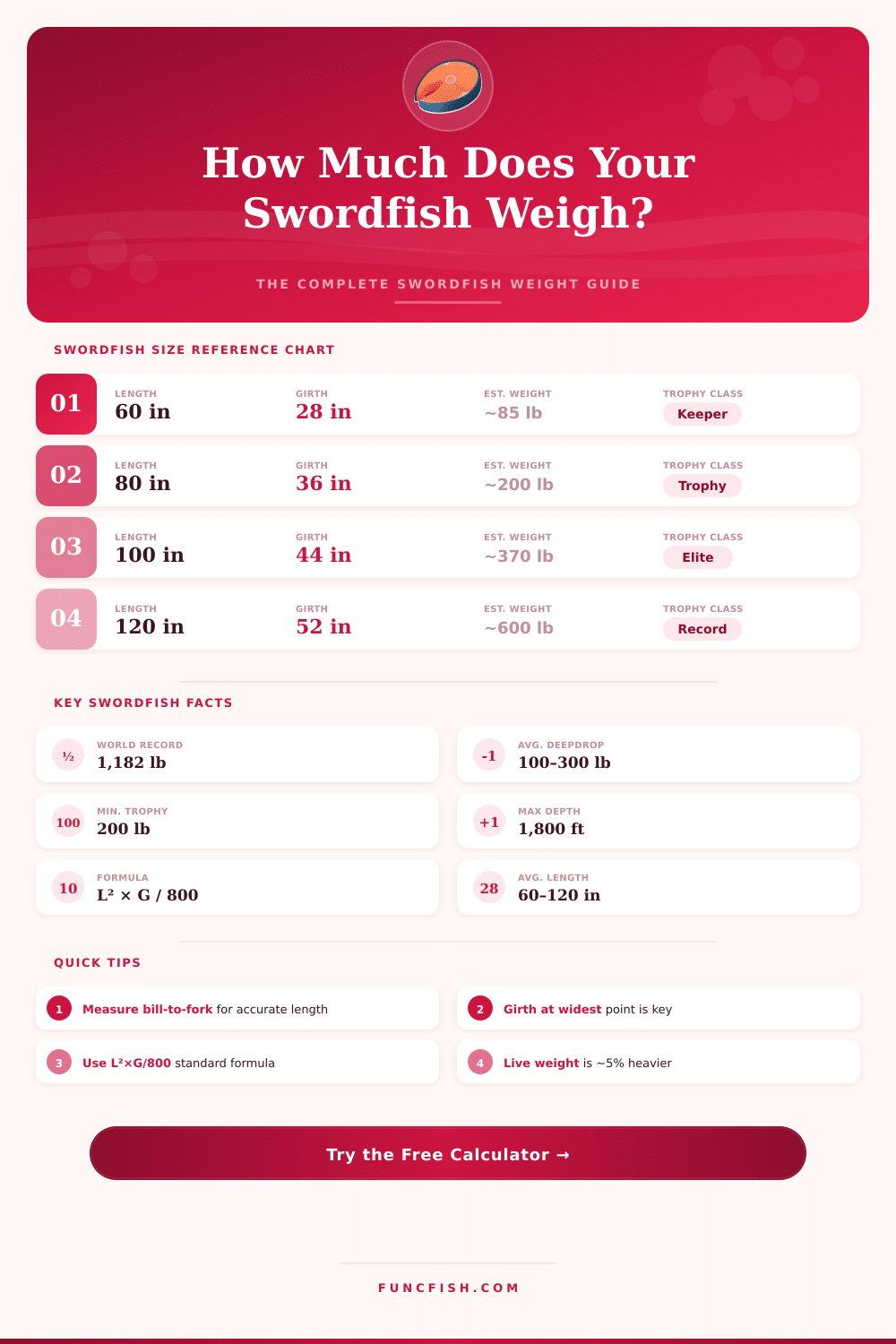
| Fork Length | Girth (Approx) | Est. Weight (lb) | Est. Weight (kg) | Trophy Class |
|---|---|---|---|---|
| 50 in (127 cm) | 24 in (61 cm) | ~60 lb | ~27 kg | Juvenile |
| 60 in (152 cm) | 28 in (71 cm) | ~85 lb | ~39 kg | Keeper |
| 70 in (178 cm) | 32 in (81 cm) | ~125 lb | ~57 kg | Good Fish |
| 80 in (203 cm) | 36 in (91 cm) | ~200 lb | ~91 kg | Trophy |
| 90 in (229 cm) | 40 in (102 cm) | ~270 lb | ~122 kg | Trophy+ |
| 100 in (254 cm) | 44 in (112 cm) | ~370 lb | ~168 kg | Elite |
| 110 in (279 cm) | 48 in (122 cm) | ~480 lb | ~218 kg | Elite+ |
| 120 in (305 cm) | 52 in (132 cm) | ~600 lb | ~272 kg | Record Class |
| 140 in (356 cm) | 60 in (152 cm) | ~900 lb | ~408 kg | Near-Record |
| 152 in (386 cm) | 65 in (165 cm) | ~1,182 lb | ~536 kg | World Record |
| Fish Weight | Rod Class | Line Strength | Reel Type | Technique |
|---|---|---|---|---|
| Under 100 lb | 20–30 lb class | 20–30 lb mono | Medium conventional | Light drifting |
| 100–200 lb | 50 lb class | 50 lb mono / 65 lb braid | Heavy conventional | Deepdrop/drift |
| 200–400 lb | 80 lb class | 80 lb mono / 100 lb braid | 2-speed conventional | Deepdrop/night |
| 400–700 lb | 130 lb class | 130 lb mono | IGFA tournament reel | Night/kite |
| 700 lb+ | Unlimited | 150–200 lb mono | Large capacity 2-speed | Tournament |
| Species | Avg. Weight | Max Weight | Typical Length | Recommended Gear |
|---|---|---|---|---|
| Swordfish | 100–300 lb | 1,182 lb (536 kg) | 60–140 in | 80–130 lb class |
| Blue Marlin | 200–400 lb | 1,402 lb (636 kg) | 84–168 in | 80–130 lb class |
| Black Marlin | 200–500 lb | 1,560 lb (708 kg) | 90–180 in | 130 lb class |
| Striped Marlin | 80–200 lb | 494 lb (224 kg) | 72–120 in | 30–50 lb class |
| Sailfish | 40–100 lb | 221 lb (100 kg) | 60–120 in | 20–30 lb class |
| Spearfish | 30–60 lb | 114 lb (52 kg) | 48–72 in | 20 lb class |
swordfish rank among the heaviest leaders of the sea. They got their name because of that unique long and flat bill that looks like a sword; and it is not something small because it forms almost a third of the whole body length of the fish. Those creatures of the ocean live in waters around the whole world and hunt with great accuracy, using their sharp bill to cut squids and smaller fishes with crushing impact.
When talking about their whole size, most swordfish reach around 10 feet or about 3 metres. The biggest one officially measured almost 15 feet, namely 4.55 metres. They can grow to lengths of around 14 feet and reach weight of around 1 200 pounds, although the record maximum mass that was ever recorded was 650 kilos or around 1 430 pounds.
Swordfish Size and Weight
Here is something interesting: the females beat the males. That is quite a big difference, if one thniks about the gaps between them.
Most swordfish that you will meet have weight between 200 and 400 pounds with typical length of around 10 feet. At fish markets, they commonly weigh from 50 to 200 pounds, average around 125 pounds. Also, those that one fishes commercially in the Pacific usually measure between 47 and 75 inches.
Sport fishermen usually catch swordfish in the range of 250 to 500 pounds, with lengths between 6 and 9 feet. The record fish weighed almost 1 200 pounds and was likewise around 14 feet. It was caught off the coast of Chile in 1953, after a two-hour struggle bent the triple strong hooks.
Rhode Island has its own state record at 434 pounds, that beat the prior mark of 360 pounds, that stayed unchanged since 1960. Back in 1917 one topped a 463-pound fish as the world record at that time.
The physical form of swordfish ranges a lot between individuals, which makes the guess of weight based only on length very doubtful. A swordfish of 100 inches could way around 400 pounds, but another one of the same length could easily reach almost 600 pounds. That range makes the calculation of weight almost impossible.
That fish grows surprisingly quickly, we talk about eight to a quarter inch daily. Young swordfish start to eat smaller fishes, and the more they eat, the more quickly they grow. Here is the weird part: young swordfish have teeth and scales, but they lose both before reaching 10 pounds.
When winter arrives, they move to tropical breeding grounds like the Caribbean. Females can carry up to 16 millions of eggs during thebreeding season.
swordfish can reach up to 5 metres, partly thanks to that extended sword of theirs. They mostly are smaller than marlins, yet manage to reach impressive weights. Up to around 650 kilos.