Tournament Weight Calculator
Estimate scored bag weight, average fish, cull target, standings gap, confidence range, and generic event scoring adjustments from individual fish weights.
📌Tournament presets
⚙Scoring inputs
The calculator scores the heaviest eligible fish up to the event limit.
Adjust only for your event format, not for local rules or eligibility.
Enter each fish in pounds or switch the scale to ounces.
Tournament scoring estimate
Calculation breakdown
🎣Gear and species comparison grid
Bass Team Bag
Walleye Team Bag
Panfish Bag
Catfish Heavy Bag
📊Reference tables
| Event format | Common scored fish | Useful entry scale | Best use in calculator |
|---|---|---|---|
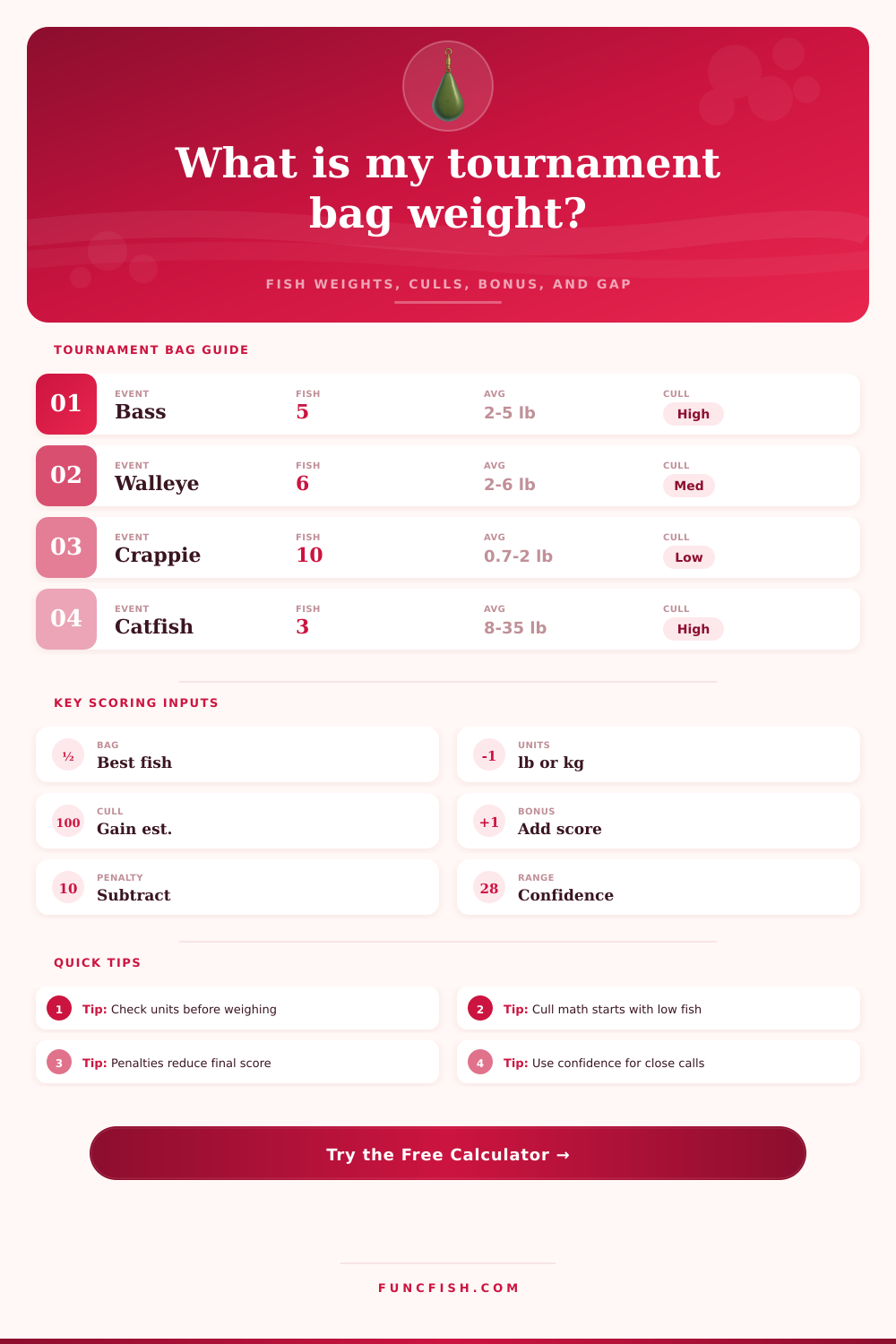
| Bass team event | 5 fish | Pounds with decimals | Track low-fish culls and podium gap |
| Kayak aggregate | 3 fish | Pounds or kilograms | Estimate compact-bag upgrades |
| Walleye team event | 6 fish | Pounds with decimals | Balance average fish against one kicker |
| Panfish event | 7 to 10 fish | Ounces or grams | Use small cull gains across many fish |
| Catfish heavy event | 1 to 3 fish | Pounds or kilograms | Compare big-fish swing against penalties |
| Species group | Typical event fish | Cull pattern | Confidence note |
|---|---|---|---|
| Largemouth and smallmouth bass | 2 to 6 lb / 0.9 to 2.7 kg | Upgrade the smallest keeper first | Close bags need precise scale reads |
| Walleye | 2 to 7 lb / 0.9 to 3.2 kg | One larger fish can swing the bag | Use same scale method all day |
| Crappie and panfish | 10 to 32 oz / 280 to 910 g | Many small upgrades add up | Ounce or gram mode is cleaner |
| Trout | 1 to 8 lb / 0.5 to 3.6 kg | Average size drives most standings | Moist nets and scale motion add range |
| Catfish | 8 to 35 lb / 3.6 to 15.9 kg | One replacement can be decisive | Heavy bags benefit from repeat reads |
| Generic scoring item | Calculator field | Math treatment | When it matters most |
|---|---|---|---|
| Livewell event deduction | Penalty count x penalty each | Subtracts from gross bag | When the field is separated by ounces |
| Time or check-in deduction | Time penalty | Subtracts after fish total | When returning late changes placement |
| Other event deduction | Other event penalty | Subtracts as generic score math | When a format has extra scoring rules |
| Bonus weight or add-on | Bonus field | Adds before final comparison | When bonus fish or side scores apply |
| Cull situation | Best input | Target logic | Result to watch |
|---|---|---|---|
| No full limit yet | Fish count below limit | Any added fish can raise the bag | Bag weight and average fish |
| Full limit, one low fish | One cull opportunity | Replacement must beat the smallest fish | Cull target card |
| Full limit, many close fish | Two or more culls | Gap can be divided across upgrades | Standings gap estimate |
| Penalty risk in play | Penalty fields | Upgrade must cover penalty loss | Net bag and confidence range |
💡Scoring notes
Cull estimate: Enter the realistic gain over your smallest scored fish, not the full weight of the fish you hope to catch. This keeps the projected standings gap from getting inflated.
Confidence range: Use a wider confidence setting when weights come from mixed scales, bouncing boat reads, visual guesses, or fish that have not been weighed the same way.
In order to compete in a fishing tournament, a person need to understand the total weight of the fishes limit that they will catch throughout the tournament. The total weight of the fishes limit will determine a persons standing in the tournament. Because tournament fishing have many different variables to consider, a person must be able to calculate the potential weight of the fish that they will catch.
The weight of the fish that are caught is a primary consideration in fishing tournaments. However, the weight of the fish limit can change due to culling or penalty. Culling involves the removal of a smaller fish from the limit and the addition of a larger fish to increase the total weight of the limit.
How to Calculate Fish Weight for a Fishing Tournament
In addition, penalties can occur that reduce the total weight of the fish limit. For instance, if there is fish that die while in the livewell of the boat, those fish will reduce the total weight of the fish limit. Therefore, a person must calculate how much weight they can gain through culling and how much weight they might lose to penalties to determine the net weight of the fish limit.
In addition to the weight of the fish that are caught, the type of fish that are caught can also impact the fish limit. For instance, in bass fishing tournaments, the limit is five fishes. However, in walleye tournaments, the limit is six fish.
Additionally, the weight of the limit for each type of fish vary. For instance, in crappie tournaments, the limit can be ten fish but each fish weigh less. However, in catfish tournaments, the limit is three fish but each fish can be very heavily.
Using cull math, a person can project the weight of the fish that they will catch at the end of the tournament. If a person can determine the weight of the smallest fish in their limit and the weight that they require to win the tournament standings, they can calculate the weight that the next fish should of have to achieve the target weight. This will allow them to decide whether to continue to fish in one area or to move to new water area to fish for additional fish.
Furthermore, by monitoring the field pace, a person can determine the weight of the fish that will likely win the tournament. If the weight of the winning fish is significantly heavier then the total weight of the limit of fish that a person has, they may want to change their fishing strategies. There are a few error that can occur while calculating the total weight of the fish that will be caught.
For instance, a person might mix pounds and ounces, which will lead to an incorrect total weight. Another error is overestimating the weight that can be gain through culling. Finally, a person might not consider the penalties that might be inflicted on their fish limit until the official weigh in.
Lastly, a person must also be aware of the different measurement units that might be utilized in the tournaments, as some weigh in in pounds while other tournaments use metric units for the weight of the fish. Therefore, before the official weigh-in for a fishing tournament, a person should calculate the total weight of the fish limit (net weight), the path that will be utilized for culling to reach the target weight. Following the plan that is set up with these calculations will allow a person to transform the element of chance in fishing to an element of strategy and prediction for the total weight of the limit.
In order to compete in a fishing tournament, a person need to understand the total weight of the fishes limit that they will catch throughout the tournament. The total weight of the fishes limit will determine a persons standing in the tournament. Because tournament fishing have many different variables to consider, a person must be able to calculate the potential weight of the fish that they will catch.
The weight of the fish that are caught is a primary consideration in fishing tournaments. However, the weight of the fish limit can change due to culling or penalty. Culling involves the removal of a smaller fish from the limit and the addition of a larger fish to increase the total weight of the limit.
In addition, penalties can occur that reduce the total weight of the fish limit. For instance, if there is fish that die while in the livewell of the boat, those fish will reduce the total weight of the fish limit. Therefore, a person must calculate how much weight they can gain through culling and how much weight they might lose to penalties to determine the net weight of the fish limit.
In addition to the weight of the fish that are caught, the type of fish that are caught can also impact the fish limit. For instance, in bass fishing tournaments, the limit is five fishes. However, in walleye tournaments, the limit is six fish.
Additionally, the weight of the limit for each type of fish vary. For instance, in crappie tournaments, the limit can be ten fish but each fish weigh less. However, in catfish tournaments, the limit is three fish but each fish can be very heavily.
Using cull math, a person can project the weight of the fish that they will catch at the end of the tournament. If a person can determine the weight of the smallest fish in their limit and the weight that they require to win the tournament standings, they can calculate the weight that the next fish should of have to achieve the target weight. This will allow them to decide whether to continue to fish in one area or to move to new water area to fish for additional fish.
Furthermore, by monitoring the field pace, a person can determine the weight of the fish that will likely win the tournament. If the weight of the winning fish is significantly heavier then the total weight of the limit of fish that a person has, they may want to change their fishing strategies. There are a few error that can occur while calculating the total weight of the fish that will be caught.
For instance, a person might mix pounds and ounces, which will lead to an incorrect total weight. Another error is overestimating the weight that can be gain through culling. Finally, a person might not consider the penalties that might be inflicted on their fish limit until the official weigh in.
Lastly, a person must also be aware of the different measurement units that might be utilized in the tournaments, as some weigh in in pounds while other tournaments use metric units for the weight of the fish. Therefore, before the official weigh-in for a fishing tournament, a person should calculate the total weight of the fish limit (net weight), the path that will be utilized for culling to reach the target weight. Following the plan that is set up with these calculations will allow a person to transform the element of chance in fishing to an element of strategy and prediction for the total weight of the limit.
In order to compete in a fishing tournament, a person need to understand the total weight of the fishes limit that they will catch throughout the tournament. The total weight of the fishes limit will determine a persons standing in the tournament. Because tournament fishing have many different variables to consider, a person must be able to calculate the potential weight of the fish that they will catch.
The weight of the fish that are caught is a primary consideration in fishing tournaments. However, the weight of the fish limit can change due to culling or penalty. Culling involves the removal of a smaller fish from the limit and the addition of a larger fish to increase the total weight of the limit.
In addition, penalties can occur that reduce the total weight of the fish limit. For instance, if there is fish that die while in the livewell of the boat, those fish will reduce the total weight of the fish limit. Therefore, a person must calculate how much weight they can gain through culling and how much weight they might lose to penalties to determine the net weight of the fish limit.
In addition to the weight of the fish that are caught, the type of fish that are caught can also impact the fish limit. For instance, in bass fishing tournaments, the limit is five fishes. However, in walleye tournaments, the limit is six fish.
Additionally, the weight of the limit for each type of fish vary. For instance, in crappie tournaments, the limit can be ten fish but each fish weigh less. However, in catfish tournaments, the limit is three fish but each fish can be very heavily.
Using cull math, a person can project the weight of the fish that they will catch at the end of the tournament. If a person can determine the weight of the smallest fish in their limit and the weight that they require to win the tournament standings, they can calculate the weight that the next fish should of have to achieve the target weight. This will allow them to decide whether to continue to fish in one area or to move to new water area to fish for additional fish.
Furthermore, by monitoring the field pace, a person can determine the weight of the fish that will likely win the tournament. If the weight of the winning fish is significantly heavier then the total weight of the limit of fish that a person has, they may want to change their fishing strategies. There are a few error that can occur while calculating the total weight of the fish that will be caught.
For instance, a person might mix pounds and ounces, which will lead to an incorrect total weight. Another error is overestimating the weight that can be gain through culling. Finally, a person might not consider the penalties that might be inflicted on their fish limit until the official weigh in.
Lastly, a person must also be aware of the different measurement units that might be utilized in the tournaments, as some weigh in in pounds while other tournaments use metric units for the weight of the fish. Therefore, before the official weigh-in for a fishing tournament, a person should calculate the total weight of the fish limit (net weight), the path that will be utilized for culling to reach the target weight. Following the plan that is set up with these calculations will allow a person to transform the element of chance in fishing to an element of strategy and prediction for the total weight of the limit.
In order to compete in a fishing tournament, a person need to understand the total weight of the fishes limit that they will catch throughout the tournament. The total weight of the fishes limit will determine a persons standing in the tournament. Because tournament fishing have many different variables to consider, a person must be able to calculate the potential weight of the fish that they will catch.
The weight of the fish that are caught is a primary consideration in fishing tournaments. However, the weight of the fish limit can change due to culling or penalty. Culling involves the removal of a smaller fish from the limit and the addition of a larger fish to increase the total weight of the limit.
In addition, penalties can occur that reduce the total weight of the fish limit. For instance, if there is fish that die while in the livewell of the boat, those fish will reduce the total weight of the fish limit. Therefore, a person must calculate how much weight they can gain through culling and how much weight they might lose to penalties to determine the net weight of the fish limit.
In addition to the weight of the fish that are caught, the type of fish that are caught can also impact the fish limit. For instance, in bass fishing tournaments, the limit is five fishes. However, in walleye tournaments, the limit is six fish.
Additionally, the weight of the limit for each type of fish vary. For instance, in crappie tournaments, the limit can be ten fish but each fish weigh less. However, in catfish tournaments, the limit is three fish but each fish can be very heavily.
Using cull math, a person can project the weight of the fish that they will catch at the end of the tournament. If a person can determine the weight of the smallest fish in their limit and the weight that they require to win the tournament standings, they can calculate the weight that the next fish should of have to achieve the target weight. This will allow them to decide whether to continue to fish in one area or to move to new water area to fish for additional fish.
Furthermore, by monitoring the field pace, a person can determine the weight of the fish that will likely win the tournament. If the weight of the winning fish is significantly heavier then the total weight of the limit of fish that a person has, they may want to change their fishing strategies. There are a few error that can occur while calculating the total weight of the fish that will be caught.
For instance, a person might mix pounds and ounces, which will lead to an incorrect total weight. Another error is overestimating the weight that can be gain through culling. Finally, a person might not consider the penalties that might be inflicted on their fish limit until the official weigh in.
Lastly, a person must also be aware of the different measurement units that might be utilized in the tournaments, as some weigh in in pounds while other tournaments use metric units for the weight of the fish. Therefore, before the official weigh-in for a fishing tournament, a person should calculate the total weight of the fish limit (net weight), the path that will be utilized for culling to reach the target weight. Following the plan that is set up with these calculations will allow a person to transform the element of chance in fishing to an element of strategy and prediction for the total weight of the limit.
In order to compete in a fishing tournament, a person need to understand the total weight of the fishes limit that they will catch throughout the tournament. The total weight of the fishes limit will determine a persons standing in the tournament. Because tournament fishing have many different variables to consider, a person must be able to calculate the potential weight of the fish that they will catch.
The weight of the fish that are caught is a primary consideration in fishing tournaments. However, the weight of the fish limit can change due to culling or penalty. Culling involves the removal of a smaller fish from the limit and the addition of a larger fish to increase the total weight of the limit.
In addition, penalties can occur that reduce the total weight of the fish limit. For instance, if there is fish that die while in the livewell of the boat, those fish will reduce the total weight of the fish limit. Therefore, a person must calculate how much weight they can gain through culling and how much weight they might lose to penalties to determine the net weight of the fish limit.
In addition to the weight of the fish that are caught, the type of fish that are caught can also impact the fish limit. For instance, in bass fishing tournaments, the limit is five fishes. However, in walleye tournaments, the limit is six fish.
Additionally, the weight of the limit for each type of fish vary. For instance, in crappie tournaments, the limit can be ten fish but each fish weigh less. However, in catfish tournaments, the limit is three fish but each fish can be very heavily.
Using cull math, a person can project the weight of the fish that they will catch at the end of the tournament. If a person can determine the weight of the smallest fish in their limit and the weight that they require to win the tournament standings, they can calculate the weight that the next fish should of have to achieve the target weight. This will allow them to decide whether to continue to fish in one area or to move to new water area to fish for additional fish.
Furthermore, by monitoring the field pace, a person can determine the weight of the fish that will likely win the tournament. If the weight of the winning fish is significantly heavier then the total weight of the limit of fish that a person has, they may want to change their fishing strategies. There are a few error that can occur while calculating the total weight of the fish that will be caught.
For instance, a person might mix pounds and ounces, which will lead to an incorrect total weight. Another error is overestimating the weight that can be gain through culling. Finally, a person might not consider the penalties that might be inflicted on their fish limit until the official weigh in.
Lastly, a person must also be aware of the different measurement units that might be utilized in the tournaments, as some weigh in in pounds while other tournaments use metric units for the weight of the fish. Therefore, before the official weigh-in for a fishing tournament, a person should calculate the total weight of the fish limit (net weight), the path that will be utilized for culling to reach the target weight. Following the plan that is set up with these calculations will allow a person to transform the element of chance in fishing to an element of strategy and prediction for the total weight of the limit.
In order to compete in a fishing tournament, a person need to understand the total weight of the fishes limit that they will catch throughout the tournament. The total weight of the fishes limit will determine a persons standing in the tournament. Because tournament fishing have many different variables to consider, a person must be able to calculate the potential weight of the fish that they will catch.
The weight of the fish that are caught is a primary consideration in fishing tournaments. However, the weight of the fish limit can change due to culling or penalty. Culling involves the removal of a smaller fish from the limit and the addition of a larger fish to increase the total weight of the limit.
In addition, penalties can occur that reduce the total weight of the fish limit. For instance, if there is fish that die while in the livewell of the boat, those fish will reduce the total weight of the fish limit. Therefore, a person must calculate how much weight they can gain through culling and how much weight they might lose to penalties to determine the net weight of the fish limit.
In addition to the weight of the fish that are caught, the type of fish that are caught can also impact the fish limit. For instance, in bass fishing tournaments, the limit is five fishes. However, in walleye tournaments, the limit is six fish.
Additionally, the weight of the limit for each type of fish vary. For instance, in crappie tournaments, the limit can be ten fish but each fish weigh less. However, in catfish tournaments, the limit is three fish but each fish can be very heavily.
Using cull math, a person can project the weight of the fish that they will catch at the end of the tournament. If a person can determine the weight of the smallest fish in their limit and the weight that they require to win the tournament standings, they can calculate the weight that the next fish should of have to achieve the target weight. This will allow them to decide whether to continue to fish in one area or to move to new water area to fish for additional fish.
Furthermore, by monitoring the field pace, a person can determine the weight of the fish that will likely win the tournament. If the weight of the winning fish is significantly heavier then the total weight of the limit of fish that a person has, they may want to change their fishing strategies. There are a few error that can occur while calculating the total weight of the fish that will be caught.
For instance, a person might mix pounds and ounces, which will lead to an incorrect total weight. Another error is overestimating the weight that can be gain through culling. Finally, a person might not consider the penalties that might be inflicted on their fish limit until the official weigh in.
Lastly, a person must also be aware of the different measurement units that might be utilized in the tournaments, as some weigh in in pounds while other tournaments use metric units for the weight of the fish. Therefore, before the official weigh-in for a fishing tournament, a person should calculate the total weight of the fish limit (net weight), the path that will be utilized for culling to reach the target weight. Following the plan that is set up with these calculations will allow a person to transform the element of chance in fishing to an element of strategy and prediction for the total weight of the limit.
In order to compete in a fishing tournament, a person need to understand the total weight of the fishes limit that they will catch throughout the tournament. The total weight of the fishes limit will determine a persons standing in the tournament. Because tournament fishing have many different variables to consider, a person must be able to calculate the potential weight of the fish that they will catch.
The weight of the fish that are caught is a primary consideration in fishing tournaments. However, the weight of the fish limit can change due to culling or penalty. Culling involves the removal of a smaller fish from the limit and the addition of a larger fish to increase the total weight of the limit.
In addition, penalties can occur that reduce the total weight of the fish limit. For instance, if there is fish that die while in the livewell of the boat, those fish will reduce the total weight of the fish limit. Therefore, a person must calculate how much weight they can gain through culling and how much weight they might lose to penalties to determine the net weight of the fish limit.
In addition to the weight of the fish that are caught, the type of fish that are caught can also impact the fish limit. For instance, in bass fishing tournaments, the limit is five fishes. However, in walleye tournaments, the limit is six fish.
Additionally, the weight of the limit for each type of fish vary. For instance, in crappie tournaments, the limit can be ten fish but each fish weigh less. However, in catfish tournaments, the limit is three fish but each fish can be very heavily.
Using cull math, a person can project the weight of the fish that they will catch at the end of the tournament. If a person can determine the weight of the smallest fish in their limit and the weight that they require to win the tournament standings, they can calculate the weight that the next fish should of have to achieve the target weight. This will allow them to decide whether to continue to fish in one area or to move to new water area to fish for additional fish.
Furthermore, by monitoring the field pace, a person can determine the weight of the fish that will likely win the tournament. If the weight of the winning fish is significantly heavier then the total weight of the limit of fish that a person has, they may want to change their fishing strategies. There are a few error that can occur while calculating the total weight of the fish that will be caught.
For instance, a person might mix pounds and ounces, which will lead to an incorrect total weight. Another error is overestimating the weight that can be gain through culling. Finally, a person might not consider the penalties that might be inflicted on their fish limit until the official weigh in.
Lastly, a person must also be aware of the different measurement units that might be utilized in the tournaments, as some weigh in in pounds while other tournaments use metric units for the weight of the fish. Therefore, before the official weigh-in for a fishing tournament, a person should calculate the total weight of the fish limit (net weight), the path that will be utilized for culling to reach the target weight. Following the plan that is set up with these calculations will allow a person to transform the element of chance in fishing to an element of strategy and prediction for the total weight of the limit.
In order to compete in a fishing tournament, a person need to understand the total weight of the fishes limit that they will catch throughout the tournament. The total weight of the fishes limit will determine a persons standing in the tournament. Because tournament fishing have many different variables to consider, a person must be able to calculate the potential weight of the fish that they will catch.
The weight of the fish that are caught is a primary consideration in fishing tournaments. However, the weight of the fish limit can change due to culling or penalty. Culling involves the removal of a smaller fish from the limit and the addition of a larger fish to increase the total weight of the limit.
In addition, penalties can occur that reduce the total weight of the fish limit. For instance, if there is fish that die while in the livewell of the boat, those fish will reduce the total weight of the fish limit. Therefore, a person must calculate how much weight they can gain through culling and how much weight they might lose to penalties to determine the net weight of the fish limit.
In addition to the weight of the fish that are caught, the type of fish that are caught can also impact the fish limit. For instance, in bass fishing tournaments, the limit is five fishes. However, in walleye tournaments, the limit is six fish.
Additionally, the weight of the limit for each type of fish vary. For instance, in crappie tournaments, the limit can be ten fish but each fish weigh less. However, in catfish tournaments, the limit is three fish but each fish can be very heavily.
Using cull math, a person can project the weight of the fish that they will catch at the end of the tournament. If a person can determine the weight of the smallest fish in their limit and the weight that they require to win the tournament standings, they can calculate the weight that the next fish should of have to achieve the target weight. This will allow them to decide whether to continue to fish in one area or to move to new water area to fish for additional fish.
Furthermore, by monitoring the field pace, a person can determine the weight of the fish that will likely win the tournament. If the weight of the winning fish is significantly heavier then the total weight of the limit of fish that a person has, they may want to change their fishing strategies. There are a few error that can occur while calculating the total weight of the fish that will be caught.
For instance, a person might mix pounds and ounces, which will lead to an incorrect total weight. Another error is overestimating the weight that can be gain through culling. Finally, a person might not consider the penalties that might be inflicted on their fish limit until the official weigh in.
Lastly, a person must also be aware of the different measurement units that might be utilized in the tournaments, as some weigh in in pounds while other tournaments use metric units for the weight of the fish. Therefore, before the official weigh-in for a fishing tournament, a person should calculate the total weight of the fish limit (net weight), the path that will be utilized for culling to reach the target weight. Following the plan that is set up with these calculations will allow a person to transform the element of chance in fishing to an element of strategy and prediction for the total weight of the limit.
In order to compete in a fishing tournament, a person need to understand the total weight of the fishes limit that they will catch throughout the tournament. The total weight of the fishes limit will determine a persons standing in the tournament. Because tournament fishing have many different variables to consider, a person must be able to calculate the potential weight of the fish that they will catch.
The weight of the fish that are caught is a primary consideration in fishing tournaments. However, the weight of the fish limit can change due to culling or penalty. Culling involves the removal of a smaller fish from the limit and the addition of a larger fish to increase the total weight of the limit.
In addition, penalties can occur that reduce the total weight of the fish limit. For instance, if there is fish that die while in the livewell of the boat, those fish will reduce the total weight of the fish limit. Therefore, a person must calculate how much weight they can gain through culling and how much weight they might lose to penalties to determine the net weight of the fish limit.
In addition to the weight of the fish that are caught, the type of fish that are caught can also impact the fish limit. For instance, in bass fishing tournaments, the limit is five fishes. However, in walleye tournaments, the limit is six fish.
Additionally, the weight of the limit for each type of fish vary. For instance, in crappie tournaments, the limit can be ten fish but each fish weigh less. However, in catfish tournaments, the limit is three fish but each fish can be very heavily.
Using cull math, a person can project the weight of the fish that they will catch at the end of the tournament. If a person can determine the weight of the smallest fish in their limit and the weight that they require to win the tournament standings, they can calculate the weight that the next fish should of have to achieve the target weight. This will allow them to decide whether to continue to fish in one area or to move to new water area to fish for additional fish.
Furthermore, by monitoring the field pace, a person can determine the weight of the fish that will likely win the tournament. If the weight of the winning fish is significantly heavier then the total weight of the limit of fish that a person has, they may want to change their fishing strategies. There are a few error that can occur while calculating the total weight of the fish that will be caught.
For instance, a person might mix pounds and ounces, which will lead to an incorrect total weight. Another error is overestimating the weight that can be gain through culling. Finally, a person might not consider the penalties that might be inflicted on their fish limit until the official weigh in.
Lastly, a person must also be aware of the different measurement units that might be utilized in the tournaments, as some weigh in in pounds while other tournaments use metric units for the weight of the fish. Therefore, before the official weigh-in for a fishing tournament, a person should calculate the total weight of the fish limit (net weight), the path that will be utilized for culling to reach the target weight. Following the plan that is set up with these calculations will allow a person to transform the element of chance in fishing to an element of strategy and prediction for the total weight of the limit.
In order to compete in a fishing tournament, a person need to understand the total weight of the fishes limit that they will catch throughout the tournament. The total weight of the fishes limit will determine a persons standing in the tournament. Because tournament fishing have many different variables to consider, a person must be able to calculate the potential weight of the fish that they will catch.
The weight of the fish that are caught is a primary consideration in fishing tournaments. However, the weight of the fish limit can change due to culling or penalty. Culling involves the removal of a smaller fish from the limit and the addition of a larger fish to increase the total weight of the limit.
In addition, penalties can occur that reduce the total weight of the fish limit. For instance, if there is fish that die while in the livewell of the boat, those fish will reduce the total weight of the fish limit. Therefore, a person must calculate how much weight they can gain through culling and how much weight they might lose to penalties to determine the net weight of the fish limit.
In addition to the weight of the fish that are caught, the type of fish that are caught can also impact the fish limit. For instance, in bass fishing tournaments, the limit is five fishes. However, in walleye tournaments, the limit is six fish.
Additionally, the weight of the limit for each type of fish vary. For instance, in crappie tournaments, the limit can be ten fish but each fish weigh less. However, in catfish tournaments, the limit is three fish but each fish can be very heavily.
Using cull math, a person can project the weight of the fish that they will catch at the end of the tournament. If a person can determine the weight of the smallest fish in their limit and the weight that they require to win the tournament standings, they can calculate the weight that the next fish should of have to achieve the target weight. This will allow them to decide whether to continue to fish in one area or to move to new water area to fish for additional fish.
Furthermore, by monitoring the field pace, a person can determine the weight of the fish that will likely win the tournament. If the weight of the winning fish is significantly heavier then the total weight of the limit of fish that a person has, they may want to change their fishing strategies. There are a few error that can occur while calculating the total weight of the fish that will be caught.
For instance, a person might mix pounds and ounces, which will lead to an incorrect total weight. Another error is overestimating the weight that can be gain through culling. Finally, a person might not consider the penalties that might be inflicted on their fish limit until the official weigh in.
Lastly, a person must also be aware of the different measurement units that might be utilized in the tournaments, as some weigh in in pounds while other tournaments use metric units for the weight of the fish. Therefore, before the official weigh-in for a fishing tournament, a person should calculate the total weight of the fish limit (net weight), the path that will be utilized for culling to reach the target weight. Following the plan that is set up with these calculations will allow a person to transform the element of chance in fishing to an element of strategy and prediction for the total weight of the limit.
In order to compete in a fishing tournament, a person need to understand the total weight of the fishes limit that they will catch throughout the tournament. The total weight of the fishes limit will determine a persons standing in the tournament. Because tournament fishing have many different variables to consider, a person must be able to calculate the potential weight of the fish that they will catch.
The weight of the fish that are caught is a primary consideration in fishing tournaments. However, the weight of the fish limit can change due to culling or penalty. Culling involves the removal of a smaller fish from the limit and the addition of a larger fish to increase the total weight of the limit.
In addition, penalties can occur that reduce the total weight of the fish limit. For instance, if there is fish that die while in the livewell of the boat, those fish will reduce the total weight of the fish limit. Therefore, a person must calculate how much weight they can gain through culling and how much weight they might lose to penalties to determine the net weight of the fish limit.
In addition to the weight of the fish that are caught, the type of fish that are caught can also impact the fish limit. For instance, in bass fishing tournaments, the limit is five fishes. However, in walleye tournaments, the limit is six fish.
Additionally, the weight of the limit for each type of fish vary. For instance, in crappie tournaments, the limit can be ten fish but each fish weigh less. However, in catfish tournaments, the limit is three fish but each fish can be very heavily.
Using cull math, a person can project the weight of the fish that they will catch at the end of the tournament. If a person can determine the weight of the smallest fish in their limit and the weight that they require to win the tournament standings, they can calculate the weight that the next fish should of have to achieve the target weight. This will allow them to decide whether to continue to fish in one area or to move to new water area to fish for additional fish.
Furthermore, by monitoring the field pace, a person can determine the weight of the fish that will likely win the tournament. If the weight of the winning fish is significantly heavier then the total weight of the limit of fish that a person has, they may want to change their fishing strategies. There are a few error that can occur while calculating the total weight of the fish that will be caught.
For instance, a person might mix pounds and ounces, which will lead to an incorrect total weight. Another error is overestimating the weight that can be gain through culling. Finally, a person might not consider the penalties that might be inflicted on their fish limit until the official weigh in.
Lastly, a person must also be aware of the different measurement units that might be utilized in the tournaments, as some weigh in in pounds while other tournaments use metric units for the weight of the fish. Therefore, before the official weigh-in for a fishing tournament, a person should calculate the total weight of the fish limit (net weight), the path that will be utilized for culling to reach the target weight. Following the plan that is set up with these calculations will allow a person to transform the element of chance in fishing to an element of strategy and prediction for the total weight of the limit.
In order to compete in a fishing tournament, a person need to understand the total weight of the fishes limit that they will catch throughout the tournament. The total weight of the fishes limit will determine a persons standing in the tournament. Because tournament fishing have many different variables to consider, a person must be able to calculate the potential weight of the fish that they will catch.
The weight of the fish that are caught is a primary consideration in fishing tournaments. However, the weight of the fish limit can change due to culling or penalty. Culling involves the removal of a smaller fish from the limit and the addition of a larger fish to increase the total weight of the limit.
In addition, penalties can occur that reduce the total weight of the fish limit. For instance, if there is fish that die while in the livewell of the boat, those fish will reduce the total weight of the fish limit. Therefore, a person must calculate how much weight they can gain through culling and how much weight they might lose to penalties to determine the net weight of the fish limit.
In addition to the weight of the fish that are caught, the type of fish that are caught can also impact the fish limit. For instance, in bass fishing tournaments, the limit is five fishes. However, in walleye tournaments, the limit is six fish.
Additionally, the weight of the limit for each type of fish vary. For instance, in crappie tournaments, the limit can be ten fish but each fish weigh less. However, in catfish tournaments, the limit is three fish but each fish can be very heavily.
Using cull math, a person can project the weight of the fish that they will catch at the end of the tournament. If a person can determine the weight of the smallest fish in their limit and the weight that they require to win the tournament standings, they can calculate the weight that the next fish should of have to achieve the target weight. This will allow them to decide whether to continue to fish in one area or to move to new water area to fish for additional fish.
Furthermore, by monitoring the field pace, a person can determine the weight of the fish that will likely win the tournament. If the weight of the winning fish is significantly heavier then the total weight of the limit of fish that a person has, they may want to change their fishing strategies. There are a few error that can occur while calculating the total weight of the fish that will be caught.
For instance, a person might mix pounds and ounces, which will lead to an incorrect total weight. Another error is overestimating the weight that can be gain through culling. Finally, a person might not consider the penalties that might be inflicted on their fish limit until the official weigh in.
Lastly, a person must also be aware of the different measurement units that might be utilized in the tournaments, as some weigh in in pounds while other tournaments use metric units for the weight of the fish. Therefore, before the official weigh-in for a fishing tournament, a person should calculate the total weight of the fish limit (net weight), the path that will be utilized for culling to reach the target weight. Following the plan that is set up with these calculations will allow a person to transform the element of chance in fishing to an element of strategy and prediction for the total weight of the limit.
In order to compete in a fishing tournament, a person need to understand the total weight of the fishes limit that they will catch throughout the tournament. The total weight of the fishes limit will determine a persons standing in the tournament. Because tournament fishing have many different variables to consider, a person must be able to calculate the potential weight of the fish that they will catch.
The weight of the fish that are caught is a primary consideration in fishing tournaments. However, the weight of the fish limit can change due to culling or penalty. Culling involves the removal of a smaller fish from the limit and the addition of a larger fish to increase the total weight of the limit.
In addition, penalties can occur that reduce the total weight of the fish limit. For instance, if there is fish that die while in the livewell of the boat, those fish will reduce the total weight of the fish limit. Therefore, a person must calculate how much weight they can gain through culling and how much weight they might lose to penalties to determine the net weight of the fish limit.
In addition to the weight of the fish that are caught, the type of fish that are caught can also impact the fish limit. For instance, in bass fishing tournaments, the limit is five fishes. However, in walleye tournaments, the limit is six fish.
Additionally, the weight of the limit for each type of fish vary. For instance, in crappie tournaments, the limit can be ten fish but each fish weigh less. However, in catfish tournaments, the limit is three fish but each fish can be very heavily.
Using cull math, a person can project the weight of the fish that they will catch at the end of the tournament. If a person can determine the weight of the smallest fish in their limit and the weight that they require to win the tournament standings, they can calculate the weight that the next fish should of have to achieve the target weight. This will allow them to decide whether to continue to fish in one area or to move to new water area to fish for additional fish.
Furthermore, by monitoring the field pace, a person can determine the weight of the fish that will likely win the tournament. If the weight of the winning fish is significantly heavier then the total weight of the limit of fish that a person has, they may want to change their fishing strategies. There are a few error that can occur while calculating the total weight of the fish that will be caught.
For instance, a person might mix pounds and ounces, which will lead to an incorrect total weight. Another error is overestimating the weight that can be gain through culling. Finally, a person might not consider the penalties that might be inflicted on their fish limit until the official weigh in.
Lastly, a person must also be aware of the different measurement units that might be utilized in the tournaments, as some weigh in in pounds while other tournaments use metric units for the weight of the fish. Therefore, before the official weigh-in for a fishing tournament, a person should calculate the total weight of the fish limit (net weight), the path that will be utilized for culling to reach the target weight. Following the plan that is set up with these calculations will allow a person to transform the element of chance in fishing to an element of strategy and prediction for the total weight of the limit.
In order to compete in a fishing tournament, a person need to understand the total weight of the fishes limit that they will catch throughout the tournament. The total weight of the fishes limit will determine a persons standing in the tournament. Because tournament fishing have many different variables to consider, a person must be able to calculate the potential weight of the fish that they will catch.
The weight of the fish that are caught is a primary consideration in fishing tournaments. However, the weight of the fish limit can change due to culling or penalty. Culling involves the removal of a smaller fish from the limit and the addition of a larger fish to increase the total weight of the limit.
In addition, penalties can occur that reduce the total weight of the fish limit. For instance, if there is fish that die while in the livewell of the boat, those fish will reduce the total weight of the fish limit. Therefore, a person must calculate how much weight they can gain through culling and how much weight they might lose to penalties to determine the net weight of the fish limit.
In addition to the weight of the fish that are caught, the type of fish that are caught can also impact the fish limit. For instance, in bass fishing tournaments, the limit is five fishes. However, in walleye tournaments, the limit is six fish.
Additionally, the weight of the limit for each type of fish vary. For instance, in crappie tournaments, the limit can be ten fish but each fish weigh less. However, in catfish tournaments, the limit is three fish but each fish can be very heavily.
Using cull math, a person can project the weight of the fish that they will catch at the end of the tournament. If a person can determine the weight of the smallest fish in their limit and the weight that they require to win the tournament standings, they can calculate the weight that the next fish should of have to achieve the target weight. This will allow them to decide whether to continue to fish in one area or to move to new water area to fish for additional fish.
Furthermore, by monitoring the field pace, a person can determine the weight of the fish that will likely win the tournament. If the weight of the winning fish is significantly heavier then the total weight of the limit of fish that a person has, they may want to change their fishing strategies. There are a few error that can occur while calculating the total weight of the fish that will be caught.
For instance, a person might mix pounds and ounces, which will lead to an incorrect total weight. Another error is overestimating the weight that can be gain through culling. Finally, a person might not consider the penalties that might be inflicted on their fish limit until the official weigh in.
Lastly, a person must also be aware of the different measurement units that might be utilized in the tournaments, as some weigh in in pounds while other tournaments use metric units for the weight of the fish. Therefore, before the official weigh-in for a fishing tournament, a person should calculate the total weight of the fish limit (net weight), the path that will be utilized for culling to reach the target weight. Following the plan that is set up with these calculations will allow a person to transform the element of chance in fishing to an element of strategy and prediction for the total weight of the limit.
In order to compete in a fishing tournament, a person need to understand the total weight of the fishes limit that they will catch throughout the tournament. The total weight of the fishes limit will determine a persons standing in the tournament. Because tournament fishing have many different variables to consider, a person must be able to calculate the potential weight of the fish that they will catch.
The weight of the fish that are caught is a primary consideration in fishing tournaments. However, the weight of the fish limit can change due to culling or penalty. Culling involves the removal of a smaller fish from the limit and the addition of a larger fish to increase the total weight of the limit.
In addition, penalties can occur that reduce the total weight of the fish limit. For instance, if there is fish that die while in the livewell of the boat, those fish will reduce the total weight of the fish limit. Therefore, a person must calculate how much weight they can gain through culling and how much weight they might lose to penalties to determine the net weight of the fish limit.
In addition to the weight of the fish that are caught, the type of fish that are caught can also impact the fish limit. For instance, in bass fishing tournaments, the limit is five fishes. However, in walleye tournaments, the limit is six fish.
Additionally, the weight of the limit for each type of fish vary. For instance, in crappie tournaments, the limit can be ten fish but each fish weigh less. However, in catfish tournaments, the limit is three fish but each fish can be very heavily.
Using cull math, a person can project the weight of the fish that they will catch at the end of the tournament. If a person can determine the weight of the smallest fish in their limit and the weight that they require to win the tournament standings, they can calculate the weight that the next fish should of have to achieve the target weight. This will allow them to decide whether to continue to fish in one area or to move to new water area to fish for additional fish.
Furthermore, by monitoring the field pace, a person can determine the weight of the fish that will likely win the tournament. If the weight of the winning fish is significantly heavier then the total weight of the limit of fish that a person has, they may want to change their fishing strategies. There are a few error that can occur while calculating the total weight of the fish that will be caught.
For instance, a person might mix pounds and ounces, which will lead to an incorrect total weight. Another error is overestimating the weight that can be gain through culling. Finally, a person might not consider the penalties that might be inflicted on their fish limit until the official weigh in.
Lastly, a person must also be aware of the different measurement units that might be utilized in the tournaments, as some weigh in in pounds while other tournaments use metric units for the weight of the fish. Therefore, before the official weigh-in for a fishing tournament, a person should calculate the total weight of the fish limit (net weight), the path that will be utilized for culling to reach the target weight. Following the plan that is set up with these calculations will allow a person to transform the element of chance in fishing to an element of strategy and prediction for the total weight of the limit.
In order to compete in a fishing tournament, a person need to understand the total weight of the fishes limit that they will catch throughout the tournament. The total weight of the fishes limit will determine a persons standing in the tournament. Because tournament fishing have many different variables to consider, a person must be able to calculate the potential weight of the fish that they will catch.
The weight of the fish that are caught is a primary consideration in fishing tournaments. However, the weight of the fish limit can change due to culling or penalty. Culling involves the removal of a smaller fish from the limit and the addition of a larger fish to increase the total weight of the limit.
In addition, penalties can occur that reduce the total weight of the fish limit. For instance, if there is fish that die while in the livewell of the boat, those fish will reduce the total weight of the fish limit. Therefore, a person must calculate how much weight they can gain through culling and how much weight they might lose to penalties to determine the net weight of the fish limit.
In addition to the weight of the fish that are caught, the type of fish that are caught can also impact the fish limit. For instance, in bass fishing tournaments, the limit is five fishes. However, in walleye tournaments, the limit is six fish.
Additionally, the weight of the limit for each type of fish vary. For instance, in crappie tournaments, the limit can be ten fish but each fish weigh less. However, in catfish tournaments, the limit is three fish but each fish can be very heavily.
Using cull math, a person can project the weight of the fish that they will catch at the end of the tournament. If a person can determine the weight of the smallest fish in their limit and the weight that they require to win the tournament standings, they can calculate the weight that the next fish should of have to achieve the target weight. This will allow them to decide whether to continue to fish in one area or to move to new water area to fish for additional fish.
Furthermore, by monitoring the field pace, a person can determine the weight of the fish that will likely win the tournament. If the weight of the winning fish is significantly heavier then the total weight of the limit of fish that a person has, they may want to change their fishing strategies. There are a few error that can occur while calculating the total weight of the fish that will be caught.
For instance, a person might mix pounds and ounces, which will lead to an incorrect total weight. Another error is overestimating the weight that can be gain through culling. Finally, a person might not consider the penalties that might be inflicted on their fish limit until the official weigh in.
Lastly, a person must also be aware of the different measurement units that might be utilized in the tournaments, as some weigh in in pounds while other tournaments use metric units for the weight of the fish. Therefore, before the official weigh-in for a fishing tournament, a person should calculate the total weight of the fish limit (net weight), the path that will be utilized for culling to reach the target weight. Following the plan that is set up with these calculations will allow a person to transform the element of chance in fishing to an element of strategy and prediction for the total weight of the limit.
In order to compete in a fishing tournament, a person need to understand the total weight of the fishes limit that they will catch throughout the tournament. The total weight of the fishes limit will determine a persons standing in the tournament. Because tournament fishing have many different variables to consider, a person must be able to calculate the potential weight of the fish that they will catch.
The weight of the fish that are caught is a primary consideration in fishing tournaments. However, the weight of the fish limit can change due to culling or penalty. Culling involves the removal of a smaller fish from the limit and the addition of a larger fish to increase the total weight of the limit.
In addition, penalties can occur that reduce the total weight of the fish limit. For instance, if there is fish that die while in the livewell of the boat, those fish will reduce the total weight of the fish limit. Therefore, a person must calculate how much weight they can gain through culling and how much weight they might lose to penalties to determine the net weight of the fish limit.
In addition to the weight of the fish that are caught, the type of fish that are caught can also impact the fish limit. For instance, in bass fishing tournaments, the limit is five fishes. However, in walleye tournaments, the limit is six fish.
Additionally, the weight of the limit for each type of fish vary. For instance, in crappie tournaments, the limit can be ten fish but each fish weigh less. However, in catfish tournaments, the limit is three fish but each fish can be very heavily.
Using cull math, a person can project the weight of the fish that they will catch at the end of the tournament. If a person can determine the weight of the smallest fish in their limit and the weight that they require to win the tournament standings, they can calculate the weight that the next fish should of have to achieve the target weight. This will allow them to decide whether to continue to fish in one area or to move to new water area to fish for additional fish.
Furthermore, by monitoring the field pace, a person can determine the weight of the fish that will likely win the tournament. If the weight of the winning fish is significantly heavier then the total weight of the limit of fish that a person has, they may want to change their fishing strategies. There are a few error that can occur while calculating the total weight of the fish that will be caught.
For instance, a person might mix pounds and ounces, which will lead to an incorrect total weight. Another error is overestimating the weight that can be gain through culling. Finally, a person might not consider the penalties that might be inflicted on their fish limit until the official weigh in.
Lastly, a person must also be aware of the different measurement units that might be utilized in the tournaments, as some weigh in in pounds while other tournaments use metric units for the weight of the fish. Therefore, before the official weigh-in for a fishing tournament, a person should calculate the total weight of the fish limit (net weight), the path that will be utilized for culling to reach the target weight. Following the plan that is set up with these calculations will allow a person to transform the element of chance in fishing to an element of strategy and prediction for the total weight of the limit.
In order to compete in a fishing tournament, a person need to understand the total weight of the fishes limit that they will catch throughout the tournament. The total weight of the fishes limit will determine a persons standing in the tournament. Because tournament fishing have many different variables to consider, a person must be able to calculate the potential weight of the fish that they will catch.
The weight of the fish that are caught is a primary consideration in fishing tournaments. However, the weight of the fish limit can change due to culling or penalty. Culling involves the removal of a smaller fish from the limit and the addition of a larger fish to increase the total weight of the limit.
In addition, penalties can occur that reduce the total weight of the fish limit. For instance, if there is fish that die while in the livewell of the boat, those fish will reduce the total weight of the fish limit. Therefore, a person must calculate how much weight they can gain through culling and how much weight they might lose to penalties to determine the net weight of the fish limit.
In addition to the weight of the fish that are caught, the type of fish that are caught can also impact the fish limit. For instance, in bass fishing tournaments, the limit is five fishes. However, in walleye tournaments, the limit is six fish.
Additionally, the weight of the limit for each type of fish vary. For instance, in crappie tournaments, the limit can be ten fish but each fish weigh less. However, in catfish tournaments, the limit is three fish but each fish can be very heavily.
Using cull math, a person can project the weight of the fish that they will catch at the end of the tournament. If a person can determine the weight of the smallest fish in their limit and the weight that they require to win the tournament standings, they can calculate the weight that the next fish should of have to achieve the target weight. This will allow them to decide whether to continue to fish in one area or to move to new water area to fish for additional fish.
Furthermore, by monitoring the field pace, a person can determine the weight of the fish that will likely win the tournament. If the weight of the winning fish is significantly heavier then the total weight of the limit of fish that a person has, they may want to change their fishing strategies. There are a few error that can occur while calculating the total weight of the fish that will be caught.
For instance, a person might mix pounds and ounces, which will lead to an incorrect total weight. Another error is overestimating the weight that can be gain through culling. Finally, a person might not consider the penalties that might be inflicted on their fish limit until the official weigh in.
Lastly, a person must also be aware of the different measurement units that might be utilized in the tournaments, as some weigh in in pounds while other tournaments use metric units for the weight of the fish. Therefore, before the official weigh-in for a fishing tournament, a person should calculate the total weight of the fish limit (net weight), the path that will be utilized for culling to reach the target weight. Following the plan that is set up with these calculations will allow a person to transform the element of chance in fishing to an element of strategy and prediction for the total weight of the limit.
In order to compete in a fishing tournament, a person need to understand the total weight of the fishes limit that they will catch throughout the tournament. The total weight of the fishes limit will determine a persons standing in the tournament. Because tournament fishing have many different variables to consider, a person must be able to calculate the potential weight of the fish that they will catch.
The weight of the fish that are caught is a primary consideration in fishing tournaments. However, the weight of the fish limit can change due to culling or penalty. Culling involves the removal of a smaller fish from the limit and the addition of a larger fish to increase the total weight of the limit.
In addition, penalties can occur that reduce the total weight of the fish limit. For instance, if there is fish that die while in the livewell of the boat, those fish will reduce the total weight of the fish limit. Therefore, a person must calculate how much weight they can gain through culling and how much weight they might lose to penalties to determine the net weight of the fish limit.
In addition to the weight of the fish that are caught, the type of fish that are caught can also impact the fish limit. For instance, in bass fishing tournaments, the limit is five fishes. However, in walleye tournaments, the limit is six fish.
Additionally, the weight of the limit for each type of fish vary. For instance, in crappie tournaments, the limit can be ten fish but each fish weigh less. However, in catfish tournaments, the limit is three fish but each fish can be very heavily.
Using cull math, a person can project the weight of the fish that they will catch at the end of the tournament. If a person can determine the weight of the smallest fish in their limit and the weight that they require to win the tournament standings, they can calculate the weight that the next fish should of have to achieve the target weight. This will allow them to decide whether to continue to fish in one area or to move to new water area to fish for additional fish.
Furthermore, by monitoring the field pace, a person can determine the weight of the fish that will likely win the tournament. If the weight of the winning fish is significantly heavier then the total weight of the limit of fish that a person has, they may want to change their fishing strategies. There are a few error that can occur while calculating the total weight of the fish that will be caught.
For instance, a person might mix pounds and ounces, which will lead to an incorrect total weight. Another error is overestimating the weight that can be gain through culling. Finally, a person might not consider the penalties that might be inflicted on their fish limit until the official weigh in.
Lastly, a person must also be aware of the different measurement units that might be utilized in the tournaments, as some weigh in in pounds while other tournaments use metric units for the weight of the fish. Therefore, before the official weigh-in for a fishing tournament, a person should calculate the total weight of the fish limit (net weight), the path that will be utilized for culling to reach the target weight. Following the plan that is set up with these calculations will allow a person to transform the element of chance in fishing to an element of strategy and prediction for the total weight of the limit.
In order to compete in a fishing tournament, a person need to understand the total weight of the fishes limit that they will catch throughout the tournament. The total weight of the fishes limit will determine a persons standing in the tournament. Because tournament fishing have many different variables to consider, a person must be able to calculate the potential weight of the fish that they will catch.
The weight of the fish that are caught is a primary consideration in fishing tournaments. However, the weight of the fish limit can change due to culling or penalty. Culling involves the removal of a smaller fish from the limit and the addition of a larger fish to increase the total weight of the limit.
In addition, penalties can occur that reduce the total weight of the fish limit. For instance, if there is fish that die while in the livewell of the boat, those fish will reduce the total weight of the fish limit. Therefore, a person must calculate how much weight they can gain through culling and how much weight they might lose to penalties to determine the net weight of the fish limit.
In addition to the weight of the fish that are caught, the type of fish that are caught can also impact the fish limit. For instance, in bass fishing tournaments, the limit is five fishes. However, in walleye tournaments, the limit is six fish.
Additionally, the weight of the limit for each type of fish vary. For instance, in crappie tournaments, the limit can be ten fish but each fish weigh less. However, in catfish tournaments, the limit is three fish but each fish can be very heavily.
Using cull math, a person can project the weight of the fish that they will catch at the end of the tournament. If a person can determine the weight of the smallest fish in their limit and the weight that they require to win the tournament standings, they can calculate the weight that the next fish should of have to achieve the target weight. This will allow them to decide whether to continue to fish in one area or to move to new water area to fish for additional fish.
Furthermore, by monitoring the field pace, a person can determine the weight of the fish that will likely win the tournament. If the weight of the winning fish is significantly heavier then the total weight of the limit of fish that a person has, they may want to change their fishing strategies. There are a few error that can occur while calculating the total weight of the fish that will be caught.
For instance, a person might mix pounds and ounces, which will lead to an incorrect total weight. Another error is overestimating the weight that can be gain through culling. Finally, a person might not consider the penalties that might be inflicted on their fish limit until the official weigh in.
Lastly, a person must also be aware of the different measurement units that might be utilized in the tournaments, as some weigh in in pounds while other tournaments use metric units for the weight of the fish. Therefore, before the official weigh-in for a fishing tournament, a person should calculate the total weight of the fish limit (net weight), the path that will be utilized for culling to reach the target weight. Following the plan that is set up with these calculations will allow a person to transform the element of chance in fishing to an element of strategy and prediction for the total weight of the limit.
In order to compete in a fishing tournament, a person need to understand the total weight of the fishes limit that they will catch throughout the tournament. The total weight of the fishes limit will determine a persons standing in the tournament. Because tournament fishing have many different variables to consider, a person must be able to calculate the potential weight of the fish that they will catch.
The weight of the fish that are caught is a primary consideration in fishing tournaments. However, the weight of the fish limit can change due to culling or penalty. Culling involves the removal of a smaller fish from the limit and the addition of a larger fish to increase the total weight of the limit.
In addition, penalties can occur that reduce the total weight of the fish limit. For instance, if there is fish that die while in the livewell of the boat, those fish will reduce the total weight of the fish limit. Therefore, a person must calculate how much weight they can gain through culling and how much weight they might lose to penalties to determine the net weight of the fish limit.
In addition to the weight of the fish that are caught, the type of fish that are caught can also impact the fish limit. For instance, in bass fishing tournaments, the limit is five fishes. However, in walleye tournaments, the limit is six fish.
Additionally, the weight of the limit for each type of fish vary. For instance, in crappie tournaments, the limit can be ten fish but each fish weigh less. However, in catfish tournaments, the limit is three fish but each fish can be very heavily.
Using cull math, a person can project the weight of the fish that they will catch at the end of the tournament. If a person can determine the weight of the smallest fish in their limit and the weight that they require to win the tournament standings, they can calculate the weight that the next fish should of have to achieve the target weight. This will allow them to decide whether to continue to fish in one area or to move to new water area to fish for additional fish.
Furthermore, by monitoring the field pace, a person can determine the weight of the fish that will likely win the tournament. If the weight of the winning fish is significantly heavier then the total weight of the limit of fish that a person has, they may want to change their fishing strategies. There are a few error that can occur while calculating the total weight of the fish that will be caught.
For instance, a person might mix pounds and ounces, which will lead to an incorrect total weight. Another error is overestimating the weight that can be gain through culling. Finally, a person might not consider the penalties that might be inflicted on their fish limit until the official weigh in.
Lastly, a person must also be aware of the different measurement units that might be utilized in the tournaments, as some weigh in in pounds while other tournaments use metric units for the weight of the fish. Therefore, before the official weigh-in for a fishing tournament, a person should calculate the total weight of the fish limit (net weight), the path that will be utilized for culling to reach the target weight. Following the plan that is set up with these calculations will allow a person to transform the element of chance in fishing to an element of strategy and prediction for the total weight of the limit.
In order to compete in a fishing tournament, a person need to understand the total weight of the fishes limit that they will catch throughout the tournament. The total weight of the fishes limit will determine a persons standing in the tournament. Because tournament fishing have many different variables to consider, a person must be able to calculate the potential weight of the fish that they will catch.
The weight of the fish that are caught is a primary consideration in fishing tournaments. However, the weight of the fish limit can change due to culling or penalty. Culling involves the removal of a smaller fish from the limit and the addition of a larger fish to increase the total weight of the limit.
In addition, penalties can occur that reduce the total weight of the fish limit. For instance, if there is fish that die while in the livewell of the boat, those fish will reduce the total weight of the fish limit. Therefore, a person must calculate how much weight they can gain through culling and how much weight they might lose to penalties to determine the net weight of the fish limit.
In addition to the weight of the fish that are caught, the type of fish that are caught can also impact the fish limit. For instance, in bass fishing tournaments, the limit is five fishes. However, in walleye tournaments, the limit is six fish.
Additionally, the weight of the limit for each type of fish vary. For instance, in crappie tournaments, the limit can be ten fish but each fish weigh less. However, in catfish tournaments, the limit is three fish but each fish can be very heavily.
Using cull math, a person can project the weight of the fish that they will catch at the end of the tournament. If a person can determine the weight of the smallest fish in their limit and the weight that they require to win the tournament standings, they can calculate the weight that the next fish should of have to achieve the target weight. This will allow them to decide whether to continue to fish in one area or to move to new water area to fish for additional fish.
Furthermore, by monitoring the field pace, a person can determine the weight of the fish that will likely win the tournament. If the weight of the winning fish is significantly heavier then the total weight of the limit of fish that a person has, they may want to change their fishing strategies. There are a few error that can occur while calculating the total weight of the fish that will be caught.
For instance, a person might mix pounds and ounces, which will lead to an incorrect total weight. Another error is overestimating the weight that can be gain through culling. Finally, a person might not consider the penalties that might be inflicted on their fish limit until the official weigh in.
Lastly, a person must also be aware of the different measurement units that might be utilized in the tournaments, as some weigh in in pounds while other tournaments use metric units for the weight of the fish. Therefore, before the official weigh-in for a fishing tournament, a person should calculate the total weight of the fish limit (net weight), the path that will be utilized for culling to reach the target weight. Following the plan that is set up with these calculations will allow a person to transform the element of chance in fishing to an element of strategy and prediction for the total weight of the limit.
In order to compete in a fishing tournament, a person need to understand the total weight of the fishes limit that they will catch throughout the tournament. The total weight of the fishes limit will determine a persons standing in the tournament. Because tournament fishing have many different variables to consider, a person must be able to calculate the potential weight of the fish that they will catch.
The weight of the fish that are caught is a primary consideration in fishing tournaments. However, the weight of the fish limit can change due to culling or penalty. Culling involves the removal of a smaller fish from the limit and the addition of a larger fish to increase the total weight of the limit.
In addition, penalties can occur that reduce the total weight of the fish limit. For instance, if there is fish that die while in the livewell of the boat, those fish will reduce the total weight of the fish limit. Therefore, a person must calculate how much weight they can gain through culling and how much weight they might lose to penalties to determine the net weight of the fish limit.
In addition to the weight of the fish that are caught, the type of fish that are caught can also impact the fish limit. For instance, in bass fishing tournaments, the limit is five fishes. However, in walleye tournaments, the limit is six fish.
Additionally, the weight of the limit for each type of fish vary. For instance, in crappie tournaments, the limit can be ten fish but each fish weigh less. However, in catfish tournaments, the limit is three fish but each fish can be very heavily.
Using cull math, a person can project the weight of the fish that they will catch at the end of the tournament. If a person can determine the weight of the smallest fish in their limit and the weight that they require to win the tournament standings, they can calculate the weight that the next fish should of have to achieve the target weight. This will allow them to decide whether to continue to fish in one area or to move to new water area to fish for additional fish.
Furthermore, by monitoring the field pace, a person can determine the weight of the fish that will likely win the tournament. If the weight of the winning fish is significantly heavier then the total weight of the limit of fish that a person has, they may want to change their fishing strategies. There are a few error that can occur while calculating the total weight of the fish that will be caught.
For instance, a person might mix pounds and ounces, which will lead to an incorrect total weight. Another error is overestimating the weight that can be gain through culling. Finally, a person might not consider the penalties that might be inflicted on their fish limit until the official weigh in.
Lastly, a person must also be aware of the different measurement units that might be utilized in the tournaments, as some weigh in in pounds while other tournaments use metric units for the weight of the fish. Therefore, before the official weigh-in for a fishing tournament, a person should calculate the total weight of the fish limit (net weight), the path that will be utilized for culling to reach the target weight. Following the plan that is set up with these calculations will allow a person to transform the element of chance in fishing to an element of strategy and prediction for the total weight of the limit.
In order to compete in a fishing tournament, a person need to understand the total weight of the fishes limit that they will catch throughout the tournament. The total weight of the fishes limit will determine a persons standing in the tournament. Because tournament fishing have many different variables to consider, a person must be able to calculate the potential weight of the fish that they will catch.
The weight of the fish that are caught is a primary consideration in fishing tournaments. However, the weight of the fish limit can change due to culling or penalty. Culling involves the removal of a smaller fish from the limit and the addition of a larger fish to increase the total weight of the limit.
In addition, penalties can occur that reduce the total weight of the fish limit. For instance, if there is fish that die while in the livewell of the boat, those fish will reduce the total weight of the fish limit. Therefore, a person must calculate how much weight they can gain through culling and how much weight they might lose to penalties to determine the net weight of the fish limit.
In addition to the weight of the fish that are caught, the type of fish that are caught can also impact the fish limit. For instance, in bass fishing tournaments, the limit is five fishes. However, in walleye tournaments, the limit is six fish.
Additionally, the weight of the limit for each type of fish vary. For instance, in crappie tournaments, the limit can be ten fish but each fish weigh less. However, in catfish tournaments, the limit is three fish but each fish can be very heavily.
Using cull math, a person can project the weight of the fish that they will catch at the end of the tournament. If a person can determine the weight of the smallest fish in their limit and the weight that they require to win the tournament standings, they can calculate the weight that the next fish should of have to achieve the target weight. This will allow them to decide whether to continue to fish in one area or to move to new water area to fish for additional fish.
Furthermore, by monitoring the field pace, a person can determine the weight of the fish that will likely win the tournament. If the weight of the winning fish is significantly heavier then the total weight of the limit of fish that a person has, they may want to change their fishing strategies. There are a few error that can occur while calculating the total weight of the fish that will be caught.
For instance, a person might mix pounds and ounces, which will lead to an incorrect total weight. Another error is overestimating the weight that can be gain through culling. Finally, a person might not consider the penalties that might be inflicted on their fish limit until the official weigh in.
Lastly, a person must also be aware of the different measurement units that might be utilized in the tournaments, as some weigh in in pounds while other tournaments use metric units for the weight of the fish. Therefore, before the official weigh-in for a fishing tournament, a person should calculate the total weight of the fish limit (net weight), the path that will be utilized for culling to reach the target weight. Following the plan that is set up with these calculations will allow a person to transform the element of chance in fishing to an element of strategy and prediction for the total weight of the limit.
In order to compete in a fishing tournament, a person need to understand the total weight of the fishes limit that they will catch throughout the tournament. The total weight of the fishes limit will determine a persons standing in the tournament. Because tournament fishing have many different variables to consider, a person must be able to calculate the potential weight of the fish that they will catch.
The weight of the fish that are caught is a primary consideration in fishing tournaments. However, the weight of the fish limit can change due to culling or penalty. Culling involves the removal of a smaller fish from the limit and the addition of a larger fish to increase the total weight of the limit.
In addition, penalties can occur that reduce the total weight of the fish limit. For instance, if there is fish that die while in the livewell of the boat, those fish will reduce the total weight of the fish limit. Therefore, a person must calculate how much weight they can gain through culling and how much weight they might lose to penalties to determine the net weight of the fish limit.
In addition to the weight of the fish that are caught, the type of fish that are caught can also impact the fish limit. For instance, in bass fishing tournaments, the limit is five fishes. However, in walleye tournaments, the limit is six fish.
Additionally, the weight of the limit for each type of fish vary. For instance, in crappie tournaments, the limit can be ten fish but each fish weigh less. However, in catfish tournaments, the limit is three fish but each fish can be very heavily.
Using cull math, a person can project the weight of the fish that they will catch at the end of the tournament. If a person can determine the weight of the smallest fish in their limit and the weight that they require to win the tournament standings, they can calculate the weight that the next fish should of have to achieve the target weight. This will allow them to decide whether to continue to fish in one area or to move to new water area to fish for additional fish.
Furthermore, by monitoring the field pace, a person can determine the weight of the fish that will likely win the tournament. If the weight of the winning fish is significantly heavier then the total weight of the limit of fish that a person has, they may want to change their fishing strategies. There are a few error that can occur while calculating the total weight of the fish that will be caught.
For instance, a person might mix pounds and ounces, which will lead to an incorrect total weight. Another error is overestimating the weight that can be gain through culling. Finally, a person might not consider the penalties that might be inflicted on their fish limit until the official weigh in.
Lastly, a person must also be aware of the different measurement units that might be utilized in the tournaments, as some weigh in in pounds while other tournaments use metric units for the weight of the fish. Therefore, before the official weigh-in for a fishing tournament, a person should calculate the total weight of the fish limit (net weight), the path that will be utilized for culling to reach the target weight. Following the plan that is set up with these calculations will allow a person to transform the element of chance in fishing to an element of strategy and prediction for the total weight of the limit.
In order to compete in a fishing tournament, a person need to understand the total weight of the fishes limit that they will catch throughout the tournament. The total weight of the fishes limit will determine a persons standing in the tournament. Because tournament fishing have many different variables to consider, a person must be able to calculate the potential weight of the fish that they will catch.
The weight of the fish that are caught is a primary consideration in fishing tournaments. However, the weight of the fish limit can change due to culling or penalty. Culling involves the removal of a smaller fish from the limit and the addition of a larger fish to increase the total weight of the limit.
In addition, penalties can occur that reduce the total weight of the fish limit. For instance, if there is fish that die while in the livewell of the boat, those fish will reduce the total weight of the fish limit. Therefore, a person must calculate how much weight they can gain through culling and how much weight they might lose to penalties to determine the net weight of the fish limit.
In addition to the weight of the fish that are caught, the type of fish that are caught can also impact the fish limit. For instance, in bass fishing tournaments, the limit is five fishes. However, in walleye tournaments, the limit is six fish.
Additionally, the weight of the limit for each type of fish vary. For instance, in crappie tournaments, the limit can be ten fish but each fish weigh less. However, in catfish tournaments, the limit is three fish but each fish can be very heavily.
Using cull math, a person can project the weight of the fish that they will catch at the end of the tournament. If a person can determine the weight of the smallest fish in their limit and the weight that they require to win the tournament standings, they can calculate the weight that the next fish should of have to achieve the target weight. This will allow them to decide whether to continue to fish in one area or to move to new water area to fish for additional fish.
Furthermore, by monitoring the field pace, a person can determine the weight of the fish that will likely win the tournament. If the weight of the winning fish is significantly heavier then the total weight of the limit of fish that a person has, they may want to change their fishing strategies. There are a few error that can occur while calculating the total weight of the fish that will be caught.
For instance, a person might mix pounds and ounces, which will lead to an incorrect total weight. Another error is overestimating the weight that can be gain through culling. Finally, a person might not consider the penalties that might be inflicted on their fish limit until the official weigh in.
Lastly, a person must also be aware of the different measurement units that might be utilized in the tournaments, as some weigh in in pounds while other tournaments use metric units for the weight of the fish. Therefore, before the official weigh-in for a fishing tournament, a person should calculate the total weight of the fish limit (net weight), the path that will be utilized for culling to reach the target weight. Following the plan that is set up with these calculations will allow a person to transform the element of chance in fishing to an element of strategy and prediction for the total weight of the limit.
In order to compete in a fishing tournament, a person need to understand the total weight of the fishes limit that they will catch throughout the tournament. The total weight of the fishes limit will determine a persons standing in the tournament. Because tournament fishing have many different variables to consider, a person must be able to calculate the potential weight of the fish that they will catch.
The weight of the fish that are caught is a primary consideration in fishing tournaments. However, the weight of the fish limit can change due to culling or penalty. Culling involves the removal of a smaller fish from the limit and the addition of a larger fish to increase the total weight of the limit.
In addition, penalties can occur that reduce the total weight of the fish limit. For instance, if there is fish that die while in the livewell of the boat, those fish will reduce the total weight of the fish limit. Therefore, a person must calculate how much weight they can gain through culling and how much weight they might lose to penalties to determine the net weight of the fish limit.
In addition to the weight of the fish that are caught, the type of fish that are caught can also impact the fish limit. For instance, in bass fishing tournaments, the limit is five fishes. However, in walleye tournaments, the limit is six fish.
Additionally, the weight of the limit for each type of fish vary. For instance, in crappie tournaments, the limit can be ten fish but each fish weigh less. However, in catfish tournaments, the limit is three fish but each fish can be very heavily.
Using cull math, a person can project the weight of the fish that they will catch at the end of the tournament. If a person can determine the weight of the smallest fish in their limit and the weight that they require to win the tournament standings, they can calculate the weight that the next fish should of have to achieve the target weight. This will allow them to decide whether to continue to fish in one area or to move to new water area to fish for additional fish.
Furthermore, by monitoring the field pace, a person can determine the weight of the fish that will likely win the tournament. If the weight of the winning fish is significantly heavier then the total weight of the limit of fish that a person has, they may want to change their fishing strategies. There are a few error that can occur while calculating the total weight of the fish that will be caught.
For instance, a person might mix pounds and ounces, which will lead to an incorrect total weight. Another error is overestimating the weight that can be gain through culling. Finally, a person might not consider the penalties that might be inflicted on their fish limit until the official weigh in.
Lastly, a person must also be aware of the different measurement units that might be utilized in the tournaments, as some weigh in in pounds while other tournaments use metric units for the weight of the fish. Therefore, before the official weigh-in for a fishing tournament, a person should calculate the total weight of the fish limit (net weight), the path that will be utilized for culling to reach the target weight. Following the plan that is set up with these calculations will allow a person to transform the element of chance in fishing to an element of strategy and prediction for the total weight of the limit.
In order to compete in a fishing tournament, a person need to understand the total weight of the fishes limit that they will catch throughout the tournament. The total weight of the fishes limit will determine a persons standing in the tournament. Because tournament fishing have many different variables to consider, a person must be able to calculate the potential weight of the fish that they will catch.
The weight of the fish that are caught is a primary consideration in fishing tournaments. However, the weight of the fish limit can change due to culling or penalty. Culling involves the removal of a smaller fish from the limit and the addition of a larger fish to increase the total weight of the limit.
In addition, penalties can occur that reduce the total weight of the fish limit. For instance, if there is fish that die while in the livewell of the boat, those fish will reduce the total weight of the fish limit. Therefore, a person must calculate how much weight they can gain through culling and how much weight they might lose to penalties to determine the net weight of the fish limit.
In addition to the weight of the fish that are caught, the type of fish that are caught can also impact the fish limit. For instance, in bass fishing tournaments, the limit is five fishes. However, in walleye tournaments, the limit is six fish.
Additionally, the weight of the limit for each type of fish vary. For instance, in crappie tournaments, the limit can be ten fish but each fish weigh less. However, in catfish tournaments, the limit is three fish but each fish can be very heavily.
Using cull math, a person can project the weight of the fish that they will catch at the end of the tournament. If a person can determine the weight of the smallest fish in their limit and the weight that they require to win the tournament standings, they can calculate the weight that the next fish should of have to achieve the target weight. This will allow them to decide whether to continue to fish in one area or to move to new water area to fish for additional fish.
Furthermore, by monitoring the field pace, a person can determine the weight of the fish that will likely win the tournament. If the weight of the winning fish is significantly heavier then the total weight of the limit of fish that a person has, they may want to change their fishing strategies. There are a few error that can occur while calculating the total weight of the fish that will be caught.
For instance, a person might mix pounds and ounces, which will lead to an incorrect total weight. Another error is overestimating the weight that can be gain through culling. Finally, a person might not consider the penalties that might be inflicted on their fish limit until the official weigh in.
Lastly, a person must also be aware of the different measurement units that might be utilized in the tournaments, as some weigh in in pounds while other tournaments use metric units for the weight of the fish. Therefore, before the official weigh-in for a fishing tournament, a person should calculate the total weight of the fish limit (net weight), the path that will be utilized for culling to reach the target weight. Following the plan that is set up with these calculations will allow a person to transform the element of chance in fishing to an element of strategy and prediction for the total weight of the limit.
In order to compete in a fishing tournament, a person need to understand the total weight of the fishes limit that they will catch throughout the tournament. The total weight of the fishes limit will determine a persons standing in the tournament. Because tournament fishing have many different variables to consider, a person must be able to calculate the potential weight of the fish that they will catch.
The weight of the fish that are caught is a primary consideration in fishing tournaments. However, the weight of the fish limit can change due to culling or penalty. Culling involves the removal of a smaller fish from the limit and the addition of a larger fish to increase the total weight of the limit.
In addition, penalties can occur that reduce the total weight of the fish limit. For instance, if there is fish that die while in the livewell of the boat, those fish will reduce the total weight of the fish limit. Therefore, a person must calculate how much weight they can gain through culling and how much weight they might lose to penalties to determine the net weight of the fish limit.
In addition to the weight of the fish that are caught, the type of fish that are caught can also impact the fish limit. For instance, in bass fishing tournaments, the limit is five fishes. However, in walleye tournaments, the limit is six fish.
Additionally, the weight of the limit for each type of fish vary. For instance, in crappie tournaments, the limit can be ten fish but each fish weigh less. However, in catfish tournaments, the limit is three fish but each fish can be very heavily.
Using cull math, a person can project the weight of the fish that they will catch at the end of the tournament. If a person can determine the weight of the smallest fish in their limit and the weight that they require to win the tournament standings, they can calculate the weight that the next fish should of have to achieve the target weight. This will allow them to decide whether to continue to fish in one area or to move to new water area to fish for additional fish.
Furthermore, by monitoring the field pace, a person can determine the weight of the fish that will likely win the tournament. If the weight of the winning fish is significantly heavier then the total weight of the limit of fish that a person has, they may want to change their fishing strategies. There are a few error that can occur while calculating the total weight of the fish that will be caught.
For instance, a person might mix pounds and ounces, which will lead to an incorrect total weight. Another error is overestimating the weight that can be gain through culling. Finally, a person might not consider the penalties that might be inflicted on their fish limit until the official weigh in.
Lastly, a person must also be aware of the different measurement units that might be utilized in the tournaments, as some weigh in in pounds while other tournaments use metric units for the weight of the fish. Therefore, before the official weigh-in for a fishing tournament, a person should calculate the total weight of the fish limit (net weight), the path that will be utilized for culling to reach the target weight. Following the plan that is set up with these calculations will allow a person to transform the element of chance in fishing to an element of strategy and prediction for the total weight of the limit.
In order to compete in a fishing tournament, a person need to understand the total weight of the fishes limit that they will catch throughout the tournament. The total weight of the fishes limit will determine a persons standing in the tournament. Because tournament fishing have many different variables to consider, a person must be able to calculate the potential weight of the fish that they will catch.
The weight of the fish that are caught is a primary consideration in fishing tournaments. However, the weight of the fish limit can change due to culling or penalty. Culling involves the removal of a smaller fish from the limit and the addition of a larger fish to increase the total weight of the limit.
In addition, penalties can occur that reduce the total weight of the fish limit. For instance, if there is fish that die while in the livewell of the boat, those fish will reduce the total weight of the fish limit. Therefore, a person must calculate how much weight they can gain through culling and how much weight they might lose to penalties to determine the net weight of the fish limit.
In addition to the weight of the fish that are caught, the type of fish that are caught can also impact the fish limit. For instance, in bass fishing tournaments, the limit is five fishes. However, in walleye tournaments, the limit is six fish.
Additionally, the weight of the limit for each type of fish vary. For instance, in crappie tournaments, the limit can be ten fish but each fish weigh less. However, in catfish tournaments, the limit is three fish but each fish can be very heavily.
Using cull math, a person can project the weight of the fish that they will catch at the end of the tournament. If a person can determine the weight of the smallest fish in their limit and the weight that they require to win the tournament standings, they can calculate the weight that the next fish should of have to achieve the target weight. This will allow them to decide whether to continue to fish in one area or to move to new water area to fish for additional fish.
Furthermore, by monitoring the field pace, a person can determine the weight of the fish that will likely win the tournament. If the weight of the winning fish is significantly heavier then the total weight of the limit of fish that a person has, they may want to change their fishing strategies. There are a few error that can occur while calculating the total weight of the fish that will be caught.
For instance, a person might mix pounds and ounces, which will lead to an incorrect total weight. Another error is overestimating the weight that can be gain through culling. Finally, a person might not consider the penalties that might be inflicted on their fish limit until the official weigh in.
Lastly, a person must also be aware of the different measurement units that might be utilized in the tournaments, as some weigh in in pounds while other tournaments use metric units for the weight of the fish. Therefore, before the official weigh-in for a fishing tournament, a person should calculate the total weight of the fish limit (net weight), the path that will be utilized for culling to reach the target weight. Following the plan that is set up with these calculations will allow a person to transform the element of chance in fishing to an element of strategy and prediction for the total weight of the limit.
In order to compete in a fishing tournament, a person need to understand the total weight of the fishes limit that they will catch throughout the tournament. The total weight of the fishes limit will determine a persons standing in the tournament. Because tournament fishing have many different variables to consider, a person must be able to calculate the potential weight of the fish that they will catch.
The weight of the fish that are caught is a primary consideration in fishing tournaments. However, the weight of the fish limit can change due to culling or penalty. Culling involves the removal of a smaller fish from the limit and the addition of a larger fish to increase the total weight of the limit.
In addition, penalties can occur that reduce the total weight of the fish limit. For instance, if there is fish that die while in the livewell of the boat, those fish will reduce the total weight of the fish limit. Therefore, a person must calculate how much weight they can gain through culling and how much weight they might lose to penalties to determine the net weight of the fish limit.
In addition to the weight of the fish that are caught, the type of fish that are caught can also impact the fish limit. For instance, in bass fishing tournaments, the limit is five fishes. However, in walleye tournaments, the limit is six fish.
Additionally, the weight of the limit for each type of fish vary. For instance, in crappie tournaments, the limit can be ten fish but each fish weigh less. However, in catfish tournaments, the limit is three fish but each fish can be very heavily.
Using cull math, a person can project the weight of the fish that they will catch at the end of the tournament. If a person can determine the weight of the smallest fish in their limit and the weight that they require to win the tournament standings, they can calculate the weight that the next fish should of have to achieve the target weight. This will allow them to decide whether to continue to fish in one area or to move to new water area to fish for additional fish.
Furthermore, by monitoring the field pace, a person can determine the weight of the fish that will likely win the tournament. If the weight of the winning fish is significantly heavier then the total weight of the limit of fish that a person has, they may want to change their fishing strategies. There are a few error that can occur while calculating the total weight of the fish that will be caught.
For instance, a person might mix pounds and ounces, which will lead to an incorrect total weight. Another error is overestimating the weight that can be gain through culling. Finally, a person might not consider the penalties that might be inflicted on their fish limit until the official weigh in.
Lastly, a person must also be aware of the different measurement units that might be utilized in the tournaments, as some weigh in in pounds while other tournaments use metric units for the weight of the fish. Therefore, before the official weigh-in for a fishing tournament, a person should calculate the total weight of the fish limit (net weight), the path that will be utilized for culling to reach the target weight. Following the plan that is set up with these calculations will allow a person to transform the element of chance in fishing to an element of strategy and prediction for the total weight of the limit.
In order to compete in a fishing tournament, a person need to understand the total weight of the fishes limit that they will catch throughout the tournament. The total weight of the fishes limit will determine a persons standing in the tournament. Because tournament fishing have many different variables to consider, a person must be able to calculate the potential weight of the fish that they will catch.
The weight of the fish that are caught is a primary consideration in fishing tournaments. However, the weight of the fish limit can change due to culling or penalty. Culling involves the removal of a smaller fish from the limit and the addition of a larger fish to increase the total weight of the limit.
In addition, penalties can occur that reduce the total weight of the fish limit. For instance, if there is fish that die while in the livewell of the boat, those fish will reduce the total weight of the fish limit. Therefore, a person must calculate how much weight they can gain through culling and how much weight they might lose to penalties to determine the net weight of the fish limit.
In addition to the weight of the fish that are caught, the type of fish that are caught can also impact the fish limit. For instance, in bass fishing tournaments, the limit is five fishes. However, in walleye tournaments, the limit is six fish.
Additionally, the weight of the limit for each type of fish vary. For instance, in crappie tournaments, the limit can be ten fish but each fish weigh less. However, in catfish tournaments, the limit is three fish but each fish can be very heavily.
Using cull math, a person can project the weight of the fish that they will catch at the end of the tournament. If a person can determine the weight of the smallest fish in their limit and the weight that they require to win the tournament standings, they can calculate the weight that the next fish should of have to achieve the target weight. This will allow them to decide whether to continue to fish in one area or to move to new water area to fish for additional fish.
Furthermore, by monitoring the field pace, a person can determine the weight of the fish that will likely win the tournament. If the weight of the winning fish is significantly heavier then the total weight of the limit of fish that a person has, they may want to change their fishing strategies. There are a few error that can occur while calculating the total weight of the fish that will be caught.
For instance, a person might mix pounds and ounces, which will lead to an incorrect total weight. Another error is overestimating the weight that can be gain through culling. Finally, a person might not consider the penalties that might be inflicted on their fish limit until the official weigh in.
Lastly, a person must also be aware of the different measurement units that might be utilized in the tournaments, as some weigh in in pounds while other tournaments use metric units for the weight of the fish. Therefore, before the official weigh-in for a fishing tournament, a person should calculate the total weight of the fish limit (net weight), the path that will be utilized for culling to reach the target weight. Following the plan that is set up with these calculations will allow a person to transform the element of chance in fishing to an element of strategy and prediction for the total weight of the limit.
In order to compete in a fishing tournament, a person need to understand the total weight of the fishes limit that they will catch throughout the tournament. The total weight of the fishes limit will determine a persons standing in the tournament. Because tournament fishing have many different variables to consider, a person must be able to calculate the potential weight of the fish that they will catch.
The weight of the fish that are caught is a primary consideration in fishing tournaments. However, the weight of the fish limit can change due to culling or penalty. Culling involves the removal of a smaller fish from the limit and the addition of a larger fish to increase the total weight of the limit.
In addition, penalties can occur that reduce the total weight of the fish limit. For instance, if there is fish that die while in the livewell of the boat, those fish will reduce the total weight of the fish limit. Therefore, a person must calculate how much weight they can gain through culling and how much weight they might lose to penalties to determine the net weight of the fish limit.
In addition to the weight of the fish that are caught, the type of fish that are caught can also impact the fish limit. For instance, in bass fishing tournaments, the limit is five fishes. However, in walleye tournaments, the limit is six fish.
Additionally, the weight of the limit for each type of fish vary. For instance, in crappie tournaments, the limit can be ten fish but each fish weigh less. However, in catfish tournaments, the limit is three fish but each fish can be very heavily.
Using cull math, a person can project the weight of the fish that they will catch at the end of the tournament. If a person can determine the weight of the smallest fish in their limit and the weight that they require to win the tournament standings, they can calculate the weight that the next fish should of have to achieve the target weight. This will allow them to decide whether to continue to fish in one area or to move to new water area to fish for additional fish.
Furthermore, by monitoring the field pace, a person can determine the weight of the fish that will likely win the tournament. If the weight of the winning fish is significantly heavier then the total weight of the limit of fish that a person has, they may want to change their fishing strategies. There are a few error that can occur while calculating the total weight of the fish that will be caught.
For instance, a person might mix pounds and ounces, which will lead to an incorrect total weight. Another error is overestimating the weight that can be gain through culling. Finally, a person might not consider the penalties that might be inflicted on their fish limit until the official weigh in.
Lastly, a person must also be aware of the different measurement units that might be utilized in the tournaments, as some weigh in in pounds while other tournaments use metric units for the weight of the fish. Therefore, before the official weigh-in for a fishing tournament, a person should calculate the total weight of the fish limit (net weight), the path that will be utilized for culling to reach the target weight. Following the plan that is set up with these calculations will allow a person to transform the element of chance in fishing to an element of strategy and prediction for the total weight of the limit.
In order to compete in a fishing tournament, a person need to understand the total weight of the fishes limit that they will catch throughout the tournament. The total weight of the fishes limit will determine a persons standing in the tournament. Because tournament fishing have many different variables to consider, a person must be able to calculate the potential weight of the fish that they will catch.
The weight of the fish that are caught is a primary consideration in fishing tournaments. However, the weight of the fish limit can change due to culling or penalty. Culling involves the removal of a smaller fish from the limit and the addition of a larger fish to increase the total weight of the limit.
In addition, penalties can occur that reduce the total weight of the fish limit. For instance, if there is fish that die while in the livewell of the boat, those fish will reduce the total weight of the fish limit. Therefore, a person must calculate how much weight they can gain through culling and how much weight they might lose to penalties to determine the net weight of the fish limit.
In addition to the weight of the fish that are caught, the type of fish that are caught can also impact the fish limit. For instance, in bass fishing tournaments, the limit is five fishes. However, in walleye tournaments, the limit is six fish.
Additionally, the weight of the limit for each type of fish vary. For instance, in crappie tournaments, the limit can be ten fish but each fish weigh less. However, in catfish tournaments, the limit is three fish but each fish can be very heavily.
Using cull math, a person can project the weight of the fish that they will catch at the end of the tournament. If a person can determine the weight of the smallest fish in their limit and the weight that they require to win the tournament standings, they can calculate the weight that the next fish should of have to achieve the target weight. This will allow them to decide whether to continue to fish in one area or to move to new water area to fish for additional fish.
Furthermore, by monitoring the field pace, a person can determine the weight of the fish that will likely win the tournament. If the weight of the winning fish is significantly heavier then the total weight of the limit of fish that a person has, they may want to change their fishing strategies. There are a few error that can occur while calculating the total weight of the fish that will be caught.
For instance, a person might mix pounds and ounces, which will lead to an incorrect total weight. Another error is overestimating the weight that can be gain through culling. Finally, a person might not consider the penalties that might be inflicted on their fish limit until the official weigh in.
Lastly, a person must also be aware of the different measurement units that might be utilized in the tournaments, as some weigh in in pounds while other tournaments use metric units for the weight of the fish. Therefore, before the official weigh-in for a fishing tournament, a person should calculate the total weight of the fish limit (net weight), the path that will be utilized for culling to reach the target weight. Following the plan that is set up with these calculations will allow a person to transform the element of chance in fishing to an element of strategy and prediction for the total weight of the limit.
In order to compete in a fishing tournament, a person need to understand the total weight of the fishes limit that they will catch throughout the tournament. The total weight of the fishes limit will determine a persons standing in the tournament. Because tournament fishing have many different variables to consider, a person must be able to calculate the potential weight of the fish that they will catch.
The weight of the fish that are caught is a primary consideration in fishing tournaments. However, the weight of the fish limit can change due to culling or penalty. Culling involves the removal of a smaller fish from the limit and the addition of a larger fish to increase the total weight of the limit.
In addition, penalties can occur that reduce the total weight of the fish limit. For instance, if there is fish that die while in the livewell of the boat, those fish will reduce the total weight of the fish limit. Therefore, a person must calculate how much weight they can gain through culling and how much weight they might lose to penalties to determine the net weight of the fish limit.
In addition to the weight of the fish that are caught, the type of fish that are caught can also impact the fish limit. For instance, in bass fishing tournaments, the limit is five fishes. However, in walleye tournaments, the limit is six fish.
Additionally, the weight of the limit for each type of fish vary. For instance, in crappie tournaments, the limit can be ten fish but each fish weigh less. However, in catfish tournaments, the limit is three fish but each fish can be very heavily.
Using cull math, a person can project the weight of the fish that they will catch at the end of the tournament. If a person can determine the weight of the smallest fish in their limit and the weight that they require to win the tournament standings, they can calculate the weight that the next fish should of have to achieve the target weight. This will allow them to decide whether to continue to fish in one area or to move to new water area to fish for additional fish.
Furthermore, by monitoring the field pace, a person can determine the weight of the fish that will likely win the tournament. If the weight of the winning fish is significantly heavier then the total weight of the limit of fish that a person has, they may want to change their fishing strategies. There are a few error that can occur while calculating the total weight of the fish that will be caught.
For instance, a person might mix pounds and ounces, which will lead to an incorrect total weight. Another error is overestimating the weight that can be gain through culling. Finally, a person might not consider the penalties that might be inflicted on their fish limit until the official weigh in.
Lastly, a person must also be aware of the different measurement units that might be utilized in the tournaments, as some weigh in in pounds while other tournaments use metric units for the weight of the fish. Therefore, before the official weigh-in for a fishing tournament, a person should calculate the total weight of the fish limit (net weight), the path that will be utilized for culling to reach the target weight. Following the plan that is set up with these calculations will allow a person to transform the element of chance in fishing to an element of strategy and prediction for the total weight of the limit.
In order to compete in a fishing tournament, a person need to understand the total weight of the fishes limit that they will catch throughout the tournament. The total weight of the fishes limit will determine a persons standing in the tournament. Because tournament fishing have many different variables to consider, a person must be able to calculate the potential weight of the fish that they will catch.
The weight of the fish that are caught is a primary consideration in fishing tournaments. However, the weight of the fish limit can change due to culling or penalty. Culling involves the removal of a smaller fish from the limit and the addition of a larger fish to increase the total weight of the limit.
In addition, penalties can occur that reduce the total weight of the fish limit. For instance, if there is fish that die while in the livewell of the boat, those fish will reduce the total weight of the fish limit. Therefore, a person must calculate how much weight they can gain through culling and how much weight they might lose to penalties to determine the net weight of the fish limit.
In addition to the weight of the fish that are caught, the type of fish that are caught can also impact the fish limit. For instance, in bass fishing tournaments, the limit is five fishes. However, in walleye tournaments, the limit is six fish.
Additionally, the weight of the limit for each type of fish vary. For instance, in crappie tournaments, the limit can be ten fish but each fish weigh less. However, in catfish tournaments, the limit is three fish but each fish can be very heavily.
Using cull math, a person can project the weight of the fish that they will catch at the end of the tournament. If a person can determine the weight of the smallest fish in their limit and the weight that they require to win the tournament standings, they can calculate the weight that the next fish should of have to achieve the target weight. This will allow them to decide whether to continue to fish in one area or to move to new water area to fish for additional fish.
Furthermore, by monitoring the field pace, a person can determine the weight of the fish that will likely win the tournament. If the weight of the winning fish is significantly heavier then the total weight of the limit of fish that a person has, they may want to change their fishing strategies. There are a few error that can occur while calculating the total weight of the fish that will be caught.
For instance, a person might mix pounds and ounces, which will lead to an incorrect total weight. Another error is overestimating the weight that can be gain through culling. Finally, a person might not consider the penalties that might be inflicted on their fish limit until the official weigh in.
Lastly, a person must also be aware of the different measurement units that might be utilized in the tournaments, as some weigh in in pounds while other tournaments use metric units for the weight of the fish. Therefore, before the official weigh-in for a fishing tournament, a person should calculate the total weight of the fish limit (net weight), the path that will be utilized for culling to reach the target weight. Following the plan that is set up with these calculations will allow a person to transform the element of chance in fishing to an element of strategy and prediction for the total weight of the limit.
In order to compete in a fishing tournament, a person need to understand the total weight of the fishes limit that they will catch throughout the tournament. The total weight of the fishes limit will determine a persons standing in the tournament. Because tournament fishing have many different variables to consider, a person must be able to calculate the potential weight of the fish that they will catch.
The weight of the fish that are caught is a primary consideration in fishing tournaments. However, the weight of the fish limit can change due to culling or penalty. Culling involves the removal of a smaller fish from the limit and the addition of a larger fish to increase the total weight of the limit.
In addition, penalties can occur that reduce the total weight of the fish limit. For instance, if there is fish that die while in the livewell of the boat, those fish will reduce the total weight of the fish limit. Therefore, a person must calculate how much weight they can gain through culling and how much weight they might lose to penalties to determine the net weight of the fish limit.
In addition to the weight of the fish that are caught, the type of fish that are caught can also impact the fish limit. For instance, in bass fishing tournaments, the limit is five fishes. However, in walleye tournaments, the limit is six fish.
Additionally, the weight of the limit for each type of fish vary. For instance, in crappie tournaments, the limit can be ten fish but each fish weigh less. However, in catfish tournaments, the limit is three fish but each fish can be very heavily.
Using cull math, a person can project the weight of the fish that they will catch at the end of the tournament. If a person can determine the weight of the smallest fish in their limit and the weight that they require to win the tournament standings, they can calculate the weight that the next fish should of have to achieve the target weight. This will allow them to decide whether to continue to fish in one area or to move to new water area to fish for additional fish.
Furthermore, by monitoring the field pace, a person can determine the weight of the fish that will likely win the tournament. If the weight of the winning fish is significantly heavier then the total weight of the limit of fish that a person has, they may want to change their fishing strategies. There are a few error that can occur while calculating the total weight of the fish that will be caught.
For instance, a person might mix pounds and ounces, which will lead to an incorrect total weight. Another error is overestimating the weight that can be gain through culling. Finally, a person might not consider the penalties that might be inflicted on their fish limit until the official weigh in.
Lastly, a person must also be aware of the different measurement units that might be utilized in the tournaments, as some weigh in in pounds while other tournaments use metric units for the weight of the fish. Therefore, before the official weigh-in for a fishing tournament, a person should calculate the total weight of the fish limit (net weight), the path that will be utilized for culling to reach the target weight. Following the plan that is set up with these calculations will allow a person to transform the element of chance in fishing to an element of strategy and prediction for the total weight of the limit.
In order to compete in a fishing tournament, a person need to understand the total weight of the fishes limit that they will catch throughout the tournament. The total weight of the fishes limit will determine a persons standing in the tournament. Because tournament fishing have many different variables to consider, a person must be able to calculate the potential weight of the fish that they will catch.
The weight of the fish that are caught is a primary consideration in fishing tournaments. However, the weight of the fish limit can change due to culling or penalty. Culling involves the removal of a smaller fish from the limit and the addition of a larger fish to increase the total weight of the limit.
In addition, penalties can occur that reduce the total weight of the fish limit. For instance, if there is fish that die while in the livewell of the boat, those fish will reduce the total weight of the fish limit. Therefore, a person must calculate how much weight they can gain through culling and how much weight they might lose to penalties to determine the net weight of the fish limit.
In addition to the weight of the fish that are caught, the type of fish that are caught can also impact the fish limit. For instance, in bass fishing tournaments, the limit is five fishes. However, in walleye tournaments, the limit is six fish.
Additionally, the weight of the limit for each type of fish vary. For instance, in crappie tournaments, the limit can be ten fish but each fish weigh less. However, in catfish tournaments, the limit is three fish but each fish can be very heavily.
Using cull math, a person can project the weight of the fish that they will catch at the end of the tournament. If a person can determine the weight of the smallest fish in their limit and the weight that they require to win the tournament standings, they can calculate the weight that the next fish should of have to achieve the target weight. This will allow them to decide whether to continue to fish in one area or to move to new water area to fish for additional fish.
Furthermore, by monitoring the field pace, a person can determine the weight of the fish that will likely win the tournament. If the weight of the winning fish is significantly heavier then the total weight of the limit of fish that a person has, they may want to change their fishing strategies. There are a few error that can occur while calculating the total weight of the fish that will be caught.
For instance, a person might mix pounds and ounces, which will lead to an incorrect total weight. Another error is overestimating the weight that can be gain through culling. Finally, a person might not consider the penalties that might be inflicted on their fish limit until the official weigh in.
Lastly, a person must also be aware of the different measurement units that might be utilized in the tournaments, as some weigh in in pounds while other tournaments use metric units for the weight of the fish. Therefore, before the official weigh-in for a fishing tournament, a person should calculate the total weight of the fish limit (net weight), the path that will be utilized for culling to reach the target weight. Following the plan that is set up with these calculations will allow a person to transform the element of chance in fishing to an element of strategy and prediction for the total weight of the limit.
In order to compete in a fishing tournament, a person need to understand the total weight of the fishes limit that they will catch throughout the tournament. The total weight of the fishes limit will determine a persons standing in the tournament. Because tournament fishing have many different variables to consider, a person must be able to calculate the potential weight of the fish that they will catch.
The weight of the fish that are caught is a primary consideration in fishing tournaments. However, the weight of the fish limit can change due to culling or penalty. Culling involves the removal of a smaller fish from the limit and the addition of a larger fish to increase the total weight of the limit.
In addition, penalties can occur that reduce the total weight of the fish limit. For instance, if there is fish that die while in the livewell of the boat, those fish will reduce the total weight of the fish limit. Therefore, a person must calculate how much weight they can gain through culling and how much weight they might lose to penalties to determine the net weight of the fish limit.
In addition to the weight of the fish that are caught, the type of fish that are caught can also impact the fish limit. For instance, in bass fishing tournaments, the limit is five fishes. However, in walleye tournaments, the limit is six fish.
Additionally, the weight of the limit for each type of fish vary. For instance, in crappie tournaments, the limit can be ten fish but each fish weigh less. However, in catfish tournaments, the limit is three fish but each fish can be very heavily.
Using cull math, a person can project the weight of the fish that they will catch at the end of the tournament. If a person can determine the weight of the smallest fish in their limit and the weight that they require to win the tournament standings, they can calculate the weight that the next fish should of have to achieve the target weight. This will allow them to decide whether to continue to fish in one area or to move to new water area to fish for additional fish.
Furthermore, by monitoring the field pace, a person can determine the weight of the fish that will likely win the tournament. If the weight of the winning fish is significantly heavier then the total weight of the limit of fish that a person has, they may want to change their fishing strategies. There are a few error that can occur while calculating the total weight of the fish that will be caught.
For instance, a person might mix pounds and ounces, which will lead to an incorrect total weight. Another error is overestimating the weight that can be gain through culling. Finally, a person might not consider the penalties that might be inflicted on their fish limit until the official weigh in.
Lastly, a person must also be aware of the different measurement units that might be utilized in the tournaments, as some weigh in in pounds while other tournaments use metric units for the weight of the fish. Therefore, before the official weigh-in for a fishing tournament, a person should calculate the total weight of the fish limit (net weight), the path that will be utilized for culling to reach the target weight. Following the plan that is set up with these calculations will allow a person to transform the element of chance in fishing to an element of strategy and prediction for the total weight of the limit.
In order to compete in a fishing tournament, a person need to understand the total weight of the fishes limit that they will catch throughout the tournament. The total weight of the fishes limit will determine a persons standing in the tournament. Because tournament fishing have many different variables to consider, a person must be able to calculate the potential weight of the fish that they will catch.
The weight of the fish that are caught is a primary consideration in fishing tournaments. However, the weight of the fish limit can change due to culling or penalty. Culling involves the removal of a smaller fish from the limit and the addition of a larger fish to increase the total weight of the limit.
In addition, penalties can occur that reduce the total weight of the fish limit. For instance, if there is fish that die while in the livewell of the boat, those fish will reduce the total weight of the fish limit. Therefore, a person must calculate how much weight they can gain through culling and how much weight they might lose to penalties to determine the net weight of the fish limit.
In addition to the weight of the fish that are caught, the type of fish that are caught can also impact the fish limit. For instance, in bass fishing tournaments, the limit is five fishes. However, in walleye tournaments, the limit is six fish.
Additionally, the weight of the limit for each type of fish vary. For instance, in crappie tournaments, the limit can be ten fish but each fish weigh less. However, in catfish tournaments, the limit is three fish but each fish can be very heavily.
Using cull math, a person can project the weight of the fish that they will catch at the end of the tournament. If a person can determine the weight of the smallest fish in their limit and the weight that they require to win the tournament standings, they can calculate the weight that the next fish should of have to achieve the target weight. This will allow them to decide whether to continue to fish in one area or to move to new water area to fish for additional fish.
Furthermore, by monitoring the field pace, a person can determine the weight of the fish that will likely win the tournament. If the weight of the winning fish is significantly heavier then the total weight of the limit of fish that a person has, they may want to change their fishing strategies. There are a few error that can occur while calculating the total weight of the fish that will be caught.
For instance, a person might mix pounds and ounces, which will lead to an incorrect total weight. Another error is overestimating the weight that can be gain through culling. Finally, a person might not consider the penalties that might be inflicted on their fish limit until the official weigh in.
Lastly, a person must also be aware of the different measurement units that might be utilized in the tournaments, as some weigh in in pounds while other tournaments use metric units for the weight of the fish. Therefore, before the official weigh-in for a fishing tournament, a person should calculate the total weight of the fish limit (net weight), the path that will be utilized for culling to reach the target weight. Following the plan that is set up with these calculations will allow a person to transform the element of chance in fishing to an element of strategy and prediction for the total weight of the limit.
In order to compete in a fishing tournament, a person need to understand the total weight of the fishes limit that they will catch throughout the tournament. The total weight of the fishes limit will determine a persons standing in the tournament. Because tournament fishing have many different variables to consider, a person must be able to calculate the potential weight of the fish that they will catch.
The weight of the fish that are caught is a primary consideration in fishing tournaments. However, the weight of the fish limit can change due to culling or penalty. Culling involves the removal of a smaller fish from the limit and the addition of a larger fish to increase the total weight of the limit.
In addition, penalties can occur that reduce the total weight of the fish limit. For instance, if there is fish that die while in the livewell of the boat, those fish will reduce the total weight of the fish limit. Therefore, a person must calculate how much weight they can gain through culling and how much weight they might lose to penalties to determine the net weight of the fish limit.
In addition to the weight of the fish that are caught, the type of fish that are caught can also impact the fish limit. For instance, in bass fishing tournaments, the limit is five fishes. However, in walleye tournaments, the limit is six fish.
Additionally, the weight of the limit for each type of fish vary. For instance, in crappie tournaments, the limit can be ten fish but each fish weigh less. However, in catfish tournaments, the limit is three fish but each fish can be very heavily.
Using cull math, a person can project the weight of the fish that they will catch at the end of the tournament. If a person can determine the weight of the smallest fish in their limit and the weight that they require to win the tournament standings, they can calculate the weight that the next fish should of have to achieve the target weight. This will allow them to decide whether to continue to fish in one area or to move to new water area to fish for additional fish.
Furthermore, by monitoring the field pace, a person can determine the weight of the fish that will likely win the tournament. If the weight of the winning fish is significantly heavier then the total weight of the limit of fish that a person has, they may want to change their fishing strategies. There are a few error that can occur while calculating the total weight of the fish that will be caught.
For instance, a person might mix pounds and ounces, which will lead to an incorrect total weight. Another error is overestimating the weight that can be gain through culling. Finally, a person might not consider the penalties that might be inflicted on their fish limit until the official weigh in.
Lastly, a person must also be aware of the different measurement units that might be utilized in the tournaments, as some weigh in in pounds while other tournaments use metric units for the weight of the fish. Therefore, before the official weigh-in for a fishing tournament, a person should calculate the total weight of the fish limit (net weight), the path that will be utilized for culling to reach the target weight. Following the plan that is set up with these calculations will allow a person to transform the element of chance in fishing to an element of strategy and prediction for the total weight of the limit.
In order to compete in a fishing tournament, a person need to understand the total weight of the fishes limit that they will catch throughout the tournament. The total weight of the fishes limit will determine a persons standing in the tournament. Because tournament fishing have many different variables to consider, a person must be able to calculate the potential weight of the fish that they will catch.
The weight of the fish that are caught is a primary consideration in fishing tournaments. However, the weight of the fish limit can change due to culling or penalty. Culling involves the removal of a smaller fish from the limit and the addition of a larger fish to increase the total weight of the limit.
In addition, penalties can occur that reduce the total weight of the fish limit. For instance, if there is fish that die while in the livewell of the boat, those fish will reduce the total weight of the fish limit. Therefore, a person must calculate how much weight they can gain through culling and how much weight they might lose to penalties to determine the net weight of the fish limit.
In addition to the weight of the fish that are caught, the type of fish that are caught can also impact the fish limit. For instance, in bass fishing tournaments, the limit is five fishes. However, in walleye tournaments, the limit is six fish.
Additionally, the weight of the limit for each type of fish vary. For instance, in crappie tournaments, the limit can be ten fish but each fish weigh less. However, in catfish tournaments, the limit is three fish but each fish can be very heavily.
Using cull math, a person can project the weight of the fish that they will catch at the end of the tournament. If a person can determine the weight of the smallest fish in their limit and the weight that they require to win the tournament standings, they can calculate the weight that the next fish should of have to achieve the target weight. This will allow them to decide whether to continue to fish in one area or to move to new water area to fish for additional fish.
Furthermore, by monitoring the field pace, a person can determine the weight of the fish that will likely win the tournament. If the weight of the winning fish is significantly heavier then the total weight of the limit of fish that a person has, they may want to change their fishing strategies. There are a few error that can occur while calculating the total weight of the fish that will be caught.
For instance, a person might mix pounds and ounces, which will lead to an incorrect total weight. Another error is overestimating the weight that can be gain through culling. Finally, a person might not consider the penalties that might be inflicted on their fish limit until the official weigh in.
Lastly, a person must also be aware of the different measurement units that might be utilized in the tournaments, as some weigh in in pounds while other tournaments use metric units for the weight of the fish. Therefore, before the official weigh-in for a fishing tournament, a person should calculate the total weight of the fish limit (net weight), the path that will be utilized for culling to reach the target weight. Following the plan that is set up with these calculations will allow a person to transform the element of chance in fishing to an element of strategy and prediction for the total weight of the limit.
In order to compete in a fishing tournament, a person need to understand the total weight of the fishes limit that they will catch throughout the tournament. The total weight of the fishes limit will determine a persons standing in the tournament. Because tournament fishing have many different variables to consider, a person must be able to calculate the potential weight of the fish that they will catch.
The weight of the fish that are caught is a primary consideration in fishing tournaments. However, the weight of the fish limit can change due to culling or penalty. Culling involves the removal of a smaller fish from the limit and the addition of a larger fish to increase the total weight of the limit.
In addition, penalties can occur that reduce the total weight of the fish limit. For instance, if there is fish that die while in the livewell of the boat, those fish will reduce the total weight of the fish limit. Therefore, a person must calculate how much weight they can gain through culling and how much weight they might lose to penalties to determine the net weight of the fish limit.
In addition to the weight of the fish that are caught, the type of fish that are caught can also impact the fish limit. For instance, in bass fishing tournaments, the limit is five fishes. However, in walleye tournaments, the limit is six fish.
Additionally, the weight of the limit for each type of fish vary. For instance, in crappie tournaments, the limit can be ten fish but each fish weigh less. However, in catfish tournaments, the limit is three fish but each fish can be very heavily.
Using cull math, a person can project the weight of the fish that they will catch at the end of the tournament. If a person can determine the weight of the smallest fish in their limit and the weight that they require to win the tournament standings, they can calculate the weight that the next fish should of have to achieve the target weight. This will allow them to decide whether to continue to fish in one area or to move to new water area to fish for additional fish.
Furthermore, by monitoring the field pace, a person can determine the weight of the fish that will likely win the tournament. If the weight of the winning fish is significantly heavier then the total weight of the limit of fish that a person has, they may want to change their fishing strategies. There are a few error that can occur while calculating the total weight of the fish that will be caught.
For instance, a person might mix pounds and ounces, which will lead to an incorrect total weight. Another error is overestimating the weight that can be gain through culling. Finally, a person might not consider the penalties that might be inflicted on their fish limit until the official weigh in.
Lastly, a person must also be aware of the different measurement units that might be utilized in the tournaments, as some weigh in in pounds while other tournaments use metric units for the weight of the fish. Therefore, before the official weigh-in for a fishing tournament, a person should calculate the total weight of the fish limit (net weight), the path that will be utilized for culling to reach the target weight. Following the plan that is set up with these calculations will allow a person to transform the element of chance in fishing to an element of strategy and prediction for the total weight of the limit.
In order to compete in a fishing tournament, a person need to understand the total weight of the fishes limit that they will catch throughout the tournament. The total weight of the fishes limit will determine a persons standing in the tournament. Because tournament fishing have many different variables to consider, a person must be able to calculate the potential weight of the fish that they will catch.
The weight of the fish that are caught is a primary consideration in fishing tournaments. However, the weight of the fish limit can change due to culling or penalty. Culling involves the removal of a smaller fish from the limit and the addition of a larger fish to increase the total weight of the limit.
In addition, penalties can occur that reduce the total weight of the fish limit. For instance, if there is fish that die while in the livewell of the boat, those fish will reduce the total weight of the fish limit. Therefore, a person must calculate how much weight they can gain through culling and how much weight they might lose to penalties to determine the net weight of the fish limit.
In addition to the weight of the fish that are caught, the type of fish that are caught can also impact the fish limit. For instance, in bass fishing tournaments, the limit is five fishes. However, in walleye tournaments, the limit is six fish.
Additionally, the weight of the limit for each type of fish vary. For instance, in crappie tournaments, the limit can be ten fish but each fish weigh less. However, in catfish tournaments, the limit is three fish but each fish can be very heavily.
Using cull math, a person can project the weight of the fish that they will catch at the end of the tournament. If a person can determine the weight of the smallest fish in their limit and the weight that they require to win the tournament standings, they can calculate the weight that the next fish should of have to achieve the target weight. This will allow them to decide whether to continue to fish in one area or to move to new water area to fish for additional fish.
Furthermore, by monitoring the field pace, a person can determine the weight of the fish that will likely win the tournament. If the weight of the winning fish is significantly heavier then the total weight of the limit of fish that a person has, they may want to change their fishing strategies. There are a few error that can occur while calculating the total weight of the fish that will be caught.
For instance, a person might mix pounds and ounces, which will lead to an incorrect total weight. Another error is overestimating the weight that can be gain through culling. Finally, a person might not consider the penalties that might be inflicted on their fish limit until the official weigh in.
Lastly, a person must also be aware of the different measurement units that might be utilized in the tournaments, as some weigh in in pounds while other tournaments use metric units for the weight of the fish. Therefore, before the official weigh-in for a fishing tournament, a person should calculate the total weight of the fish limit (net weight), the path that will be utilized for culling to reach the target weight. Following the plan that is set up with these calculations will allow a person to transform the element of chance in fishing to an element of strategy and prediction for the total weight of the limit.
In order to compete in a fishing tournament, a person need to understand the total weight of the fishes limit that they will catch throughout the tournament. The total weight of the fishes limit will determine a persons standing in the tournament. Because tournament fishing have many different variables to consider, a person must be able to calculate the potential weight of the fish that they will catch.
The weight of the fish that are caught is a primary consideration in fishing tournaments. However, the weight of the fish limit can change due to culling or penalty. Culling involves the removal of a smaller fish from the limit and the addition of a larger fish to increase the total weight of the limit.
In addition, penalties can occur that reduce the total weight of the fish limit. For instance, if there is fish that die while in the livewell of the boat, those fish will reduce the total weight of the fish limit. Therefore, a person must calculate how much weight they can gain through culling and how much weight they might lose to penalties to determine the net weight of the fish limit.
In addition to the weight of the fish that are caught, the type of fish that are caught can also impact the fish limit. For instance, in bass fishing tournaments, the limit is five fishes. However, in walleye tournaments, the limit is six fish.
Additionally, the weight of the limit for each type of fish vary. For instance, in crappie tournaments, the limit can be ten fish but each fish weigh less. However, in catfish tournaments, the limit is three fish but each fish can be very heavily.
Using cull math, a person can project the weight of the fish that they will catch at the end of the tournament. If a person can determine the weight of the smallest fish in their limit and the weight that they require to win the tournament standings, they can calculate the weight that the next fish should of have to achieve the target weight. This will allow them to decide whether to continue to fish in one area or to move to new water area to fish for additional fish.
Furthermore, by monitoring the field pace, a person can determine the weight of the fish that will likely win the tournament. If the weight of the winning fish is significantly heavier then the total weight of the limit of fish that a person has, they may want to change their fishing strategies. There are a few error that can occur while calculating the total weight of the fish that will be caught.
For instance, a person might mix pounds and ounces, which will lead to an incorrect total weight. Another error is overestimating the weight that can be gain through culling. Finally, a person might not consider the penalties that might be inflicted on their fish limit until the official weigh in.
Lastly, a person must also be aware of the different measurement units that might be utilized in the tournaments, as some weigh in in pounds while other tournaments use metric units for the weight of the fish. Therefore, before the official weigh-in for a fishing tournament, a person should calculate the total weight of the fish limit (net weight), the path that will be utilized for culling to reach the target weight. Following the plan that is set up with these calculations will allow a person to transform the element of chance in fishing to an element of strategy and prediction for the total weight of the limit.
In order to compete in a fishing tournament, a person need to understand the total weight of the fishes limit that they will catch throughout the tournament. The total weight of the fishes limit will determine a persons standing in the tournament. Because tournament fishing have many different variables to consider, a person must be able to calculate the potential weight of the fish that they will catch.
The weight of the fish that are caught is a primary consideration in fishing tournaments. However, the weight of the fish limit can change due to culling or penalty. Culling involves the removal of a smaller fish from the limit and the addition of a larger fish to increase the total weight of the limit.
In addition, penalties can occur that reduce the total weight of the fish limit. For instance, if there is fish that die while in the livewell of the boat, those fish will reduce the total weight of the fish limit. Therefore, a person must calculate how much weight they can gain through culling and how much weight they might lose to penalties to determine the net weight of the fish limit.
In addition to the weight of the fish that are caught, the type of fish that are caught can also impact the fish limit. For instance, in bass fishing tournaments, the limit is five fishes. However, in walleye tournaments, the limit is six fish.
Additionally, the weight of the limit for each type of fish vary. For instance, in crappie tournaments, the limit can be ten fish but each fish weigh less. However, in catfish tournaments, the limit is three fish but each fish can be very heavily.
Using cull math, a person can project the weight of the fish that they will catch at the end of the tournament. If a person can determine the weight of the smallest fish in their limit and the weight that they require to win the tournament standings, they can calculate the weight that the next fish should of have to achieve the target weight. This will allow them to decide whether to continue to fish in one area or to move to new water area to fish for additional fish.
Furthermore, by monitoring the field pace, a person can determine the weight of the fish that will likely win the tournament. If the weight of the winning fish is significantly heavier then the total weight of the limit of fish that a person has, they may want to change their fishing strategies. There are a few error that can occur while calculating the total weight of the fish that will be caught.
For instance, a person might mix pounds and ounces, which will lead to an incorrect total weight. Another error is overestimating the weight that can be gain through culling. Finally, a person might not consider the penalties that might be inflicted on their fish limit until the official weigh in.
Lastly, a person must also be aware of the different measurement units that might be utilized in the tournaments, as some weigh in in pounds while other tournaments use metric units for the weight of the fish. Therefore, before the official weigh-in for a fishing tournament, a person should calculate the total weight of the fish limit (net weight), the path that will be utilized for culling to reach the target weight. Following the plan that is set up with these calculations will allow a person to transform the element of chance in fishing to an element of strategy and prediction for the total weight of the limit.
In order to compete in a fishing tournament, a person need to understand the total weight of the fishes limit that they will catch throughout the tournament. The total weight of the fishes limit will determine a persons standing in the tournament. Because tournament fishing have many different variables to consider, a person must be able to calculate the potential weight of the fish that they will catch.
The weight of the fish that are caught is a primary consideration in fishing tournaments. However, the weight of the fish limit can change due to culling or penalty. Culling involves the removal of a smaller fish from the limit and the addition of a larger fish to increase the total weight of the limit.
In addition, penalties can occur that reduce the total weight of the fish limit. For instance, if there is fish that die while in the livewell of the boat, those fish will reduce the total weight of the fish limit. Therefore, a person must calculate how much weight they can gain through culling and how much weight they might lose to penalties to determine the net weight of the fish limit.
In addition to the weight of the fish that are caught, the type of fish that are caught can also impact the fish limit. For instance, in bass fishing tournaments, the limit is five fishes. However, in walleye tournaments, the limit is six fish.
Additionally, the weight of the limit for each type of fish vary. For instance, in crappie tournaments, the limit can be ten fish but each fish weigh less. However, in catfish tournaments, the limit is three fish but each fish can be very heavily.
Using cull math, a person can project the weight of the fish that they will catch at the end of the tournament. If a person can determine the weight of the smallest fish in their limit and the weight that they require to win the tournament standings, they can calculate the weight that the next fish should of have to achieve the target weight. This will allow them to decide whether to continue to fish in one area or to move to new water area to fish for additional fish.
Furthermore, by monitoring the field pace, a person can determine the weight of the fish that will likely win the tournament. If the weight of the winning fish is significantly heavier then the total weight of the limit of fish that a person has, they may want to change their fishing strategies. There are a few error that can occur while calculating the total weight of the fish that will be caught.
For instance, a person might mix pounds and ounces, which will lead to an incorrect total weight. Another error is overestimating the weight that can be gain through culling. Finally, a person might not consider the penalties that might be inflicted on their fish limit until the official weigh in.
Lastly, a person must also be aware of the different measurement units that might be utilized in the tournaments, as some weigh in in pounds while other tournaments use metric units for the weight of the fish. Therefore, before the official weigh-in for a fishing tournament, a person should calculate the total weight of the fish limit (net weight), the path that will be utilized for culling to reach the target weight. Following the plan that is set up with these calculations will allow a person to transform the element of chance in fishing to an element of strategy and prediction for the total weight of the limit.
In order to compete in a fishing tournament, a person need to understand the total weight of the fishes limit that they will catch throughout the tournament. The total weight of the fishes limit will determine a persons standing in the tournament. Because tournament fishing have many different variables to consider, a person must be able to calculate the potential weight of the fish that they will catch.
The weight of the fish that are caught is a primary consideration in fishing tournaments. However, the weight of the fish limit can change due to culling or penalty. Culling involves the removal of a smaller fish from the limit and the addition of a larger fish to increase the total weight of the limit.
In addition, penalties can occur that reduce the total weight of the fish limit. For instance, if there is fish that die while in the livewell of the boat, those fish will reduce the total weight of the fish limit. Therefore, a person must calculate how much weight they can gain through culling and how much weight they might lose to penalties to determine the net weight of the fish limit.
In addition to the weight of the fish that are caught, the type of fish that are caught can also impact the fish limit. For instance, in bass fishing tournaments, the limit is five fishes. However, in walleye tournaments, the limit is six fish.
Additionally, the weight of the limit for each type of fish vary. For instance, in crappie tournaments, the limit can be ten fish but each fish weigh less. However, in catfish tournaments, the limit is three fish but each fish can be very heavily.
Using cull math, a person can project the weight of the fish that they will catch at the end of the tournament. If a person can determine the weight of the smallest fish in their limit and the weight that they require to win the tournament standings, they can calculate the weight that the next fish should of have to achieve the target weight. This will allow them to decide whether to continue to fish in one area or to move to new water area to fish for additional fish.
Furthermore, by monitoring the field pace, a person can determine the weight of the fish that will likely win the tournament. If the weight of the winning fish is significantly heavier then the total weight of the limit of fish that a person has, they may want to change their fishing strategies. There are a few error that can occur while calculating the total weight of the fish that will be caught.
For instance, a person might mix pounds and ounces, which will lead to an incorrect total weight. Another error is overestimating the weight that can be gain through culling. Finally, a person might not consider the penalties that might be inflicted on their fish limit until the official weigh in.
Lastly, a person must also be aware of the different measurement units that might be utilized in the tournaments, as some weigh in in pounds while other tournaments use metric units for the weight of the fish. Therefore, before the official weigh-in for a fishing tournament, a person should calculate the total weight of the fish limit (net weight), the path that will be utilized for culling to reach the target weight. Following the plan that is set up with these calculations will allow a person to transform the element of chance in fishing to an element of strategy and prediction for the total weight of the limit.
In order to compete in a fishing tournament, a person need to understand the total weight of the fishes limit that they will catch throughout the tournament. The total weight of the fishes limit will determine a persons standing in the tournament. Because tournament fishing have many different variables to consider, a person must be able to calculate the potential weight of the fish that they will catch.
The weight of the fish that are caught is a primary consideration in fishing tournaments. However, the weight of the fish limit can change due to culling or penalty. Culling involves the removal of a smaller fish from the limit and the addition of a larger fish to increase the total weight of the limit.
In addition, penalties can occur that reduce the total weight of the fish limit. For instance, if there is fish that die while in the livewell of the boat, those fish will reduce the total weight of the fish limit. Therefore, a person must calculate how much weight they can gain through culling and how much weight they might lose to penalties to determine the net weight of the fish limit.
In addition to the weight of the fish that are caught, the type of fish that are caught can also impact the fish limit. For instance, in bass fishing tournaments, the limit is five fishes. However, in walleye tournaments, the limit is six fish.
Additionally, the weight of the limit for each type of fish vary. For instance, in crappie tournaments, the limit can be ten fish but each fish weigh less. However, in catfish tournaments, the limit is three fish but each fish can be very heavily.
Using cull math, a person can project the weight of the fish that they will catch at the end of the tournament. If a person can determine the weight of the smallest fish in their limit and the weight that they require to win the tournament standings, they can calculate the weight that the next fish should of have to achieve the target weight. This will allow them to decide whether to continue to fish in one area or to move to new water area to fish for additional fish.
Furthermore, by monitoring the field pace, a person can determine the weight of the fish that will likely win the tournament. If the weight of the winning fish is significantly heavier then the total weight of the limit of fish that a person has, they may want to change their fishing strategies. There are a few error that can occur while calculating the total weight of the fish that will be caught.
For instance, a person might mix pounds and ounces, which will lead to an incorrect total weight. Another error is overestimating the weight that can be gain through culling. Finally, a person might not consider the penalties that might be inflicted on their fish limit until the official weigh in.
Lastly, a person must also be aware of the different measurement units that might be utilized in the tournaments, as some weigh in in pounds while other tournaments use metric units for the weight of the fish. Therefore, before the official weigh-in for a fishing tournament, a person should calculate the total weight of the fish limit (net weight), the path that will be utilized for culling to reach the target weight. Following the plan that is set up with these calculations will allow a person to transform the element of chance in fishing to an element of strategy and prediction for the total weight of the limit.
In order to compete in a fishing tournament, a person need to understand the total weight of the fishes limit that they will catch throughout the tournament. The total weight of the fishes limit will determine a persons standing in the tournament. Because tournament fishing have many different variables to consider, a person must be able to calculate the potential weight of the fish that they will catch.
The weight of the fish that are caught is a primary consideration in fishing tournaments. However, the weight of the fish limit can change due to culling or penalty. Culling involves the removal of a smaller fish from the limit and the addition of a larger fish to increase the total weight of the limit.
In addition, penalties can occur that reduce the total weight of the fish limit. For instance, if there is fish that die while in the livewell of the boat, those fish will reduce the total weight of the fish limit. Therefore, a person must calculate how much weight they can gain through culling and how much weight they might lose to penalties to determine the net weight of the fish limit.
In addition to the weight of the fish that are caught, the type of fish that are caught can also impact the fish limit. For instance, in bass fishing tournaments, the limit is five fishes. However, in walleye tournaments, the limit is six fish.
Additionally, the weight of the limit for each type of fish vary. For instance, in crappie tournaments, the limit can be ten fish but each fish weigh less. However, in catfish tournaments, the limit is three fish but each fish can be very heavily.
Using cull math, a person can project the weight of the fish that they will catch at the end of the tournament. If a person can determine the weight of the smallest fish in their limit and the weight that they require to win the tournament standings, they can calculate the weight that the next fish should of have to achieve the target weight. This will allow them to decide whether to continue to fish in one area or to move to new water area to fish for additional fish.
Furthermore, by monitoring the field pace, a person can determine the weight of the fish that will likely win the tournament. If the weight of the winning fish is significantly heavier then the total weight of the limit of fish that a person has, they may want to change their fishing strategies. There are a few error that can occur while calculating the total weight of the fish that will be caught.
For instance, a person might mix pounds and ounces, which will lead to an incorrect total weight. Another error is overestimating the weight that can be gain through culling. Finally, a person might not consider the penalties that might be inflicted on their fish limit until the official weigh in.
Lastly, a person must also be aware of the different measurement units that might be utilized in the tournaments, as some weigh in in pounds while other tournaments use metric units for the weight of the fish. Therefore, before the official weigh-in for a fishing tournament, a person should calculate the total weight of the fish limit (net weight), the path that will be utilized for culling to reach the target weight. Following the plan that is set up with these calculations will allow a person to transform the element of chance in fishing to an element of strategy and prediction for the total weight of the limit.
In order to compete in a fishing tournament, a person need to understand the total weight of the fishes limit that they will catch throughout the tournament. The total weight of the fishes limit will determine a persons standing in the tournament. Because tournament fishing have many different variables to consider, a person must be able to calculate the potential weight of the fish that they will catch.
The weight of the fish that are caught is a primary consideration in fishing tournaments. However, the weight of the fish limit can change due to culling or penalty. Culling involves the removal of a smaller fish from the limit and the addition of a larger fish to increase the total weight of the limit.
In addition, penalties can occur that reduce the total weight of the fish limit. For instance, if there is fish that die while in the livewell of the boat, those fish will reduce the total weight of the fish limit. Therefore, a person must calculate how much weight they can gain through culling and how much weight they might lose to penalties to determine the net weight of the fish limit.
In addition to the weight of the fish that are caught, the type of fish that are caught can also impact the fish limit. For instance, in bass fishing tournaments, the limit is five fishes. However, in walleye tournaments, the limit is six fish.
Additionally, the weight of the limit for each type of fish vary. For instance, in crappie tournaments, the limit can be ten fish but each fish weigh less. However, in catfish tournaments, the limit is three fish but each fish can be very heavily.
Using cull math, a person can project the weight of the fish that they will catch at the end of the tournament. If a person can determine the weight of the smallest fish in their limit and the weight that they require to win the tournament standings, they can calculate the weight that the next fish should of have to achieve the target weight. This will allow them to decide whether to continue to fish in one area or to move to new water area to fish for additional fish.
Furthermore, by monitoring the field pace, a person can determine the weight of the fish that will likely win the tournament. If the weight of the winning fish is significantly heavier then the total weight of the limit of fish that a person has, they may want to change their fishing strategies. There are a few error that can occur while calculating the total weight of the fish that will be caught.
For instance, a person might mix pounds and ounces, which will lead to an incorrect total weight. Another error is overestimating the weight that can be gain through culling. Finally, a person might not consider the penalties that might be inflicted on their fish limit until the official weigh in.
Lastly, a person must also be aware of the different measurement units that might be utilized in the tournaments, as some weigh in in pounds while other tournaments use metric units for the weight of the fish. Therefore, before the official weigh-in for a fishing tournament, a person should calculate the total weight of the fish limit (net weight), the path that will be utilized for culling to reach the target weight. Following the plan that is set up with these calculations will allow a person to transform the element of chance in fishing to an element of strategy and prediction for the total weight of the limit.
In order to compete in a fishing tournament, a person need to understand the total weight of the fishes limit that they will catch throughout the tournament. The total weight of the fishes limit will determine a persons standing in the tournament. Because tournament fishing have many different variables to consider, a person must be able to calculate the potential weight of the fish that they will catch.
The weight of the fish that are caught is a primary consideration in fishing tournaments. However, the weight of the fish limit can change due to culling or penalty. Culling involves the removal of a smaller fish from the limit and the addition of a larger fish to increase the total weight of the limit.
In addition, penalties can occur that reduce the total weight of the fish limit. For instance, if there is fish that die while in the livewell of the boat, those fish will reduce the total weight of the fish limit. Therefore, a person must calculate how much weight they can gain through culling and how much weight they might lose to penalties to determine the net weight of the fish limit.
In addition to the weight of the fish that are caught, the type of fish that are caught can also impact the fish limit. For instance, in bass fishing tournaments, the limit is five fishes. However, in walleye tournaments, the limit is six fish.
Additionally, the weight of the limit for each type of fish vary. For instance, in crappie tournaments, the limit can be ten fish but each fish weigh less. However, in catfish tournaments, the limit is three fish but each fish can be very heavily.
Using cull math, a person can project the weight of the fish that they will catch at the end of the tournament. If a person can determine the weight of the smallest fish in their limit and the weight that they require to win the tournament standings, they can calculate the weight that the next fish should of have to achieve the target weight. This will allow them to decide whether to continue to fish in one area or to move to new water area to fish for additional fish.
Furthermore, by monitoring the field pace, a person can determine the weight of the fish that will likely win the tournament. If the weight of the winning fish is significantly heavier then the total weight of the limit of fish that a person has, they may want to change their fishing strategies. There are a few error that can occur while calculating the total weight of the fish that will be caught.
For instance, a person might mix pounds and ounces, which will lead to an incorrect total weight. Another error is overestimating the weight that can be gain through culling. Finally, a person might not consider the penalties that might be inflicted on their fish limit until the official weigh in.
Lastly, a person must also be aware of the different measurement units that might be utilized in the tournaments, as some weigh in in pounds while other tournaments use metric units for the weight of the fish. Therefore, before the official weigh-in for a fishing tournament, a person should calculate the total weight of the fish limit (net weight), the path that will be utilized for culling to reach the target weight. Following the plan that is set up with these calculations will allow a person to transform the element of chance in fishing to an element of strategy and prediction for the total weight of the limit.
In order to compete in a fishing tournament, a person need to understand the total weight of the fishes limit that they will catch throughout the tournament. The total weight of the fishes limit will determine a persons standing in the tournament. Because tournament fishing have many different variables to consider, a person must be able to calculate the potential weight of the fish that they will catch.
The weight of the fish that are caught is a primary consideration in fishing tournaments. However, the weight of the fish limit can change due to culling or penalty. Culling involves the removal of a smaller fish from the limit and the addition of a larger fish to increase the total weight of the limit.
In addition, penalties can occur that reduce the total weight of the fish limit. For instance, if there is fish that die while in the livewell of the boat, those fish will reduce the total weight of the fish limit. Therefore, a person must calculate how much weight they can gain through culling and how much weight they might lose to penalties to determine the net weight of the fish limit.
In addition to the weight of the fish that are caught, the type of fish that are caught can also impact the fish limit. For instance, in bass fishing tournaments, the limit is five fishes. However, in walleye tournaments, the limit is six fish.
Additionally, the weight of the limit for each type of fish vary. For instance, in crappie tournaments, the limit can be ten fish but each fish weigh less. However, in catfish tournaments, the limit is three fish but each fish can be very heavily.
Using cull math, a person can project the weight of the fish that they will catch at the end of the tournament. If a person can determine the weight of the smallest fish in their limit and the weight that they require to win the tournament standings, they can calculate the weight that the next fish should of have to achieve the target weight. This will allow them to decide whether to continue to fish in one area or to move to new water area to fish for additional fish.
Furthermore, by monitoring the field pace, a person can determine the weight of the fish that will likely win the tournament. If the weight of the winning fish is significantly heavier then the total weight of the limit of fish that a person has, they may want to change their fishing strategies. There are a few error that can occur while calculating the total weight of the fish that will be caught.
For instance, a person might mix pounds and ounces, which will lead to an incorrect total weight. Another error is overestimating the weight that can be gain through culling. Finally, a person might not consider the penalties that might be inflicted on their fish limit until the official weigh in.
Lastly, a person must also be aware of the different measurement units that might be utilized in the tournaments, as some weigh in in pounds while other tournaments use metric units for the weight of the fish. Therefore, before the official weigh-in for a fishing tournament, a person should calculate the total weight of the fish limit (net weight), the path that will be utilized for culling to reach the target weight. Following the plan that is set up with these calculations will allow a person to transform the element of chance in fishing to an element of strategy and prediction for the total weight of the limit.
In order to compete in a fishing tournament, a person need to understand the total weight of the fishes limit that they will catch throughout the tournament. The total weight of the fishes limit will determine a persons standing in the tournament. Because tournament fishing have many different variables to consider, a person must be able to calculate the potential weight of the fish that they will catch.
The weight of the fish that are caught is a primary consideration in fishing tournaments. However, the weight of the fish limit can change due to culling or penalty. Culling involves the removal of a smaller fish from the limit and the addition of a larger fish to increase the total weight of the limit.
In addition, penalties can occur that reduce the total weight of the fish limit. For instance, if there is fish that die while in the livewell of the boat, those fish will reduce the total weight of the fish limit. Therefore, a person must calculate how much weight they can gain through culling and how much weight they might lose to penalties to determine the net weight of the fish limit.
In addition to the weight of the fish that are caught, the type of fish that are caught can also impact the fish limit. For instance, in bass fishing tournaments, the limit is five fishes. However, in walleye tournaments, the limit is six fish.
Additionally, the weight of the limit for each type of fish vary. For instance, in crappie tournaments, the limit can be ten fish but each fish weigh less. However, in catfish tournaments, the limit is three fish but each fish can be very heavily.
Using cull math, a person can project the weight of the fish that they will catch at the end of the tournament. If a person can determine the weight of the smallest fish in their limit and the weight that they require to win the tournament standings, they can calculate the weight that the next fish should of have to achieve the target weight. This will allow them to decide whether to continue to fish in one area or to move to new water area to fish for additional fish.
Furthermore, by monitoring the field pace, a person can determine the weight of the fish that will likely win the tournament. If the weight of the winning fish is significantly heavier then the total weight of the limit of fish that a person has, they may want to change their fishing strategies. There are a few error that can occur while calculating the total weight of the fish that will be caught.
For instance, a person might mix pounds and ounces, which will lead to an incorrect total weight. Another error is overestimating the weight that can be gain through culling. Finally, a person might not consider the penalties that might be inflicted on their fish limit until the official weigh in.
Lastly, a person must also be aware of the different measurement units that might be utilized in the tournaments, as some weigh in in pounds while other tournaments use metric units for the weight of the fish. Therefore, before the official weigh-in for a fishing tournament, a person should calculate the total weight of the fish limit (net weight), the path that will be utilized for culling to reach the target weight. Following the plan that is set up with these calculations will allow a person to transform the element of chance in fishing to an element of strategy and prediction for the total weight of the limit.
In order to compete in a fishing tournament, a person need to understand the total weight of the fishes limit that they will catch throughout the tournament. The total weight of the fishes limit will determine a persons standing in the tournament. Because tournament fishing have many different variables to consider, a person must be able to calculate the potential weight of the fish that they will catch.
The weight of the fish that are caught is a primary consideration in fishing tournaments. However, the weight of the fish limit can change due to culling or penalty. Culling involves the removal of a smaller fish from the limit and the addition of a larger fish to increase the total weight of the limit.
In addition, penalties can occur that reduce the total weight of the fish limit. For instance, if there is fish that die while in the livewell of the boat, those fish will reduce the total weight of the fish limit. Therefore, a person must calculate how much weight they can gain through culling and how much weight they might lose to penalties to determine the net weight of the fish limit.
In addition to the weight of the fish that are caught, the type of fish that are caught can also impact the fish limit. For instance, in bass fishing tournaments, the limit is five fishes. However, in walleye tournaments, the limit is six fish.
Additionally, the weight of the limit for each type of fish vary. For instance, in crappie tournaments, the limit can be ten fish but each fish weigh less. However, in catfish tournaments, the limit is three fish but each fish can be very heavily.
Using cull math, a person can project the weight of the fish that they will catch at the end of the tournament. If a person can determine the weight of the smallest fish in their limit and the weight that they require to win the tournament standings, they can calculate the weight that the next fish should of have to achieve the target weight. This will allow them to decide whether to continue to fish in one area or to move to new water area to fish for additional fish.
Furthermore, by monitoring the field pace, a person can determine the weight of the fish that will likely win the tournament. If the weight of the winning fish is significantly heavier then the total weight of the limit of fish that a person has, they may want to change their fishing strategies. There are a few error that can occur while calculating the total weight of the fish that will be caught.
For instance, a person might mix pounds and ounces, which will lead to an incorrect total weight. Another error is overestimating the weight that can be gain through culling. Finally, a person might not consider the penalties that might be inflicted on their fish limit until the official weigh in.
Lastly, a person must also be aware of the different measurement units that might be utilized in the tournaments, as some weigh in in pounds while other tournaments use metric units for the weight of the fish. Therefore, before the official weigh-in for a fishing tournament, a person should calculate the total weight of the fish limit (net weight), the path that will be utilized for culling to reach the target weight. Following the plan that is set up with these calculations will allow a person to transform the element of chance in fishing to an element of strategy and prediction for the total weight of the limit.
In order to compete in a fishing tournament, a person need to understand the total weight of the fishes limit that they will catch throughout the tournament. The total weight of the fishes limit will determine a persons standing in the tournament. Because tournament fishing have many different variables to consider, a person must be able to calculate the potential weight of the fish that they will catch.
The weight of the fish that are caught is a primary consideration in fishing tournaments. However, the weight of the fish limit can change due to culling or penalty. Culling involves the removal of a smaller fish from the limit and the addition of a larger fish to increase the total weight of the limit.
In addition, penalties can occur that reduce the total weight of the fish limit. For instance, if there is fish that die while in the livewell of the boat, those fish will reduce the total weight of the fish limit. Therefore, a person must calculate how much weight they can gain through culling and how much weight they might lose to penalties to determine the net weight of the fish limit.
In addition to the weight of the fish that are caught, the type of fish that are caught can also impact the fish limit. For instance, in bass fishing tournaments, the limit is five fishes. However, in walleye tournaments, the limit is six fish.
Additionally, the weight of the limit for each type of fish vary. For instance, in crappie tournaments, the limit can be ten fish but each fish weigh less. However, in catfish tournaments, the limit is three fish but each fish can be very heavily.
Using cull math, a person can project the weight of the fish that they will catch at the end of the tournament. If a person can determine the weight of the smallest fish in their limit and the weight that they require to win the tournament standings, they can calculate the weight that the next fish should of have to achieve the target weight. This will allow them to decide whether to continue to fish in one area or to move to new water area to fish for additional fish.
Furthermore, by monitoring the field pace, a person can determine the weight of the fish that will likely win the tournament. If the weight of the winning fish is significantly heavier then the total weight of the limit of fish that a person has, they may want to change their fishing strategies. There are a few error that can occur while calculating the total weight of the fish that will be caught.
For instance, a person might mix pounds and ounces, which will lead to an incorrect total weight. Another error is overestimating the weight that can be gain through culling. Finally, a person might not consider the penalties that might be inflicted on their fish limit until the official weigh in.
Lastly, a person must also be aware of the different measurement units that might be utilized in the tournaments, as some weigh in in pounds while other tournaments use metric units for the weight of the fish. Therefore, before the official weigh-in for a fishing tournament, a person should calculate the total weight of the fish limit (net weight), the path that will be utilized for culling to reach the target weight. Following the plan that is set up with these calculations will allow a person to transform the element of chance in fishing to an element of strategy and prediction for the total weight of the limit.
In order to compete in a fishing tournament, a person need to understand the total weight of the fishes limit that they will catch throughout the tournament. The total weight of the fishes limit will determine a persons standing in the tournament. Because tournament fishing have many different variables to consider, a person must be able to calculate the potential weight of the fish that they will catch.
The weight of the fish that are caught is a primary consideration in fishing tournaments. However, the weight of the fish limit can change due to culling or penalty. Culling involves the removal of a smaller fish from the limit and the addition of a larger fish to increase the total weight of the limit.
In addition, penalties can occur that reduce the total weight of the fish limit. For instance, if there is fish that die while in the livewell of the boat, those fish will reduce the total weight of the fish limit. Therefore, a person must calculate how much weight they can gain through culling and how much weight they might lose to penalties to determine the net weight of the fish limit.
In addition to the weight of the fish that are caught, the type of fish that are caught can also impact the fish limit. For instance, in bass fishing tournaments, the limit is five fishes. However, in walleye tournaments, the limit is six fish.
Additionally, the weight of the limit for each type of fish vary. For instance, in crappie tournaments, the limit can be ten fish but each fish weigh less. However, in catfish tournaments, the limit is three fish but each fish can be very heavily.
Using cull math, a person can project the weight of the fish that they will catch at the end of the tournament. If a person can determine the weight of the smallest fish in their limit and the weight that they require to win the tournament standings, they can calculate the weight that the next fish should of have to achieve the target weight. This will allow them to decide whether to continue to fish in one area or to move to new water area to fish for additional fish.
Furthermore, by monitoring the field pace, a person can determine the weight of the fish that will likely win the tournament. If the weight of the winning fish is significantly heavier then the total weight of the limit of fish that a person has, they may want to change their fishing strategies. There are a few error that can occur while calculating the total weight of the fish that will be caught.
For instance, a person might mix pounds and ounces, which will lead to an incorrect total weight. Another error is overestimating the weight that can be gain through culling. Finally, a person might not consider the penalties that might be inflicted on their fish limit until the official weigh in.
Lastly, a person must also be aware of the different measurement units that might be utilized in the tournaments, as some weigh in in pounds while other tournaments use metric units for the weight of the fish. Therefore, before the official weigh-in for a fishing tournament, a person should calculate the total weight of the fish limit (net weight), the path that will be utilized for culling to reach the target weight. Following the plan that is set up with these calculations will allow a person to transform the element of chance in fishing to an element of strategy and prediction for the total weight of the limit.
In order to compete in a fishing tournament, a person need to understand the total weight of the fishes limit that they will catch throughout the tournament. The total weight of the fishes limit will determine a persons standing in the tournament. Because tournament fishing have many different variables to consider, a person must be able to calculate the potential weight of the fish that they will catch.
The weight of the fish that are caught is a primary consideration in fishing tournaments. However, the weight of the fish limit can change due to culling or penalty. Culling involves the removal of a smaller fish from the limit and the addition of a larger fish to increase the total weight of the limit.
In addition, penalties can occur that reduce the total weight of the fish limit. For instance, if there is fish that die while in the livewell of the boat, those fish will reduce the total weight of the fish limit. Therefore, a person must calculate how much weight they can gain through culling and how much weight they might lose to penalties to determine the net weight of the fish limit.
In addition to the weight of the fish that are caught, the type of fish that are caught can also impact the fish limit. For instance, in bass fishing tournaments, the limit is five fishes. However, in walleye tournaments, the limit is six fish.
Additionally, the weight of the limit for each type of fish vary. For instance, in crappie tournaments, the limit can be ten fish but each fish weigh less. However, in catfish tournaments, the limit is three fish but each fish can be very heavily.
Using cull math, a person can project the weight of the fish that they will catch at the end of the tournament. If a person can determine the weight of the smallest fish in their limit and the weight that they require to win the tournament standings, they can calculate the weight that the next fish should of have to achieve the target weight. This will allow them to decide whether to continue to fish in one area or to move to new water area to fish for additional fish.
Furthermore, by monitoring the field pace, a person can determine the weight of the fish that will likely win the tournament. If the weight of the winning fish is significantly heavier then the total weight of the limit of fish that a person has, they may want to change their fishing strategies. There are a few error that can occur while calculating the total weight of the fish that will be caught.
For instance, a person might mix pounds and ounces, which will lead to an incorrect total weight. Another error is overestimating the weight that can be gain through culling. Finally, a person might not consider the penalties that might be inflicted on their fish limit until the official weigh in.
Lastly, a person must also be aware of the different measurement units that might be utilized in the tournaments, as some weigh in in pounds while other tournaments use metric units for the weight of the fish. Therefore, before the official weigh-in for a fishing tournament, a person should calculate the total weight of the fish limit (net weight), the path that will be utilized for culling to reach the target weight. Following the plan that is set up with these calculations will allow a person to transform the element of chance in fishing to an element of strategy and prediction for the total weight of the limit.
In order to compete in a fishing tournament, a person need to understand the total weight of the fishes limit that they will catch throughout the tournament. The total weight of the fishes limit will determine a persons standing in the tournament. Because tournament fishing have many different variables to consider, a person must be able to calculate the potential weight of the fish that they will catch.
The weight of the fish that are caught is a primary consideration in fishing tournaments. However, the weight of the fish limit can change due to culling or penalty. Culling involves the removal of a smaller fish from the limit and the addition of a larger fish to increase the total weight of the limit.
In addition, penalties can occur that reduce the total weight of the fish limit. For instance, if there is fish that die while in the livewell of the boat, those fish will reduce the total weight of the fish limit. Therefore, a person must calculate how much weight they can gain through culling and how much weight they might lose to penalties to determine the net weight of the fish limit.
In addition to the weight of the fish that are caught, the type of fish that are caught can also impact the fish limit. For instance, in bass fishing tournaments, the limit is five fishes. However, in walleye tournaments, the limit is six fish.
Additionally, the weight of the limit for each type of fish vary. For instance, in crappie tournaments, the limit can be ten fish but each fish weigh less. However, in catfish tournaments, the limit is three fish but each fish can be very heavily.
Using cull math, a person can project the weight of the fish that they will catch at the end of the tournament. If a person can determine the weight of the smallest fish in their limit and the weight that they require to win the tournament standings, they can calculate the weight that the next fish should of have to achieve the target weight. This will allow them to decide whether to continue to fish in one area or to move to new water area to fish for additional fish.
Furthermore, by monitoring the field pace, a person can determine the weight of the fish that will likely win the tournament. If the weight of the winning fish is significantly heavier then the total weight of the limit of fish that a person has, they may want to change their fishing strategies. There are a few error that can occur while calculating the total weight of the fish that will be caught.
For instance, a person might mix pounds and ounces, which will lead to an incorrect total weight. Another error is overestimating the weight that can be gain through culling. Finally, a person might not consider the penalties that might be inflicted on their fish limit until the official weigh in.
Lastly, a person must also be aware of the different measurement units that might be utilized in the tournaments, as some weigh in in pounds while other tournaments use metric units for the weight of the fish. Therefore, before the official weigh-in for a fishing tournament, a person should calculate the total weight of the fish limit (net weight), the path that will be utilized for culling to reach the target weight. Following the plan that is set up with these calculations will allow a person to transform the element of chance in fishing to an element of strategy and prediction for the total weight of the limit.
In order to compete in a fishing tournament, a person need to understand the total weight of the fishes limit that they will catch throughout the tournament. The total weight of the fishes limit will determine a persons standing in the tournament. Because tournament fishing have many different variables to consider, a person must be able to calculate the potential weight of the fish that they will catch.
The weight of the fish that are caught is a primary consideration in fishing tournaments. However, the weight of the fish limit can change due to culling or penalty. Culling involves the removal of a smaller fish from the limit and the addition of a larger fish to increase the total weight of the limit.
In addition, penalties can occur that reduce the total weight of the fish limit. For instance, if there is fish that die while in the livewell of the boat, those fish will reduce the total weight of the fish limit. Therefore, a person must calculate how much weight they can gain through culling and how much weight they might lose to penalties to determine the net weight of the fish limit.
In addition to the weight of the fish that are caught, the type of fish that are caught can also impact the fish limit. For instance, in bass fishing tournaments, the limit is five fishes. However, in walleye tournaments, the limit is six fish.
Additionally, the weight of the limit for each type of fish vary. For instance, in crappie tournaments, the limit can be ten fish but each fish weigh less. However, in catfish tournaments, the limit is three fish but each fish can be very heavily.
Using cull math, a person can project the weight of the fish that they will catch at the end of the tournament. If a person can determine the weight of the smallest fish in their limit and the weight that they require to win the tournament standings, they can calculate the weight that the next fish should of have to achieve the target weight. This will allow them to decide whether to continue to fish in one area or to move to new water area to fish for additional fish.
Furthermore, by monitoring the field pace, a person can determine the weight of the fish that will likely win the tournament. If the weight of the winning fish is significantly heavier then the total weight of the limit of fish that a person has, they may want to change their fishing strategies. There are a few error that can occur while calculating the total weight of the fish that will be caught.
For instance, a person might mix pounds and ounces, which will lead to an incorrect total weight. Another error is overestimating the weight that can be gain through culling. Finally, a person might not consider the penalties that might be inflicted on their fish limit until the official weigh in.
Lastly, a person must also be aware of the different measurement units that might be utilized in the tournaments, as some weigh in in pounds while other tournaments use metric units for the weight of the fish. Therefore, before the official weigh-in for a fishing tournament, a person should calculate the total weight of the fish limit (net weight), the path that will be utilized for culling to reach the target weight. Following the plan that is set up with these calculations will allow a person to transform the element of chance in fishing to an element of strategy and prediction for the total weight of the limit.
In order to compete in a fishing tournament, a person need to understand the total weight of the fishes limit that they will catch throughout the tournament. The total weight of the fishes limit will determine a persons standing in the tournament. Because tournament fishing have many different variables to consider, a person must be able to calculate the potential weight of the fish that they will catch.
The weight of the fish that are caught is a primary consideration in fishing tournaments. However, the weight of the fish limit can change due to culling or penalty. Culling involves the removal of a smaller fish from the limit and the addition of a larger fish to increase the total weight of the limit.
In addition, penalties can occur that reduce the total weight of the fish limit. For instance, if there is fish that die while in the livewell of the boat, those fish will reduce the total weight of the fish limit. Therefore, a person must calculate how much weight they can gain through culling and how much weight they might lose to penalties to determine the net weight of the fish limit.
In addition to the weight of the fish that are caught, the type of fish that are caught can also impact the fish limit. For instance, in bass fishing tournaments, the limit is five fishes. However, in walleye tournaments, the limit is six fish.
Additionally, the weight of the limit for each type of fish vary. For instance, in crappie tournaments, the limit can be ten fish but each fish weigh less. However, in catfish tournaments, the limit is three fish but each fish can be very heavily.
Using cull math, a person can project the weight of the fish that they will catch at the end of the tournament. If a person can determine the weight of the smallest fish in their limit and the weight that they require to win the tournament standings, they can calculate the weight that the next fish should of have to achieve the target weight. This will allow them to decide whether to continue to fish in one area or to move to new water area to fish for additional fish.
Furthermore, by monitoring the field pace, a person can determine the weight of the fish that will likely win the tournament. If the weight of the winning fish is significantly heavier then the total weight of the limit of fish that a person has, they may want to change their fishing strategies. There are a few error that can occur while calculating the total weight of the fish that will be caught.
For instance, a person might mix pounds and ounces, which will lead to an incorrect total weight. Another error is overestimating the weight that can be gain through culling. Finally, a person might not consider the penalties that might be inflicted on their fish limit until the official weigh in.
Lastly, a person must also be aware of the different measurement units that might be utilized in the tournaments, as some weigh in in pounds while other tournaments use metric units for the weight of the fish. Therefore, before the official weigh-in for a fishing tournament, a person should calculate the total weight of the fish limit (net weight), the path that will be utilized for culling to reach the target weight. Following the plan that is set up with these calculations will allow a person to transform the element of chance in fishing to an element of strategy and prediction for the total weight of the limit.
In order to compete in a fishing tournament, a person need to understand the total weight of the fishes limit that they will catch throughout the tournament. The total weight of the fishes limit will determine a persons standing in the tournament. Because tournament fishing have many different variables to consider, a person must be able to calculate the potential weight of the fish that they will catch.
The weight of the fish that are caught is a primary consideration in fishing tournaments. However, the weight of the fish limit can change due to culling or penalty. Culling involves the removal of a smaller fish from the limit and the addition of a larger fish to increase the total weight of the limit.
In addition, penalties can occur that reduce the total weight of the fish limit. For instance, if there is fish that die while in the livewell of the boat, those fish will reduce the total weight of the fish limit. Therefore, a person must calculate how much weight they can gain through culling and how much weight they might lose to penalties to determine the net weight of the fish limit.
In addition to the weight of the fish that are caught, the type of fish that are caught can also impact the fish limit. For instance, in bass fishing tournaments, the limit is five fishes. However, in walleye tournaments, the limit is six fish.
Additionally, the weight of the limit for each type of fish vary. For instance, in crappie tournaments, the limit can be ten fish but each fish weigh less. However, in catfish tournaments, the limit is three fish but each fish can be very heavily.
Using cull math, a person can project the weight of the fish that they will catch at the end of the tournament. If a person can determine the weight of the smallest fish in their limit and the weight that they require to win the tournament standings, they can calculate the weight that the next fish should of have to achieve the target weight. This will allow them to decide whether to continue to fish in one area or to move to new water area to fish for additional fish.
Furthermore, by monitoring the field pace, a person can determine the weight of the fish that will likely win the tournament. If the weight of the winning fish is significantly heavier then the total weight of the limit of fish that a person has, they may want to change their fishing strategies. There are a few error that can occur while calculating the total weight of the fish that will be caught.
For instance, a person might mix pounds and ounces, which will lead to an incorrect total weight. Another error is overestimating the weight that can be gain through culling. Finally, a person might not consider the penalties that might be inflicted on their fish limit until the official weigh in.
Lastly, a person must also be aware of the different measurement units that might be utilized in the tournaments, as some weigh in in pounds while other tournaments use metric units for the weight of the fish. Therefore, before the official weigh-in for a fishing tournament, a person should calculate the total weight of the fish limit (net weight), the path that will be utilized for culling to reach the target weight. Following the plan that is set up with these calculations will allow a person to transform the element of chance in fishing to an element of strategy and prediction for the total weight of the limit.
In order to compete in a fishing tournament, a person need to understand the total weight of the fishes limit that they will catch throughout the tournament. The total weight of the fishes limit will determine a persons standing in the tournament. Because tournament fishing have many different variables to consider, a person must be able to calculate the potential weight of the fish that they will catch.
The weight of the fish that are caught is a primary consideration in fishing tournaments. However, the weight of the fish limit can change due to culling or penalty. Culling involves the removal of a smaller fish from the limit and the addition of a larger fish to increase the total weight of the limit.
In addition, penalties can occur that reduce the total weight of the fish limit. For instance, if there is fish that die while in the livewell of the boat, those fish will reduce the total weight of the fish limit. Therefore, a person must calculate how much weight they can gain through culling and how much weight they might lose to penalties to determine the net weight of the fish limit.
In addition to the weight of the fish that are caught, the type of fish that are caught can also impact the fish limit. For instance, in bass fishing tournaments, the limit is five fishes. However, in walleye tournaments, the limit is six fish.
Additionally, the weight of the limit for each type of fish vary. For instance, in crappie tournaments, the limit can be ten fish but each fish weigh less. However, in catfish tournaments, the limit is three fish but each fish can be very heavily.
Using cull math, a person can project the weight of the fish that they will catch at the end of the tournament. If a person can determine the weight of the smallest fish in their limit and the weight that they require to win the tournament standings, they can calculate the weight that the next fish should of have to achieve the target weight. This will allow them to decide whether to continue to fish in one area or to move to new water area to fish for additional fish.
Furthermore, by monitoring the field pace, a person can determine the weight of the fish that will likely win the tournament. If the weight of the winning fish is significantly heavier then the total weight of the limit of fish that a person has, they may want to change their fishing strategies. There are a few error that can occur while calculating the total weight of the fish that will be caught.
For instance, a person might mix pounds and ounces, which will lead to an incorrect total weight. Another error is overestimating the weight that can be gain through culling. Finally, a person might not consider the penalties that might be inflicted on their fish limit until the official weigh in.
Lastly, a person must also be aware of the different measurement units that might be utilized in the tournaments, as some weigh in in pounds while other tournaments use metric units for the weight of the fish. Therefore, before the official weigh-in for a fishing tournament, a person should calculate the total weight of the fish limit (net weight), the path that will be utilized for culling to reach the target weight. Following the plan that is set up with these calculations will allow a person to transform the element of chance in fishing to an element of strategy and prediction for the total weight of the limit.
In order to compete in a fishing tournament, a person need to understand the total weight of the fishes limit that they will catch throughout the tournament. The total weight of the fishes limit will determine a persons standing in the tournament. Because tournament fishing have many different variables to consider, a person must be able to calculate the potential weight of the fish that they will catch.
The weight of the fish that are caught is a primary consideration in fishing tournaments. However, the weight of the fish limit can change due to culling or penalty. Culling involves the removal of a smaller fish from the limit and the addition of a larger fish to increase the total weight of the limit.
In addition, penalties can occur that reduce the total weight of the fish limit. For instance, if there is fish that die while in the livewell of the boat, those fish will reduce the total weight of the fish limit. Therefore, a person must calculate how much weight they can gain through culling and how much weight they might lose to penalties to determine the net weight of the fish limit.
In addition to the weight of the fish that are caught, the type of fish that are caught can also impact the fish limit. For instance, in bass fishing tournaments, the limit is five fishes. However, in walleye tournaments, the limit is six fish.
Additionally, the weight of the limit for each type of fish vary. For instance, in crappie tournaments, the limit can be ten fish but each fish weigh less. However, in catfish tournaments, the limit is three fish but each fish can be very heavily.
Using cull math, a person can project the weight of the fish that they will catch at the end of the tournament. If a person can determine the weight of the smallest fish in their limit and the weight that they require to win the tournament standings, they can calculate the weight that the next fish should of have to achieve the target weight. This will allow them to decide whether to continue to fish in one area or to move to new water area to fish for additional fish.
Furthermore, by monitoring the field pace, a person can determine the weight of the fish that will likely win the tournament. If the weight of the winning fish is significantly heavier then the total weight of the limit of fish that a person has, they may want to change their fishing strategies. There are a few error that can occur while calculating the total weight of the fish that will be caught.
For instance, a person might mix pounds and ounces, which will lead to an incorrect total weight. Another error is overestimating the weight that can be gain through culling. Finally, a person might not consider the penalties that might be inflicted on their fish limit until the official weigh in.
Lastly, a person must also be aware of the different measurement units that might be utilized in the tournaments, as some weigh in in pounds while other tournaments use metric units for the weight of the fish. Therefore, before the official weigh-in for a fishing tournament, a person should calculate the total weight of the fish limit (net weight), the path that will be utilized for culling to reach the target weight. Following the plan that is set up with these calculations will allow a person to transform the element of chance in fishing to an element of strategy and prediction for the total weight of the limit.
In order to compete in a fishing tournament, a person need to understand the total weight of the fishes limit that they will catch throughout the tournament. The total weight of the fishes limit will determine a persons standing in the tournament. Because tournament fishing have many different variables to consider, a person must be able to calculate the potential weight of the fish that they will catch.
The weight of the fish that are caught is a primary consideration in fishing tournaments. However, the weight of the fish limit can change due to culling or penalty. Culling involves the removal of a smaller fish from the limit and the addition of a larger fish to increase the total weight of the limit.
In addition, penalties can occur that reduce the total weight of the fish limit. For instance, if there is fish that die while in the livewell of the boat, those fish will reduce the total weight of the fish limit. Therefore, a person must calculate how much weight they can gain through culling and how much weight they might lose to penalties to determine the net weight of the fish limit.
In addition to the weight of the fish that are caught, the type of fish that are caught can also impact the fish limit. For instance, in bass fishing tournaments, the limit is five fishes. However, in walleye tournaments, the limit is six fish.
Additionally, the weight of the limit for each type of fish vary. For instance, in crappie tournaments, the limit can be ten fish but each fish weigh less. However, in catfish tournaments, the limit is three fish but each fish can be very heavily.
Using cull math, a person can project the weight of the fish that they will catch at the end of the tournament. If a person can determine the weight of the smallest fish in their limit and the weight that they require to win the tournament standings, they can calculate the weight that the next fish should of have to achieve the target weight. This will allow them to decide whether to continue to fish in one area or to move to new water area to fish for additional fish.
Furthermore, by monitoring the field pace, a person can determine the weight of the fish that will likely win the tournament. If the weight of the winning fish is significantly heavier then the total weight of the limit of fish that a person has, they may want to change their fishing strategies. There are a few error that can occur while calculating the total weight of the fish that will be caught.
For instance, a person might mix pounds and ounces, which will lead to an incorrect total weight. Another error is overestimating the weight that can be gain through culling. Finally, a person might not consider the penalties that might be inflicted on their fish limit until the official weigh in.
Lastly, a person must also be aware of the different measurement units that might be utilized in the tournaments, as some weigh in in pounds while other tournaments use metric units for the weight of the fish. Therefore, before the official weigh-in for a fishing tournament, a person should calculate the total weight of the fish limit (net weight), the path that will be utilized for culling to reach the target weight. Following the plan that is set up with these calculations will allow a person to transform the element of chance in fishing to an element of strategy and prediction for the total weight of the limit.
In order to compete in a fishing tournament, a person need to understand the total weight of the fishes limit that they will catch throughout the tournament. The total weight of the fishes limit will determine a persons standing in the tournament. Because tournament fishing have many different variables to consider, a person must be able to calculate the potential weight of the fish that they will catch.
The weight of the fish that are caught is a primary consideration in fishing tournaments. However, the weight of the fish limit can change due to culling or penalty. Culling involves the removal of a smaller fish from the limit and the addition of a larger fish to increase the total weight of the limit.
In addition, penalties can occur that reduce the total weight of the fish limit. For instance, if there is fish that die while in the livewell of the boat, those fish will reduce the total weight of the fish limit. Therefore, a person must calculate how much weight they can gain through culling and how much weight they might lose to penalties to determine the net weight of the fish limit.
In addition to the weight of the fish that are caught, the type of fish that are caught can also impact the fish limit. For instance, in bass fishing tournaments, the limit is five fishes. However, in walleye tournaments, the limit is six fish.
Additionally, the weight of the limit for each type of fish vary. For instance, in crappie tournaments, the limit can be ten fish but each fish weigh less. However, in catfish tournaments, the limit is three fish but each fish can be very heavily.
Using cull math, a person can project the weight of the fish that they will catch at the end of the tournament. If a person can determine the weight of the smallest fish in their limit and the weight that they require to win the tournament standings, they can calculate the weight that the next fish should of have to achieve the target weight. This will allow them to decide whether to continue to fish in one area or to move to new water area to fish for additional fish.
Furthermore, by monitoring the field pace, a person can determine the weight of the fish that will likely win the tournament. If the weight of the winning fish is significantly heavier then the total weight of the limit of fish that a person has, they may want to change their fishing strategies. There are a few error that can occur while calculating the total weight of the fish that will be caught.
For instance, a person might mix pounds and ounces, which will lead to an incorrect total weight. Another error is overestimating the weight that can be gain through culling. Finally, a person might not consider the penalties that might be inflicted on their fish limit until the official weigh in.
Lastly, a person must also be aware of the different measurement units that might be utilized in the tournaments, as some weigh in in pounds while other tournaments use metric units for the weight of the fish. Therefore, before the official weigh-in for a fishing tournament, a person should calculate the total weight of the fish limit (net weight), the path that will be utilized for culling to reach the target weight. Following the plan that is set up with these calculations will allow a person to transform the element of chance in fishing to an element of strategy and prediction for the total weight of the limit.
In order to compete in a fishing tournament, a person need to understand the total weight of the fishes limit that they will catch throughout the tournament. The total weight of the fishes limit will determine a persons standing in the tournament. Because tournament fishing have many different variables to consider, a person must be able to calculate the potential weight of the fish that they will catch.
The weight of the fish that are caught is a primary consideration in fishing tournaments. However, the weight of the fish limit can change due to culling or penalty. Culling involves the removal of a smaller fish from the limit and the addition of a larger fish to increase the total weight of the limit.
In addition, penalties can occur that reduce the total weight of the fish limit. For instance, if there is fish that die while in the livewell of the boat, those fish will reduce the total weight of the fish limit. Therefore, a person must calculate how much weight they can gain through culling and how much weight they might lose to penalties to determine the net weight of the fish limit.
In addition to the weight of the fish that are caught, the type of fish that are caught can also impact the fish limit. For instance, in bass fishing tournaments, the limit is five fishes. However, in walleye tournaments, the limit is six fish.
Additionally, the weight of the limit for each type of fish vary. For instance, in crappie tournaments, the limit can be ten fish but each fish weigh less. However, in catfish tournaments, the limit is three fish but each fish can be very heavily.
Using cull math, a person can project the weight of the fish that they will catch at the end of the tournament. If a person can determine the weight of the smallest fish in their limit and the weight that they require to win the tournament standings, they can calculate the weight that the next fish should of have to achieve the target weight. This will allow them to decide whether to continue to fish in one area or to move to new water area to fish for additional fish.
Furthermore, by monitoring the field pace, a person can determine the weight of the fish that will likely win the tournament. If the weight of the winning fish is significantly heavier then the total weight of the limit of fish that a person has, they may want to change their fishing strategies. There are a few error that can occur while calculating the total weight of the fish that will be caught.
For instance, a person might mix pounds and ounces, which will lead to an incorrect total weight. Another error is overestimating the weight that can be gain through culling. Finally, a person might not consider the penalties that might be inflicted on their fish limit until the official weigh in.
Lastly, a person must also be aware of the different measurement units that might be utilized in the tournaments, as some weigh in in pounds while other tournaments use metric units for the weight of the fish. Therefore, before the official weigh-in for a fishing tournament, a person should calculate the total weight of the fish limit (net weight), the path that will be utilized for culling to reach the target weight. Following the plan that is set up with these calculations will allow a person to transform the element of chance in fishing to an element of strategy and prediction for the total weight of the limit.
In order to compete in a fishing tournament, a person need to understand the total weight of the fishes limit that they will catch throughout the tournament. The total weight of the fishes limit will determine a persons standing in the tournament. Because tournament fishing have many different variables to consider, a person must be able to calculate the potential weight of the fish that they will catch.
The weight of the fish that are caught is a primary consideration in fishing tournaments. However, the weight of the fish limit can change due to culling or penalty. Culling involves the removal of a smaller fish from the limit and the addition of a larger fish to increase the total weight of the limit.
In addition, penalties can occur that reduce the total weight of the fish limit. For instance, if there is fish that die while in the livewell of the boat, those fish will reduce the total weight of the fish limit. Therefore, a person must calculate how much weight they can gain through culling and how much weight they might lose to penalties to determine the net weight of the fish limit.
In addition to the weight of the fish that are caught, the type of fish that are caught can also impact the fish limit. For instance, in bass fishing tournaments, the limit is five fishes. However, in walleye tournaments, the limit is six fish.
Additionally, the weight of the limit for each type of fish vary. For instance, in crappie tournaments, the limit can be ten fish but each fish weigh less. However, in catfish tournaments, the limit is three fish but each fish can be very heavily.
Using cull math, a person can project the weight of the fish that they will catch at the end of the tournament. If a person can determine the weight of the smallest fish in their limit and the weight that they require to win the tournament standings, they can calculate the weight that the next fish should of have to achieve the target weight. This will allow them to decide whether to continue to fish in one area or to move to new water area to fish for additional fish.
Furthermore, by monitoring the field pace, a person can determine the weight of the fish that will likely win the tournament. If the weight of the winning fish is significantly heavier then the total weight of the limit of fish that a person has, they may want to change their fishing strategies. There are a few error that can occur while calculating the total weight of the fish that will be caught.
For instance, a person might mix pounds and ounces, which will lead to an incorrect total weight. Another error is overestimating the weight that can be gain through culling. Finally, a person might not consider the penalties that might be inflicted on their fish limit until the official weigh in.
Lastly, a person must also be aware of the different measurement units that might be utilized in the tournaments, as some weigh in in pounds while other tournaments use metric units for the weight of the fish. Therefore, before the official weigh-in for a fishing tournament, a person should calculate the total weight of the fish limit (net weight), the path that will be utilized for culling to reach the target weight. Following the plan that is set up with these calculations will allow a person to transform the element of chance in fishing to an element of strategy and prediction for the total weight of the limit.
In order to compete in a fishing tournament, a person need to understand the total weight of the fishes limit that they will catch throughout the tournament. The total weight of the fishes limit will determine a persons standing in the tournament. Because tournament fishing have many different variables to consider, a person must be able to calculate the potential weight of the fish that they will catch.
The weight of the fish that are caught is a primary consideration in fishing tournaments. However, the weight of the fish limit can change due to culling or penalty. Culling involves the removal of a smaller fish from the limit and the addition of a larger fish to increase the total weight of the limit.
In addition, penalties can occur that reduce the total weight of the fish limit. For instance, if there is fish that die while in the livewell of the boat, those fish will reduce the total weight of the fish limit. Therefore, a person must calculate how much weight they can gain through culling and how much weight they might lose to penalties to determine the net weight of the fish limit.
In addition to the weight of the fish that are caught, the type of fish that are caught can also impact the fish limit. For instance, in bass fishing tournaments, the limit is five fishes. However, in walleye tournaments, the limit is six fish.
Additionally, the weight of the limit for each type of fish vary. For instance, in crappie tournaments, the limit can be ten fish but each fish weigh less. However, in catfish tournaments, the limit is three fish but each fish can be very heavily.
Using cull math, a person can project the weight of the fish that they will catch at the end of the tournament. If a person can determine the weight of the smallest fish in their limit and the weight that they require to win the tournament standings, they can calculate the weight that the next fish should of have to achieve the target weight. This will allow them to decide whether to continue to fish in one area or to move to new water area to fish for additional fish.
Furthermore, by monitoring the field pace, a person can determine the weight of the fish that will likely win the tournament. If the weight of the winning fish is significantly heavier then the total weight of the limit of fish that a person has, they may want to change their fishing strategies. There are a few error that can occur while calculating the total weight of the fish that will be caught.
For instance, a person might mix pounds and ounces, which will lead to an incorrect total weight. Another error is overestimating the weight that can be gain through culling. Finally, a person might not consider the penalties that might be inflicted on their fish limit until the official weigh in.
Lastly, a person must also be aware of the different measurement units that might be utilized in the tournaments, as some weigh in in pounds while other tournaments use metric units for the weight of the fish. Therefore, before the official weigh-in for a fishing tournament, a person should calculate the total weight of the fish limit (net weight), the path that will be utilized for culling to reach the target weight. Following the plan that is set up with these calculations will allow a person to transform the element of chance in fishing to an element of strategy and prediction for the total weight of the limit.
In order to compete in a fishing tournament, a person need to understand the total weight of the fishes limit that they will catch throughout the tournament. The total weight of the fishes limit will determine a persons standing in the tournament. Because tournament fishing have many different variables to consider, a person must be able to calculate the potential weight of the fish that they will catch.
The weight of the fish that are caught is a primary consideration in fishing tournaments. However, the weight of the fish limit can change due to culling or penalty. Culling involves the removal of a smaller fish from the limit and the addition of a larger fish to increase the total weight of the limit.
In addition, penalties can occur that reduce the total weight of the fish limit. For instance, if there is fish that die while in the livewell of the boat, those fish will reduce the total weight of the fish limit. Therefore, a person must calculate how much weight they can gain through culling and how much weight they might lose to penalties to determine the net weight of the fish limit.
In addition to the weight of the fish that are caught, the type of fish that are caught can also impact the fish limit. For instance, in bass fishing tournaments, the limit is five fishes. However, in walleye tournaments, the limit is six fish.
Additionally, the weight of the limit for each type of fish vary. For instance, in crappie tournaments, the limit can be ten fish but each fish weigh less. However, in catfish tournaments, the limit is three fish but each fish can be very heavily.
Using cull math, a person can project the weight of the fish that they will catch at the end of the tournament. If a person can determine the weight of the smallest fish in their limit and the weight that they require to win the tournament standings, they can calculate the weight that the next fish should of have to achieve the target weight. This will allow them to decide whether to continue to fish in one area or to move to new water area to fish for additional fish.
Furthermore, by monitoring the field pace, a person can determine the weight of the fish that will likely win the tournament. If the weight of the winning fish is significantly heavier then the total weight of the limit of fish that a person has, they may want to change their fishing strategies. There are a few error that can occur while calculating the total weight of the fish that will be caught.
For instance, a person might mix pounds and ounces, which will lead to an incorrect total weight. Another error is overestimating the weight that can be gain through culling. Finally, a person might not consider the penalties that might be inflicted on their fish limit until the official weigh in.
Lastly, a person must also be aware of the different measurement units that might be utilized in the tournaments, as some weigh in in pounds while other tournaments use metric units for the weight of the fish. Therefore, before the official weigh-in for a fishing tournament, a person should calculate the total weight of the fish limit (net weight), the path that will be utilized for culling to reach the target weight. Following the plan that is set up with these calculations will allow a person to transform the element of chance in fishing to an element of strategy and prediction for the total weight of the limit.
In order to compete in a fishing tournament, a person need to understand the total weight of the fishes limit that they will catch throughout the tournament. The total weight of the fishes limit will determine a persons standing in the tournament. Because tournament fishing have many different variables to consider, a person must be able to calculate the potential weight of the fish that they will catch.
The weight of the fish that are caught is a primary consideration in fishing tournaments. However, the weight of the fish limit can change due to culling or penalty. Culling involves the removal of a smaller fish from the limit and the addition of a larger fish to increase the total weight of the limit.
In addition, penalties can occur that reduce the total weight of the fish limit. For instance, if there is fish that die while in the livewell of the boat, those fish will reduce the total weight of the fish limit. Therefore, a person must calculate how much weight they can gain through culling and how much weight they might lose to penalties to determine the net weight of the fish limit.
In addition to the weight of the fish that are caught, the type of fish that are caught can also impact the fish limit. For instance, in bass fishing tournaments, the limit is five fishes. However, in walleye tournaments, the limit is six fish.
Additionally, the weight of the limit for each type of fish vary. For instance, in crappie tournaments, the limit can be ten fish but each fish weigh less. However, in catfish tournaments, the limit is three fish but each fish can be very heavily.
Using cull math, a person can project the weight of the fish that they will catch at the end of the tournament. If a person can determine the weight of the smallest fish in their limit and the weight that they require to win the tournament standings, they can calculate the weight that the next fish should of have to achieve the target weight. This will allow them to decide whether to continue to fish in one area or to move to new water area to fish for additional fish.
Furthermore, by monitoring the field pace, a person can determine the weight of the fish that will likely win the tournament. If the weight of the winning fish is significantly heavier then the total weight of the limit of fish that a person has, they may want to change their fishing strategies. There are a few error that can occur while calculating the total weight of the fish that will be caught.
For instance, a person might mix pounds and ounces, which will lead to an incorrect total weight. Another error is overestimating the weight that can be gain through culling. Finally, a person might not consider the penalties that might be inflicted on their fish limit until the official weigh in.
Lastly, a person must also be aware of the different measurement units that might be utilized in the tournaments, as some weigh in in pounds while other tournaments use metric units for the weight of the fish. Therefore, before the official weigh-in for a fishing tournament, a person should calculate the total weight of the fish limit (net weight), the path that will be utilized for culling to reach the target weight. Following the plan that is set up with these calculations will allow a person to transform the element of chance in fishing to an element of strategy and prediction for the total weight of the limit.
In order to compete in a fishing tournament, a person need to understand the total weight of the fishes limit that they will catch throughout the tournament. The total weight of the fishes limit will determine a persons standing in the tournament. Because tournament fishing have many different variables to consider, a person must be able to calculate the potential weight of the fish that they will catch.
The weight of the fish that are caught is a primary consideration in fishing tournaments. However, the weight of the fish limit can change due to culling or penalty. Culling involves the removal of a smaller fish from the limit and the addition of a larger fish to increase the total weight of the limit.
In addition, penalties can occur that reduce the total weight of the fish limit. For instance, if there is fish that die while in the livewell of the boat, those fish will reduce the total weight of the fish limit. Therefore, a person must calculate how much weight they can gain through culling and how much weight they might lose to penalties to determine the net weight of the fish limit.
In addition to the weight of the fish that are caught, the type of fish that are caught can also impact the fish limit. For instance, in bass fishing tournaments, the limit is five fishes. However, in walleye tournaments, the limit is six fish.
Additionally, the weight of the limit for each type of fish vary. For instance, in crappie tournaments, the limit can be ten fish but each fish weigh less. However, in catfish tournaments, the limit is three fish but each fish can be very heavily.
Using cull math, a person can project the weight of the fish that they will catch at the end of the tournament. If a person can determine the weight of the smallest fish in their limit and the weight that they require to win the tournament standings, they can calculate the weight that the next fish should of have to achieve the target weight. This will allow them to decide whether to continue to fish in one area or to move to new water area to fish for additional fish.
Furthermore, by monitoring the field pace, a person can determine the weight of the fish that will likely win the tournament. If the weight of the winning fish is significantly heavier then the total weight of the limit of fish that a person has, they may want to change their fishing strategies. There are a few error that can occur while calculating the total weight of the fish that will be caught.
For instance, a person might mix pounds and ounces, which will lead to an incorrect total weight. Another error is overestimating the weight that can be gain through culling. Finally, a person might not consider the penalties that might be inflicted on their fish limit until the official weigh in.
Lastly, a person must also be aware of the different measurement units that might be utilized in the tournaments, as some weigh in in pounds while other tournaments use metric units for the weight of the fish. Therefore, before the official weigh-in for a fishing tournament, a person should calculate the total weight of the fish limit (net weight), the path that will be utilized for culling to reach the target weight. Following the plan that is set up with these calculations will allow a person to transform the element of chance in fishing to an element of strategy and prediction for the total weight of the limit.
In order to compete in a fishing tournament, a person need to understand the total weight of the fishes limit that they will catch throughout the tournament. The total weight of the fishes limit will determine a persons standing in the tournament. Because tournament fishing have many different variables to consider, a person must be able to calculate the potential weight of the fish that they will catch.
The weight of the fish that are caught is a primary consideration in fishing tournaments. However, the weight of the fish limit can change due to culling or penalty. Culling involves the removal of a smaller fish from the limit and the addition of a larger fish to increase the total weight of the limit.
In addition, penalties can occur that reduce the total weight of the fish limit. For instance, if there is fish that die while in the livewell of the boat, those fish will reduce the total weight of the fish limit. Therefore, a person must calculate how much weight they can gain through culling and how much weight they might lose to penalties to determine the net weight of the fish limit.
In addition to the weight of the fish that are caught, the type of fish that are caught can also impact the fish limit. For instance, in bass fishing tournaments, the limit is five fishes. However, in walleye tournaments, the limit is six fish.
Additionally, the weight of the limit for each type of fish vary. For instance, in crappie tournaments, the limit can be ten fish but each fish weigh less. However, in catfish tournaments, the limit is three fish but each fish can be very heavily.
Using cull math, a person can project the weight of the fish that they will catch at the end of the tournament. If a person can determine the weight of the smallest fish in their limit and the weight that they require to win the tournament standings, they can calculate the weight that the next fish should of have to achieve the target weight. This will allow them to decide whether to continue to fish in one area or to move to new water area to fish for additional fish.
Furthermore, by monitoring the field pace, a person can determine the weight of the fish that will likely win the tournament. If the weight of the winning fish is significantly heavier then the total weight of the limit of fish that a person has, they may want to change their fishing strategies. There are a few error that can occur while calculating the total weight of the fish that will be caught.
For instance, a person might mix pounds and ounces, which will lead to an incorrect total weight. Another error is overestimating the weight that can be gain through culling. Finally, a person might not consider the penalties that might be inflicted on their fish limit until the official weigh in.
Lastly, a person must also be aware of the different measurement units that might be utilized in the tournaments, as some weigh in in pounds while other tournaments use metric units for the weight of the fish. Therefore, before the official weigh-in for a fishing tournament, a person should calculate the total weight of the fish limit (net weight), the path that will be utilized for culling to reach the target weight. Following the plan that is set up with these calculations will allow a person to transform the element of chance in fishing to an element of strategy and prediction for the total weight of the limit.
In order to compete in a fishing tournament, a person need to understand the total weight of the fishes limit that they will catch throughout the tournament. The total weight of the fishes limit will determine a persons standing in the tournament. Because tournament fishing have many different variables to consider, a person must be able to calculate the potential weight of the fish that they will catch.
The weight of the fish that are caught is a primary consideration in fishing tournaments. However, the weight of the fish limit can change due to culling or penalty. Culling involves the removal of a smaller fish from the limit and the addition of a larger fish to increase the total weight of the limit.
In addition, penalties can occur that reduce the total weight of the fish limit. For instance, if there is fish that die while in the livewell of the boat, those fish will reduce the total weight of the fish limit. Therefore, a person must calculate how much weight they can gain through culling and how much weight they might lose to penalties to determine the net weight of the fish limit.
In addition to the weight of the fish that are caught, the type of fish that are caught can also impact the fish limit. For instance, in bass fishing tournaments, the limit is five fishes. However, in walleye tournaments, the limit is six fish.
Additionally, the weight of the limit for each type of fish vary. For instance, in crappie tournaments, the limit can be ten fish but each fish weigh less. However, in catfish tournaments, the limit is three fish but each fish can be very heavily.
Using cull math, a person can project the weight of the fish that they will catch at the end of the tournament. If a person can determine the weight of the smallest fish in their limit and the weight that they require to win the tournament standings, they can calculate the weight that the next fish should of have to achieve the target weight. This will allow them to decide whether to continue to fish in one area or to move to new water area to fish for additional fish.
Furthermore, by monitoring the field pace, a person can determine the weight of the fish that will likely win the tournament. If the weight of the winning fish is significantly heavier then the total weight of the limit of fish that a person has, they may want to change their fishing strategies. There are a few error that can occur while calculating the total weight of the fish that will be caught.
For instance, a person might mix pounds and ounces, which will lead to an incorrect total weight. Another error is overestimating the weight that can be gain through culling. Finally, a person might not consider the penalties that might be inflicted on their fish limit until the official weigh in.
Lastly, a person must also be aware of the different measurement units that might be utilized in the tournaments, as some weigh in in pounds while other tournaments use metric units for the weight of the fish. Therefore, before the official weigh-in for a fishing tournament, a person should calculate the total weight of the fish limit (net weight), the path that will be utilized for culling to reach the target weight. Following the plan that is set up with these calculations will allow a person to transform the element of chance in fishing to an element of strategy and prediction for the total weight of the limit.
In order to compete in a fishing tournament, a person need to understand the total weight of the fishes limit that they will catch throughout the tournament. The total weight of the fishes limit will determine a persons standing in the tournament. Because tournament fishing have many different variables to consider, a person must be able to calculate the potential weight of the fish that they will catch.
The weight of the fish that are caught is a primary consideration in fishing tournaments. However, the weight of the fish limit can change due to culling or penalty. Culling involves the removal of a smaller fish from the limit and the addition of a larger fish to increase the total weight of the limit.
In addition, penalties can occur that reduce the total weight of the fish limit. For instance, if there is fish that die while in the livewell of the boat, those fish will reduce the total weight of the fish limit. Therefore, a person must calculate how much weight they can gain through culling and how much weight they might lose to penalties to determine the net weight of the fish limit.
In addition to the weight of the fish that are caught, the type of fish that are caught can also impact the fish limit. For instance, in bass fishing tournaments, the limit is five fishes. However, in walleye tournaments, the limit is six fish.
Additionally, the weight of the limit for each type of fish vary. For instance, in crappie tournaments, the limit can be ten fish but each fish weigh less. However, in catfish tournaments, the limit is three fish but each fish can be very heavily.
Using cull math, a person can project the weight of the fish that they will catch at the end of the tournament. If a person can determine the weight of the smallest fish in their limit and the weight that they require to win the tournament standings, they can calculate the weight that the next fish should of have to achieve the target weight. This will allow them to decide whether to continue to fish in one area or to move to new water area to fish for additional fish.
Furthermore, by monitoring the field pace, a person can determine the weight of the fish that will likely win the tournament. If the weight of the winning fish is significantly heavier then the total weight of the limit of fish that a person has, they may want to change their fishing strategies. There are a few error that can occur while calculating the total weight of the fish that will be caught.
For instance, a person might mix pounds and ounces, which will lead to an incorrect total weight. Another error is overestimating the weight that can be gain through culling. Finally, a person might not consider the penalties that might be inflicted on their fish limit until the official weigh in.
Lastly, a person must also be aware of the different measurement units that might be utilized in the tournaments, as some weigh in in pounds while other tournaments use metric units for the weight of the fish. Therefore, before the official weigh-in for a fishing tournament, a person should calculate the total weight of the fish limit (net weight), the path that will be utilized for culling to reach the target weight. Following the plan that is set up with these calculations will allow a person to transform the element of chance in fishing to an element of strategy and prediction for the total weight of the limit.
In order to compete in a fishing tournament, a person need to understand the total weight of the fishes limit that they will catch throughout the tournament. The total weight of the fishes limit will determine a persons standing in the tournament. Because tournament fishing have many different variables to consider, a person must be able to calculate the potential weight of the fish that they will catch.
The weight of the fish that are caught is a primary consideration in fishing tournaments. However, the weight of the fish limit can change due to culling or penalty. Culling involves the removal of a smaller fish from the limit and the addition of a larger fish to increase the total weight of the limit.
In addition, penalties can occur that reduce the total weight of the fish limit. For instance, if there is fish that die while in the livewell of the boat, those fish will reduce the total weight of the fish limit. Therefore, a person must calculate how much weight they can gain through culling and how much weight they might lose to penalties to determine the net weight of the fish limit.
In addition to the weight of the fish that are caught, the type of fish that are caught can also impact the fish limit. For instance, in bass fishing tournaments, the limit is five fishes. However, in walleye tournaments, the limit is six fish.
Additionally, the weight of the limit for each type of fish vary. For instance, in crappie tournaments, the limit can be ten fish but each fish weigh less. However, in catfish tournaments, the limit is three fish but each fish can be very heavily.
Using cull math, a person can project the weight of the fish that they will catch at the end of the tournament. If a person can determine the weight of the smallest fish in their limit and the weight that they require to win the tournament standings, they can calculate the weight that the next fish should of have to achieve the target weight. This will allow them to decide whether to continue to fish in one area or to move to new water area to fish for additional fish.
Furthermore, by monitoring the field pace, a person can determine the weight of the fish that will likely win the tournament. If the weight of the winning fish is significantly heavier then the total weight of the limit of fish that a person has, they may want to change their fishing strategies. There are a few error that can occur while calculating the total weight of the fish that will be caught.
For instance, a person might mix pounds and ounces, which will lead to an incorrect total weight. Another error is overestimating the weight that can be gain through culling. Finally, a person might not consider the penalties that might be inflicted on their fish limit until the official weigh in.
Lastly, a person must also be aware of the different measurement units that might be utilized in the tournaments, as some weigh in in pounds while other tournaments use metric units for the weight of the fish. Therefore, before the official weigh-in for a fishing tournament, a person should calculate the total weight of the fish limit (net weight), the path that will be utilized for culling to reach the target weight. Following the plan that is set up with these calculations will allow a person to transform the element of chance in fishing to an element of strategy and prediction for the total weight of the limit.
In order to compete in a fishing tournament, a person need to understand the total weight of the fishes limit that they will catch throughout the tournament. The total weight of the fishes limit will determine a persons standing in the tournament. Because tournament fishing have many different variables to consider, a person must be able to calculate the potential weight of the fish that they will catch.
The weight of the fish that are caught is a primary consideration in fishing tournaments. However, the weight of the fish limit can change due to culling or penalty. Culling involves the removal of a smaller fish from the limit and the addition of a larger fish to increase the total weight of the limit.
In addition, penalties can occur that reduce the total weight of the fish limit. For instance, if there is fish that die while in the livewell of the boat, those fish will reduce the total weight of the fish limit. Therefore, a person must calculate how much weight they can gain through culling and how much weight they might lose to penalties to determine the net weight of the fish limit.
In addition to the weight of the fish that are caught, the type of fish that are caught can also impact the fish limit. For instance, in bass fishing tournaments, the limit is five fishes. However, in walleye tournaments, the limit is six fish.
Additionally, the weight of the limit for each type of fish vary. For instance, in crappie tournaments, the limit can be ten fish but each fish weigh less. However, in catfish tournaments, the limit is three fish but each fish can be very heavily.
Using cull math, a person can project the weight of the fish that they will catch at the end of the tournament. If a person can determine the weight of the smallest fish in their limit and the weight that they require to win the tournament standings, they can calculate the weight that the next fish should of have to achieve the target weight. This will allow them to decide whether to continue to fish in one area or to move to new water area to fish for additional fish.
Furthermore, by monitoring the field pace, a person can determine the weight of the fish that will likely win the tournament. If the weight of the winning fish is significantly heavier then the total weight of the limit of fish that a person has, they may want to change their fishing strategies. There are a few error that can occur while calculating the total weight of the fish that will be caught.
For instance, a person might mix pounds and ounces, which will lead to an incorrect total weight. Another error is overestimating the weight that can be gain through culling. Finally, a person might not consider the penalties that might be inflicted on their fish limit until the official weigh in.
Lastly, a person must also be aware of the different measurement units that might be utilized in the tournaments, as some weigh in in pounds while other tournaments use metric units for the weight of the fish. Therefore, before the official weigh-in for a fishing tournament, a person should calculate the total weight of the fish limit (net weight), the path that will be utilized for culling to reach the target weight. Following the plan that is set up with these calculations will allow a person to transform the element of chance in fishing to an element of strategy and prediction for the total weight of the limit.
In order to compete in a fishing tournament, a person need to understand the total weight of the fishes limit that they will catch throughout the tournament. The total weight of the fishes limit will determine a persons standing in the tournament. Because tournament fishing have many different variables to consider, a person must be able to calculate the potential weight of the fish that they will catch.
The weight of the fish that are caught is a primary consideration in fishing tournaments. However, the weight of the fish limit can change due to culling or penalty. Culling involves the removal of a smaller fish from the limit and the addition of a larger fish to increase the total weight of the limit.
In addition, penalties can occur that reduce the total weight of the fish limit. For instance, if there is fish that die while in the livewell of the boat, those fish will reduce the total weight of the fish limit. Therefore, a person must calculate how much weight they can gain through culling and how much weight they might lose to penalties to determine the net weight of the fish limit.
In addition to the weight of the fish that are caught, the type of fish that are caught can also impact the fish limit. For instance, in bass fishing tournaments, the limit is five fishes. However, in walleye tournaments, the limit is six fish.
Additionally, the weight of the limit for each type of fish vary. For instance, in crappie tournaments, the limit can be ten fish but each fish weigh less. However, in catfish tournaments, the limit is three fish but each fish can be very heavily.
Using cull math, a person can project the weight of the fish that they will catch at the end of the tournament. If a person can determine the weight of the smallest fish in their limit and the weight that they require to win the tournament standings, they can calculate the weight that the next fish should of have to achieve the target weight. This will allow them to decide whether to continue to fish in one area or to move to new water area to fish for additional fish.
Furthermore, by monitoring the field pace, a person can determine the weight of the fish that will likely win the tournament. If the weight of the winning fish is significantly heavier then the total weight of the limit of fish that a person has, they may want to change their fishing strategies. There are a few error that can occur while calculating the total weight of the fish that will be caught.
For instance, a person might mix pounds and ounces, which will lead to an incorrect total weight. Another error is overestimating the weight that can be gain through culling. Finally, a person might not consider the penalties that might be inflicted on their fish limit until the official weigh in.
Lastly, a person must also be aware of the different measurement units that might be utilized in the tournaments, as some weigh in in pounds while other tournaments use metric units for the weight of the fish. Therefore, before the official weigh-in for a fishing tournament, a person should calculate the total weight of the fish limit (net weight), the path that will be utilized for culling to reach the target weight. Following the plan that is set up with these calculations will allow a person to transform the element of chance in fishing to an element of strategy and prediction for the total weight of the limit.
In order to compete in a fishing tournament, a person need to understand the total weight of the fishes limit that they will catch throughout the tournament. The total weight of the fishes limit will determine a persons standing in the tournament. Because tournament fishing have many different variables to consider, a person must be able to calculate the potential weight of the fish that they will catch.
The weight of the fish that are caught is a primary consideration in fishing tournaments. However, the weight of the fish limit can change due to culling or penalty. Culling involves the removal of a smaller fish from the limit and the addition of a larger fish to increase the total weight of the limit.
In addition, penalties can occur that reduce the total weight of the fish limit. For instance, if there is fish that die while in the livewell of the boat, those fish will reduce the total weight of the fish limit. Therefore, a person must calculate how much weight they can gain through culling and how much weight they might lose to penalties to determine the net weight of the fish limit.
In addition to the weight of the fish that are caught, the type of fish that are caught can also impact the fish limit. For instance, in bass fishing tournaments, the limit is five fishes. However, in walleye tournaments, the limit is six fish.
Additionally, the weight of the limit for each type of fish vary. For instance, in crappie tournaments, the limit can be ten fish but each fish weigh less. However, in catfish tournaments, the limit is three fish but each fish can be very heavily.
Using cull math, a person can project the weight of the fish that they will catch at the end of the tournament. If a person can determine the weight of the smallest fish in their limit and the weight that they require to win the tournament standings, they can calculate the weight that the next fish should of have to achieve the target weight. This will allow them to decide whether to continue to fish in one area or to move to new water area to fish for additional fish.
Furthermore, by monitoring the field pace, a person can determine the weight of the fish that will likely win the tournament. If the weight of the winning fish is significantly heavier then the total weight of the limit of fish that a person has, they may want to change their fishing strategies. There are a few error that can occur while calculating the total weight of the fish that will be caught.
For instance, a person might mix pounds and ounces, which will lead to an incorrect total weight. Another error is overestimating the weight that can be gain through culling. Finally, a person might not consider the penalties that might be inflicted on their fish limit until the official weigh in.
Lastly, a person must also be aware of the different measurement units that might be utilized in the tournaments, as some weigh in in pounds while other tournaments use metric units for the weight of the fish. Therefore, before the official weigh-in for a fishing tournament, a person should calculate the total weight of the fish limit (net weight), the path that will be utilized for culling to reach the target weight. Following the plan that is set up with these calculations will allow a person to transform the element of chance in fishing to an element of strategy and prediction for the total weight of the limit.
In order to compete in a fishing tournament, a person need to understand the total weight of the fishes limit that they will catch throughout the tournament. The total weight of the fishes limit will determine a persons standing in the tournament. Because tournament fishing have many different variables to consider, a person must be able to calculate the potential weight of the fish that they will catch.
The weight of the fish that are caught is a primary consideration in fishing tournaments. However, the weight of the fish limit can change due to culling or penalty. Culling involves the removal of a smaller fish from the limit and the addition of a larger fish to increase the total weight of the limit.
In addition, penalties can occur that reduce the total weight of the fish limit. For instance, if there is fish that die while in the livewell of the boat, those fish will reduce the total weight of the fish limit. Therefore, a person must calculate how much weight they can gain through culling and how much weight they might lose to penalties to determine the net weight of the fish limit.
In addition to the weight of the fish that are caught, the type of fish that are caught can also impact the fish limit. For instance, in bass fishing tournaments, the limit is five fishes. However, in walleye tournaments, the limit is six fish.
Additionally, the weight of the limit for each type of fish vary. For instance, in crappie tournaments, the limit can be ten fish but each fish weigh less. However, in catfish tournaments, the limit is three fish but each fish can be very heavily.
Using cull math, a person can project the weight of the fish that they will catch at the end of the tournament. If a person can determine the weight of the smallest fish in their limit and the weight that they require to win the tournament standings, they can calculate the weight that the next fish should of have to achieve the target weight. This will allow them to decide whether to continue to fish in one area or to move to new water area to fish for additional fish.
Furthermore, by monitoring the field pace, a person can determine the weight of the fish that will likely win the tournament. If the weight of the winning fish is significantly heavier then the total weight of the limit of fish that a person has, they may want to change their fishing strategies. There are a few error that can occur while calculating the total weight of the fish that will be caught.
For instance, a person might mix pounds and ounces, which will lead to an incorrect total weight. Another error is overestimating the weight that can be gain through culling. Finally, a person might not consider the penalties that might be inflicted on their fish limit until the official weigh in.
Lastly, a person must also be aware of the different measurement units that might be utilized in the tournaments, as some weigh in in pounds while other tournaments use metric units for the weight of the fish. Therefore, before the official weigh-in for a fishing tournament, a person should calculate the total weight of the fish limit (net weight), the path that will be utilized for culling to reach the target weight. Following the plan that is set up with these calculations will allow a person to transform the element of chance in fishing to an element of strategy and prediction for the total weight of the limit.
In order to compete in a fishing tournament, a person need to understand the total weight of the fishes limit that they will catch throughout the tournament. The total weight of the fishes limit will determine a persons standing in the tournament. Because tournament fishing have many different variables to consider, a person must be able to calculate the potential weight of the fish that they will catch.
The weight of the fish that are caught is a primary consideration in fishing tournaments. However, the weight of the fish limit can change due to culling or penalty. Culling involves the removal of a smaller fish from the limit and the addition of a larger fish to increase the total weight of the limit.
In addition, penalties can occur that reduce the total weight of the fish limit. For instance, if there is fish that die while in the livewell of the boat, those fish will reduce the total weight of the fish limit. Therefore, a person must calculate how much weight they can gain through culling and how much weight they might lose to penalties to determine the net weight of the fish limit.
In addition to the weight of the fish that are caught, the type of fish that are caught can also impact the fish limit. For instance, in bass fishing tournaments, the limit is five fishes. However, in walleye tournaments, the limit is six fish.
Additionally, the weight of the limit for each type of fish vary. For instance, in crappie tournaments, the limit can be ten fish but each fish weigh less. However, in catfish tournaments, the limit is three fish but each fish can be very heavily.
Using cull math, a person can project the weight of the fish that they will catch at the end of the tournament. If a person can determine the weight of the smallest fish in their limit and the weight that they require to win the tournament standings, they can calculate the weight that the next fish should of have to achieve the target weight. This will allow them to decide whether to continue to fish in one area or to move to new water area to fish for additional fish.
Furthermore, by monitoring the field pace, a person can determine the weight of the fish that will likely win the tournament. If the weight of the winning fish is significantly heavier then the total weight of the limit of fish that a person has, they may want to change their fishing strategies. There are a few error that can occur while calculating the total weight of the fish that will be caught.
For instance, a person might mix pounds and ounces, which will lead to an incorrect total weight. Another error is overestimating the weight that can be gain through culling. Finally, a person might not consider the penalties that might be inflicted on their fish limit until the official weigh in.
Lastly, a person must also be aware of the different measurement units that might be utilized in the tournaments, as some weigh in in pounds while other tournaments use metric units for the weight of the fish. Therefore, before the official weigh-in for a fishing tournament, a person should calculate the total weight of the fish limit (net weight), the path that will be utilized for culling to reach the target weight. Following the plan that is set up with these calculations will allow a person to transform the element of chance in fishing to an element of strategy and prediction for the total weight of the limit.
In order to compete in a fishing tournament, a person need to understand the total weight of the fishes limit that they will catch throughout the tournament. The total weight of the fishes limit will determine a persons standing in the tournament. Because tournament fishing have many different variables to consider, a person must be able to calculate the potential weight of the fish that they will catch.
The weight of the fish that are caught is a primary consideration in fishing tournaments. However, the weight of the fish limit can change due to culling or penalty. Culling involves the removal of a smaller fish from the limit and the addition of a larger fish to increase the total weight of the limit.
In addition, penalties can occur that reduce the total weight of the fish limit. For instance, if there is fish that die while in the livewell of the boat, those fish will reduce the total weight of the fish limit. Therefore, a person must calculate how much weight they can gain through culling and how much weight they might lose to penalties to determine the net weight of the fish limit.
In addition to the weight of the fish that are caught, the type of fish that are caught can also impact the fish limit. For instance, in bass fishing tournaments, the limit is five fishes. However, in walleye tournaments, the limit is six fish.
Additionally, the weight of the limit for each type of fish vary. For instance, in crappie tournaments, the limit can be ten fish but each fish weigh less. However, in catfish tournaments, the limit is three fish but each fish can be very heavily.
Using cull math, a person can project the weight of the fish that they will catch at the end of the tournament. If a person can determine the weight of the smallest fish in their limit and the weight that they require to win the tournament standings, they can calculate the weight that the next fish should of have to achieve the target weight. This will allow them to decide whether to continue to fish in one area or to move to new water area to fish for additional fish.
Furthermore, by monitoring the field pace, a person can determine the weight of the fish that will likely win the tournament. If the weight of the winning fish is significantly heavier then the total weight of the limit of fish that a person has, they may want to change their fishing strategies. There are a few error that can occur while calculating the total weight of the fish that will be caught.
For instance, a person might mix pounds and ounces, which will lead to an incorrect total weight. Another error is overestimating the weight that can be gain through culling. Finally, a person might not consider the penalties that might be inflicted on their fish limit until the official weigh in.
Lastly, a person must also be aware of the different measurement units that might be utilized in the tournaments, as some weigh in in pounds while other tournaments use metric units for the weight of the fish. Therefore, before the official weigh-in for a fishing tournament, a person should calculate the total weight of the fish limit (net weight), the path that will be utilized for culling to reach the target weight. Following the plan that is set up with these calculations will allow a person to transform the element of chance in fishing to an element of strategy and prediction for the total weight of the limit.
In order to compete in a fishing tournament, a person need to understand the total weight of the fishes limit that they will catch throughout the tournament. The total weight of the fishes limit will determine a persons standing in the tournament. Because tournament fishing have many different variables to consider, a person must be able to calculate the potential weight of the fish that they will catch.
The weight of the fish that are caught is a primary consideration in fishing tournaments. However, the weight of the fish limit can change due to culling or penalty. Culling involves the removal of a smaller fish from the limit and the addition of a larger fish to increase the total weight of the limit.
In addition, penalties can occur that reduce the total weight of the fish limit. For instance, if there is fish that die while in the livewell of the boat, those fish will reduce the total weight of the fish limit. Therefore, a person must calculate how much weight they can gain through culling and how much weight they might lose to penalties to determine the net weight of the fish limit.
In addition to the weight of the fish that are caught, the type of fish that are caught can also impact the fish limit. For instance, in bass fishing tournaments, the limit is five fishes. However, in walleye tournaments, the limit is six fish.
Additionally, the weight of the limit for each type of fish vary. For instance, in crappie tournaments, the limit can be ten fish but each fish weigh less. However, in catfish tournaments, the limit is three fish but each fish can be very heavily.
Using cull math, a person can project the weight of the fish that they will catch at the end of the tournament. If a person can determine the weight of the smallest fish in their limit and the weight that they require to win the tournament standings, they can calculate the weight that the next fish should of have to achieve the target weight. This will allow them to decide whether to continue to fish in one area or to move to new water area to fish for additional fish.
Furthermore, by monitoring the field pace, a person can determine the weight of the fish that will likely win the tournament. If the weight of the winning fish is significantly heavier then the total weight of the limit of fish that a person has, they may want to change their fishing strategies. There are a few error that can occur while calculating the total weight of the fish that will be caught.
For instance, a person might mix pounds and ounces, which will lead to an incorrect total weight. Another error is overestimating the weight that can be gain through culling. Finally, a person might not consider the penalties that might be inflicted on their fish limit until the official weigh in.
Lastly, a person must also be aware of the different measurement units that might be utilized in the tournaments, as some weigh in in pounds while other tournaments use metric units for the weight of the fish. Therefore, before the official weigh-in for a fishing tournament, a person should calculate the total weight of the fish limit (net weight), the path that will be utilized for culling to reach the target weight. Following the plan that is set up with these calculations will allow a person to transform the element of chance in fishing to an element of strategy and prediction for the total weight of the limit.
In order to compete in a fishing tournament, a person need to understand the total weight of the fishes limit that they will catch throughout the tournament. The total weight of the fishes limit will determine a persons standing in the tournament. Because tournament fishing have many different variables to consider, a person must be able to calculate the potential weight of the fish that they will catch.
The weight of the fish that are caught is a primary consideration in fishing tournaments. However, the weight of the fish limit can change due to culling or penalty. Culling involves the removal of a smaller fish from the limit and the addition of a larger fish to increase the total weight of the limit.
In addition, penalties can occur that reduce the total weight of the fish limit. For instance, if there is fish that die while in the livewell of the boat, those fish will reduce the total weight of the fish limit. Therefore, a person must calculate how much weight they can gain through culling and how much weight they might lose to penalties to determine the net weight of the fish limit.
In addition to the weight of the fish that are caught, the type of fish that are caught can also impact the fish limit. For instance, in bass fishing tournaments, the limit is five fishes. However, in walleye tournaments, the limit is six fish.
Additionally, the weight of the limit for each type of fish vary. For instance, in crappie tournaments, the limit can be ten fish but each fish weigh less. However, in catfish tournaments, the limit is three fish but each fish can be very heavily.
Using cull math, a person can project the weight of the fish that they will catch at the end of the tournament. If a person can determine the weight of the smallest fish in their limit and the weight that they require to win the tournament standings, they can calculate the weight that the next fish should of have to achieve the target weight. This will allow them to decide whether to continue to fish in one area or to move to new water area to fish for additional fish.
Furthermore, by monitoring the field pace, a person can determine the weight of the fish that will likely win the tournament. If the weight of the winning fish is significantly heavier then the total weight of the limit of fish that a person has, they may want to change their fishing strategies. There are a few error that can occur while calculating the total weight of the fish that will be caught.
For instance, a person might mix pounds and ounces, which will lead to an incorrect total weight. Another error is overestimating the weight that can be gain through culling. Finally, a person might not consider the penalties that might be inflicted on their fish limit until the official weigh in.
Lastly, a person must also be aware of the different measurement units that might be utilized in the tournaments, as some weigh in in pounds while other tournaments use metric units for the weight of the fish. Therefore, before the official weigh-in for a fishing tournament, a person should calculate the total weight of the fish limit (net weight), the path that will be utilized for culling to reach the target weight. Following the plan that is set up with these calculations will allow a person to transform the element of chance in fishing to an element of strategy and prediction for the total weight of the limit.
In order to compete in a fishing tournament, a person need to understand the total weight of the fishes limit that they will catch throughout the tournament. The total weight of the fishes limit will determine a persons standing in the tournament. Because tournament fishing have many different variables to consider, a person must be able to calculate the potential weight of the fish that they will catch.
The weight of the fish that are caught is a primary consideration in fishing tournaments. However, the weight of the fish limit can change due to culling or penalty. Culling involves the removal of a smaller fish from the limit and the addition of a larger fish to increase the total weight of the limit.
In addition, penalties can occur that reduce the total weight of the fish limit. For instance, if there is fish that die while in the livewell of the boat, those fish will reduce the total weight of the fish limit. Therefore, a person must calculate how much weight they can gain through culling and how much weight they might lose to penalties to determine the net weight of the fish limit.
In addition to the weight of the fish that are caught, the type of fish that are caught can also impact the fish limit. For instance, in bass fishing tournaments, the limit is five fishes. However, in walleye tournaments, the limit is six fish.
Additionally, the weight of the limit for each type of fish vary. For instance, in crappie tournaments, the limit can be ten fish but each fish weigh less. However, in catfish tournaments, the limit is three fish but each fish can be very heavily.
Using cull math, a person can project the weight of the fish that they will catch at the end of the tournament. If a person can determine the weight of the smallest fish in their limit and the weight that they require to win the tournament standings, they can calculate the weight that the next fish should of have to achieve the target weight. This will allow them to decide whether to continue to fish in one area or to move to new water area to fish for additional fish.
Furthermore, by monitoring the field pace, a person can determine the weight of the fish that will likely win the tournament. If the weight of the winning fish is significantly heavier then the total weight of the limit of fish that a person has, they may want to change their fishing strategies. There are a few error that can occur while calculating the total weight of the fish that will be caught.
For instance, a person might mix pounds and ounces, which will lead to an incorrect total weight. Another error is overestimating the weight that can be gain through culling. Finally, a person might not consider the penalties that might be inflicted on their fish limit until the official weigh in.
Lastly, a person must also be aware of the different measurement units that might be utilized in the tournaments, as some weigh in in pounds while other tournaments use metric units for the weight of the fish. Therefore, before the official weigh-in for a fishing tournament, a person should calculate the total weight of the fish limit (net weight), the path that will be utilized for culling to reach the target weight. Following the plan that is set up with these calculations will allow a person to transform the element of chance in fishing to an element of strategy and prediction for the total weight of the limit.
In order to compete in a fishing tournament, a person need to understand the total weight of the fishes limit that they will catch throughout the tournament. The total weight of the fishes limit will determine a persons standing in the tournament. Because tournament fishing have many different variables to consider, a person must be able to calculate the potential weight of the fish that they will catch.
The weight of the fish that are caught is a primary consideration in fishing tournaments. However, the weight of the fish limit can change due to culling or penalty. Culling involves the removal of a smaller fish from the limit and the addition of a larger fish to increase the total weight of the limit.
In addition, penalties can occur that reduce the total weight of the fish limit. For instance, if there is fish that die while in the livewell of the boat, those fish will reduce the total weight of the fish limit. Therefore, a person must calculate how much weight they can gain through culling and how much weight they might lose to penalties to determine the net weight of the fish limit.
In addition to the weight of the fish that are caught, the type of fish that are caught can also impact the fish limit. For instance, in bass fishing tournaments, the limit is five fishes. However, in walleye tournaments, the limit is six fish.
Additionally, the weight of the limit for each type of fish vary. For instance, in crappie tournaments, the limit can be ten fish but each fish weigh less. However, in catfish tournaments, the limit is three fish but each fish can be very heavily.
Using cull math, a person can project the weight of the fish that they will catch at the end of the tournament. If a person can determine the weight of the smallest fish in their limit and the weight that they require to win the tournament standings, they can calculate the weight that the next fish should of have to achieve the target weight. This will allow them to decide whether to continue to fish in one area or to move to new water area to fish for additional fish.
Furthermore, by monitoring the field pace, a person can determine the weight of the fish that will likely win the tournament. If the weight of the winning fish is significantly heavier then the total weight of the limit of fish that a person has, they may want to change their fishing strategies. There are a few error that can occur while calculating the total weight of the fish that will be caught.
For instance, a person might mix pounds and ounces, which will lead to an incorrect total weight. Another error is overestimating the weight that can be gain through culling. Finally, a person might not consider the penalties that might be inflicted on their fish limit until the official weigh in.
Lastly, a person must also be aware of the different measurement units that might be utilized in the tournaments, as some weigh in in pounds while other tournaments use metric units for the weight of the fish. Therefore, before the official weigh-in for a fishing tournament, a person should calculate the total weight of the fish limit (net weight), the path that will be utilized for culling to reach the target weight. Following the plan that is set up with these calculations will allow a person to transform the element of chance in fishing to an element of strategy and prediction for the total weight of the limit.
In order to compete in a fishing tournament, a person need to understand the total weight of the fishes limit that they will catch throughout the tournament. The total weight of the fishes limit will determine a persons standing in the tournament. Because tournament fishing have many different variables to consider, a person must be able to calculate the potential weight of the fish that they will catch.
The weight of the fish that are caught is a primary consideration in fishing tournaments. However, the weight of the fish limit can change due to culling or penalty. Culling involves the removal of a smaller fish from the limit and the addition of a larger fish to increase the total weight of the limit.
In addition, penalties can occur that reduce the total weight of the fish limit. For instance, if there is fish that die while in the livewell of the boat, those fish will reduce the total weight of the fish limit. Therefore, a person must calculate how much weight they can gain through culling and how much weight they might lose to penalties to determine the net weight of the fish limit.
In addition to the weight of the fish that are caught, the type of fish that are caught can also impact the fish limit. For instance, in bass fishing tournaments, the limit is five fishes. However, in walleye tournaments, the limit is six fish.
Additionally, the weight of the limit for each type of fish vary. For instance, in crappie tournaments, the limit can be ten fish but each fish weigh less. However, in catfish tournaments, the limit is three fish but each fish can be very heavily.
Using cull math, a person can project the weight of the fish that they will catch at the end of the tournament. If a person can determine the weight of the smallest fish in their limit and the weight that they require to win the tournament standings, they can calculate the weight that the next fish should of have to achieve the target weight. This will allow them to decide whether to continue to fish in one area or to move to new water area to fish for additional fish.
Furthermore, by monitoring the field pace, a person can determine the weight of the fish that will likely win the tournament. If the weight of the winning fish is significantly heavier then the total weight of the limit of fish that a person has, they may want to change their fishing strategies. There are a few error that can occur while calculating the total weight of the fish that will be caught.
For instance, a person might mix pounds and ounces, which will lead to an incorrect total weight. Another error is overestimating the weight that can be gain through culling. Finally, a person might not consider the penalties that might be inflicted on their fish limit until the official weigh in.
Lastly, a person must also be aware of the different measurement units that might be utilized in the tournaments, as some weigh in in pounds while other tournaments use metric units for the weight of the fish. Therefore, before the official weigh-in for a fishing tournament, a person should calculate the total weight of the fish limit (net weight), the path that will be utilized for culling to reach the target weight. Following the plan that is set up with these calculations will allow a person to transform the element of chance in fishing to an element of strategy and prediction for the total weight of the limit.
In order to compete in a fishing tournament, a person need to understand the total weight of the fishes limit that they will catch throughout the tournament. The total weight of the fishes limit will determine a persons standing in the tournament. Because tournament fishing have many different variables to consider, a person must be able to calculate the potential weight of the fish that they will catch.
The weight of the fish that are caught is a primary consideration in fishing tournaments. However, the weight of the fish limit can change due to culling or penalty. Culling involves the removal of a smaller fish from the limit and the addition of a larger fish to increase the total weight of the limit.
In addition, penalties can occur that reduce the total weight of the fish limit. For instance, if there is fish that die while in the livewell of the boat, those fish will reduce the total weight of the fish limit. Therefore, a person must calculate how much weight they can gain through culling and how much weight they might lose to penalties to determine the net weight of the fish limit.
In addition to the weight of the fish that are caught, the type of fish that are caught can also impact the fish limit. For instance, in bass fishing tournaments, the limit is five fishes. However, in walleye tournaments, the limit is six fish.
Additionally, the weight of the limit for each type of fish vary. For instance, in crappie tournaments, the limit can be ten fish but each fish weigh less. However, in catfish tournaments, the limit is three fish but each fish can be very heavily.
Using cull math, a person can project the weight of the fish that they will catch at the end of the tournament. If a person can determine the weight of the smallest fish in their limit and the weight that they require to win the tournament standings, they can calculate the weight that the next fish should of have to achieve the target weight. This will allow them to decide whether to continue to fish in one area or to move to new water area to fish for additional fish.
Furthermore, by monitoring the field pace, a person can determine the weight of the fish that will likely win the tournament. If the weight of the winning fish is significantly heavier then the total weight of the limit of fish that a person has, they may want to change their fishing strategies. There are a few error that can occur while calculating the total weight of the fish that will be caught.
For instance, a person might mix pounds and ounces, which will lead to an incorrect total weight. Another error is overestimating the weight that can be gain through culling. Finally, a person might not consider the penalties that might be inflicted on their fish limit until the official weigh in.
Lastly, a person must also be aware of the different measurement units that might be utilized in the tournaments, as some weigh in in pounds while other tournaments use metric units for the weight of the fish. Therefore, before the official weigh-in for a fishing tournament, a person should calculate the total weight of the fish limit (net weight), the path that will be utilized for culling to reach the target weight. Following the plan that is set up with these calculations will allow a person to transform the element of chance in fishing to an element of strategy and prediction for the total weight of the limit.
In order to compete in a fishing tournament, a person need to understand the total weight of the fishes limit that they will catch throughout the tournament. The total weight of the fishes limit will determine a persons standing in the tournament. Because tournament fishing have many different variables to consider, a person must be able to calculate the potential weight of the fish that they will catch.
The weight of the fish that are caught is a primary consideration in fishing tournaments. However, the weight of the fish limit can change due to culling or penalty. Culling involves the removal of a smaller fish from the limit and the addition of a larger fish to increase the total weight of the limit.
In addition, penalties can occur that reduce the total weight of the fish limit. For instance, if there is fish that die while in the livewell of the boat, those fish will reduce the total weight of the fish limit. Therefore, a person must calculate how much weight they can gain through culling and how much weight they might lose to penalties to determine the net weight of the fish limit.
In addition to the weight of the fish that are caught, the type of fish that are caught can also impact the fish limit. For instance, in bass fishing tournaments, the limit is five fishes. However, in walleye tournaments, the limit is six fish.
Additionally, the weight of the limit for each type of fish vary. For instance, in crappie tournaments, the limit can be ten fish but each fish weigh less. However, in catfish tournaments, the limit is three fish but each fish can be very heavily.
Using cull math, a person can project the weight of the fish that they will catch at the end of the tournament. If a person can determine the weight of the smallest fish in their limit and the weight that they require to win the tournament standings, they can calculate the weight that the next fish should of have to achieve the target weight. This will allow them to decide whether to continue to fish in one area or to move to new water area to fish for additional fish.
Furthermore, by monitoring the field pace, a person can determine the weight of the fish that will likely win the tournament. If the weight of the winning fish is significantly heavier then the total weight of the limit of fish that a person has, they may want to change their fishing strategies. There are a few error that can occur while calculating the total weight of the fish that will be caught.
For instance, a person might mix pounds and ounces, which will lead to an incorrect total weight. Another error is overestimating the weight that can be gain through culling. Finally, a person might not consider the penalties that might be inflicted on their fish limit until the official weigh in.
Lastly, a person must also be aware of the different measurement units that might be utilized in the tournaments, as some weigh in in pounds while other tournaments use metric units for the weight of the fish. Therefore, before the official weigh-in for a fishing tournament, a person should calculate the total weight of the fish limit (net weight), the path that will be utilized for culling to reach the target weight. Following the plan that is set up with these calculations will allow a person to transform the element of chance in fishing to an element of strategy and prediction for the total weight of the limit.
In order to compete in a fishing tournament, a person need to understand the total weight of the fishes limit that they will catch throughout the tournament. The total weight of the fishes limit will determine a persons standing in the tournament. Because tournament fishing have many different variables to consider, a person must be able to calculate the potential weight of the fish that they will catch.
The weight of the fish that are caught is a primary consideration in fishing tournaments. However, the weight of the fish limit can change due to culling or penalty. Culling involves the removal of a smaller fish from the limit and the addition of a larger fish to increase the total weight of the limit.
In addition, penalties can occur that reduce the total weight of the fish limit. For instance, if there is fish that die while in the livewell of the boat, those fish will reduce the total weight of the fish limit. Therefore, a person must calculate how much weight they can gain through culling and how much weight they might lose to penalties to determine the net weight of the fish limit.
In addition to the weight of the fish that are caught, the type of fish that are caught can also impact the fish limit. For instance, in bass fishing tournaments, the limit is five fishes. However, in walleye tournaments, the limit is six fish.
Additionally, the weight of the limit for each type of fish vary. For instance, in crappie tournaments, the limit can be ten fish but each fish weigh less. However, in catfish tournaments, the limit is three fish but each fish can be very heavily.
Using cull math, a person can project the weight of the fish that they will catch at the end of the tournament. If a person can determine the weight of the smallest fish in their limit and the weight that they require to win the tournament standings, they can calculate the weight that the next fish should of have to achieve the target weight. This will allow them to decide whether to continue to fish in one area or to move to new water area to fish for additional fish.
Furthermore, by monitoring the field pace, a person can determine the weight of the fish that will likely win the tournament. If the weight of the winning fish is significantly heavier then the total weight of the limit of fish that a person has, they may want to change their fishing strategies. There are a few error that can occur while calculating the total weight of the fish that will be caught.
For instance, a person might mix pounds and ounces, which will lead to an incorrect total weight. Another error is overestimating the weight that can be gain through culling. Finally, a person might not consider the penalties that might be inflicted on their fish limit until the official weigh in.
Lastly, a person must also be aware of the different measurement units that might be utilized in the tournaments, as some weigh in in pounds while other tournaments use metric units for the weight of the fish. Therefore, before the official weigh-in for a fishing tournament, a person should calculate the total weight of the fish limit (net weight), the path that will be utilized for culling to reach the target weight. Following the plan that is set up with these calculations will allow a person to transform the element of chance in fishing to an element of strategy and prediction for the total weight of the limit.
In order to compete in a fishing tournament, a person need to understand the total weight of the fishes limit that they will catch throughout the tournament. The total weight of the fishes limit will determine a persons standing in the tournament. Because tournament fishing have many different variables to consider, a person must be able to calculate the potential weight of the fish that they will catch.
The weight of the fish that are caught is a primary consideration in fishing tournaments. However, the weight of the fish limit can change due to culling or penalty. Culling involves the removal of a smaller fish from the limit and the addition of a larger fish to increase the total weight of the limit.
In addition, penalties can occur that reduce the total weight of the fish limit. For instance, if there is fish that die while in the livewell of the boat, those fish will reduce the total weight of the fish limit. Therefore, a person must calculate how much weight they can gain through culling and how much weight they might lose to penalties to determine the net weight of the fish limit.
In addition to the weight of the fish that are caught, the type of fish that are caught can also impact the fish limit. For instance, in bass fishing tournaments, the limit is five fishes. However, in walleye tournaments, the limit is six fish.
Additionally, the weight of the limit for each type of fish vary. For instance, in crappie tournaments, the limit can be ten fish but each fish weigh less. However, in catfish tournaments, the limit is three fish but each fish can be very heavily.
Using cull math, a person can project the weight of the fish that they will catch at the end of the tournament. If a person can determine the weight of the smallest fish in their limit and the weight that they require to win the tournament standings, they can calculate the weight that the next fish should of have to achieve the target weight. This will allow them to decide whether to continue to fish in one area or to move to new water area to fish for additional fish.
Furthermore, by monitoring the field pace, a person can determine the weight of the fish that will likely win the tournament. If the weight of the winning fish is significantly heavier then the total weight of the limit of fish that a person has, they may want to change their fishing strategies. There are a few error that can occur while calculating the total weight of the fish that will be caught.
For instance, a person might mix pounds and ounces, which will lead to an incorrect total weight. Another error is overestimating the weight that can be gain through culling. Finally, a person might not consider the penalties that might be inflicted on their fish limit until the official weigh in.
Lastly, a person must also be aware of the different measurement units that might be utilized in the tournaments, as some weigh in in pounds while other tournaments use metric units for the weight of the fish. Therefore, before the official weigh-in for a fishing tournament, a person should calculate the total weight of the fish limit (net weight), the path that will be utilized for culling to reach the target weight. Following the plan that is set up with these calculations will allow a person to transform the element of chance in fishing to an element of strategy and prediction for the total weight of the limit.
In order to compete in a fishing tournament, a person need to understand the total weight of the fishes limit that they will catch throughout the tournament. The total weight of the fishes limit will determine a persons standing in the tournament. Because tournament fishing have many different variables to consider, a person must be able to calculate the potential weight of the fish that they will catch.
The weight of the fish that are caught is a primary consideration in fishing tournaments. However, the weight of the fish limit can change due to culling or penalty. Culling involves the removal of a smaller fish from the limit and the addition of a larger fish to increase the total weight of the limit.
In addition, penalties can occur that reduce the total weight of the fish limit. For instance, if there is fish that die while in the livewell of the boat, those fish will reduce the total weight of the fish limit. Therefore, a person must calculate how much weight they can gain through culling and how much weight they might lose to penalties to determine the net weight of the fish limit.
In addition to the weight of the fish that are caught, the type of fish that are caught can also impact the fish limit. For instance, in bass fishing tournaments, the limit is five fishes. However, in walleye tournaments, the limit is six fish.
Additionally, the weight of the limit for each type of fish vary. For instance, in crappie tournaments, the limit can be ten fish but each fish weigh less. However, in catfish tournaments, the limit is three fish but each fish can be very heavily.
Using cull math, a person can project the weight of the fish that they will catch at the end of the tournament. If a person can determine the weight of the smallest fish in their limit and the weight that they require to win the tournament standings, they can calculate the weight that the next fish should of have to achieve the target weight. This will allow them to decide whether to continue to fish in one area or to move to new water area to fish for additional fish.
Furthermore, by monitoring the field pace, a person can determine the weight of the fish that will likely win the tournament. If the weight of the winning fish is significantly heavier then the total weight of the limit of fish that a person has, they may want to change their fishing strategies. There are a few error that can occur while calculating the total weight of the fish that will be caught.
For instance, a person might mix pounds and ounces, which will lead to an incorrect total weight. Another error is overestimating the weight that can be gain through culling. Finally, a person might not consider the penalties that might be inflicted on their fish limit until the official weigh in.
Lastly, a person must also be aware of the different measurement units that might be utilized in the tournaments, as some weigh in in pounds while other tournaments use metric units for the weight of the fish. Therefore, before the official weigh-in for a fishing tournament, a person should calculate the total weight of the fish limit (net weight), the path that will be utilized for culling to reach the target weight. Following the plan that is set up with these calculations will allow a person to transform the element of chance in fishing to an element of strategy and prediction for the total weight of the limit.
In order to compete in a fishing tournament, a person need to understand the total weight of the fishes limit that they will catch throughout the tournament. The total weight of the fishes limit will determine a persons standing in the tournament. Because tournament fishing have many different variables to consider, a person must be able to calculate the potential weight of the fish that they will catch.
The weight of the fish that are caught is a primary consideration in fishing tournaments. However, the weight of the fish limit can change due to culling or penalty. Culling involves the removal of a smaller fish from the limit and the addition of a larger fish to increase the total weight of the limit.
In addition, penalties can occur that reduce the total weight of the fish limit. For instance, if there is fish that die while in the livewell of the boat, those fish will reduce the total weight of the fish limit. Therefore, a person must calculate how much weight they can gain through culling and how much weight they might lose to penalties to determine the net weight of the fish limit.
In addition to the weight of the fish that are caught, the type of fish that are caught can also impact the fish limit. For instance, in bass fishing tournaments, the limit is five fishes. However, in walleye tournaments, the limit is six fish.
Additionally, the weight of the limit for each type of fish vary. For instance, in crappie tournaments, the limit can be ten fish but each fish weigh less. However, in catfish tournaments, the limit is three fish but each fish can be very heavily.
Using cull math, a person can project the weight of the fish that they will catch at the end of the tournament. If a person can determine the weight of the smallest fish in their limit and the weight that they require to win the tournament standings, they can calculate the weight that the next fish should of have to achieve the target weight. This will allow them to decide whether to continue to fish in one area or to move to new water area to fish for additional fish.
Furthermore, by monitoring the field pace, a person can determine the weight of the fish that will likely win the tournament. If the weight of the winning fish is significantly heavier then the total weight of the limit of fish that a person has, they may want to change their fishing strategies. There are a few error that can occur while calculating the total weight of the fish that will be caught.
For instance, a person might mix pounds and ounces, which will lead to an incorrect total weight. Another error is overestimating the weight that can be gain through culling. Finally, a person might not consider the penalties that might be inflicted on their fish limit until the official weigh in.
Lastly, a person must also be aware of the different measurement units that might be utilized in the tournaments, as some weigh in in pounds while other tournaments use metric units for the weight of the fish. Therefore, before the official weigh-in for a fishing tournament, a person should calculate the total weight of the fish limit (net weight), the path that will be utilized for culling to reach the target weight. Following the plan that is set up with these calculations will allow a person to transform the element of chance in fishing to an element of strategy and prediction for the total weight of the limit.
In order to compete in a fishing tournament, a person need to understand the total weight of the fishes limit that they will catch throughout the tournament. The total weight of the fishes limit will determine a persons standing in the tournament. Because tournament fishing have many different variables to consider, a person must be able to calculate the potential weight of the fish that they will catch.
The weight of the fish that are caught is a primary consideration in fishing tournaments. However, the weight of the fish limit can change due to culling or penalty. Culling involves the removal of a smaller fish from the limit and the addition of a larger fish to increase the total weight of the limit.
In addition, penalties can occur that reduce the total weight of the fish limit. For instance, if there is fish that die while in the livewell of the boat, those fish will reduce the total weight of the fish limit. Therefore, a person must calculate how much weight they can gain through culling and how much weight they might lose to penalties to determine the net weight of the fish limit.
In addition to the weight of the fish that are caught, the type of fish that are caught can also impact the fish limit. For instance, in bass fishing tournaments, the limit is five fishes. However, in walleye tournaments, the limit is six fish.
Additionally, the weight of the limit for each type of fish vary. For instance, in crappie tournaments, the limit can be ten fish but each fish weigh less. However, in catfish tournaments, the limit is three fish but each fish can be very heavily.
Using cull math, a person can project the weight of the fish that they will catch at the end of the tournament. If a person can determine the weight of the smallest fish in their limit and the weight that they require to win the tournament standings, they can calculate the weight that the next fish should of have to achieve the target weight. This will allow them to decide whether to continue to fish in one area or to move to new water area to fish for additional fish.
Furthermore, by monitoring the field pace, a person can determine the weight of the fish that will likely win the tournament. If the weight of the winning fish is significantly heavier then the total weight of the limit of fish that a person has, they may want to change their fishing strategies. There are a few error that can occur while calculating the total weight of the fish that will be caught.
For instance, a person might mix pounds and ounces, which will lead to an incorrect total weight. Another error is overestimating the weight that can be gain through culling. Finally, a person might not consider the penalties that might be inflicted on their fish limit until the official weigh in.
Lastly, a person must also be aware of the different measurement units that might be utilized in the tournaments, as some weigh in in pounds while other tournaments use metric units for the weight of the fish. Therefore, before the official weigh-in for a fishing tournament, a person should calculate the total weight of the fish limit (net weight), the path that will be utilized for culling to reach the target weight. Following the plan that is set up with these calculations will allow a person to transform the element of chance in fishing to an element of strategy and prediction for the total weight of the limit.
In order to compete in a fishing tournament, a person need to understand the total weight of the fishes limit that they will catch throughout the tournament. The total weight of the fishes limit will determine a persons standing in the tournament. Because tournament fishing have many different variables to consider, a person must be able to calculate the potential weight of the fish that they will catch.
The weight of the fish that are caught is a primary consideration in fishing tournaments. However, the weight of the fish limit can change due to culling or penalty. Culling involves the removal of a smaller fish from the limit and the addition of a larger fish to increase the total weight of the limit.
In addition, penalties can occur that reduce the total weight of the fish limit. For instance, if there is fish that die while in the livewell of the boat, those fish will reduce the total weight of the fish limit. Therefore, a person must calculate how much weight they can gain through culling and how much weight they might lose to penalties to determine the net weight of the fish limit.
In addition to the weight of the fish that are caught, the type of fish that are caught can also impact the fish limit. For instance, in bass fishing tournaments, the limit is five fishes. However, in walleye tournaments, the limit is six fish.
Additionally, the weight of the limit for each type of fish vary. For instance, in crappie tournaments, the limit can be ten fish but each fish weigh less. However, in catfish tournaments, the limit is three fish but each fish can be very heavily.
Using cull math, a person can project the weight of the fish that they will catch at the end of the tournament. If a person can determine the weight of the smallest fish in their limit and the weight that they require to win the tournament standings, they can calculate the weight that the next fish should of have to achieve the target weight. This will allow them to decide whether to continue to fish in one area or to move to new water area to fish for additional fish.
Furthermore, by monitoring the field pace, a person can determine the weight of the fish that will likely win the tournament. If the weight of the winning fish is significantly heavier then the total weight of the limit of fish that a person has, they may want to change their fishing strategies. There are a few error that can occur while calculating the total weight of the fish that will be caught.
For instance, a person might mix pounds and ounces, which will lead to an incorrect total weight. Another error is overestimating the weight that can be gain through culling. Finally, a person might not consider the penalties that might be inflicted on their fish limit until the official weigh in.
Lastly, a person must also be aware of the different measurement units that might be utilized in the tournaments, as some weigh in in pounds while other tournaments use metric units for the weight of the fish. Therefore, before the official weigh-in for a fishing tournament, a person should calculate the total weight of the fish limit (net weight), the path that will be utilized for culling to reach the target weight. Following the plan that is set up with these calculations will allow a person to transform the element of chance in fishing to an element of strategy and prediction for the total weight of the limit.
In order to compete in a fishing tournament, a person need to understand the total weight of the fishes limit that they will catch throughout the tournament. The total weight of the fishes limit will determine a persons standing in the tournament. Because tournament fishing have many different variables to consider, a person must be able to calculate the potential weight of the fish that they will catch.
The weight of the fish that are caught is a primary consideration in fishing tournaments. However, the weight of the fish limit can change due to culling or penalty. Culling involves the removal of a smaller fish from the limit and the addition of a larger fish to increase the total weight of the limit.
In addition, penalties can occur that reduce the total weight of the fish limit. For instance, if there is fish that die while in the livewell of the boat, those fish will reduce the total weight of the fish limit. Therefore, a person must calculate how much weight they can gain through culling and how much weight they might lose to penalties to determine the net weight of the fish limit.
In addition to the weight of the fish that are caught, the type of fish that are caught can also impact the fish limit. For instance, in bass fishing tournaments, the limit is five fishes. However, in walleye tournaments, the limit is six fish.
Additionally, the weight of the limit for each type of fish vary. For instance, in crappie tournaments, the limit can be ten fish but each fish weigh less. However, in catfish tournaments, the limit is three fish but each fish can be very heavily.
Using cull math, a person can project the weight of the fish that they will catch at the end of the tournament. If a person can determine the weight of the smallest fish in their limit and the weight that they require to win the tournament standings, they can calculate the weight that the next fish should of have to achieve the target weight. This will allow them to decide whether to continue to fish in one area or to move to new water area to fish for additional fish.
Furthermore, by monitoring the field pace, a person can determine the weight of the fish that will likely win the tournament. If the weight of the winning fish is significantly heavier then the total weight of the limit of fish that a person has, they may want to change their fishing strategies. There are a few error that can occur while calculating the total weight of the fish that will be caught.
For instance, a person might mix pounds and ounces, which will lead to an incorrect total weight. Another error is overestimating the weight that can be gain through culling. Finally, a person might not consider the penalties that might be inflicted on their fish limit until the official weigh in.
Lastly, a person must also be aware of the different measurement units that might be utilized in the tournaments, as some weigh in in pounds while other tournaments use metric units for the weight of the fish. Therefore, before the official weigh-in for a fishing tournament, a person should calculate the total weight of the fish limit (net weight), the path that will be utilized for culling to reach the target weight. Following the plan that is set up with these calculations will allow a person to transform the element of chance in fishing to an element of strategy and prediction for the total weight of the limit.
In order to compete in a fishing tournament, a person need to understand the total weight of the fishes limit that they will catch throughout the tournament. The total weight of the fishes limit will determine a persons standing in the tournament. Because tournament fishing have many different variables to consider, a person must be able to calculate the potential weight of the fish that they will catch.
The weight of the fish that are caught is a primary consideration in fishing tournaments. However, the weight of the fish limit can change due to culling or penalty. Culling involves the removal of a smaller fish from the limit and the addition of a larger fish to increase the total weight of the limit.
In addition, penalties can occur that reduce the total weight of the fish limit. For instance, if there is fish that die while in the livewell of the boat, those fish will reduce the total weight of the fish limit. Therefore, a person must calculate how much weight they can gain through culling and how much weight they might lose to penalties to determine the net weight of the fish limit.
In addition to the weight of the fish that are caught, the type of fish that are caught can also impact the fish limit. For instance, in bass fishing tournaments, the limit is five fishes. However, in walleye tournaments, the limit is six fish.
Additionally, the weight of the limit for each type of fish vary. For instance, in crappie tournaments, the limit can be ten fish but each fish weigh less. However, in catfish tournaments, the limit is three fish but each fish can be very heavily.
Using cull math, a person can project the weight of the fish that they will catch at the end of the tournament. If a person can determine the weight of the smallest fish in their limit and the weight that they require to win the tournament standings, they can calculate the weight that the next fish should of have to achieve the target weight. This will allow them to decide whether to continue to fish in one area or to move to new water area to fish for additional fish.
Furthermore, by monitoring the field pace, a person can determine the weight of the fish that will likely win the tournament. If the weight of the