Trolling Depth by Line Diameter Calculator
Estimate running depth from line diameter, line out, lure dive profile, trolling speed, current, and drag so you can compare thin braid, mono, fluoro, wire, and leadcore setups.
📌Scenario presets
⚙Trolling inputs
Trolling depth estimate
Full calculation breakdown
📊Line drag data grid
8-Carrier Braid
Mono Main Line
Wire Line
Leadcore
📏Lure and diver profile reference
| Profile | Ref depth at 100 ft | Reference speed | Diameter sensitivity | Best use |
|---|---|---|---|---|
| Shallow plug / spoon | 6-10 ft / 1.8-3.0 m | 1.5-2.4 mph | Low to medium | Trout, crappie, kokanee |
| Medium crankbait | 10-16 ft / 3.0-4.9 m | 1.8-2.8 mph | Medium | Bass, walleye, sauger |
| Deep diving crankbait | 18-28 ft / 5.5-8.5 m | 2.0-3.2 mph | High | Musky, pike, deep walleye |
| Snap weight / keel sinker | 14-30 ft / 4.3-9.1 m | 1.0-2.4 mph | Medium high | Harnesses, spoons, spinners |
| Disk or directional diver | 30-55 ft / 9.1-16.8 m | 2.0-3.0 mph | High | Salmon, lake trout, steelhead |
| Planer or high-speed diver | 25-80 ft / 7.6-24.4 m | 4.5-10 mph | Very high | Striper, tuna, wahoo |
🐟Species and gear comparison grid
Kokanee / Trout
1.0-1.8 mphSmall spoons, dodgers, and light braid or mono. Diameter changes are obvious because lures have modest diving force.
Walleye
1.2-2.4 mphCranks and crawler harnesses respond well to diameter tuning. Snap weights need current-aware speed correction.
Salmon / Lakers
2.0-3.0 mphDivers, wire, braid, and leadcore have different drag profiles. Line diameter affects both depth and rod load.
Offshore Spread
5-10 mphHeavy mono creates large drag at speed. Planers fight diameter hard, so small changes can shift depth quickly.
📘Line diameter reference table
| Line class | Typical diameter | Depth tendency | Drag note | Common trolling role |
|---|---|---|---|---|
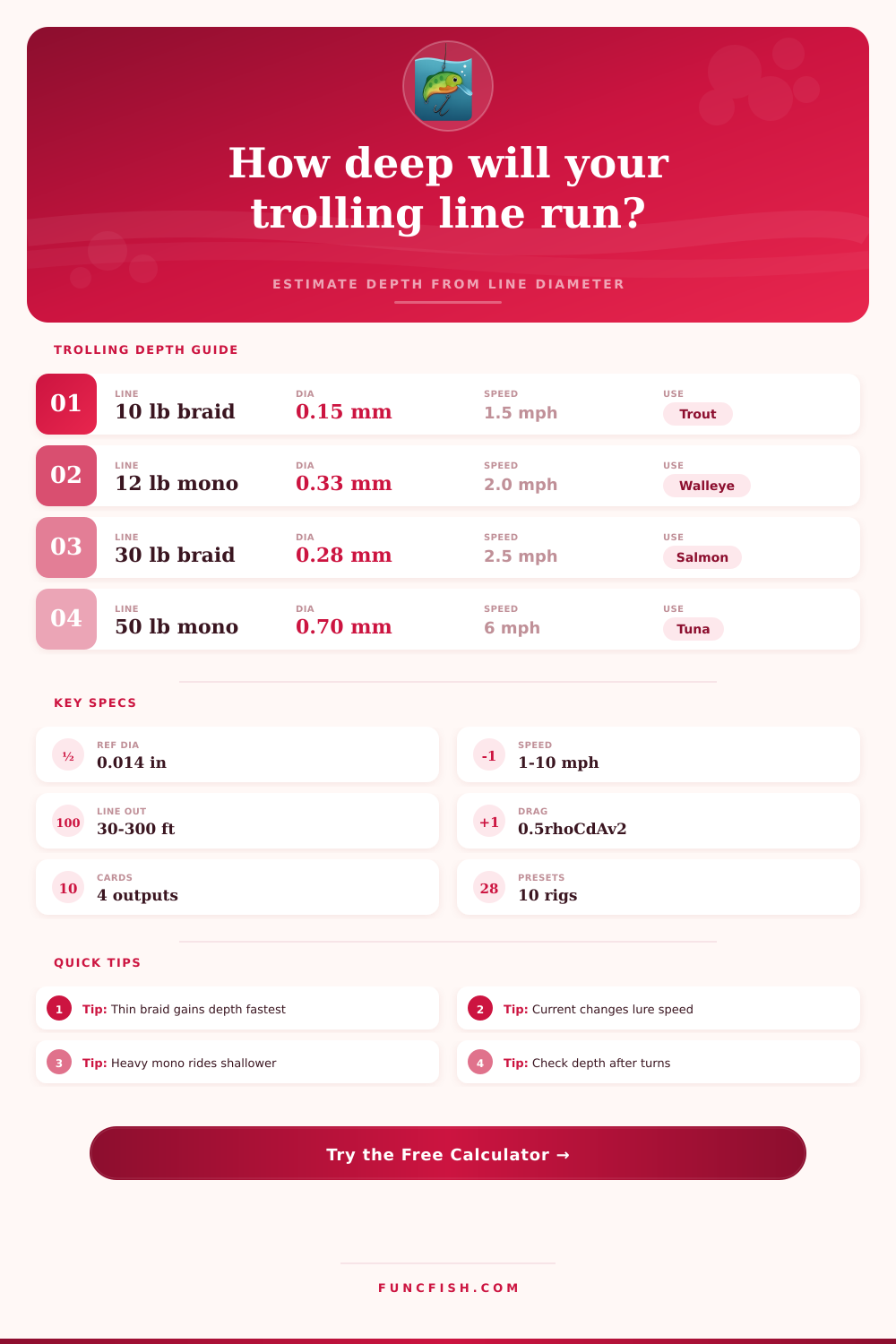
| 10 lb braid | 0.006 in / 0.15 mm | Runs deeper | Low frontal area | Kokanee, trout, crappie |
| 12 lb mono | 0.013 in / 0.33 mm | Chart baseline | Round, predictable | Walleye cranks |
| 30 lb braid | 0.011 in / 0.28 mm | Deeper than mono | Slick, low stretch | Divers, boards, salmon |
| 45 lb wire | 0.015 in / 0.38 mm | Stable pull | Small but stiff | Great Lakes divers |
| 18 lb leadcore | 0.027 in / 0.69 mm | Sink plus drag | Large sheath area | Open-water spoons |
| 80 lb mono | 0.035 in / 0.89 mm | Runs shallower | High drag at speed | Tuna, wahoo, mahi |
🌊Water and speed correction table
| Condition | Calculator correction | Depth effect | Use when |
|---|---|---|---|
| Following current | 0.90x speed through lure | Often deeper for weights, less bite for divers | Down-current troll or strong river flow |
| Into current | 1.12x speed through lure | More drag, many rigs ride higher | Up-current passes, tidal rips, river mouths |
| Cross current | 1.06x effective sweep | More line bow and setback | Boards, turns, wind-driven surface flow |
| Surge or chop | 1.08x drag factor | Depth pulses and rod load rises | Boat roll, rough water, speed hunting |
💡Depth calculation tips
Diameter tip: If two setups use the same lure and line out, the thinner effective wet diameter usually runs deeper because it creates less line drag and less upward bow.
Speed tip: When current is present, compare lure action and rod load to speed-through-water. GPS speed can be misleading on rivers, tides, and tight trolling turns.
You’ve found your system; tweaked the speeds, dialed-in the boards and perfected your trolling spread. Now the rods is biting at the familiar rhythm. But then there are those mornings when everything runs three feet too high. You are outside the thermocline while the walleyes holds below. Or maybe the opposite happen; you run down deep enough to get hung up on something you believed was mapped out to perfection. The lure isn’t the problem and seldom is it the boat speed. Almost every time it’s the line running between two adult-sized sofa that’s the cause.
Monofilament is a catch-all category for most anglers. They assume any size 12-pound test are going to behave exactly the same no matter what diameter it is. Bites cost. The physics are simple, but they don’t give an inch. Everything moving in water is like going through thick syrup.
Why Line Thickness Matters for Trolling Depth
The thinner your braid, the less surface area it have to push against the current. This reduces drag and lets the diving bill of lure work as intended. Conversely, heavy mono or leadcore works like a parachute by fighting its way down for every inch of depth you’re attempting to achieve.
Once you input your individual gear information into the calculator above, it’ll spit out the numbers for you. But understanding the principle enable you to make adjustments on the fly if current changes direction or wind picks up.
How Line Diameter Affects Trolling Depth It is about much more than size; hydrodynamic efficiency matter as well. A long heavy leader with an even heavier diameter of monofilament added to the end create noticeable drag. And so many people use 6-foot leaders they don’t know all those inches or even feet of vertical lift are being added above their lure. Look at the table on the page which compares various line types in a typical application and it lays this out clearly.
Wire line is great but only for toothy predators, but its drag factor can also affect your depth greatly when comparing it to braid. It is not merely because it cuts down power. It’s because water pushes back on the line’s surface area.
The other factor in this equation is speed. Your line’s drag doesn’t increase linearly, it increases exponentially as you speed up. What will run great at two miles per hour can jump several feet up if you have to step on gas to three miles per hour to cover water. That’s why fishing deep with heavy mono at high speeds is like holding down a beach ball underwater. The harder you try to hold it under the water the faster the water tries to push it back up.
The same is true for current. If you troll into a strong current, you’re effectively making your lure move faster. As a result, the water moves around your lure faster. This creates more drag which also tends to lift those shallow running lures higher off the bottom. To combat the additional lift from the increased water speed relative to the lure, you’ll need to thin out your line or add more weight to fight flow.
Few things are overlooked as much as line. Straight from the package, a spool of monofilament has a smooth, round shape and glides easy. But after months of fishing it gets nicked up and fuzzy, which increases its effective diameter and drag coefficient. Mono can get fuzzy and nicked after a season of use, which increases its diameter and drag, while fuzzy braid creates even more turbulence as it moves through the water. That slight increase in diameter shifts your trolling depth a foot or two throughout the day. It’s subtle, but if the fish are on a tight band around a ridge of rocks, that can make all the differance. Make sure to check not only your lure action, but your line too for wear.
Trolling depth is all about feeling how much resistance a lure has. If you have too little it won’t stay down in the right place and if you have too much, it will lift up out of the strike zone. Treat your line as another component of your lure and not just a way to connect them. Swapping lines is swapping the whole hydrodynamic profile of what you’re trying to make dive. And when a fish bites, feel how the rod tip loads. That is just as much telling you about depth than a depth finder would be.
After you begin treating diameter as a tuning knob and not just a strength rating, you’ll find yourself getting these precise depths easier then just guessing at it. You spend hours planning this spread. Now put the line to work for you too.