🐟 Tuna Weight Calculator
Estimate tuna weight from length & girth measurements — all major species, imperial & metric
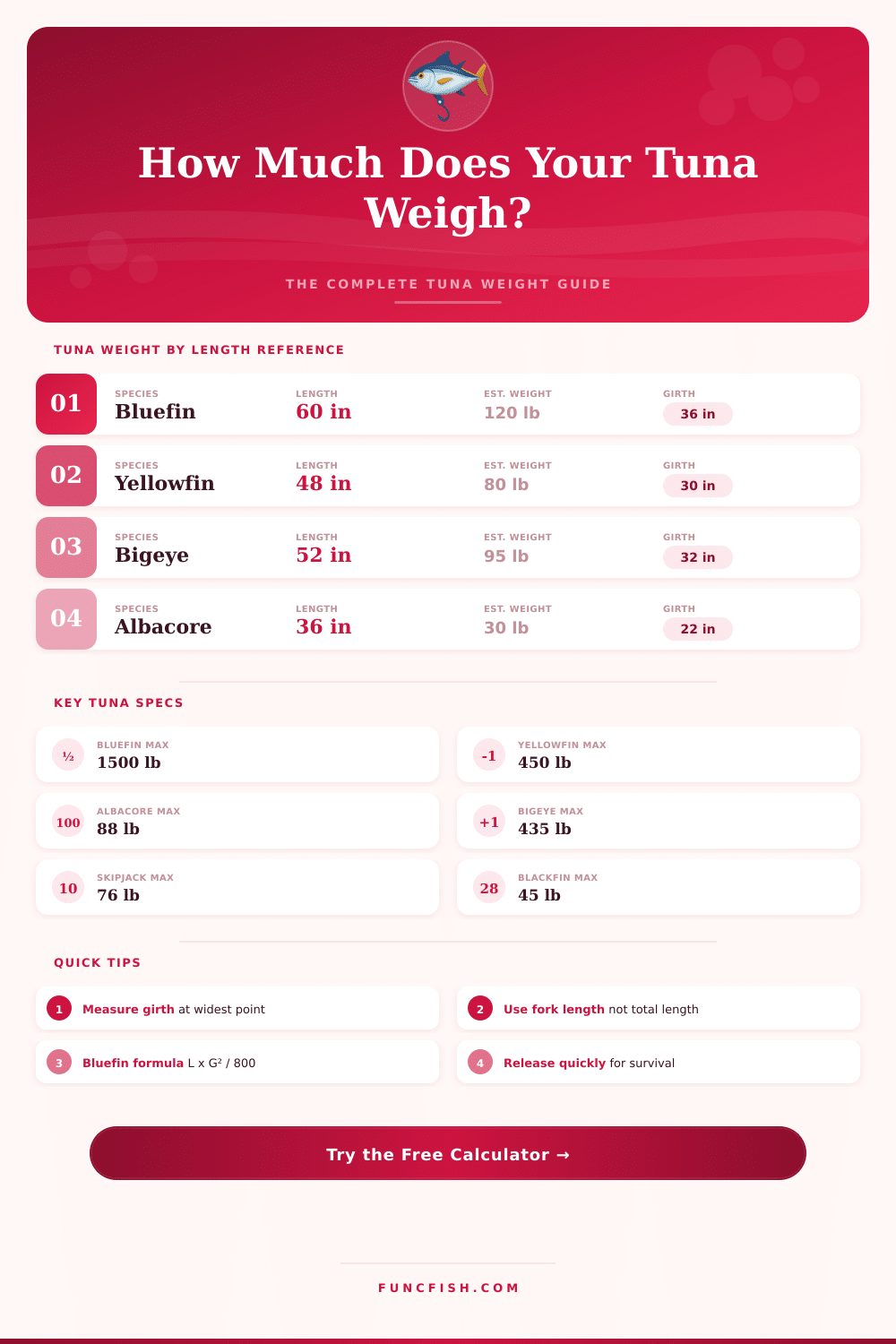
| Species | Formula Divisor | Typical L:G Ratio | Avg. Form Factor | Max IGFA (lb) |
|---|---|---|---|---|
| Atlantic Bluefin | 800 | 0.60 | Heavy / Robust | 1,496 |
| Yellowfin (Ahi) | 800 | 0.58 | Moderate | 450 |
| Bigeye | 800 | 0.60 | Heavy | 435 |
| Albacore | 900 | 0.55 | Slim | 88 |
| Skipjack | 900 | 0.55 | Slim | 76 |
| Blackfin | 850 | 0.57 | Moderate | 49 |
| Longtail | 850 | 0.56 | Moderate | 105 |
| Pacific Bluefin | 800 | 0.61 | Heavy / Robust | 446 |
| Fork Length (in) | Fork Length (cm) | Est. Weight (lb) | Est. Weight (kg) | Class |
|---|---|---|---|---|
| 24 | 61 | 8–12 | 3.6–5.4 | School |
| 36 | 91 | 25–40 | 11–18 | School |
| 48 | 122 | 60–90 | 27–41 | Medium |
| 60 | 152 | 120–160 | 54–73 | Large |
| 72 | 183 | 220–300 | 100–136 | Giant |
| 84 | 213 | 380–500 | 172–227 | Giant |
| 96 | 244 | 600–800 | 272–363 | Trophy |
| 110 | 279 | 900–1200 | 408–544 | Trophy |
| Est. Fish Weight | Rod Class | Line Class (lb) | Hook Size | Leader (lb) |
|---|---|---|---|---|
| Under 20 lb (9 kg) | Light (10–20 lb) | 10–20 | 3/0–5/0 | 30–50 |
| 20–50 lb (9–23 kg) | Medium (20–30 lb) | 20–30 | 5/0–7/0 | 50–80 |
| 50–100 lb (23–45 kg) | Medium-Heavy (30 lb) | 30–50 | 7/0–9/0 | 80–130 |
| 100–200 lb (45–91 kg) | Heavy (50–80 lb) | 50–80 | 9/0–11/0 | 130–200 |
| 200–500 lb (91–227 kg) | Heavy (80–130 lb) | 80–130 | 11/0–13/0 | 200–400 |
| Over 500 lb (227 kg) | IGFA 130 lb Class | 130 | 13/0–16/0 | 400–600 |
tuna come in many different forms depending on the species. There are 15 species of tuna that spread across seven groups and their weight changes a lot. The smallest are the bullet tuna that weigh only 1,8 kg.
Or around 4 pounds. The atlantic bluefin tuna belong to the biggest in the tuna family and can reach maximum weight of 684 kg., what matches about 1 508 pounds. This shows huge contrast between the smallest and the biggest species.
How Big Tuna Can Be
The atlantic bluefin tuna is an enormous fish. It can reach up to 10 feet long and weigh up to 1 000 pounds. Most adults reach around 200 pounds when they hit 10 years.
On average, they measure 5 feet long and 130 pounds heavy. At 30 years old, bluefin tuna can grow to 3 metres and pass 600 kg. They grow fairly fast compared to other tuna and can live up to 20 years.
The Smithsonian Institute and the American National Marine Fisheries Service agreed, that this species can weigh up to 910 kg., so around 2 010 pounds. A huge bluefin tuna of 1 058 puonds was caught recently by Cayde Walker, what maybe marks a record for the Bahamas seas.
Four other tuna species have their own weight ranges. The blackfin tuna reach a maximum of 46 pounds and 39 inches long, although most are caught at around 19,75 inches. Skipjack tuna can weigh up to 75 pounds and grow up to 3,5 feet.
Yellowfin tuna go up to around 450 pounds in weight. The albacore stays between up to 100 pounds. Blackfin, yellowfin and bluefin are considered the heavy ones in that order.
Bluefin tuna cannot be farmed, so you can only catch them in the wild. There speed and strength makes them hard to catch, while their shortage means only a few catches of some millions of pounds yearly. Some tuna stock is fully used without space for more fishing, and some are already overfished.
tuna is also good protein with low calories. For a 100-gram serving of regular tuna there are around 144 calories, 23,33 grams of protein and 4,9 grams of fat with no carbs. A third serving of canned light tuna packed in water holds only 73 calories.
That amount is about the size of a checkbook. Tuna is naturally low in sodium. It fills you up without adding too many calories, what makes it good for weightcontrol.
Canned tuna comes in various sizes from 3 to 66,5 units depending on the brand.
When you clean tuna after a fishing trip, the edible flesh results in around 42 percent of the whole fish weight.