Cut Bait Portion Calculator
Estimate how many cut bait chunks, strips, steaks, or slabs to prepare from your bait source, rods, soak time, trip length, and target species.
📌Scenario presets
⚙Cut bait settings
Cut bait portion plan
Full breakdown
📋Cut style comparison grid
Cube Chunk
Cross Steak
Belly Strip
Side Slab
Head Section
Butterfly
Taper Plug
Mixed Tray
📐Reference tables
| Target species | Common cut | Portion weight | Typical hook gap |
|---|---|---|---|
| Channel catfish | Cube chunk | 18-35 g / 0.6-1.2 oz | 0.45-0.75 in |
| Blue catfish | Steak or slab | 35-80 g / 1.2-2.8 oz | 0.75-1.25 in |
| Flathead catfish | Head section | 50-110 g / 1.8-3.9 oz | 0.9-1.4 in |
| Striped bass | Steak or plug | 35-65 g / 1.2-2.3 oz | 0.7-1.1 in |
| Redfish | Mullet strip | 20-45 g / 0.7-1.6 oz | 0.55-0.9 in |
| Snapper | Firm strip | 12-30 g / 0.4-1.1 oz | 0.35-0.65 in |
| Small shark | Oily slab | 120-260 g / 4.2-9.2 oz | 1.3-2.2 in |
| Walleye | Minnow half | 8-18 g / 0.3-0.6 oz | 0.3-0.55 in |
| Bait source | Usable yield | Texture | Best portion style |
|---|---|---|---|
| Whole shad | 68% | Soft and oily | Chunks, head sections |
| Whole mullet | 74% | Firm skin | Strips, steaks |
| Whole herring | 70% | Oily, medium firm | Steaks, plugs |
| Whole sucker | 72% | Firm freshwater flesh | Chunks, slabs |
| Mackerel fillet | 88% | Oily fillet | Strips, slabs |
| Menhaden / bunker | 64% | Very oily and soft | Large steaks |
| Squid mantle | 82% | Firm and elastic | Strips, tapered plugs |
| Skipjack section | 76% | Firm and bloody | Chunks, steaks |
| Condition | Portion change | Refresh change | Reason |
|---|---|---|---|
| Still / light flow | -5% | Longer soak | Scent stays close to bait |
| Moderate current | Baseline | Baseline | Good scent spread |
| Fast current | +18% | Shorter soak | Bait washes and spins faster |
| Surf or surge | +25% | Shorter soak | Cast force and sand wear bait |
| Warm water | -5% | Shorter soak | More activity, faster scent loss |
| Cold bite | +8% | Longer soak | Fewer checks, larger scent target |
| Trip style | Rod count | Portion reserve | Tray mix |
|---|---|---|---|
| Short bank session | 1-2 rods | 10-15% | Mostly starter chunks |
| Evening catfish set | 3-4 rods | 15-25% | Chunks plus one head bait |
| Surf bait spread | 2-5 rods | 25-35% | Steaks, plugs, slabs |
| Boat drift | 2-6 rods | 20-30% | Strips and tapered cuts |
| Big-bait soak | 1-3 rods | 10-20% | Large slabs and heads |
💡Portioning checks
Tip: Leave enough exposed hook gap after threading the bait. A perfect-looking piece that fills the gap can miss clean hookups.
Tip: Cut a small mixed tray when scouting. Once one size gets picked up cleanly, portion the rest of the bait to match it.
Planning the correct amount of cut bait are necessary when fishing for many different types of fish. The amount of cut bait that is necessary to catch the fish is dependent upon many different factor. For instance, the current in the area can change, and the fish may consume the cut bait at a rapid rate.
Therefore, it is important to have the correct number of portion of cut bait that is cut to the correct size. Furthermore, the cut bait should be refreshed at regular interval, which a cut bait calculator can calculate by the use of. The cut bait calculator will ask for several different type of information from the angler who intends to use the calculator to determine the amount of cut bait that will be necessary for the fishing trip.
How to Plan the Right Amount of Cut Bait
For instance, the calculator will ask for the type of fish that will be targeted, the type of cut bait that will be used, the number of fishing rod that will be used, and the length of the fishing trip. Based off the information provided, the calculator can determine how quickly the cut bait will dissapear, so that the angler does not experience the issues of either running out of cut bait or wasting the cut bait that was prepared. Anglers often make the mistake of using too much weight in the amount of cut bait that is brought to the fishing trip, yet using too little individual portion of cut bait.
In other examples, anglers may use too much cut bait and portion it into small strip to allow for the fish to consume the cut bait in a light bite fashion. However, if the current should become too strong for the trip, the cut bait strips will disappear from the hook. Instead, the angler must adjust the dimensions of the portions of cut bait according to the cut style and the hook gap.
Otherwise, the cut bait may become used for fishing trip, instead of the cut bait that was prepared for fishing. The timing in which the cut bait is refreshed is also important to consider. For instance, if the fish are experiencing a cold and slow bite, the cut bait may remain on the hook for longer periods of time, thus allowing the anglors to use fewer piece of cut bait.
In situations with warm water where the fish are active and eating the cut bait, the angler should refresh the cut bait more often. If other fish within the same area are stealing the cut bait, the math behind the amount of cut bait that should be prepared for the fishing trip will change. These alterations to the amount of cut bait will be accounted for in the cut bait calculator.
The factors that influence the amount of cut bait that should be prepared will often not match the plans that are made. For instance, the wind may change direction during the fishing trip, or the fishing boat may drift into areas of varying depths. A percentage of the total amount of cut bait can be reserved in case of these issue.
This percentage will account for instances where the angler may miss some of the fish pickups, or the pieces of cut bait may fall apart when placing the hook into the rigging. Furthermore, a reserve percentage will account for instances where a rod may need a second piece of starter bait. Thus, by including a reserve percentage into the total amount of cut bait that is prepared for the fishing trip, the angler will not have to guess the amount of extra cut bait that may be required for the trip.
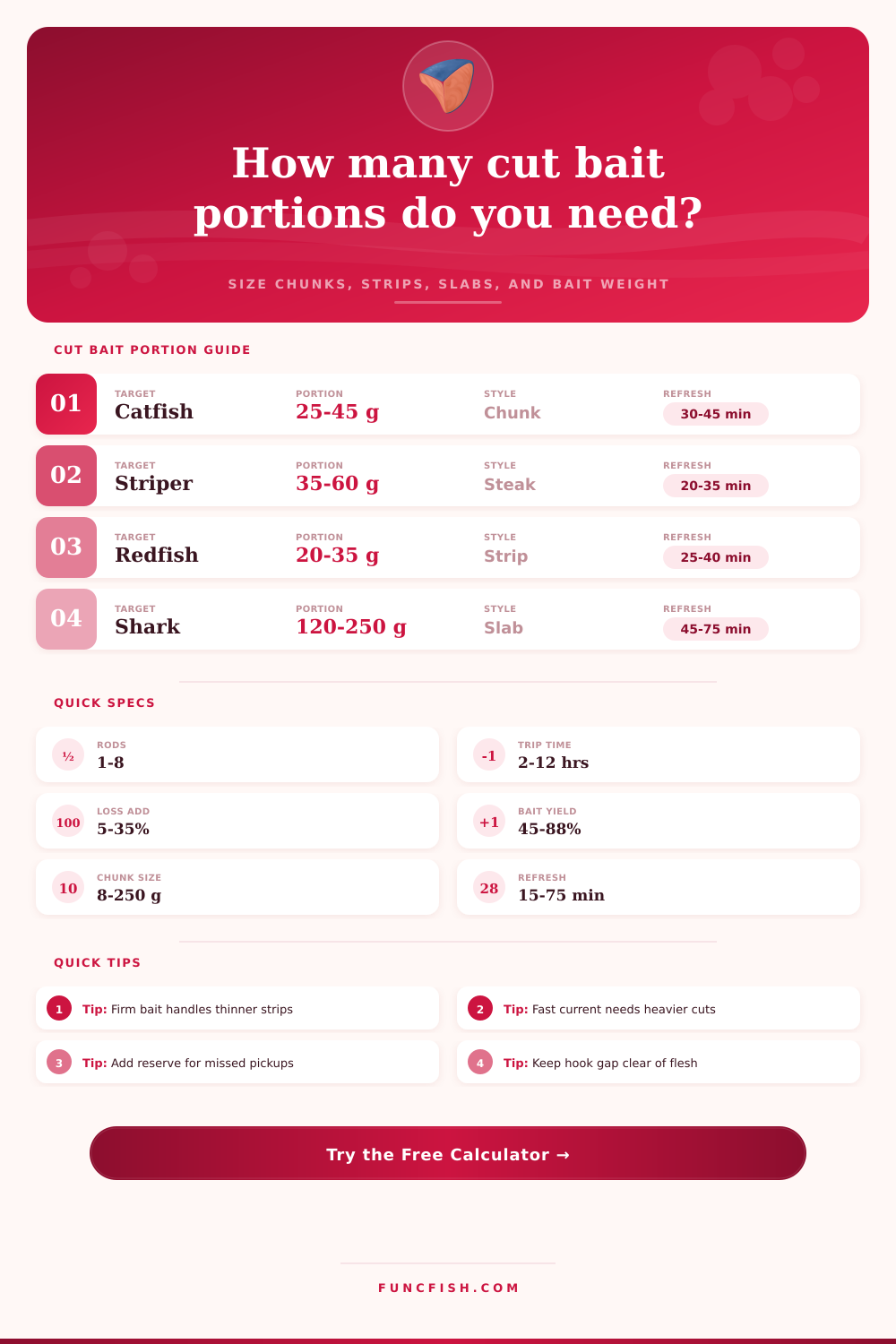
The reference tables located on the page may allow the angler to compare the different species of fish to the various sources of cut bait. These table will indicate why certain fish will require more weight from their cut bait source than others. For instance, the tables will indicate that a shark slab will require more weight than a redfish strip, yet a head section of fish will last longer than a belly strip of the same type of fish.
Furthermore, the tables will also indicate how many pieces of cut bait of each type the certain sources of cut bait will yield. This information can help save the angler time when preparing the cut bait at the cleaning table. In order to use the cut bait calculator effectively, it is important to understand what each field within the calculator represent.
Each type of fish may require different amounts of cut bait of different types, based upon the characteristics of the species of fish that will be targeted during the fishing trip. Furthermore, the cut bait itself will have different weights and scent strength, the current will degrade the cut bait at different rate, and the water temperature will impact the rate of degradation of the cut bait. By understanding these factor, an angler can prepare the cut bait according to the needs of the fishing trip.
Furthermore, by understanding these factors, the angler will be able to stop adding too much cut bait to the fishing trip, or too little of the required cut bait. Instead, the angler will understand how to bring the amount of cut bait necessary to ensure that the angler spends less time searching for cut bait within the cooler, and more time actually fishing for the target species of fish. Additionally, the cut bait will stay fresh during the fishing trip, and the portions will match the hook gap and the current during the fishing trip.