Fish Length Measurement Converter
Convert a fish measurement between total length, fork length, standard length, inches, centimeters, and millimeters while keeping the measurement method visible.
📌Real measurement presets
⚙Converter settings
The converter standardizes the source reading to an estimated pinched total length, then projects the selected target method using species ratios and measurement error.
Converted fish length
Conversion breakdown
📋Measurement method comparison grid
Total Length
Fork Length
Standard Length
Curved Length
📐Reference tables
| Species profile | Typical tail | Fork ratio | Standard ratio |
|---|---|---|---|
| Largemouth bass | Rounded | 0.94 TL | 0.82 TL |
| Trout | Forked | 0.91 TL | 0.80 TL |
| Walleye | Forked | 0.94 TL | 0.84 TL |
| Northern pike | Forked | 0.96 TL | 0.86 TL |
| Channel catfish | Shallow fork | 0.95 TL | 0.83 TL |
| Tuna / mackerel | Lunate | 0.88 TL | 0.76 TL |
| Measurement type | Start point | End point | Best match |
|---|---|---|---|
| Total length (TL) | Closed mouth | Longest tail ray | Flat board records |
| Fork length (FL) | Closed mouth | Tail fork center | Forked-tail fish |
| Standard length (SL) | Snout tip | Caudal base | Biology samples |
| Curved length | Nose mark | Arc path mark | Photo or tape estimates |
| Resolution | Metric increment | Imperial increment | Expected read error |
|---|---|---|---|
| Fine board | 1 mm | 0.04 in | Very low |
| Common metric board | 5 mm | 0.20 in | Low |
| Quarter-inch board | 6.35 mm | 0.25 in | Low |
| Half-inch board | 12.7 mm | 0.50 in | Moderate |
| Photo scale | 25.4 mm | 1.00 in | High |
| Preset scenario | Observed method | Typical purpose | Watch item |
|---|---|---|---|
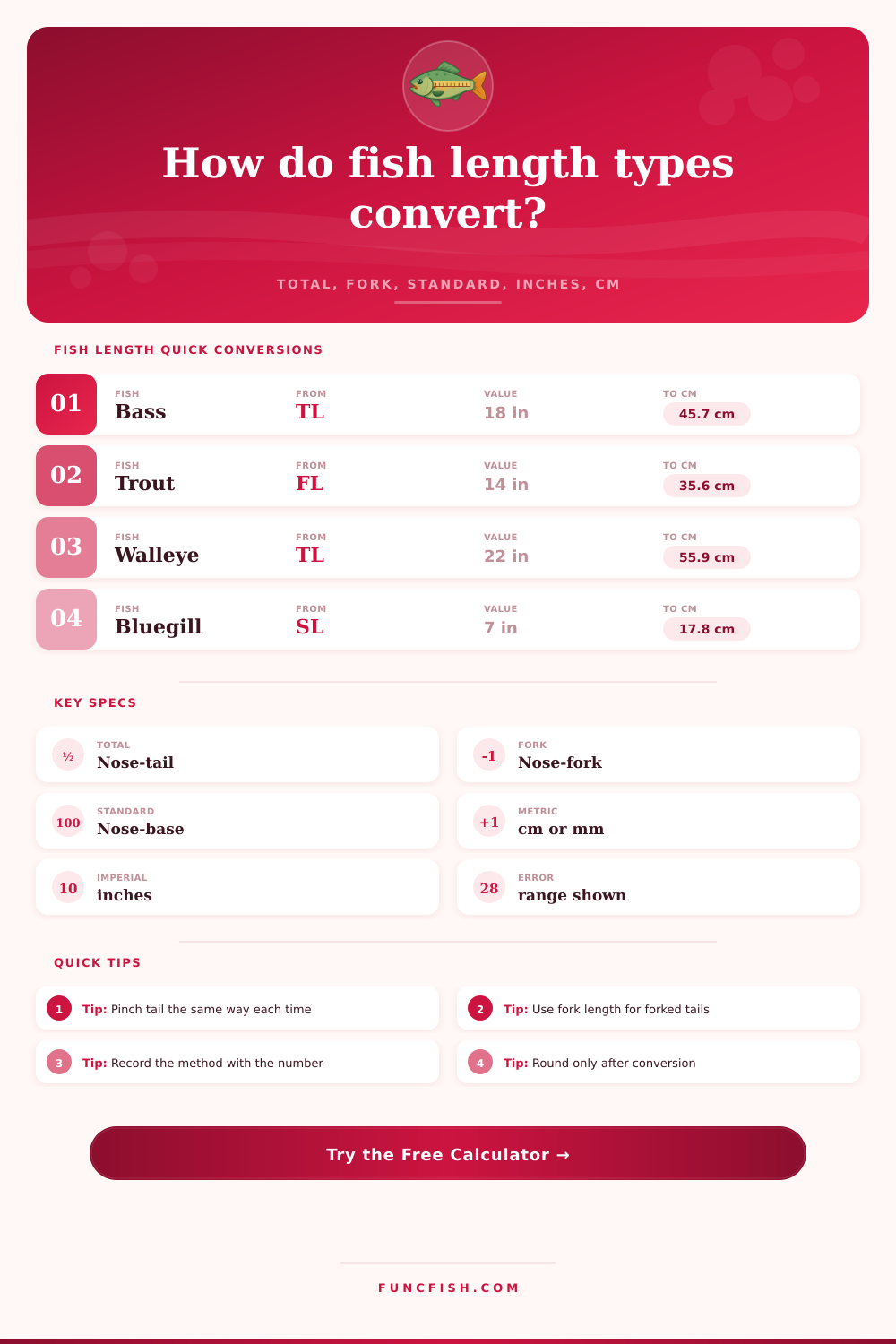
| Bass total board | TL | Trip log | Tail pinch |
| Trout fork note | FL | Stream log | Fork ratio |
| Bluegill sample | SL | Data sheet | Caudal base |
| Tuna photo | Curved | Photo estimate | Angle error |
💡Measurement tips
Tip: Write the length method with the number. An 18 inch TL and an 18 inch FL are not the same fish measurement.
Tip: Convert first, then round to the board mark. Rounding before conversion can move short fish by a visible fraction.
When you measure a fish, the number you gets will depend upon the measurement method you use. For instance, total length measure from the tip of the nose of the fish to the tip of its tail. Fork length measures from the nose to the forked end of the tail.
Standard length measures to the base of the tail. Each of these measurement is appropriate in certain situations. However, each of these methods will produce a more different number for the same fish.
How to Measure Fish Length and Avoid Mistakes
These different numbers has an impact upon the way in which you compare the size of your fish to the length requirements or limits of your area, hatchery, or log. The position of the tail of the fish will also impact the length measurement. For instance, some people will pinch the tail of the fish to flatten it.
In this case, the length will measure to a greater number than if the tail of the fish was allowed to relax natural. Additionally, if the tail of the fish is damaged or worn, this will impact the length that is measured. The calculator account for these different positions of the tail of the fish before it begins to calculate the length of the fish.
First, the calculator determines the pinched total length of the fish. Then, it applies the appropriate ratio for the species of fish to the pinched total length of the fish. The body and tail shape of the fish will influence the ratios applied to calculate the length of the fish.
For instance, largemouth bass have a rounded tail. A largemouth bass will measure to 0.94 of its total length when measured to the fork of its tail. Tuna have a deep lunate tail.
A tuna will measure to 0.88 of its total length. The calculator use this ratio for the species of fish that is being measured. However, the calculator also allows for the tail shape to be overridden so that an individual fish’s tail does not have to conform to the tail shape of the average individual of that species.
The override allow individuals to account for the fact that some fish fall outside the range of the average of that species. The context from which the length of the fish is measured can impact the accuracy of the length measurement. For instance, if you measure the length of the fish on a flat board, the measurement will be more accurate than if the length of the fish was measured using a flexible tape measure.
Flexible tape can be difficult to use because it must be stretched over the curved body of the fish. If the photo of the fish is taken from an angle, perspective error will occur in the length measurement. A lab board does not have this problem in measuring the length of the fish.
The uncertainty window account for these potential errors. The uncertainty window shows the range within which the true length of the fish lives. The uncertainty window is based off both the scale that you used to measure the length of the fish and the condition of the measurement.
Many people make mistake when measuring their fish. For instance, many people treat the number on the tape as the final length of the fish. Many people will round the length of the fish before they convert the length to another measurement system.
Additionally, many people will skip recording the type of length measurement that was used. These habit can create problems for those anglers who attempt to compare the size of the fish that they caught to other fish logs. For instance, an 18-inch total length of fish will have a different species than an 18 inch fork length of the same fish species.
These two fish may be logged into the same bookkeeping system for anglers, but the lack of a note regarding the type of length measurement used for each species will make the logbook difficultly to understand. Thus, the calculator help to avoid these problems by designating a unit of measurement to each result of the length of the fish. Additionally, the calculator display the length of the fish in each of the other measurement systems for that type of fish.
Uncertainty in the length of the fish can provide important information regarding the fish that was caught. For instance, uncertainty can tell you if the length of the fish that you caught is above the minimum size requirement in your area. Additionally, uncertainty can tell you if the length of the fish that was caught is near the limit requirement for that area.
The breakdown section of the tool list the various adjustments to the length of the fish. These adjustments account for tail position, body alignment, and the resolution of the scale. The breakdown section makes clear which adjustments to the length of the fish produced the length of fish that is logged in the system.
Thus, the breakdown section improve the readability of the system for the user. Another reason why the tool is valuable is that it can compare the length of the fish from different sources. For instance, a biologist may use one measurement system when logging the length of the fish in data sheets.
A tournament log may use a different measurement system. If length is measured without using the proper ratio, errors will result. The tool account for these errors and performs the calculation for the user.
However, the tool also maintains the original way that the length of the fish was measured so that it can still be properly log in the original measuring system. Thus, length is a measurement that depends upon the decision of where to stop measuring the fish. Therefore, length only has meaning if the type of length measurement is specified.