State Record Gap Calculator
Compare a fish weight against a state record, required beat margin, scale resolution, and length-girth estimate to see how close the catch really is.
📌Record presets
⚙Catch and record inputs
State record gap results
Full breakdown
📊Record gap comparison grid
📋State record preset reference
| Preset | Listed record | Typical unit | Calculator model |
|---|---|---|---|
| Texas largemouth bass | 18.18 lb | Freshwater weight | Bass body |
| Florida largemouth bass | 17.27 lb | Freshwater weight | Bass body |
| Georgia largemouth bass | 22 lb 4 oz | Freshwater weight | Bass body |
| New York largemouth bass | 12 lb 6 oz | Freshwater weight | Bass body |
| Texas smallmouth bass | 7.93 lb | Freshwater weight | Bass body |
| Florida butterfly peacock bass | 9.11 lb | Freshwater weight | Bass body |
| Texas blue catfish | 121.50 lb | Freshwater weight | Catfish body |
| Georgia hybrid bass | 25 lb 8 oz | Freshwater weight | Bass body |
| California lingcod | 56 lb | Ocean angling | Ocean body |
| California barred sand bass | 13 lb 3 oz | Ocean angling | Ocean body |
📏Length-girth weight model table
| Body model | Formula divisor | Best fit | Estimate caution |
|---|---|---|---|
| Bass / sunfish | 1200 | Deep freshwater bodies | Good for comparison only |
| Catfish | 800 | Heavy round bodies | Big girth changes fast |
| Pike / muskie | 900 | Long torpedo bodies | Length matters strongly |
| Trout / salmon | 900 | Salmonid shape | Spawning fish vary |
| Ocean bottomfish | 800 | Lingcod and rockfish | Species shapes vary |
⚖Scale and margin reference
| Scale status | Suggested buffer | Risk level | Calculator effect |
|---|---|---|---|
| Certified scale | Half resolution | Lowest | Small buffer |
| Shop scale | One resolution step | Moderate | Medium buffer |
| Handheld digital | Two resolution steps | Higher | Larger buffer |
| Spring field scale | Three resolution steps | Highest | Largest buffer |
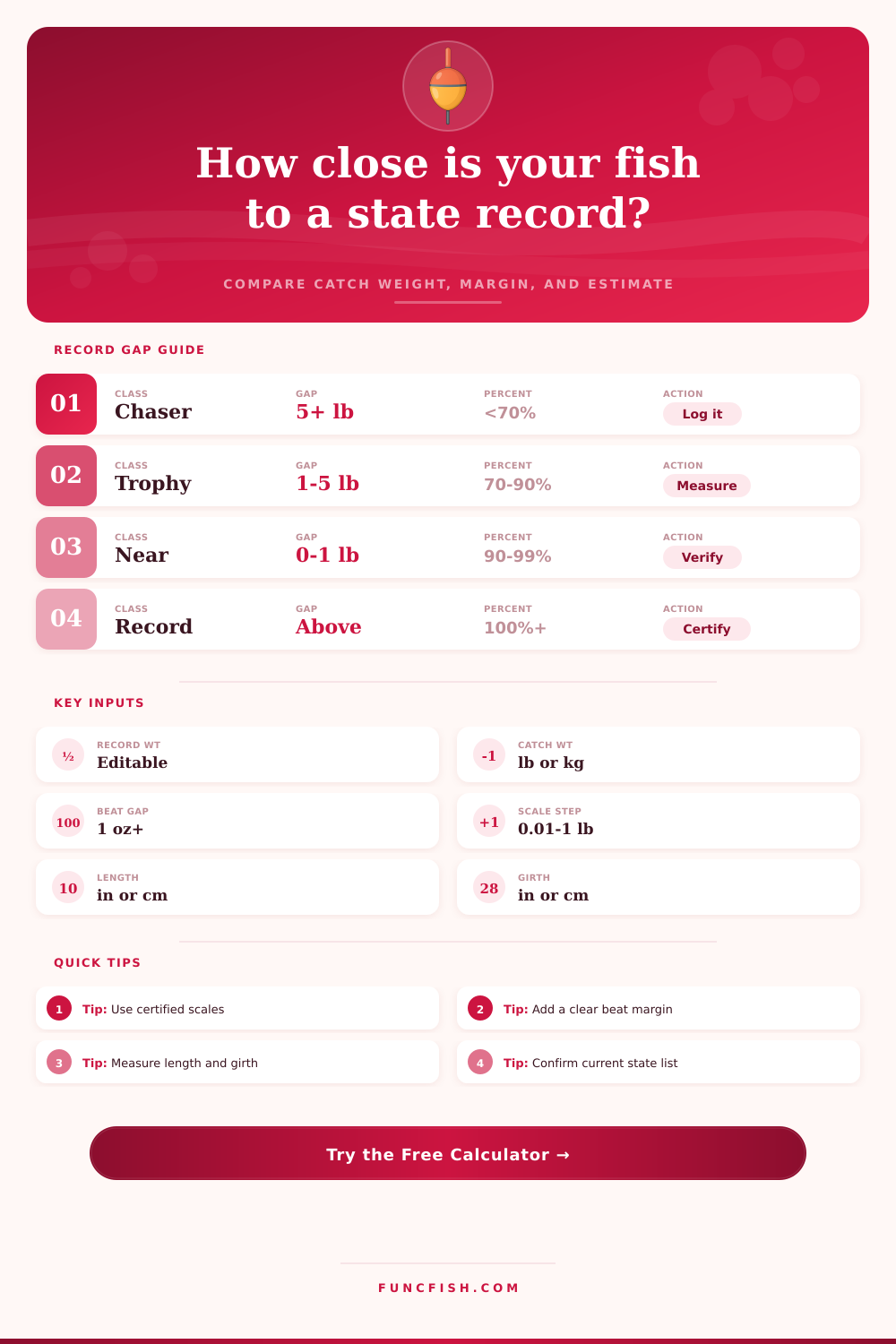
🧮Gap class comparison
Logbook fish
Less than 70% of the listed record. Useful for personal tracking, pattern notes, and future waterbody comparison.
Trophy fish
About 70% to 90% of the record. Measure carefully and keep a full weight, length, and girth entry.
Record chaser
About 90% to 100% of the record. Use the most accurate scale available and document every measurement.
Potential record
At or above the safe beat target. Confirm the current state list and follow the official submission process.
💡Practical record checks
Tip: A field scale number is a screening value, not the final record number. The calculator adds a scale buffer so close fish do not look safer than they are.
Tip: State records can change. Use the preset as a fast starting point, then enter the latest official record weight before making a submission decision.
When you catches a fish, you have to determine how close the weights of the fish is to a state record. The distance between the weight of the fish and the state record will determine your next step in catching the state record fish. If the weight of the fish are close to the state record, then you will have to make a measurements of the fish to determine if it is a state record fish.
If the weight of the catch isnt close to the state record, you can simply record the weight of the fish. The weight of the fish is crucial in determine if the fish is a personal or state record. The weight of the fish can be influenced by many different factor.
How to Check If Your Fish Is Close to the State Record
For example, if you use a digital scale to weigh the fish, the measurement will not be as precise as if you used a certified scale. Additionally, the moisture on the fish will change the weight of the fish if its different before the weigh-in. A fish that is weighed while it is wet will weigh more than a fish that is weighed after it has dried.
Due to these different variables, the weight of the fish will be uncertainly. The calculator that is included in this article can help you to calculate the target weight for the fish that you have caught. To use the calculator, you will need to enter the weight of the fish that you have caught, the state record for the state that you live in, and the resolution of the scale that you used to weigh the fish.
The calculator will use these variables to calculate the target weight for the fish. This target weight will be used in place of the actual weight of the fish because the target weight account for the uncertainty of the measurement of the weight of the fish. Additionally, the length and girth of the fish can be used to determine the weight of the fish.
This estimation of the weight of the fish is used to ensure that the weight of the fish that is measured on the digital scale are accurate. For example, not all fish have the same shape; bass, pike, and catfish all have different body shape, so they will have different mathematical divisor to determine the weight of the fish. If the length-girth estimation of the weight and the weight of the scale are similar, the measurement of the fish is accurate.
If the length-girth estimation of the weight and the weight of the scale are different, you must measure the scale and the fish again. Finally, the state fish record is not a permanent number for the state. When a person catches a heavier fish than the state record for that state, the state record will change.
If the state record is removed, it is possible for the state record to change again. Due to these different possibility for the state record, the number that is entered into the calculator should always be the most up-to-date state record. The resolution of the scale that is used to measure the weight of the fish will have an influence upon the buffer that is calculated for the fish.
For example, if the scale has a high resolution, such as to the ounce, it will be more precise than a scale that has a lower resolution, such as one that measures to the quarter pound. Because this scale is less precise, a larger buffer will be applied to that number in the calculation. A spring scale can be used to measure the weight of the fish, but the spring scale will not be as accurately as a certified bench scale.
The condition of the fish can change the weight of the fish. For example, if you place the fish on ice for a period of time, the weight will be less than if the fish is just removed from the water. Additionally, the fish may be placed in a livewell to keep it fresh, but the fish will weigh more because of the film of water on the fish.
This variable are accounted for in the calculator. Finally, the length-girth model is used as a check to the weight of the fish that is measured on the scale. The length-girth model will provide another estimation of the weight of the fish.
For example, if the length-girth estimation of the weight and the weight of the fish that was measured on the scale are similar, then the weight of the fish is accurate. If the two measurement of the weight of the fish do not agree, then the scale or the fish should be measured again. Because the state record programs use rules and documentation, the scales and the details of the fish must be recorded correctly to ensure that the weight of the fish is enough to earn the state record.