Catch Rate by Depth Calculator
Estimate fish per hour at a target depth, compare nearby depth bands, and project expected catches from species, temperature, structure, visibility, and effort.
📌Scenario presets
⚙Depth and catch inputs
Depth catch rate forecast
Full breakdown
📊Depth behavior reference
Best during low light, warming trends, shallow cover, or muddy water when fish can feed without bright overhead light.
Common summer and fall zone for bass, walleye, crappie, and baitfish edges on lakes and reservoirs.
Works when fish stack on ledges, channel swings, rock, timber, or stable oxygen layers near the thermocline.
Mostly for trout, striped bass, offshore species, and suspended bait schools where electronics or trolling help control depth.
📋Species depth tables
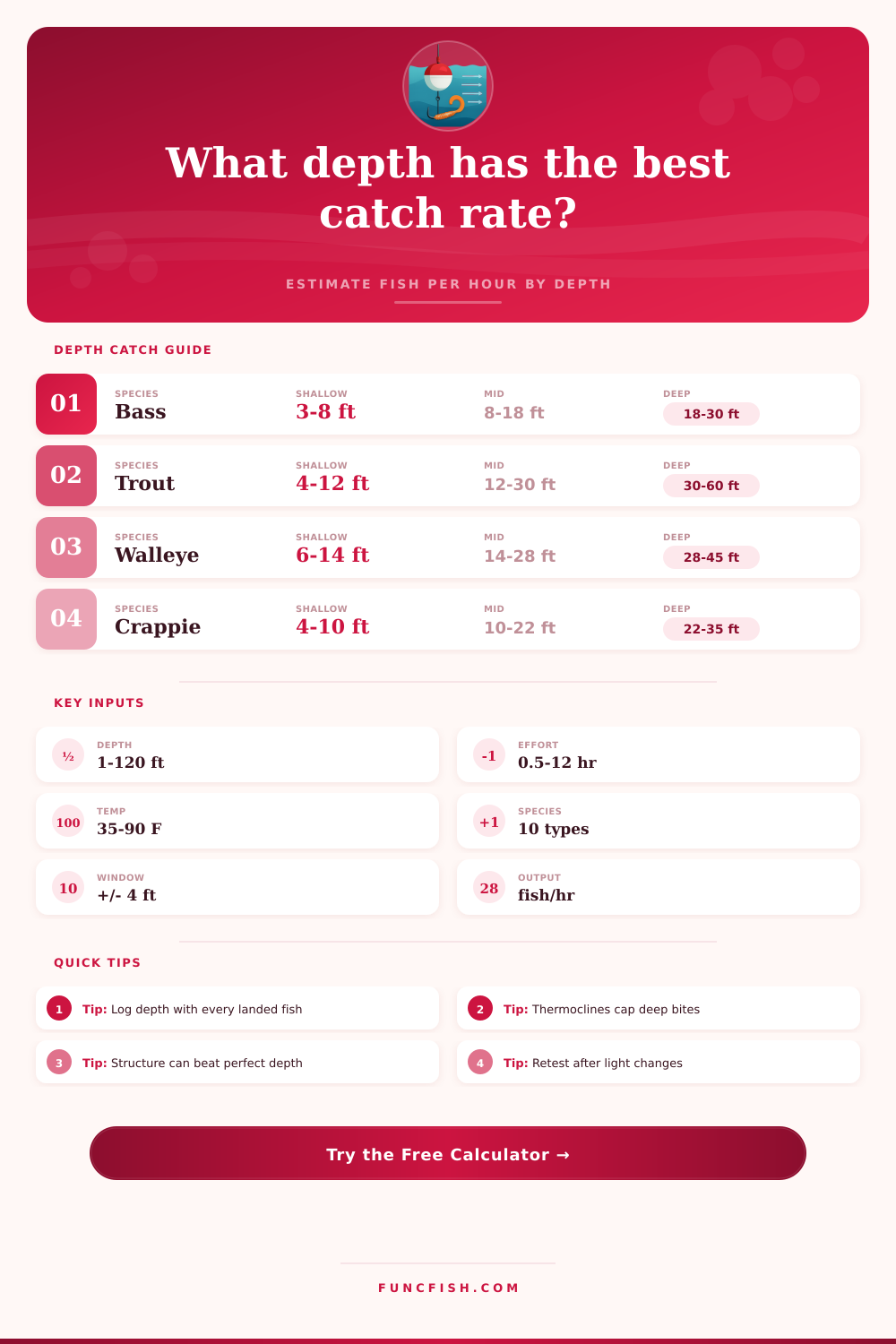
| Species | Cool water range | Warm water range | Strong depth clue |
|---|---|---|---|
| Largemouth bass | 3-12 ft / 0.9-3.7 m | 8-24 ft / 2.4-7.3 m | Weeds, shade, ledges |
| Smallmouth bass | 6-18 ft / 1.8-5.5 m | 12-32 ft / 3.7-9.8 m | Rock and bait |
| Trout | 4-18 ft / 1.2-5.5 m | 18-60 ft / 5.5-18.3 m | Temperature layer |
| Walleye | 6-16 ft / 1.8-4.9 m | 14-35 ft / 4.3-10.7 m | Breaklines and dusk |
| Crappie | 4-14 ft / 1.2-4.3 m | 10-28 ft / 3-8.5 m | Brush and schools |
| Catfish | 5-18 ft / 1.5-5.5 m | 10-35 ft / 3-10.7 m | Channel bends |
| Northern pike | 4-14 ft / 1.2-4.3 m | 8-28 ft / 2.4-8.5 m | Cool weed edges |
| Striped bass | 8-25 ft / 2.4-7.6 m | 20-70 ft / 6.1-21.3 m | Bait schools |
| Depth factor | Rate effect | When it helps | When to adjust |
|---|---|---|---|
| Thermocline edge | Strong boost | Summer stratified lakes | Move above it if oxygen is poor |
| Bait present | Strong boost | Suspended predators | Match the bait depth first |
| Drop-off edge | Medium boost | Ambush feeders | Check both lip and base |
| Muddy water | Shallow shift | Low visibility | Fish closer to cover |
| Clear midday | Deep shift | Bright stable weather | Slide deeper or slow down |
| Strong current | Mixed effect | River seams and bait lanes | Reduce depth if control suffers |
💡Practical checks
Tip: Log each fish with depth, time, and lure running depth. A small log at one depth is more useful than a vague full-day total.
Tip: If the calculator points deeper than the thermocline, fish just above the layer first unless sonar shows active fish below it.
Fishing involve many decisions. One of the most important decisions are choosing the correct depth for your bait in a water column. The depth of your bait is important because the depth can determine whether or not the fish will see your bait.
Additionally, the depth also determine whether or not the fish will feel comfortabley enough to eat the bait that you are fishing for them. If the fish cannot see your bait, they will not eat it. Therefore, you have to pay attention to where the fish are located in the depth of the area that you are fishing instead of guessing at what the depth should be for your specific area.
How to Pick the Right Depth for Your Bait
The calculator on this page include several different variables that will help to determine your estimated catch rate. One of the variables is the species that you are fishing for. For example, different fish species lives at different depths in the water column, and some species live at deeper depths than others.
For example, largemouth bass live at significantly different depths than trout. The second of the variables are water temperature. Water temperature has a direct effect on fish metabolism.
Fish will be more likely to turn and look at your bait when they are in the temperature of the water that they prefer to live in. The third of the variables are structure and water clarity. Structure in the water can attract the fish to the area that you are fishing.
Additionally, if the water is muddy the fish may be in different depth of the water than you expect. Light levels and the time of year when you are fishing is two different variables that will have an impact on the result of the calculator. For example, many fish will be deeper in the water during the middle of the day than during the dawn or dusk hours when they are coming close to the surface.
The fourth of the variables include the recent signal of the fish bites that you have had in your area recently and the number of fish that you have logged that you have caught. The reason for this variable is to provide the website with information regarding what you have actualy seen on the water in your area. The fifth of the variables are how well you can control the depth of your bait.
For example, if significant factors makes it difficult for you to control the depth of your bait the calculator will provide a lower estimated catch rate to account for that difficulty in controlling the depth of your bait. Conversely, if your depth control is easy the calculator will provide an increased catch rate. This variable is important to account for because this prevents you from thinking your catch rate will be higher then it will actually be when you are on a windy day for example.
The reference tables included with this calculator will help to provide information on the depths at which the fish that you are catching live. These depths will be specific depth band for each species of fish. Depending on the water temperature the depth bands may change.
These bands are not rules that you must follow but they do provide you with a starting point when you are on unfamiliar water. Additionally, if you choose a depth that is only a fair fit for your species the calculator will show you which factors is helping your catch rate and which factors is hurting your catch rate. This information is helpful because it allows you to understand what variable you should of change during the next fishing trip that you make.
The thermoclines and bait layers in the water can change the depths at which the fish live. Depending on whether or not the depths of the water contain a thermocline or bait the calculator may show you an improved catch rate. However, if the depth has a thermocline with poor levels of oxygen in the water beneath the thermocline the calculator may tell you that you may find fewer fish if you add depth to your current fishing depth.
The calculator makes these modifications to account for the changing condition in the lakes that you fish in. Finally, this calculator will show you the expected catch rate at your depth as compared to the depths immediately above and below your depth. It is possible that the best fishing spot is only a few feet away from where you are currently fishing but the expected catch rate would be much higher at that depth.
By checking these neighboring depth bands you may save yourself time by not fishing in an area that dont contain many fish. If you use this calculator regularly you will begin to think about fishing in these different depth band. Additionally, if you use both this calculator and your own logs the calculator will begin to show you pattern in the water in which you fish for the fish that you catch.
The calculator will provide you with a baseline and your own records will transform that baseline into knowledge of your own local water.