Fish to Ice Ratio Calculator
Estimate ice weight, fish-to-ice ratio, cooler load, melt reserve, and refresh timing for packed catches in different trip and cooler conditions.
📌Scenario presets
⚙Ice packing inputs
Fish ice plan
Full breakdown
🧊Ice and cooler data grid
Cube Ice
Flake Ice
Block Ice
Slurry
📋Fish to ice ratio reference
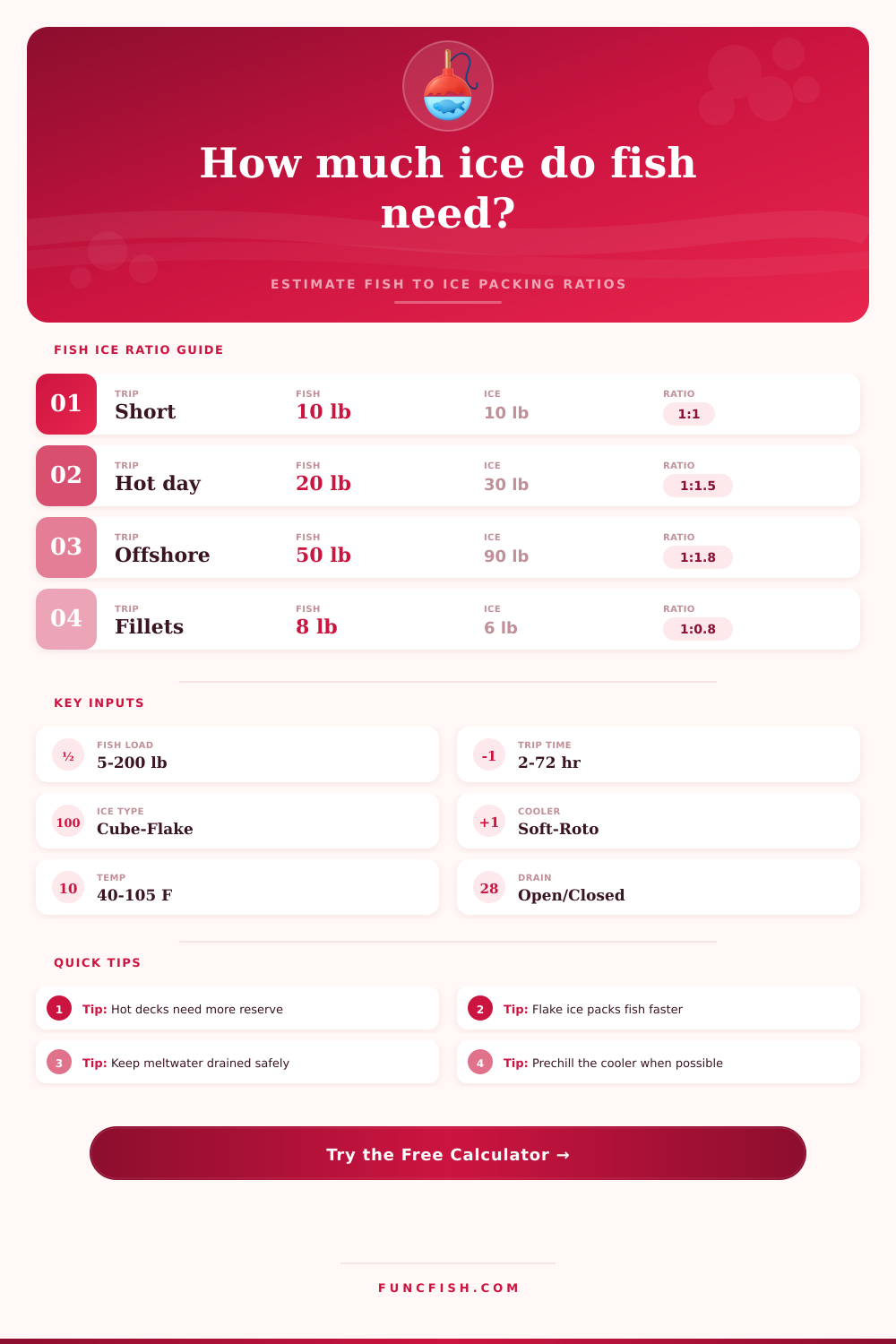
| Situation | Base ratio | Typical ice for 25 lb fish | Use case |
|---|---|---|---|
| Short freshwater hold | 1:0.7 to 1:1.0 | 18-25 lb / 8-11 kg | Cool weather, quick return |
| Warm day catch box | 1:1.1 to 1:1.5 | 28-38 lb / 13-17 kg | Sun, deck heat, mixed fish |
| Offshore fish box | 1:1.5 to 1:2.2 | 38-55 lb / 17-25 kg | Long runs and large fish |
| Fillets in sealed bags | 1:0.5 to 1:0.9 | 13-23 lb / 6-10 kg | Already chilled, dry contact |
| Weigh-in short hold | 1:0.4 to 1:0.8 | 10-20 lb / 5-9 kg | Short transport only |
| Ice type | Cooling contact | Volume per 10 lb ice | Best calculation note |
|---|---|---|---|
| Cube ice | Good gaps | 19 qt / 18 L | Reliable default for most coolers |
| Crushed ice | High contact | 22 qt / 21 L | Fast chill but melts faster |
| Flake ice | Very high | 24 qt / 23 L | Best around whole fish |
| Block ice | Low contact | 18 qt / 17 L | Good reserve, slower pull-down |
| Ice slurry | Maximum | 21 qt / 20 L | Fastest pull-down, manage water |
| Cooler type | Heat protection | Holding factor | Practical range |
|---|---|---|---|
| Soft cooler bag | Light | 1.22 | 2-10 hr day trips |
| Basic hard cooler | Moderate | 1.08 | 6-18 hr holds |
| Marine cooler | Good | 0.96 | 12-30 hr holds |
| Rotomolded cooler | Strong | 0.84 | 18-48 hr holds |
| Boat fish box | Variable | 1.02 | Depends on hatch heat |
💡Calculation checks
Tip: The calculator separates pull-down ice from hold-time ice. Warm fish, hot decks, and open drains raise the reserve more than the base ratio alone suggests.
Tip: For best contact, layer ice below, between, and over fish. Top-only ice often leaves warm pockets even when the total ice weight looks adequate.
When you are fishing and the fish is on the deck, you have to determine how much ice to use to keep the fish cold in order to ensure the quality of the fish dont drop. If you use too little ice, the quality of the fish will drop. However, if you use too much ice you will have to carry too much weight.
You have to find a balance between the amount of fish that you have and the amount of ice that you use, because the amount of ice that you use will determine whether or not your fish fillet remain firm or become too soft and warm. Ice performs two specific function in order to keep the fish that you have caught on the fishing deck cold. First, the ice must remove heat from the fish because the warm fish require a great deal of energy to cool down.
How Much Ice to Use for Your Fish
Second, the ice must work to melt and remove heat from the air, the deck, and the sides of the cooler in which you are storing the fish. As you go on your fishing trip longer the more heat will be introduced into the cooler and the more ice will melt. In order to figure out how much ice to use on the trip you can use a calculator.
The calculator can determine how much ice is needed for the trip using the weight of the fish that you will catch, the length of the fishing trip, the type of ice that you will use, and the type of cooler that you will use to transport the fish. The type of ice that you use will change the way that the ice will function within the cooler. For example, flake ice is effective in removing heat from the fish because the flake ice will touch the fish, but flake ice melt faster than block ice.
Block ice can last longer but can leave gaps in which warm air can remain within the cooler. Finally, slurry ice is effective in quickly chilling the fish but introduces water that remains from the slurry ice. You should choose the type of ice that you use in reaction to the conditions in which you will be fishing so that you dont have to guess what kind of ice to use.
Additionally, the way in which the fish and ice are layered within the cooler will affect the results of the ice’s abilities to keep the fish cold. For instance, if you layer the fish and ice together it ensure that each fillet of fish has cold ice on at least two sides. This method is better than simply dumping the fish and ice into the cooler because if you dump the fish and ice into the cooler at once the bottom fillet of fish will become warmer than the top fillet of fish.
The calculator includes an option for selecting the type of packing pattern for the fish and ice within the cooler. Another factor in determining the temperature of the fish is the drain of the cooler. For example, if you leave the drain of the cooler open the cold water will leave the cooler and the ice will have to work harder to keep the fish cold.
However, if you leave the drain closed the melt water from the ice will remain within the cooler and will help to keep the temperature of the fish steady. The disadvantage of leaving the drain closed is that the fish will remain in the water and the water will become warmer over time. The calculator can calculate the effect that the drain has on the amount of ice that must be used while fishing.
Another factor that will play a role in the amount of ice that you need to use to keep the fish cold is the quality of the cooler in which the fish are being stored. For example, a basic cooler may be sufficient for a short fishing trip in cool weather but a rotomolded cooler may allow a fisherman to carry less ice because the thick walls of the cooler will melt the ice at a slower rate. Soft bags of ice will allow heat to enter the cooler more quick.
Additionally, if the sun is hitting the cooler the rate at which the ice melts will increase. Tables are included that show the common ratios of the weight of the fish to the amount of ice that should be used. These tables allow for fishers to verify the calculations that the calculator made.
For instance, a short fishing trip in cool weather will require less ice per pound of fish then a long fishing trip in the sun. Additionally, if the fish fillets are already chilled they will require less ice than fish fillets that are not chilled. While the calculator cannot account for every change in the weather, the calculator will help the fisherman to create a plan for the trip.
For instance, if the air temperature changes throughout a trip the rate of which the ice melts will change. Therefore, it is to the advantage of the fisherman to use the calculator to remove as many variable as possible from the trip so that he can have a solid plan for the amount of ice that he will need to carry when he goes fishing. By understanding the conditions under which the fish are to be stored and transported and by being able to make accurate calculations of the amount of ice that will be necessary to maintain the cold temperature of the fish, a fisherman can decide how much ice to carry when going fishing on the deck.