Fly Reel Drag Startup Inertia Calculator
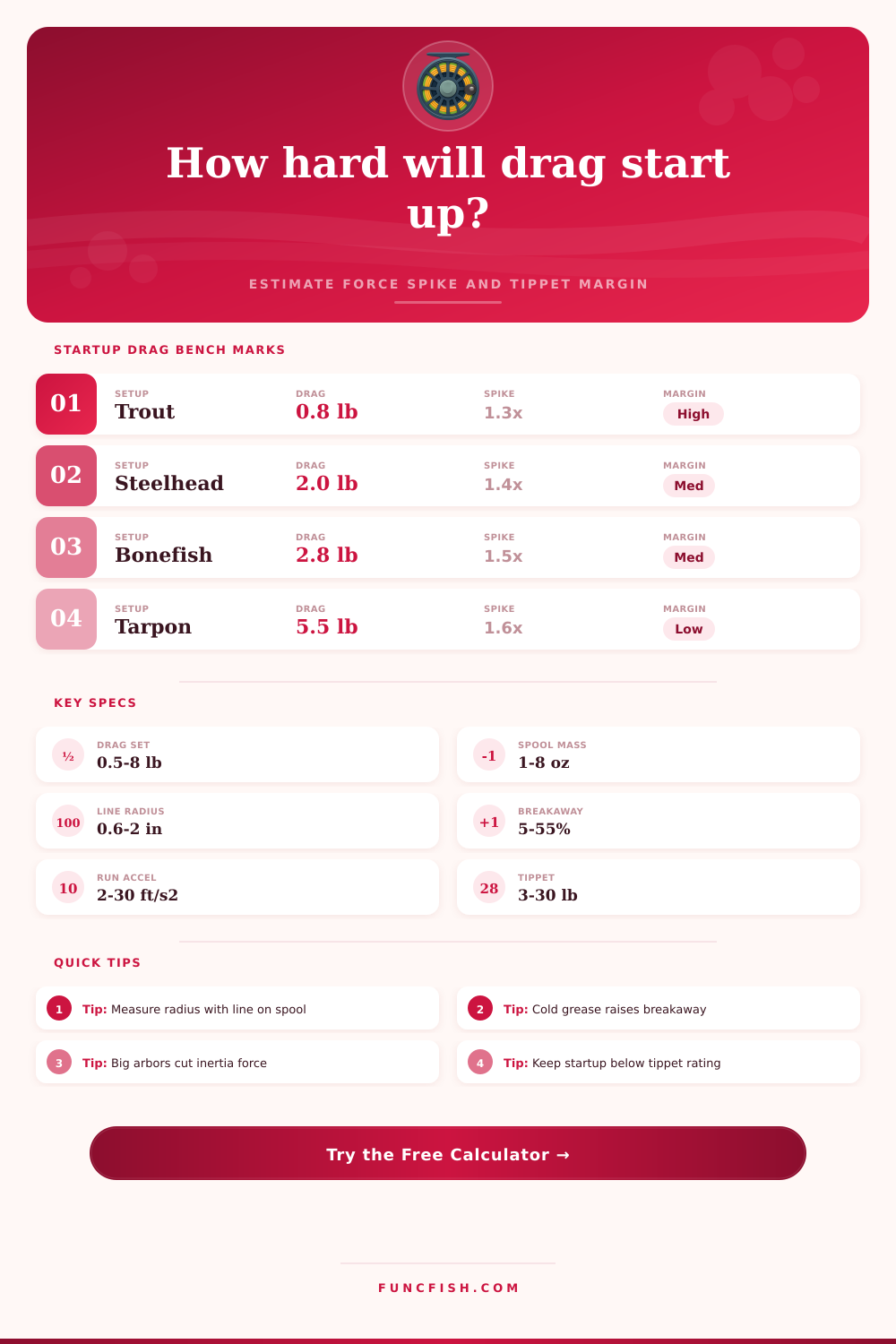
Estimate the first-pull force spike from static drag, spool inertia, line-pack radius, and fish acceleration before it reaches your tippet.
📌Scenario presets
⚙Reel and drag inputs
Startup drag forecast
Full breakdown
📋Reel inertia reference grid
Click-Pawl
Small Disc
Large Arbor
Bluewater
📐Reference tables
| Drag material | Static behavior | Startup bias | Bench note |
|---|---|---|---|
| Carbon disc | Moderate breakaway | +4% | Consistent when clean and dry |
| Cork disc | Smooth once moving | +7% | Can swell when wet or compressed |
| Rulon washer | Low mass stack | +5% | Common in compact trout reels |
| Felt washer | Higher first pull | +11% | Oil and age change the first peak |
| Click pawl | Pulsing spring load | +2% | Startup depends on pawl tooth position |
| Sealed carbon | Stable stack | +3% | Seal friction adds small torque |
| Scenario | Steady drag target | Startup factor target | Useful margin |
|---|---|---|---|
| Technical trout | 10-18% of tippet | Under 1.35x | High margin for light knots |
| Steelhead | 18-28% of tippet | Under 1.45x | Room for surges and current |
| Bonefish | 22-35% of class | Under 1.55x | Fast acceleration on first run |
| Permit | 20-32% of class | Under 1.50x | Protects small crab knots |
| Tarpon | 25-40% of class | Under 1.60x | Use measured class tippet |
| Bluewater | 28-45% of class | Under 1.65x | Check heat and long-run fade |
| Line-pack radius change | Torque for same pull | Inertia force trend | What it means |
|---|---|---|---|
| Full spool | Higher torque | Lower inertia force | Smoother startup, faster pickup |
| Half backing out | Moderate torque | Moderate inertia force | Drag setting starts to feel firmer |
| Near arbor | Lower torque | Higher inertia force | Startup spike climbs during long runs |
| Large arbor design | Higher base radius | Lower spike | Good choice for light tippet starts |
💡Bench checks
Tip: For a useful breakaway number, pull the line straight off the reel with a spring or digital scale and note the first peak before the spool turns smoothly.
Tip: Recheck the line-pack radius after a long run. A smaller effective radius raises inertia force even when the drag knob has not moved.
Lots of folks have lost their fair share of fish on that first run and never knew it was happening. When the fish comes off the bottom and picks up speed, it create an immediate burst of line pressure. This pressure is much more than your maintained drag can handle.
The first run fight the inertia of the line spinning around. It also fights resistance of the reel itself as all the moving parts spin over each other. This creates a point of maximum static resistance to your line. At the same time, the combination of the line and spool spinning resist forward motion. Combined they are stronger then the breaking strength of the tippet so it breaks immediately.
Why Fish Lines Break When You Start Fishing
Knowing what happens there allow you to put fish into net rather than see him take off down stream with your fly stuck in his mouth. All you do is enter your personal variables into calculator (above) and it does the rest of the math for you. You won’t have to guess during those split second moment anymore.
Basically you put in how much your spool weighs without any line or backing on it, then add weight of whatever line and backing you have already put on your spool. More weight mean more torque necessary to break inertia when that fish bites. Then you define the radius where the line leaves the spool. That’s important because as the line gets pulled off the spool, a full spool has a larger radius. This creates a smaller inertial spike to deal with. But the smaller radius as the line pack shrinks towards the arbor coupled with the same drag tension mean increasing forces are needed to drive the spool. So later stage runs can be more risky to light tippet than early runs due to this dynamic.
Drag material plays a surprisingly large role in how smooth that initial engagement feel. Carbon discs has consistent friction that peaks before they start to slide freely. Cork drags provides good modulation after they break away. But cork will compress over time and get wet and can swell out and change its static friction properties. Washers made from synthetic materials such as Rulon are more common in smaller reels and tend to show lower mass stack which translate into less rotational inertia to overcome. The reference table on the page is a comparison chart of the behavior of various drag materials under load.
You can see that even on sealed higher end drags, there is some small but measurable start up bias. If you don’t account for this bias, you’ll be either having your drag set too high for efficiency or too low for safety. Adjust to the environment. Environmental considerations are important as well. Lubricants and grease can become thicker in cold weather, requiring more resistance before getting spools spinning again. Grit from salt water deposited on drag stacks will catch upon initial rotation. Compare reels that has been freshly serviced to ones worked through a tough season. Considering these variables will save you some embarrassing moments as the drag tightens up.
Lots of guys simply adjust their drag for the size of the tippet, divide by 2 or 3 and they are ready to go. Forget about the inertial kick completely. The trick is to account for the maximum force and not the constant draw. Acceleration is immediate and violent when it comes to bonefish flats. They don’t think about it. Inertia plus static friction will create a startup spike greater than your drag setting of twenty percent of your tippet strength. This happen before you’re even out of the gate, leaving you behind the eight ball.
With big arbor designs, bigger line radius (even while the spool is empty) keep inertial forces lower over the course of the fight. Small trout reels with click-pawl systems has very little drag capacity but can be plagued by uneven drag pressure that creates unexpected peaks and valleys. Minor adjustments with a drag knob won’t trump good architecture choices for your target species.
Before hitting the water, this one’s easy to test for yourself. Take your line and pull it with a scale to find the true breakaway point. How hard does it take to get up to speed? What’s the maximum load just before the spool begins turning freely? That’s your breakaway point. Compare that figure to the length of your leader and the extra strength you want to include. Is there not enough slack between two adult-sized sofa? Back off the drag and/or decrease weight on the spool. Remember each ounce of mass taken off the spool decreases the resistance to movement.
The drag should of been strong enough to tire the fish out without being so high that every tug is a gamble. Predictable wins. Knowing the connection between friction and inertia will cause you to cease battling your reel and begin using it. The confidence carries over into more fish to the boat and less busted off leaders on game days.